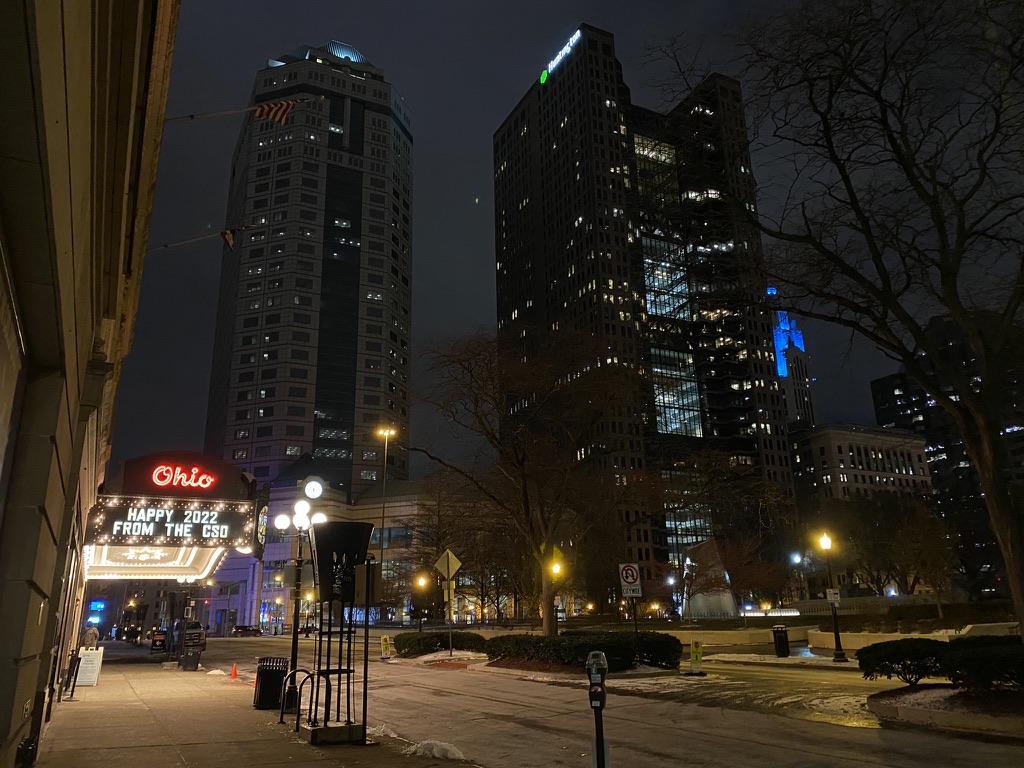
Eddins shows his mettle as both conductor and pianist with the Columbus Symphony

Columbus Symphony Orchestra
William Eddins, conductor and piano
Ohio Theatre
Columbus, OH
February 20, 2022

Perkinson: Sinfonietta No. 1
Gershwin: Rhapsody in Blue (1926 orchestration, Grofé)
Beethoven: Symphony No. 5 in C minor, Op. 67

Guest conductor Williams Eddins led the Columbus Symphony last weekend in a decidedly populist program, though matters nonetheless opened with an unfamiliar work by an unfamiliar composer. The quantity in question was the Sinfonietta No. 1 by African-American composer Coleridge-Taylor Perkinson, named after Samuel Coleridge-Taylor who perhaps served as a guiding inspiration to the younger composer. A compact three-movement work dating from 1954, the work opened with angular gestures though generally lyrical at heart, colored by piquant harmonies. A mournful slow movement seemed to echo Barber’s Adagio for Strings (this work too was scored for strings alone), while the vigorous finale purveyed textures akin to a Baroque concerto grosso. A finely crafted product of midcentury America given with compelling advocacy from Eddins and the Columbus strings.
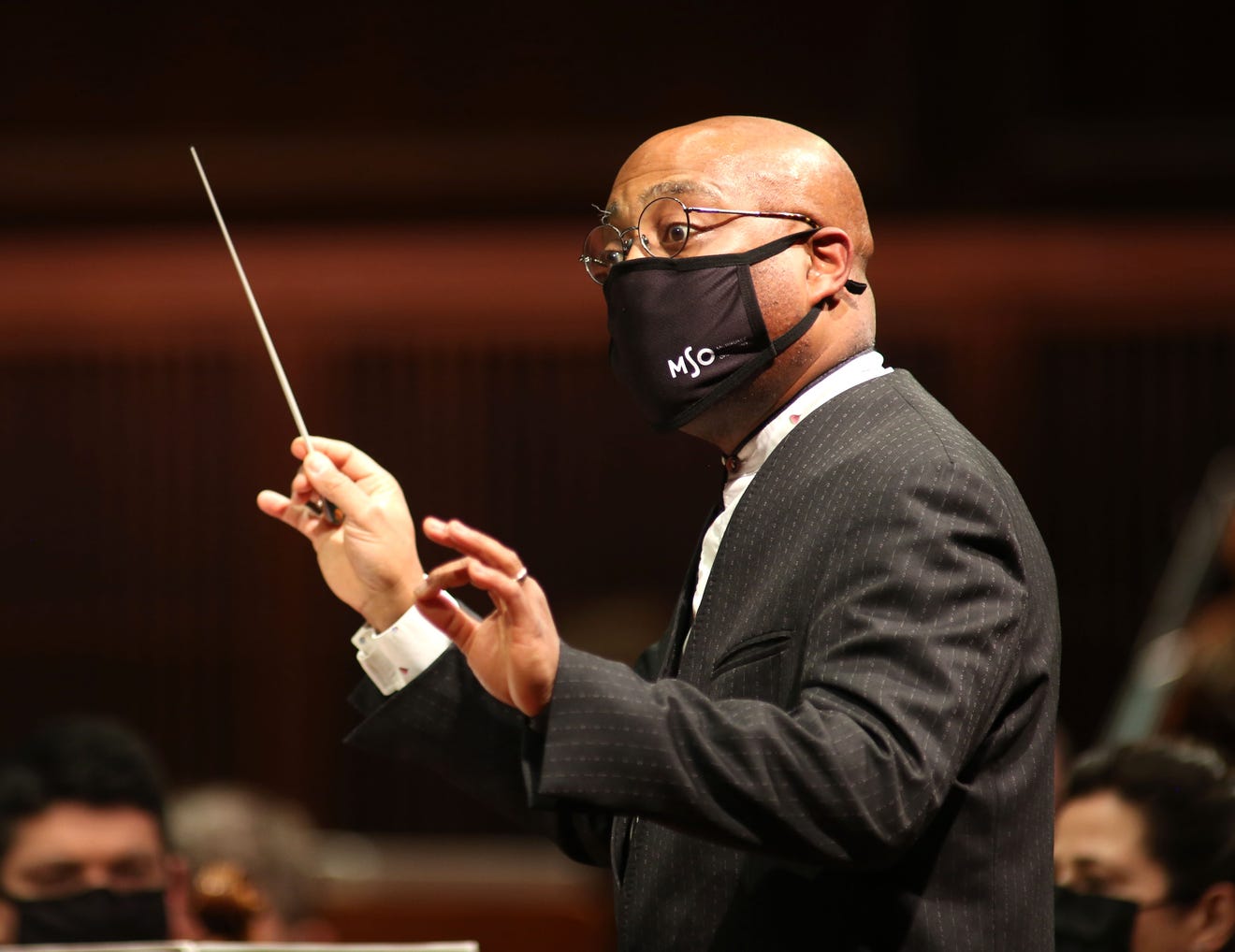
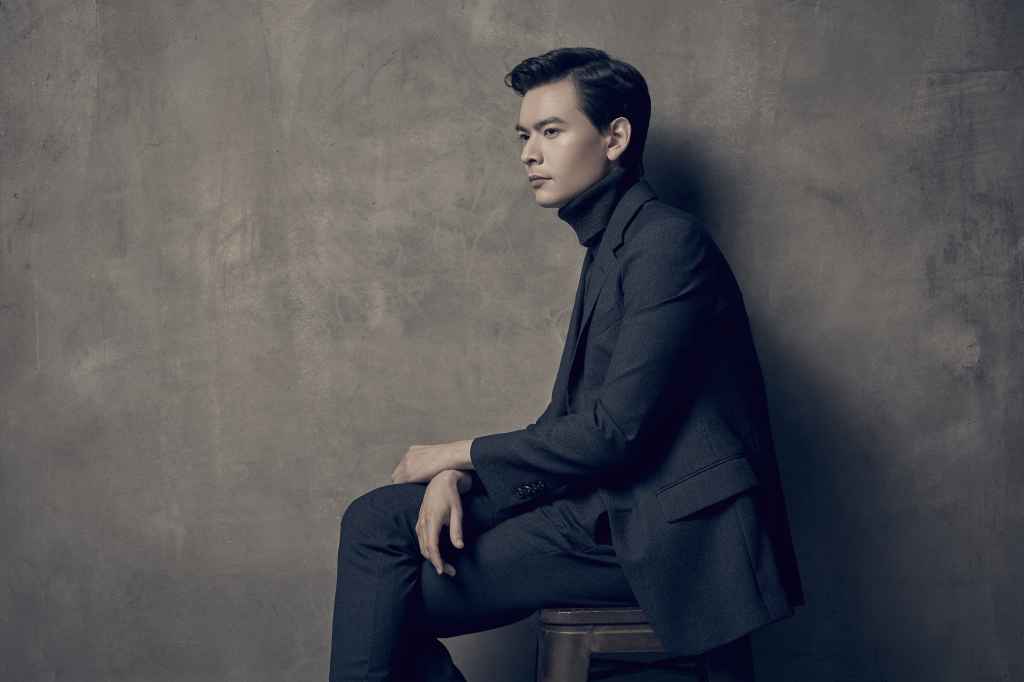
William Eddins, photo credit Jonathan Kim

Eddins served double duty as pianist and conductor in Gershwin’s Rhapsody in Blue, but first took several minutes to introduce the work – as historically-informed as it was entertaining. Principal clarinet David Thomas delivered the iconic opening in a sultry solo. The work was presented in its 1926 pit orchestra scoring for an authentic feel of the roaring twenties, and it was certainly fitting for the performance to take place in a venue that was a product of the same decade. Eddins proved equally adept at both roles, and guided the ensemble in a charismatic, high-octane performance.

It’s a challenge for conductors to make such a well-worn piece as Beethoven’s Fifth Symphony sound fresh. I wasn’t convinced Eddins managed to say anything novel, but the performance nonetheless served as an always welcome encounter with an old friend. The opening Allegro con brio benefitted from Eddins’ energetic conducting, an intensity countered by the warm lyricism of the strings in the slow movement – though I found the brass to be a bit overzealous. The scherzo started out as a whisper, employing the ubiquitous rhythmic gesture that binds the work, and gradually grew in urgency. Matters were held in suspense until the brassy C major finale broke through the clouds. Still, the journey is far from over – Beethoven has gift for profligate finales! – and the energy on stage seemed to flag for a somewhat anticlimactic ending.
A lush La bohème from the Columbus Symphony

Columbus Symphony Orchestra
Rossen Milanov, conductor

S Katy Tucker, video artist
James Marvel, director

Joshua Stewart, Rodolfo
Michelle Johnson, Mimì
Abigail Rethwisch, Musetta
Ethan Vincent, Marcello
Brian Major, Schaunard
Robert Kerr, Colline
Cody Müller, Alcindoro

Columbus Symphony Chorus
Ronald J. Jenkins, chorus director

Ohio Theatre
Columbus, OH
February 4, 2022

Puccini: La bohème

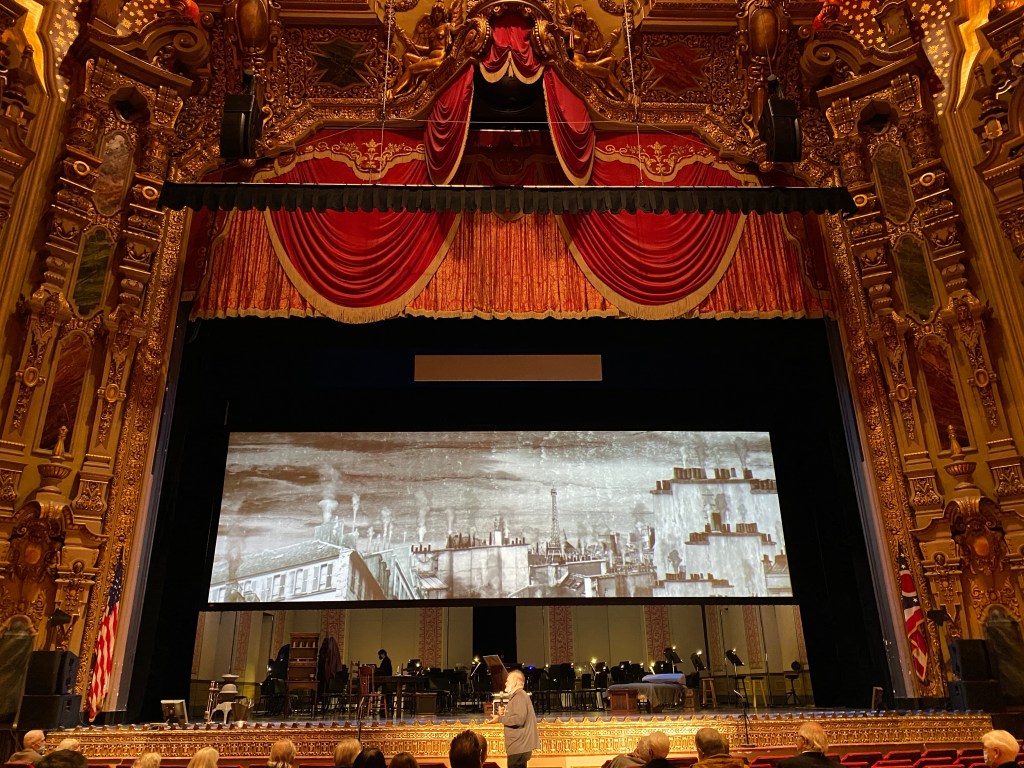
In their most ambitious undertaking so far of the current season, the Columbus Symphony offered a complete staged performance of Puccini’s indelible opera La bohème. The orchestra was perhaps the biggest star of the evening, aided by a compelling cast of singers and chorus, with the narrative brought to life by way of simple yet effective staging further enhanced by video projections, spanning the stage of the Ohio Theatre as a massive canvas.

Ohio Theatre during Christopher Purdy’s pre-concert talk. Note the video projection spanning the stage

La bohème is a compact, fast-paced affair, certainly by operatic standards. Eschewing a full-scale overture, a few bars of orchestral introduction led directly to the opening dialogue wherein we were transported in an instant to a Parisian garret. The four flatmates had a wonderfully conversational chemistry. Michelle Johnson’s Mimì was sweet and pure, but portrayed from the beginning with signs of the tragic character’s illness – an ominous foreshadowing. As Rodolfo, Joshua Stewart’s first moment to shine came in the aria Che gelida manina, sung with great tenderness. Johnson followed with a dulcet but full-bodied Sì, mi chiamano Mimì. A moonlit duet between the two (O soave fanciulla) closed the first act in the loveliest fashion.

Act II took matters to the bustling Latin Quarter, the stage brimming with members of the Columbus Symphony Chorus, excellently prepared by Ronald J. Jenkins. It was interesting to see the chorus members masked – perhaps this was merely Covid protocol, but masked faces in a crowded public setting made this nineteenth-century tableau feel quite topical. Abigail Rethwisch made a terrific Musetta, highlighted by the lilting Quando me’n vo’, her charm a stark foil to the hapless Alcindoro.

Lush harps and projections of falling snow made for an atmospheric opening to Act III, and again rather topical as it quite literally takes place in February (as did the opera’s 1896 premiere). A duet between Mimì and Marcello (Ethan Vincent) was especially touching. The final act returned to the garret where it all began, depicting the cyclical and perhaps inevitable nature of things. A short-lived moment of levity was to be had before the heart-wrenching conclusion, certainly one that packed an emotional punch. Milanov certainly has a gift for opera conducting, and I look forward to any future operatic forays from these forces. A shame the severe winter weather prevented a larger audience!

Barnatan’s ravishing Rachmaninov closes Columbus Symphony’s Russian festival

Columbus Symphony Orchestra
Rossen Milanov, conductor
Inon Barnatan, piano
Ohio Theatre
Columbus, OH
January 23, 2022

Tchaikovsky: Orchestral Suite No. 3 in G major, Op. 55
Rachmaninov: Piano Concerto No. 3 in D minor, Op. 30

Two weeks after a memorable first entry of the Russian Winter Festival, the Columbus Symphony offered an even more compelling second foray into the repertoire, in this case focusing on Tchaikovsky and Rachmaninov. Despite the seemingly innocuous title, at over forty minutes, Tchaikovsky’s Suite No. 3 is a work very much on the scale of the symphonies. If there are salient differences to be noted, the Suite is rather lighter in character than the often tragic symphonies, and includes scoring for English horn and harp – instruments the composer avoided in the symphonies. The opening Élégie was graceful, delicate, and tinged with melancholy. Tchaikovsky’s arching lyricism was in plain sight, heightened by a languid English horn solo from Robert Royse. The Valse mélancolique that followed was of an ineffable charm, a lilting waltz but with doleful underpinnings, subsequently countered by an energetic yet featherlight scherzo.

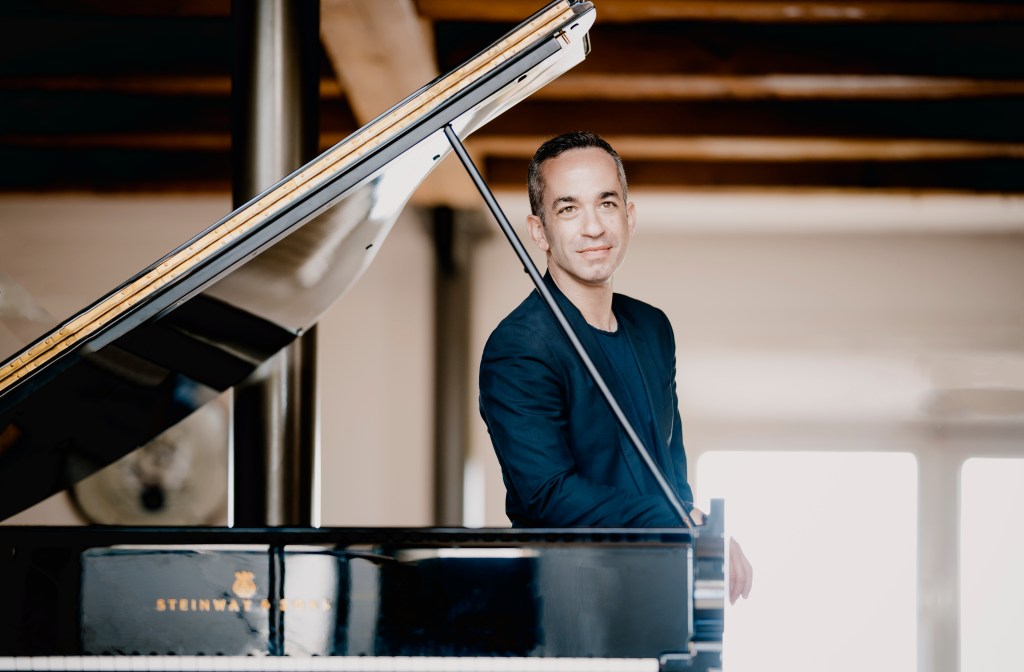
Inon Barnatan, photo credit Marco Borggreve

The closing theme and variations is as long as the first three movements combined. Matters were inaugurated by a stately presentation of the theme in the strings, and with charm and delight, Milanov shaped each of the twelve variations that followed with individual character in this first CSO performance of the work. Variation 4 featured a powerful invocation of the Dies irae, and the fugato of the following was given with exacting clarity. Variation 9 closed with a wonderfully virtuosic violin cadenza from associate concertmaster Leonid Polonsky, leading into the deeply melancholic tenth variation. Not only is the suite as a whole end-weighted, but so are the variations themselves with the final few being the most extensive and expressive. A grandiose polonaise concluded the set in bellicose fashion. Following the performance, Milanov offered gratitude and tribute to violist Mary Farrington, stepping down after a remarkable 42 years.

Rachmaninov’s famously virtuosic Piano Concerto No. 3 brought Israeli pianist Inon Barnatan in the spotlight. Haunting, monastic beginnings were taken at an indulgently slow tempo, but vigor was amassed in due course. The sumptuous orchestral accompaniment complemented Barnatan’s virtuosity well, with the pianist conveying a rich tone, amply projected, though perhaps a bit too mild-mannered for such impassioned repertoire. Barnatan opted for the shorter of the two cadenzas Rachmaninov provided, though it still packed a punch, putting his commanding technique on full display – certainly one of the most thrilling moments in the piano concerto literature. Lush textures crested to passionate outpourings in the central movement, and a seamless transition led directly into the energetic march of the finale, building to a blazingly virtuosic conclusion.

Columbus Symphony opens new year in powerful Russian repertoire

Columbus Symphony Orchestra
Rossen Milanov, conductor
Ohio Theatre
Columbus, OH
January 7, 2022

Mussorgsky/Ravel: Pictures at an Exhibition
Stravinsky: Le sacre du printemps (arr. Jonathan McPhee)

The Columbus Symphony opened the New Year with its annual Russian Winter Festival, now in its seventh year. The first of two programs in the Festival, Friday night’s offering put forth two of the most pivotal works – and orchestral showpieces – of the Russian repertoire: Mussorgsky’s Pictures at an Exhibition and Stravinsky’s Rite of Spring. Such a meaty program made for an exciting night of orchestral virtuosity.

Presented in its (overly?) familiar Ravel orchestration, Pictures at Exhibition was certainly a rousing way with which to begin the year, with the clarion trumpets calls of the opening “Promenade” setting a ceremonial tone (principal trumpet Mark Grisez). The coloristic “Gnomus” put Ravel’s mastery of instrumentation on full display. Marked contrast was to be had in the lightness of “Tuileries” preceding the weight of the imposing “Bydło” – the latter a shining moment for the tuba. “Samuel Goldenberg und Schmuÿle” stood out by its striking use of the muted trumpet, showing the many colors of an instrument so pivotal to the suite. A tragic chorale opened the “Catacombae” segment, perhaps the emotional core of the work, while closing “Great Gate of Kiev” was solemn and stentorian, with a suitably grandiose finish enhanced by the tolling bells.

Stravinsky’s Rite of Spring amply filled out the balance of the evening. Milanov opted to use a version for reduced orchestra arranged by conductor Jonathan McPhee. While perhaps some of the raw excitement is lost when performed by slimmer forces, the McPhee arrangement stays faithful to the original (a few samples can he heard here) and is the only reduction to be approved by the Stravinsky estate (and when the work is performed as a staged ballet, this version accommodates venues that lack a pit large enough to fit the vast number of players the composer originally envisioned).

The work began in a bassoon solo (Betsy Sturdevant), sounding nearly otherworldly in its unnaturally high register. The music progressed discursively, gaining momentum until it crested in the iconic passage of manically repeated, pulsating rhythmic gestures. Milanov’s exacting baton work carefully guided the orchestra through the piece’s fearsome rhythmic complexes. Part II opened shrouded in the same mystery as the beginning with fine solo contributions from concertmaster Joanna Frankel, astringently portraying a desolate atmosphere. The pounding bass drum ignited the kinetic energy of “Glorification of the Chosen One”, bursting with a primal fury that pointed in due course towards the final, cataclysmic crash. There’s certainly much to forward to in the second installment of the Russian Winter Festival, featuring works of Tchaikovsky and Rachmaninov.

Columbus Symphony explores Romanticism in Liszt and Brahms

Columbus Symphony Orchestra
Rossen Milanov, conductor
Claire Huangci, piano
Ohio Theatre
Columbus, OH
November 12, 2021

Williams: The Dream Deferred
Liszt: Piano Concerto No. 2 in A major, S125
 Encore:
 Gulda: Piano Play No. 6
Brahms: Symphony No. 2 in D major, Op. 73

As with the previous entry in the Masterworks series, the Columbus Symphony’s program on Friday night thoughtfully opened with a socially-relevant work by a contemporary African-American composer. Here, the work in question was the 2017 composition The Dream Deferred by Chicago native Evan Williams. Alluding to the Langston Hughes poem, the present work contends with how the American dream is all too often deferred for the Black and Latino communities, particularly amongst young males in what is chillingly referred to as the school-to-prison pipeline. Scored for string orchestra and harp, the piece is bifurcated into two brief movements, “it explodes” and “it dries up” respectively. The harp textures in particular showed the composer’s skill as the unsettled, ominous music proceeded until the titular dream eventually faded away into darkness.

A preconcert conversation between Claire Huangci and Rossen Milanov

The preconcert talk featured an informative conversation between music director Rossen Milanov and guest pianist Claire Huangci. The two first collaborated in Philadelphia when Huangci was just 12 years old. She was featured this weekend in Liszt’s Piano Concerto No. 2, a rather more lyrical foil to its more frequently heard predecessor. Plaintive winds were answered by gentle cascades in the piano, and the pianist’s elegant, sensitive playing captured one’s attention. Though certainly more subdued than the First Concerto, there were nonetheless ample opportunities for flair and virtuosity which Huangci delivered with aplomb, particularly in the riveting march. A ravishingly beautiful duet between the pianist and principal cellist Luis Biava offered a moment of calm before the big-boned finish. Huangci indulged the appreciative audience with an encore in Friedrich Gulda’s Piano Play No. 6, thoroughly entertaining in its jazz inflections and rapid-fire repeated notes.

The so-called “War of the Romantics” was a defining feature of nineteenth-century music, pitting against each other two vastly different approaches to composition. The present program intriguingly explored that by contrasting the Liszt with the latter half devoted to Brahms’ Second Symphony. The first movement opened gentle and genial, though it sounded as if it could have benefitted from additional rehearsal time. The trajectory of this expansive movement was not always clear as matters plodded along, with interjections from the brass fitfully uncoordinated and out of tune. Nonetheless, I found the slow movement more convincing with a serenity encouraged by the resonant cellos, and Milanov led the orchestra to a fiery passion before peacefully subsiding. Milanov aptly referred to the Allegretto grazioso as a “stylized minuet”, and it provided much charm ahead of the finale, certainly one of the most jubilant in the repertoire – just what was needed on a cold November night.

Columbus Symphony opens season with appealing Brahms and Dvořák

Columbus Symphony Orchestra
Rossen Milanov, conductor
Stefan Jackiw, violin
Ohio Theatre
Columbus, OH
October 22, 2021

Montgomery: Banner
Brahms: Violin Concerto in D major, Op. 77
 Encore:
 Bach: Largo from Violin Sonata No. 3 in C major, BWV 1005
Dvořák: Symphony No. 8 in G major, Op. 88

Friday marked opening night of the Columbus Symphony’s Masterworks series, the core of its landmark 70th season. As is standard practice from most American orchestras, the CSO would typically open the season with a rendition of the national anthem. Extraordinary times, however, make business as usual ring hollow, and a thoughtful opener was to be had in Jessie Montgomery’s 2014 work Banner. Written in 2014, two hundred years after Francis Scott Key’s indelible poem, the work pits the Star-Spangled Banner against a wealth of melodies from other cultures, depicting in musical terms the vast array of cultures that comprise the United States today. While the contours of the Star-Spangled Banner form the backbone of the work, no less than seven other songs are woven together into a single multicultural fabric, often yielding a spiky polytonality. A deeply engaging opener, and I hope the CSO continues to explore Montgomery’s work in future seasons.

Stefan Jackiw, photo credit stefanjackiw.com

The remainder of the program retreated to more familiar territory in seminal works of Brahms and Dvořák. Stefan Jackiw served as a commendable soloist in the Brahms Violin Concerto. The graceful and genial opening gave way to the dramatic, punctuated by Jackiw’s jagged entrance. He displayed an accomplished virtuosity, delivering the extended cadenza with flair, but never without sensitivity, continually drawing focus towards the work’s lyrical heart. A rapturous oboe solo opened the central Adagio, answered in the rich lyricism of the solo violin. The Hungarian finale was given with both effervescence and drama, and the orchestra matched Jackiw’s high spirits. As an encore, Jackiw offered the Largo from Bach’s C major sonata – a lovely pendant.

Dvořák’s Symphony No. 8 closed the evening, and here, Milanov opted to conduct from memory. The work saw brooding beginnings, but rays of sunlight quickly broke through. The principal winds – the flute in particular – were the standouts here. A second movement Adagio proceeded as calm and untroubled affair, while the lilting penultimate movement had a dancing charm – though one wanted perhaps even more emphasis on the insouciant dance rhythms. Clarion trumpet calls heralded the boisterous finale. All in all, a very satisfying start to the season.