Chamayou makes impressive Cleveland debut with Scriabin rarity

Cleveland Orchestra
Susanna Mälkki, conductor
Bertrand Chamayou, piano
Severance Hall
Cleveland, OH
July 28, 2017

Scriabin: Piano Concerto in F sharp minor, Op. 20
Schumann: Symphony No. 3 in E flat major, Op. 97, Rhenish

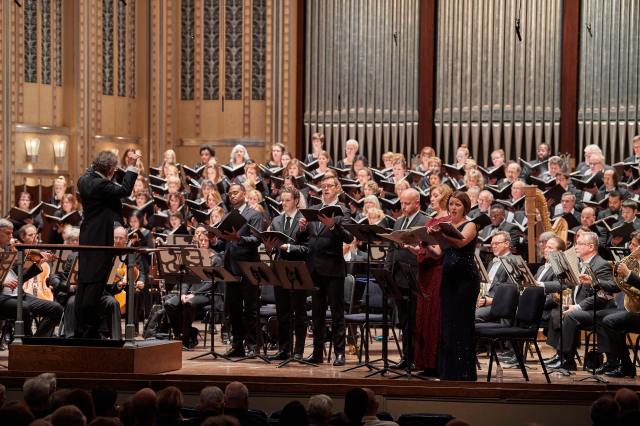
After opening the Summers@Severance season with a bread-and-butter all-Beethoven program, the Cleveland Orchestra turned to less familiar repertoire for the second installment.  Two firsts for the orchestra were to be had in the opening selection of Scriabin’s youthful piano concerto: it was a vehicle for the Cleveland Orchestra debut of the French pianist Bertrand Chamayou, as well as the inaugural performance of the work in the ensemble’s century-long history.  At the podium was Susanna Mälkki, a dynamic podium presence who never fails to strike me in her attention to color and nuance (and parenthetically, this was right on the heels of her memorable performance I caught in Chicago last month).
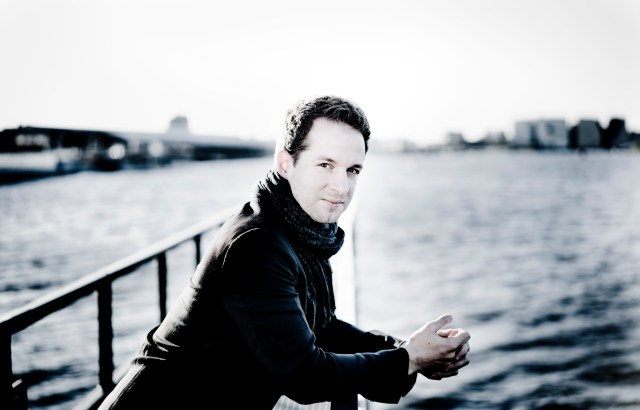
Bertrand Chamayou (c) Marco Borggreve - Warner Classics 2
Bertrand Chamayou, photo credit Marco Borggreve

The Scriabin piano concerto is firmly in the grand Romantic tradition, in no way anticipatory of the revolutionary atonality the composer’s works would soon embrace.  That being said, it’s a relatively compact work, the three movements cumulatively clocking in at under a half hour, and tends towards restraint over bombast.  Opening with solo passages for the horn and clarinet, the wistful piano entrance piano entrance was unmistakably Chopinesque, displaying the influence of Scriabin’s muse at the time, and later countered by a more jestful theme.  Arching melodies swelled in the orchestra, Mälkki skillfully balancing the dense orchestration with the solo piano, and movement built to a grandiose conclusion.

The central movement was cast in variations, an unusual form for Scriabin.  Serene strings introduced the theme, while the first variation was marked by delicate filigree in the piano in dialogue with the clarinet.  More animated material was to be had in the following variation, evidencing Chamayou’s considerable technical arsenal, while the third variation – and heart of the movement – was a somber funeral march, grounded in the piano’s lowest registers.  A dramatic flourish in the piano opened the finale, Scriabin at his most extrovert.  This gave way to a deeply passionate melody, of the kind one could easily mistake for the composer’s fellow Moscow Conservatory student Rachmaninov, and a display of blistering virtuosity and rich orchestral texture continued unabated through the resounding final chord.

Schumann’s Rhenish symphony made for a fitting counterpart to the concerto.  The opening movement was majestic, the orchestral lines flowing together as one to bring to life the work’s namesake river, and it exuded the heroic potential of its key of E flat major, by no coincidence the same key as Beethoven’s Eroica.  Widely-spaced strings characterized the scherzo, as if gently gliding along the water, and a choir of gentle winds highlighted the slow movement, later contrasted by the lushness of the strings.  The crux of the symphony – and where Schumann breaks from his classical forebears – is in the penultimate movement, a stirring brass chorale, presaging the awe-inspiring solemnity of Bruckner (who was also quite fond of the movement in question’s marking of feierlich).  While not without some unfortunate flubs in the brass, the effect was nonetheless imposing; the finale, however, was of unfettered jubilation, offering spirited playfulness to counter the stoicism of the preceding.

Summers@Severance opens with hearty Beethoven

Cleveland Orchestra
Franz Welser-Möst, conductor
Severance Hall
Cleveland, OH
July 14, 2017

Beethoven: Overture to Egmont, Op. 84
Beethoven: Symphony No. 1 in C major, Op. 21
Beethoven: Symphony No. 5 in C minor, Op. 67

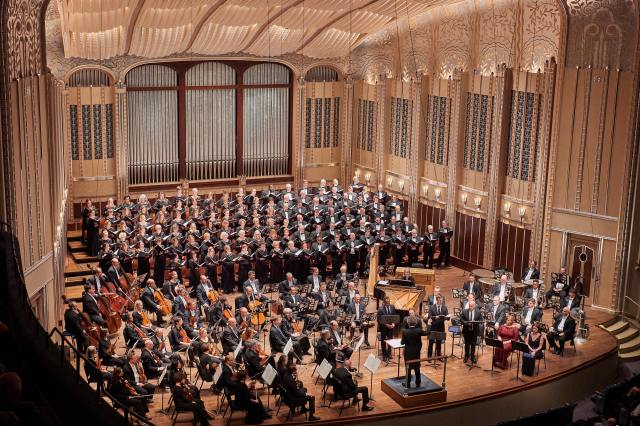
As a respite from the sometimes problematic conditions of al fresco performances, the Cleveland Orchestra offers the opportunity to hear them indoors through the summer at Severance Hall (which, incidentally, was recently featured on CNN as one of the finest music venues in the US) in tandem with their usual Blossom residency.  Matters opened in auspicious form Friday evening, with music director Franz Welser-Möst leading an all-Beethoven program as a preview of sorts for the upcoming season’s Beethoven symphony cycle.

22157127-mmmain
Summer festivities at Severance Hall, photo credit Roger Mastroianni

The Egmont overture made for a dramatic opening, apparent from the sustained introductory chords which which given with a glowering intensity.  The principal winds were particular standouts when in dialogue with one another, and Welser-Möst had taut control of the work’s sonata form architecture.  A piece of unrelenting Sturm und Drang, it was only occasionally mitigated by brief forays in the major, hardly enough to hint at the work’s jubilant conclusion.

In similar fashion to the preceding, the Symphony No. 1 in C major boasted a deftly-shaped chordal introduction, but otherwise this sprightly early work was worlds apart.  The theme of the movement proper crept in unassumingly, and burst with the self-assurance of the young composer.  A secondary theme was very finely given in the oboe by Frank Rosenwein, and with the Austrian on the podium, the orchestra sounded like a proper Viennese ensemble.  The genteel slow movement oscillated back and forth between playing in unison and various instrumental combinations in counterpoint, while the vigorous abandon of the third movement was a bona fide scherzo in all but name.  The finale opened in a stately manner, echoing the symphony’s beginning, only to proceed in unabated high spirits.

Beethoven’s Fifth, that rather well-known quantity in the parallel minor of the First, rounded off the evening, for which the orchestra swelled to 19th-century proportions.  Welser-Möst’s tempo choice was brisk and exacting, and despite the familiarity of this territory one never felt he was merely coasting on autopilot.  Rosenwein’s solo passage in the development was a striking moment of stasis in a world otherwise defined by searing drama.  There was a wonderful, burnished richness of the strings in the slow movement, and the winds were of note in the variation that perhaps interpolates La Folia.

In the penultimate movement, granite blocks of singularity gave way to delicate string filigree, although a somewhat more conservative tempo choice in the latter perhaps would have yielded clearer articulation.  This led attacca to the brassy exultation of the finale.  Welser-Möst opted for minimal dynamic contrast, which had the interesting (and perhaps intended?) benefit of making the ghostly return of the gesture from the third movement all the more haunting.  That mood of course wasn’t maintained for long in this archetypal journey from darkness to light, and there was no ambiguity that we had firmly arrived at C major in the extensive coda.  This drew a rapturous ovation from the packed house, and if Friday was any indication, next season’s traversal of the nine symphonies promises to be enormously rewarding.

Welser-Möst and Cleveland Orchestra vivdly trace Stravinsky’s musical development

Cleveland Orchestra
Franz Welser-Möst, conductor

Seraphic Fire
Patrick Dupré Quigley, artistic director
Margot Rood, soprano
Margaret Lias, mezzo-soprano
Steven Soph, tenor
Brian Giebler, tenor
James K. Bass, bass
Charles Wesley Evans, bass

Cleveland Orchestra Chorus
Robert Porco, director

Severance Hall
Cleveland, OH
March 18, 2017

Stravinsky: Feu d’artifice, Op. 4
Stravinsky: Apollo (1947 version)
Stravinsky: Symphonies of Wind Instruments (1947 version)
Stravinsky: Threni

An all-Stravinsky program that doesn’t include a note of The Firebird¸ Petrushka, or The Rite of Spring – impossible you say?  Not for Franz Welser-Möst and the Cleveland Orchestra who presented a thoughtful survey of Stravinsky’s output while managing to skirt the well-worn blockbusters.  Each of Stravinsky’s major stylistic periods were represented, and each work on the program was markedly different from the others, a testament to the composer’s remarkable versatility.  A video of Welser-Möst speaking about the program can be viewed here:

Feu d’artifice, dating from 1908, comes from Stravinsky’s so-called Russian period that would eventually produce his watershed ballet scores for Diaghilev’s Ballets Russes.  The brief but brilliant work is certainly the vision of a youthful firebrand, scored for large orchestra with some particularly striking writing for the celesta.  While there was a sensuous contrasting theme, matters were largely big-boned and extrovert in this last vestige of Russian Romanticism.

Originally composed 1927-28, the ballet score Apollo (variously known by its French title Apollon musagète) was presented in its 1947 revision.  Conceived for strings alone, Apollo is a major product of Stravinsky’s neoclassical period, both in terms of its language, elegant in its clarity and restraint, and its classical inspiration.  The untroubled “Prologue” showcased the beauty of the Cleveland strings, and the ensuing “Variation d’Apollon” featured graceful solo playing from concertmaster William Preucil.  A “Pas d’action” was characterized by long melodies well-suited to the strings which set up a series of variations depicting three of the Muses.  The “Pas de deux” was delicate and given with an ineffable charm, while the “Coda” offered contrast in its jaunty syncopations.  Matters were left in serenity by means of the concluding “Apothéose”, music of haunting stasis.

Apollo was suitably complemented by the Symphonies of Wind Instruments, also stemming from the neoclassical period, but earlier enough to offer some stylistic variety.  Dating from 1919-20, like the preceding, it was performed in its revised version (coincidentally, from 1947 as well, also the year that the ever-fastidious composer revised Petrushka).  The titular wind instruments were not restricted to just the woodwind family, but the broader category of aerophones; hence, the brass were included as well.  “Symphonies”, in its intentional plurality, invoked the term’s Greek origins (literally, “sounding together”), and in the work Stravinsky accordingly was keen to explore various combinations of instrumentation.

Opening with striking, piquant harmonies, the work mercilessly jettisoned sentimentality, demanding such razor-sharp precision that its tempo changes were in a carefully proportioned 1:1.5:2 ratio.  Under Welser-Möst’s taut direction, the desired effect was expertly achieved.  A rhythmically-driven section recalled perhaps the primacy of rhythm in The Rite of Spring, and in spite of its apparent callousness, the work closed in a poignant chorale, meant as a tombeau for the recently deceased Debussy.

CLO031617_269_select for media
Cleveland Orchestra & Chorus, Franz Welser-Möst, and Seraphic Fire in Stravinsky’s Threni
© Roger Mastroianni, courtesy of The Cleveland Orchestra

The evening’s most intriguing discovery was the final work, the rarely performed Threni, in its belated Cleveland premiere.  Completed in 1958, it was the composer’s first completely serial foray, scored for full orchestra, chorus, and six vocal soloists.  This weekend’s sextet of soloists were from the acclaimed South Florida based choral group Seraphic Fire.  Subtitled “Lamentations of Jeremiah”, the 35-minute work sets text from the Old Testament in Vulgate Latin, punctuated by the chorus exclaiming a letter from the Hebrew alphabet which served as veritable signposts in this demanding score.  Also useful in such unfamiliar territory were the detailed and informative remarks Welser-Möst presented prior to commencing.

The religious discipline was conveyed in the work’s austerity; despite being cast for large orchestra, the textures were dominated by sparse, chamber-like combinations.  A brief introduction was given with declamatory seriousness by Margot Rood and Margaret Lias, soprano and mezzo-soprano respectively.  The first section of the work proper (“De Elegia Prima”) was marked by very fine playing from Michael Sachs on the bugle (flugelhorn), often in dialogue with tenor Brian Giebler, and the chorus commanded a wide dynamic range, from monastic whispers to cataclysmic climaxes.  “De Elegia Tertia” featured striking contributions from the booming bass of the aptly named James K. Bass, his delivery suggesting that of a monk.  Stravinsky was almost certainly influenced by Gesualdo; the sophisticated pointillist counterpoint of a Renaissance motet was cleanly negotiated by all, and the closing “De Elegia Quinta” brought forth a conclusion of solemn resolution.

CLO031617_315_select for media
Cleveland Orchestra & Chorus, Franz Welser-Möst, and Seraphic Fire in Stravinsky’s Threni
© Roger Mastroianni, courtesy of The Cleveland Orchestra

Van Zweden, Trifonov, and the Cleveland Orchestra find fresh inspiration in Mozart and Beethoven

Cleveland Orchestra
Jaap van Zweden, conductor
Daniil Trifonov, piano
Severance Hall
Cleveland, OH
November 27, 2016

Britten: Sinfonia da Requiem, Op. 20
Mozart: Piano Concerto No. 23 in A major, K488
Beethoven: Symphony No. 5 in C minor, Op. 67

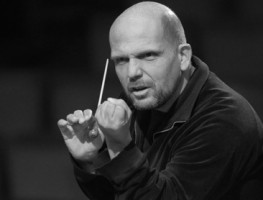
Over the Thanksgiving weekend, the Cleveland Orchestra presented a sumptuous program anchored by seminal works of Mozart and Beethoven.  After being heralded earlier this year as the New York Philharmonic’s music director-designate, all eyes have been on Jaap van Zweden.  The program played on his strengths, and even the most familiar of repertoire sounded dynamic and anew under his probing guidance.

Antwerp_JvZ1-263x200.jpg
Jaap van Zweden, photo credit Bert Hulselmans

The afternoon began in somewhat less familiar territory with Britten’s Sinfonia da Requiem, a work the orchestra has not performed since the 1970s.  A triptych of succinct, interconnected movements, it encapsulates the composer’s pacifist leanings and is an important precursor to the watershed War Requiem.  The opening Lacrymosa began quite strikingly in the timpani and piano, keyboardist Joela Jones providing an unrelenting, anxious ostinato.  The oboe passages of principal Frank Rosenwein were strained and pained in a texture that built to surging brass climaxes in its ethos of despair.

Nervous flutes opened the Dies irae but the heart of the piece was in the concluding Requiem aeternam.  While in lesser hands it can sound like a plodding passacaglia, under van Zweden’s baton it was peaceful and plaintive, building to an arching lyricism in serene resolution, worlds apart from the austerity of the opening.

Mozart’s Piano Concerto No. 23 brought forth the remarkable young pianist Daniil Trifonov, who has an important connection to the city having studied at the Cleveland Institute of Music.  The concerto opened in the airy textures of the strings, with a gesture as gentle as an exhale, and it was with that naturalness the music flowed.  Trifonov’s entrance was unassuming and graceful, and he emphasized the work’s lyrical beauty and dramatic contrasts as per his propensity to the Romantic repertoire, though never in excess.  The cadenza was fleet and deftly balanced, displaying Trifonov’s astonishing dexterity.

7714
Daniil Trifonov

Cast in the relative key of F sharp minor, the slow movement was filled with longing, and the winds were almost decadent in the splendor of their singing lines.  Trifonov would often glance heavenward as if seeking some divine inspiration, fitting for music this sublime.  The sprightly rondo finale is inherently familiar to many Clevelanders, in its frequent appearances as theme music on WCLV.  Although there were shades of darkness in its minor key episodes, the overall mood was of pure joie de vivre.

Perhaps the greatest interpretative challenge of Beethoven’s Fifth Symphony is making one of the most popular pieces in the literature sound anything but trite and clichéd.  Van Zweden proved amply up to the challenge as was apparent right from the crispness of the arresting opening, in a first movement that was lean and taut.  Its violent contrasts were emphasized, keeping the audience on the edge of their seats as it seemingly could devolve into wild abandon at any moment, yet matters were always tightly controlled.

The slow movement began with some especially lovely tones in the cellos, and the interplay between the martial and lyrical themes was cleanly delineated.  I was especially struck by the clarity of the third movement’s fugato section, the contrapuntal lines weaving in and out of the strings.  The finale was an exuberant and joyous affair, and the noteworthy addition of the trombone and the piccolo heightened its sense of drama to bring the concert to a rousing close.