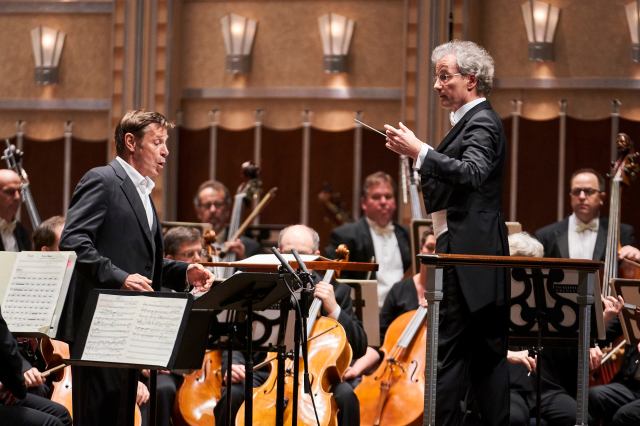
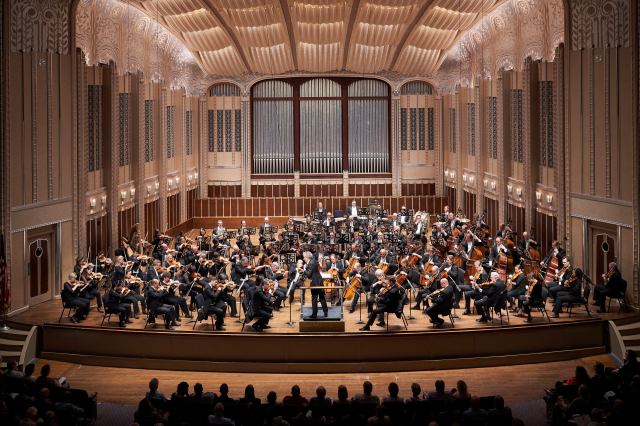
Tilson Thomas shines as both composer and conductor with The Cleveland Orchestra

Cleveland Orchestra
Michael Tilson Thomas, conductor
Sasha Cooke, mezzo-soprano
Dashon Burton, bass
Severance Hall
Cleveland, OH
February 20, 2020

Tilson Thomas: Meditations on Rilke
Berlioz: Symphonie fantastique, Op. 14

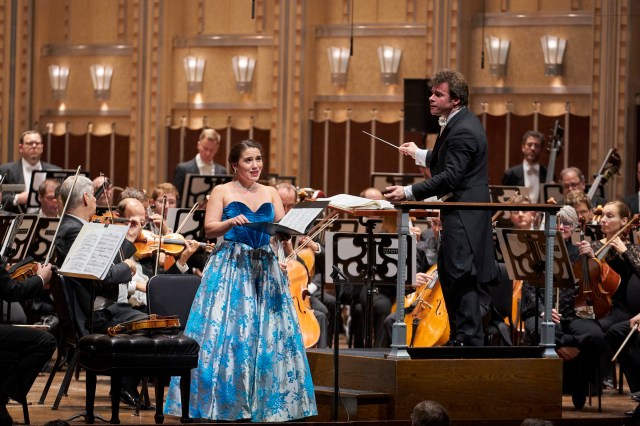
Now in his twenty-fifth and final season as music director of the San Francisco Symphony, Michael Tilson Thomas has increasingly devoted his time to composition, following in the footsteps of the composer-conductor luminaries with whom he closely worked – Stravinsky, Copland, and Bernstein amongst them. His freshly-minted song cycle Meditations on Rilke was given its second set of performances last weekend, following the San Francisco world premiere in January. It’s a work, however, which has been gestating in the back of Tilson Thomas’ mind for some time: in a recent interview, he referred to it as a “pages of [his] musical diary.” Structurally, the piece immediately brings to mind Mahler’s Das Lied von der Erde in its scoring for large orchestra with mezzo-soprano and bass soloists alternating between the six Rilke poems. While not on as large a scale as the Mahler, it’s still quite substantial, clocking in at just under forty minutes – the program was originally slated to open with Berlioz’s Roman Carnival Overture, a quantity which was excised when the MTT work burgeoned to its current dimensions.
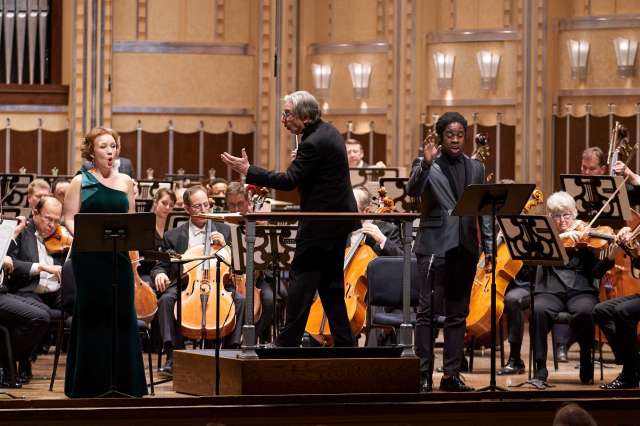
164968-clo-022020-270c-roger-mastroianni--courtesy-of-the-cleveland-orchestra
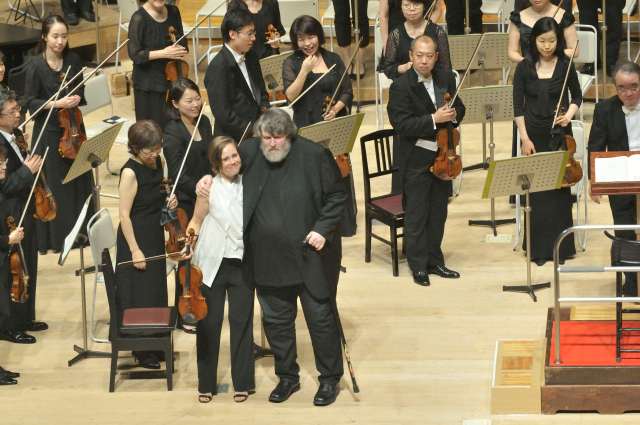
Sasha Cooke, Michael Tilson Thomas, and Dashon Burton with The Cleveland Orchestra, photos credit Roger Mastroianni, courtesy of The Cleveland Orchestra

A deliberately out-of-tune, honky-tonk sounding upright piano had the first word in the opening “Herbsttag,” setting the scene in a small-town dive bar where the pianist introduces influences from the classical repertoire in addition to the standard pub fare, setting in motion the present set of stream-of-consciousness reflections. The texture grew from the solo piano to an orchestral landscape of colorful effects, remaining resolutely tonal and approachable. Dashon Burton offered a deep and powerful tone, yet was often touchingly pensive, and the spirit of Mahler was never far away – hardly a surprise in a work from such a distinguished Mahlerian as MTT. “Ich lebe mein Leben” was given a lushly gorgeous setting, sweetly sung by Sasha Cooke, and an oboe passage from Frank Rosenwein served as a further highlight. “Das Lied des Trinkers” again brought to mind Das Lied von der Erde in its apparent affinity for drinking songs. A rather more rambunctious counterpart to the preceding song, matters began plaintively but soon crested to the thorny and dissonant.

“Immer wieder” featured a glowing brass chorale, and as elsewhere, extensive paragraphs for orchestra alone. Cooke had a natural feel for MTT’s language in this gem of the cycle, which the composer colorfully likened to a “Schubert cowboy song” – Morricone came to my mind as well. The crack of a whip epitomized the vigor given to “Imaginärer Lebenslauf” which called upon both singers, often quite ingeniously blended. The concluding “Herbst” opened with a long flute solo very finely given by Joshua Smith. The harp and pizzicato strings gave matters an ineffably autumnal quality, and the cycle closed with Burton’s repeated incantation of “fallen”, serving a similar function as “ewig” in the work’s Maherlian predecessor.

MTT has a long history of not only conducting the Berlioz Symphonie fantastique, but conducting it in Cleveland, having first performed it with this orchestra in 1977. It made for a choice pairing with the Rilke songs with both works deeply autobiographical and evidencing their respective conductors’ acute ear for orchestral color. The dreamy “Rêveries” that opened was meditative yet never shying away from building to hypnotic passions. The first presentation of the ubiquitous idée fixe was refined, hardly hinting at the grotesque mutations to come, and the pious solemnity of the coda was another highpoint of this first movement. “Un bal” began as lilting waltz, emanating a Gallic elegance, only to dissolve in making way for the idée fixe. There was sharp clarity even given the sprawling orchestra, paying dividends in the blazing conclusion.

The “Scène aux champs” was given with ample breathing room, a capacious portrait of the quietude of the countryside. The dialogue between English horn Robert Walters and offstage oboe Jeffrey Rathbun was expertly articulated – and at the long movement’s end, Walters was answered not by Rathbun, but by the rumbling timpani, signaling the impending storm. “Marche au supplice” was tautly concentrated, erupting with brilliant brass anchored by a backbone of bassoons (four of them, no less). Daniel McKelway’s shrill interjections on the E-flat clarinet made for arresting effect in the closing “Songe d’une nuit du sabbat”, perhaps only outdone by the tolling cathedral bells and goosebumps-inducing low brass.
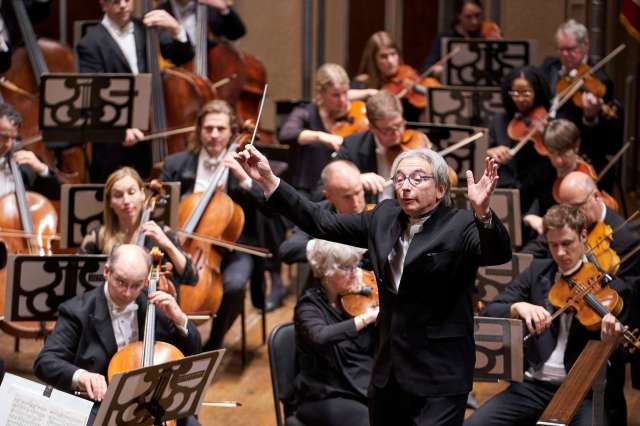
164966-clo-022020-473c-roger-mastroianni--courtesy-of-the-cleveland-orchestra
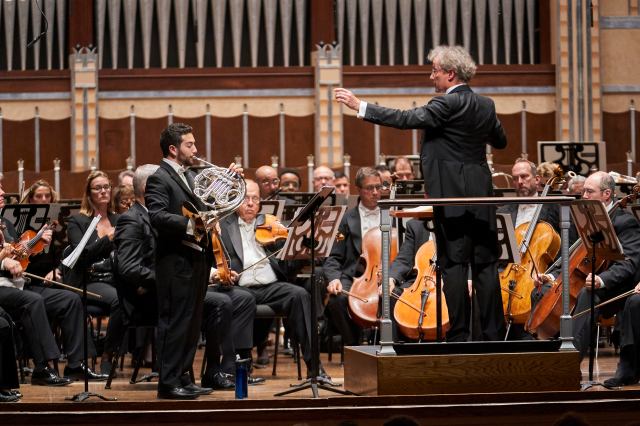
Tilson Thomas and The Cleveland Orchestra

Mälkki and Josefowicz champion Sibelius, Knussen with The Cleveland Orchestra

Cleveland Orchestra
Susanna Mälkki, conductor
Leila Josefowicz, violin
Severance Hall
Cleveland, OH
February 6, 2020

Sibelius: En saga, Op. 9
Knussen: Violin Concerto, Op. 30
Sibelius: Symphony No. 1 in E minor, Op. 39

Ever the dynamic podium presence, Susanna Mälkki brought to The Cleveland Orchestra a pair of imposing yet less-trodden Sibelius scores, bookending a seminal 21st-centruy concerto from the late Oliver Knussen. Sibelius’ early tone poem En saga is the work of a confident young composer self-assuredly finding his voice, not heard at Severance Hall since a 1965 performance under George Szell. Undulating strings gave this single-movement essay an epic sense of scale, countered by thornier winds with the composer masterfully spinning a tale worthy its saga designation. A particularly memorable theme was articulated through the burnished, musky warmth of the violas and cellos, while a solo from clarinetist Daniel McKelway pointed towards a somber end: a mere whisper in the strings, fading away with remarkable control at the ppp dynamic level.

DSC_0072_nolamp-1024x683
Susanna Mälkki, photo credit Jiyang Chen

Knussen is a man who had a wonderfully fruitful relationship with TCO up to his untimely passing in 2018, both as composer and conductor. His 2002 violin concerto received its second Cleveland hearing, this time with champion of the contemporary violin repertoire Leila Josefowicz. Orchestral bells opened the work in striking fashion, with rapid runs high in the violin’s stratosphere. Despite the modernist dissonances, Josefowicz delivered with a luminous clarity. In many regards, this is a Romantic work at heart, a persuasion most pronounced in the resonant lyricism of the central Aria. The closing Gigue thrilled in its intricate web of rhythmic intricacies, negotiated with aplomb and finesse by all.

While the influences of the late Romantic milieu abound in Sibelius’ First Symphony, its opening of a solo clarinet – gorgeously played by Afendi Yusuf – over a rumbling timpani is pure Sibelius, unmistakably the composer’s own rarefied language, even in this inaugural symphonic effort. The strings entered in their celestial radiance for the movement proper with the music lush and rewarding. A dose of Nordic chill was introduced in the development, and perhaps it was Mälkki’s shared heritage with the composer that gave her such innate Sibelian fluency in this thoroughly convincing performance.

The endless melody of the Andante could easily be mistaken for a Tchaikovsky slow movement: he we saw not the forward-thinking Sibelius we would later come to know, but one firmly – and comfortably – rooted in the 19th-century. The scherzo was in turn a nod to Bruckner, and the orchestra remained in tight cohesion even at vigorous speed. A slow, measured introduction to the finale was seeped in melancholy and tragedy, yet in due course gave way to a boisterous, unrelenting affair, occasionally contrasted by a rich melody that resided deep in the strings. The brash coda proceeded with confident swagger, only to turn inward at the last moment to close in unexpected anticlimax.

20150924_C000231cRikimaru_Hotta
Leila Josefowicz with Oliver Knussen in 2015, photo credit Rikimaru Hotta

Rare Prokofiev highlights Welser-Möst’s offbeat Cleveland Orchestra program

Cleveland Orchestra
Franz Welser-Möst, conductor
Severance Hall
Cleveland, OH
January 30, 2020

Prokofiev: Symphony No. 6 in E flat minor, Op. 111
Bridge: The Sea, H100
Dukas: The Sorcerer’s Apprentice

Following their annual residency in Miami, The Cleveland Orchestra is back home for a hearty stretch of concerts leading up to another tour this spring that will take them to Europe and the Middle East. Franz Welser-Möst, continuing his often revelatory exploration of Prokofiev, opened the program with the composer’s seldom heard Sixth Symphony. If the Fifth Symphony celebrates the glories and triumphs of World War II, the Sixth takes a much darker approach in its bracing depiction of the war’s tragedies and losses. As Welser-Möst noted in his spoken introduction, here we have the usually complacent Prokofiev living on the “knife’s edge” of what was acceptable artistically to the Soviet authorities – with its ambiguities and underlying tragedy, it draws comparison to the subversive works of Shostakovich.

prok6
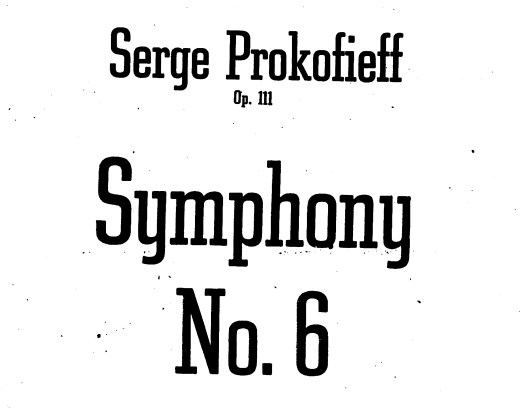
Title page of Prokofiev’s Sixth Symphony

The opening Allegro moderato was thorny and unforgiving, foregoing the familiar cohesion of sonata form for a structure underpinned by garish thematic transitions, through which Welser-Möst guided the orchestra with exacting precision. Stark textures were drawn from the low brass and rather busy piano, and the metallic climaxes depicted in no uncertain terms the true trauma of war. The central Largo served as the emotional crux, with arching strings introducing a pained lyricism. A percussive section, however, ensured this was far from a purely meditative affair, and the celesta added another striking timbre. The motoric finale, patently Prokofiev, delivered rapid fire repeated notes with a Haydnesque wit. An interjection of sparse and forlorn material gave pause before the conclusion – cacophonous, bombastic, and in apparent triumph, albeit only skin-deep.

An even rarer quantity followed after intermission in Frank Bridge’s orchestral suite The Sea. The Cleveland Orchestra gave the US premiere of the work under first music director Nikolai Sokoloff in 1923, and remarkably, hasn’t touched it since. Its four movements depict the titular entity in various guises, and would be a clear inspiration for the Four Sea Interludes from Peter Grimes by Britten, Bridge’s one and only composition student. Additionally, Bridge spent much time on the coast at Eastbourne, where Debussy too gleaned inspiration for another indelible musical sea portrait, La mer.

“Seascape” opened in lavish orchestration with a flowing melody in clear evocation of the sea – music of great beauty and appeal. The scherzo-like frothiness of “Sea Foam” depicted the ever-changing surface, while “Moonlight” unfolded as a nocturne with a delicate flute melody in counterpoint with the harp. Thundering timpani and dissonant brass conjured the closing “Storm”, but the sun shone through for a resplendent end – let us hope it is not nearly another century before we hear the work again!

Dukas’ one-hit wonder The Sorcerer’s Apprentice closed the evening in exciting fashion. Quiet mystery opened, setting the stage for the indestructible march theme, giving the bassoon and contrabassoon a rare moment in the spotlight. The orchestra amassed to vigor in bringing Goethe’s fantastical poem to life in musical terms, only to dissipate in a closing gesture as blistering as it was sudden.

Viotti makes memorable Cleveland debut in Russo-French program

Cleveland Orchestra
Lorenzo Viotti, conductor
Yuja Wang, piano
Severance Hall
Cleveland, OH
November 29, 2019

Prokofiev: Suite from The Love for Three Oranges, Op. 33bis
Rachmaninov: Piano Concerto No. 4 in G minor, Op. 40
 Encore:
 Gluck-Sgambati: “Dance of the Blessed Spirits” from Orfeo ed Euridice
Poulenc: Sinfonietta, FP 141
Ravel: La valse

Over the Thanksgiving weekend, The Cleveland Orchestra dependably serves a musical feast, and this year was hardly an exception. Friday (coincidentally, the 150th birthday of the orchestra’s founder, Adella Prentiss Hughes) marked the local debut of 29-year-old conductor Lorenzo Viotti. Currently principal conductor of Portugal’s Gulbenkian Orchestra, and dubbed to assume the same role with the Netherlands Philharmonic Orchestra next season, Viotti is a conductor who Cleveland music director Franz Welser-Möst singled out as being especially promising during an interview previewing the current season. Viotti’s colorfully appealing program was bifurcated by nationality with a Russian first half preceding a French second.

900 Lorenzo-liggend (1)
Lorenzo Viotti, photo credit Desiré van den Berg

Prokofiev’s six-movement suite from The Love for Three Oranges opened with the composer’s characteristically vigorous orchestrations, bringing to life the opera’s colorful cast of characters with gentler, dancing winds contrasting. The following “Infernal Scene” was darkly surreal in its unusual timbres, while the “Marche” – the opera’s most indelible quantity – was given a crisply rhythmic and foot-tapping workout. “The Prince and the Princess” made for a lyrical interlude, the deeply touching language anticipating Romeo and Juliet. Viotti roused the requisite virtuosity for the roiling “Flight” that closed.

As central to repertoire as Rachmaninov’s works for piano and orchestra are, the Fourth Concerto has been relegated to periphery, not having been performed by this orchestra since 1996. An arsenal of energy opened, quickly paving the way for the full-bodied entry of the incomparable Yuja Wang. The fiendishly difficult piano writing was easily surmounted by her fleet fingerwork, and about two thirds of the way through the movement, matters burgeoned to a climax as grand and lush as anything Rachmaninov wrote. The solo introduction of the Largo was of deep melancholy, revealing Wang’s lyrical gifts, and in due course aided by burnished strings.

Textures grew impassioned and stormier, leading to the jarring transition to the closing Allegro vivace. Wang’s sleight-of-hand pianism negotiated the jazz-inflected rhythmic complexities, and chains of double octaves were effortlessly delivered with fire and panache. The orchestra supported Wang with a colorful accompaniment – Jeffrey Rathbun’s oboe a standout – culminating in a muscular conclusion. While ultimately perhaps not as memorable as the composer’s other works in the medium, it certainly merits hearings at more regular intervals! Although not indulging the Severance Hall audience in one of her encore marathons, Wang nonetheless responded to the hearty ovation with the wistful lyricism of a transcription from Gluck’s Orfeo ed Euridice.

The Cleveland Orchestra gave the US premiere of Poulenc’s Sinfonietta under George Szell in 1949, but remarkably hasn’t touched it since. Kudos then to Viotti for resurrecting this vintage gem, which despite its obscurity, local audiences had the chance to hear as recently as this past March on a CityMusic program. The opening movement brimmed with melodies of immediate appeal, piquant and bright, a sort of synthesis of 20th-century sensibilities within a classical economy, invoking comparison to Prokofiev’s Classical symphony. The inner movements were respectively joyfully light-hearted and sweetly songful, the latter with noteworthy solo passages from the trumpet and clarinet. Perhaps an expression of post-war bliss, the finale was utterly untroubled, and delectably so.

Continuing with French appropriations Germanic forms, matters turned to waltz in Ravel’s iconic La valse. Originally conceived for solo piano (heard just the previous weekend in Soyeon Kate Lee’s recital at the Cleveland Museum of Art), the orchestral version shows in no uncertain terms the composer’s stunning mastery of instrumentation. Beginning with barely audible rumbles, a sultry waltz theme took shape, with sumptuous harps adding to the dizzyingly rich tapestry: a glitteringly cataclysmic dissolution of the once venerable waltz.

Yuja-Wang-by-Norbert-Kniat-DG-11
Yuja Wang, photo credit Norbert Kniat


McGegan’s Cleveland Orchestra program effervesces with classical charm

Cleveland Orchestra
Nicholas McGegan, condcutor
Michael Sachs, trumpet
Severance Hall
Cleveland, OH
November 21, 2019

Schubert: Selections from Rosamunde, D797: Overture – Ballet Music No. 1 – Entr’acte No. 3 – Ballet Music No. 2
Hummel: Trumpet Concerto in E major
Haydn: Symphony No. 104 in D major, Hob. I:104, London

This marked the third consecutive November Nicholas McGegan has stood at The Cleveland Orchestra podium, and his charm and affable spirit without fail warms an otherwise chilly time of the year. The present program straddled the eighteenth and nineteenth centuries, with Hummel’s Trumpet Concerto the centerpiece, bringing into the spotlight Cleveland principal Michael Sachs. Proceeding in reverse chronological order, McGegan opened with selections from Schubert’s incidental music to Rosamunde.

Nicholas+McGegan+Photographer+Randy+Beach.jpg
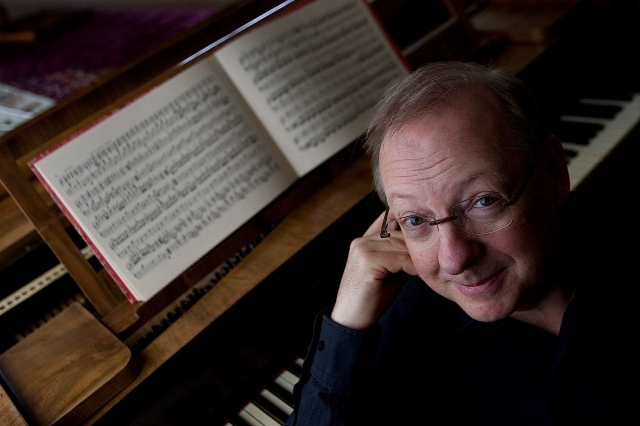
Nicholas McGegan, photo credit Randy Beach

What is known as the overture to Rosamunde was in fact the repurposed overture to Schubert’s earlier (and unsuccessful) opera Der Zauberharfe. A bold sense of drama opened, but the remainder of the work bubbled with a graceful Schubertian charm. The first of the ballets was of a symphonic weight in its Sturm und Drang sensibility, but more mellow material offered contrast near the end, heightened by the clarinet of Afendi Yusuf. One of Schubert’s most cherished melodies, later reused in one of the impromptus for piano as well as the thirteenth string quartet, resounded through a choir of strings and winds in the Entr’acte. Another ballet rounded off McGegan’s suite, given with a rustic abandon.

Hummel’s Trumpet Concerto remained a forgotten quantity until it was rediscovered in the 1950s by trumpeter Armando Ghitalla. Originally cast in the key of E major, Ghitalla opted to publish the work transposed to E flat for ease of playability on the modern trumpet. It continues to be most often heard in the lower tonality today, including in Sachs’ two previous performances of the work with this orchestra. This time, however, Sachs stayed faithful to the composer’s intentions, easily surmounting the inherent technical hurdles. The martial opening was bright and brilliant with the soloist offering a limpid flexibility and climactic trills. The long-breathed tones of the central Andante, interjected by further trilling gestures, were pitted over an undulating accompaniment – a lyrical essay to be sure, but not without a certain grandeur. A jaunty rondo served as the finale, showcasing Sachs’ rapid-fire virtuosity and a never-waning vigor from both soloist and orchestra.

Haydn’s final entry of his long series of symphonies concluded the evening. The attention-grabbing opening made a sharp turn to the doleful minor before this introductory material gave way to the delectably appealing material firmly in the home key of D major. Here and throughout, McGegan drew out a playing in equal parts refined and joyous. The slow movement was a gentle affair, deftly balanced and crisply articulated. A rhythmic vitality served the minuet well, with Jeffrey Rathbun’s oboe of note in the trio. Energy was never at the expense of clarity in the effusive finale, the main subject of which was rooted in a Croatian folk song.

Hrůša explores the end of life through Adams and Mahler

Cleveland Orchestra
Jakub Hrůša, conductor
Joélle Harvey, soprano

Cleveland Orchestra Chorus
Lisa Wong, director
Cleveland Orchestra Children’s Chorus
Ann Usher, director
Cleveland Orchestra Youth Chorus
Daniel Singer, director

Severance Hall
Cleveland, OH
November 14, 2019

Adams: On the Transmigration of Souls
Mahler: Symphony No. 4 in G major

Following up on last week’s juxtaposition of Shostakovich and Beethoven, Jakub Hrůša offered a second week of incisive contrasts in Adams and Mahler. Both works were concerned in some fashion with the end of life, though of vastly different orientations. Written as a tombeau for the victims of 9/11, Adams’ On the Transmigration of Souls received its belated Cleveland premiere this week. Conceived almost immediately in the wake of the events memorialized, the work was first performed in New York in September 2002, and earned Adams the Pulitzer Prize for Music the following year.

151730-clo111419-508-credit-roger-mastroianni-courtesy-of-the-cleveland-orchestra
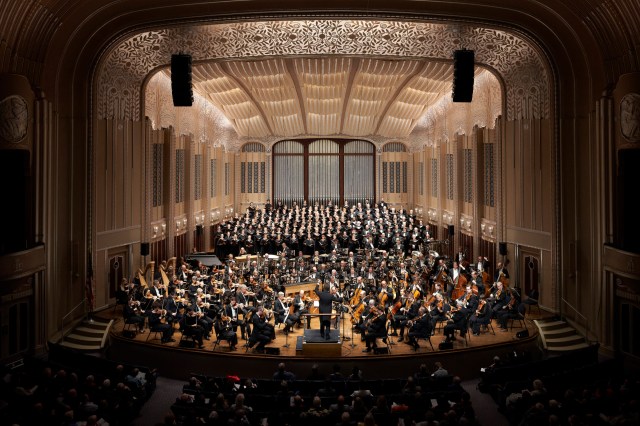
Jakub Hrůša and Cleveland Orchestra and choruses perform On the Transmigration of Souls. Photos credit Roger Mastroianni, Courtesy of The Cleveland Orchestra

In addition to large orchestra, chorus, and children’s chorus, the work makes extensive use of pre-recorded electronica, with an elaborate array of speakers wrapping the hall in surround sound. Ambient sounds of the city opened the piece, initially sounding as business as usual, but quickly giving way to sirens and boy’s repeated incantation of “missing.” The choir entered, ethereal and wordless, and strident trumpet solo was heard from an offstage Michael Sachs. It’s a daunting task to adequately capture the emotions of this subject matter in music, and to that end, Adams took pains to eschew any conventional notions of a requiem, instead producing a work with almost no narrative structure, allowing for a multitude of individual responses to its entrancing and mournful solemnity.

Particularly poignant were the recordings of brief tributes to certain victims – one who was described as having “a voice like an angel”: and such a voice we were to hear in the subsequent Mahler. About two-thirds of the way in came a caustic climax, and one could viscerally feel the weight of the events of that day. I would suggest another parallel to Mahler in that it follows a similar arc to the first movement of the Tenth Symphony, spanning roughly the same length, and of autumnal feeling until the shattering crest at about the same point. The music waned, especially doleful as names were read, and matters faded once again into the fabric of the cityscape.

Mahler’s Fourth Symphony has been called the most Viennese of his symphonies, following a more traditional four movement structure and of modest proportions in length and orchestration (by Mahler’s standards, at least). It’s a piece thus particularly well-suited to this orchestra, noted for their classical precision and balance as well as a strong Mahler tradition – and documented in a noted recording of this symphony with Pierre Boulez. The sleigh bells that opened made for a fantastical, almost fairy-tale like atmosphere, countered by graceful strings. The apparent naïveté ran only surface-deep, however, with Hrůša probing beyond its appealing veneer. The winds were in fine form, especially principal flute Joshua Smith, bright and bucolic, and the trumpets hinted at what would become the iconic opening of the Fifth. The more impassioned sections could have benefited from greater clarity, but there was a wonderful moment of serenity before the movement’s boisterous end.

Announced by the horns, the second movement was rooted in the ländler, but as through a distorted lens. Concertmaster Peter Otto coarsely played a detuned violin, emulating a folksy fiddle, and Daniel McKelway’s contributions on the clarinet were shrill yet stylish. The ensuing Ruhevoll opened in a divine simplicity, the strings of the orchestra playing with the intimacy of a quartet. In his pre-concert lecture, Bryan Gilliam keenly noted that Mahler created a nostalgia for a world that never was. The brass were particularly warm in the climactic opening of heaven’s gates, with the strings reaching higher and higher, grounded by the angelic harp. A silky clarinet marked the finale, introducing soprano Joélle Harvey, who previously sang Mahler with this orchestra in last season’s performance of the Second. Her limpid and fluid voice offered the Wunderhorn setting much character, closing each stanza with a profundity that gave weight and authenticity to this child’s depiction of heaven.

151728-clo111419-390-credit-roger-mastroianni-courtesy-of-the-cleveland-orchestra
Joélle Harvey in Mahler’s Fourth Symphony

An unexpected Severance Hall debut yields appealing results

Cleveland Orchestra
Klaus Mäkelä, conductor
Augustin Hadelich, violin
Severance Hall
Cleveland, OH
October 17, 2019

Messiaen: Les Offrandes oubliées
Prokofiev: Violin Concerto No. 2 in G minor, Op. 63
 Encore:
 Tárrega: Recuerdos de la Alhambra
Beethoven: Symphony No. 7 in A major, Op. 92

Following the cancellation of Jaap van Zweden, the weekend’s Cleveland Orchestra concerts found a substitute in the shape of the youthful Finnish conductor Klaus Mäkelä, poised to become chief conductor of the Oslo Philharmonic next season. Thursday counted as Mäkelä’s Severance Hall debut, having first conducted TCO at Blossom just a few months ago. Van Zweden’s program stayed intact save for the originally slated opener of Louis Andriessen’s Agamemnon, which hopefully can be revisited in a future season. When faced with a last-minute program change, most orchestras would opt for the familiar, but not so for TCO who turned attention to Messiaen’s Les Offrandes oubliées.

Makela_17-04-25_067c_A4
Klaus Mäkelä, photo credit Heikki Tuuli

Dating from 1930, Les Offrandes oubliées is the composer’s first published orchestral work (a piano transcription would follow the next year). Structured as triptych in evocation of the trinity, the plaintive opening was almost monastic in its austerity. The central section contrasted in every way, often violent in intensity, and time stood still in the glacially-paced final panel, entranced in spiritual contemplation – even in spite of the particularly vociferous army of coughers present in Thursday night’s audience.

Violinist Augustin Hadelich was also making his Severance Hall debut, having performed with this orchestra a handful of times at Blossom since 2009. Prokofiev’s Violin Concerto No. 2 shows the composer at his most lyrical, beginning unaccompanied with a winding and rather unsettling lyricism emanating from Hadelich’s “Ex-Kiesewetter” Stradivarius. The orchestra supported him via a colorful accompaniment, with Hadelich in deft balance, always achieving a clear projection. The central slow movement features one of Prokofiev’s most lush and lovely melodies, so different from the motoric and mechanistic works of his youthful years as an iconoclastic firebrand. Near the movement’s end was a striking role reversal wherein Hadelich offered a pizzicato accompaniment to buttress the orchestra’s lyricism. The foot-tapping finale was given with a driving vigor, its dance inflections heightened by the use of castanets, also a nod to where the concerto received its 1935 premiere: Madrid. Hadelich’s encore continued the Spanish thread with a transcription of Tárrega’s Recuerdos de la Alhambra, the rapid repeated notes of mesmerizing effect.

The finale of the Prokofiev also dovetailed neatly with the closing Beethoven: none of Beethoven’s works invoke dance as much as the Seventh Symphony, which Wagner famously called “the apotheosis of the dance.” The introduction, the longest of any of the Beethoven symphonies, was given with marked weight in hinting at all that was to come. Rhythmic fragments were introduced, eventually coalescing into the movement proper’s thematic material, heralded by principal flute Joshua Smith. Featherlight textures danced, soon to be countered by the might of the full orchestra. The principal winds were all in fine form, the leading force of the orchestra’s seemingly boundless reserves of energy.

Mäkelä rightly conducted the Allegretto not as a funereal dirge, but in emphasizing its songful beauty, with matters solemn and often awe-inspiring. Rambunctious strings took flight in the scherzo, contrasted by the gleaming brass of its trio. The energy was cranked up yet another notch for the finale, taken at a brisk, uncompromising tempo. An all-around strong showing from a talented young conductor.

Welser-Möst and Cleveland Orchestra deliver an imposing Mahler 5

Cleveland Orchestra
Franz Welser-Möst, conductor
Severance Hall
Cleveland, OH
September 26, 2019

Neuwirth: Masaot/Clocks Without Hands
Mahler: Symphony No. 5 in C sharp minor

A Mahler symphony is, virtually by definition, an evening’s worth of music in its own right. While including another work on the same program can feel all but gratuitous, a thoughtful choice can offer illuminating possibilities. This was the case Thursday night, with Welser-Möst pairing Mahler’s Fifth Symphony with a work by Austrian compatriot Olga Neuwirth. Welser-Möst has a keen ear for identifying compositional talent from his home country by names otherwise little known this side of the Atlantic. Neuwirth proved to be another such discovery, a composer The Cleveland Orchestra has touched just once before in a 2004 performance of locus…doublure…solus, also under Welser-Möst’s direction.

CLO092619_388
Nathaniel Silberschlag, Franz Welser-Möst, and The Cleveland Orchestra in Mahler’s Fifth. Photos credit Roger Mastroianni, Courtesy of The Cleveland Orchestra

The intriguingly titled Masaot/Clocks Without Hands was originally commissioned by the Vienna Philharmonic for the 2011 centenary of Mahler’s death. Saddled with other projects, Neuwirth delayed composition until 2013-14, and noted that the primary inspiration came from a dream about a grandfather she never met. Nonetheless, the spirit of Mahler runs through the work abundantly. The first part of the title comes from the Hebrew work for “journey”; Neuwirth further depicted a central image of a river that connects disparate groups of people on its long journey to the sea. In that regard, I was reminded of Stromab by Johannes Maria Staud – another work by a contemporary Austrian depicting a river which Welser-Möst fittingly paired with a Mahler symphony two seasons ago.

The work began barely audibly, almost unrecognizable as acoustic sound, but soon erupted into cacophony. Stark contrasts and sharp juxtapositions dominated the bulk of the texture, certainly bringing to mind Mahler’s eclecticism. There was colorfully prominent writing for the celesta, and other passages vaguely brought to mind Jewish folk music, appropriate given the Hebrew title. The woodblock served as a ticking clock – sometimes the only instrument playing – yet by the work’s end, high in the stratosphere, any semblance of time had all but dissolved, hence the titular “clocks without hands.” As a sidenote, the orchestra is bringing the program to Carnegie Hall next week, but replacing the Neuwirth with Widmann’s Trauermarsch – another choice pairing, with the piece directly inspired by the namesake opening movement of Mahler’s Fifth.

The bold, declamatory trumpet of Michael Sachs made for an imposing beginning to the Mahler, even as the music morphed into a doleful lament in the strings. The glacial dirge crested to powerful climaxes, but ultimately withered away at movement’s end. A motoric intensity marked the ensuing Stürmisch bewegt, filled with biting ironies. The sun was nonetheless eventually allowed to shine through, and quite brilliantly in a powerful chorale, but only for a fleeting moment as darkness ultimately prevailed. A massive scherzo serves as the symphony’s centerpiece; some commenters have likened it to a horn concerto given its extended solos for that instrument. This was taken quite literally with newly appointed principal horn Nathaniel Silberschlag standing front and center – a supreme test of his mettle, and quite an initiation to this orchestra. His gleaming tone surmounted the challenges presented, and I look forward to hearing more from him.

A scherzo to end all scherzos, the movement is something of hybrid between the vigor of Beethoven’s and the tragedy of Chopin’s, offering some lighter contrast to the rest of the work but not without eschewing its monumentalism. Shrill clarinets added splashes of color, and the wistful pizzicato strings were particularly lovely. The Adagietto unfurled as a divine love song, strikingly scored for strings and harp alone. Welser-Möst’s tempo choice was prime, sumptuous but not indulgent. Matters grew rapturously passionate before quietly fading. A sunny horn call marked the closing Rondo-Finale, quite a shift in texture and character. This was hardly a straightforward rondo, not in the least for the contrapuntal intricacies, performed with crystalline clarity. The chorale theme first introduced in the second movement returned, as if being reunited with an old friend. This time, however, it flourished unencumbered for an unambiguously glorious ending.

CLO092619_662


Halls leads Cleveland Orchestra in moving Mozart mass

Cleveland Orchestra
Matthew Halls, conductor

Joélle Harvey, soprano
Krisztina Szabo, mezzo-soprano
Paul Appleby, tenor
Michael Sumuel, bass-baritone
Blossom Festival Chorus
Lisa Wong, director

Severance Hall
Cleveland, OH
August 2, 2019

Mozart: Mass in C minor, K427, Great

The Blossom Festival Chorus had one chance to shine during the Summers@Severance series this year, and they more than made it count in Friday’s performance of Mozart’s Mass in C minor. Mozart perplexingly never completed the Mass (and unlike the case of the also incomplete Requiem, he lived for nearly another decade), yet even its fragmentary state, it remains an undisputed masterwork. Several attempts have been made to complete the work, but conductor Matthew Halls opted for the extant torso in a performing edition by Helmut Eder.

Matt-Halls-41-1024x683
Matthew Halls, photo credit Jon Christopher Meyers © Oregon Bach Festival

A weighty pathos, buttressing the epithet Great, was to be had from the onset of the Kyrie. The force of the chorus was quickly introduced, countered by the delicate beauty of soprano Joélle Harvey’s voice (in a passage I cannot dissociate from a memorable scene in Amadeus). A powerful response from the chorus was elicited. Tenor Paul Appleby introduced the Gloria unaccompanied as if to announce the commanding fugue, a rather glorious affair bearing a more than passing resemblance to Handel’s Hallelujah chorus.

Mozart wrote the work with his soprano wife Constanze in mind, and consequently there exists a bounty of wondrous writing for the two soprano soloists – and Krisztina Szabo’s flexible instrument was up to the vocal acrobatics in the “Laudamus te”. Crisp dotted rhythms during “Qui tollis” were emblematic of Halls’ tight direction, and there the choral passages were of a tragic beauty that foreshadowed the Requiem. The closing “Cum Sancto Spiritu” beamed in its contrapuntal splendors, anchored by an imposing bass line in the trombone.

The booming bass-baritone of Michael Sumuel opened the Credo just as Appleby did in the Gloria. “Et incarnatus est” was a highlight in its delicate orchestrations, with fine contributions from the principal winds, strings, organ, and Harvey’s limpid vocals. An ebullient and brassy Sanctus led to the prematurely closing Benedictus, the only time vocal quartet were scored together – one only wished there were more opportunities for the ensemble to explore their obvious chemistry.

From Scandinavia to Italy, Cleveland Orchestra closes season in colorful travelogue

Cleveland Orchestra
Franz Welser-Möst, conductor
Simon Keenlyside, baritone
Severance Hall
Cleveland, OH
May 23, 2019

Grieg: Morning Mood, The Death of Åse, and At the Wedding from Peer Gynt, Op. 23
Sibelius: Kaiutar, No. 4 from Six Songs, Op. 72
Sibelius: Illale, No. 6 from Seven Songs, Op. 17
Sibelius: Aus banger Brust, No. 4 from Six Songs, Op. 50
Sibelius: Svarta rosor, No. 1 from Six Songs, Op. 36
Sibelius: Kom nu hit, död!, No. 1 from Two Songs for Shakespeare’s The Twelfth Night, Op. 60
Sibelius: Im Feld ein Mädchen singt, No. 3 from Six Songs, Op. 50
Sibelius: Die stille Stadt, No. 5 from Six Songs, Op. 50
Sibelius: Var det en dröm?, No. 4 from Five Songs, Op. 37
Strauss: Aus Italien, Op. 16

Franz Welser-Möst and The Cleveland Orchestra closed the 2018-19 season in an alluring program, with all selections stemming from the late 19th-century (and in to the early 20th), connected by Romantic fascinations from awe-inspiring destinations to drama and poetry. Beginning the evening were selections from Grieg’s incidental music to Peer Gynt. Welser-Möst culled his own suite of three excerpts rather than opting for either of the two suites the composer later produced. The selections were performed in reverse order of appearance in the source material, opening with the familiar Morning Mood (which serves as the prelude to Act 4). Silvery flutes beckoned the morning, with the songful theme passed around the woodwinds before appearing in the strings. Welser-Möst’s brisk tempo ensured matters were never sentimentalized. Lush and mournful strings made The Death of Åse the emotional crux, easily a precursor to Barber’s Adagio. At the Wedding (which opens the complete work) was given with vigor and joyous abandon. A more languorous theme was very finely played in turn by the principal winds while Wesley Collins’ offstage viola radiated folksy charm.

CLO052319__197_select
Simon Keenlyside and Franz Welser-Möst, photos credit Roger Mastroianni, Courtesy of The Cleveland Orchestra

On the heels of his lieder recital a few days prior, Simon Keenlyside returned for the evening’s centerpiece and highpoint – a helping of eight of the seldom-performed songs of Sibelius. The songs at hand were variously in Finnish, Swedish, or German, and in some cases orchestrated by Sibelius himself, others by contemporaries. Keenlyside brought out the lyrical qualities of the Swedish language in Kaiutar, with an orchestration that encouraged its fantastical, fairy-tale atmosphere. Crepuscular strings made Illale a true gem, and the next selection turned to German in a setting of Richard Dehmel’s Aus banger Brust. Dehmel’s poetry served as text for the likes of Strauss and Schoenberg, and Sibelius proved no less adept with the work’s acerbic dissonances and moving solo passages from concertmaster Peter Otto in faithful service of the text. Svarta rosor, a comparatively better-known quantity, was of robust lyricism and grand emotions, nearly operatic with an unforgiving close to boot.

Unlike the others all originally scored for voice and piano, Kom nu hit, död! came from a set of two Swedish settings of Shakespeare’s The Twelfth Night for voice and guitar, given a rather gloomy reading at present. The richness of Im Feld ein Mädchen singt could easily have been mistaken for Strauss, while Die stille Stadt – another Dehmel setting – maintained a remarkably surreal atmosphere, enhanced by ethereal sounds from the glockenspiel, harp, and high strings. The last selection, Var det en dröm?, displayed again Keenlyside’s keen ability to seamlessly switch languages, and brought matters to a passionate, satisfying close, feeling almost as if these eight otherwise disparate songs were conceived as a unified cycle.

Strauss’ Aus Italien drew inspiration from an Italian journey undertaken by the composer as an impressionable youth, and became the first entry in his great series of tone poems. It’s an immature work to be sure, yet many Straussian hallmarks are already firmly in place, setting the stage for the musical revolutions that would soon be flowing from his pen. This was certainly apparent in the opening Auf der Campagne which could only have been written by Strauss, with elemental beginnings burgeoning into material larger than life. Brassy passages were of arresting vigor, although otherwise matters in performance weren’t entirely polished, sounding as if some extra rehearsal time was needed – no doubt, I suspect, ironed out by the Saturday performance.

Rather than the single-movement architecture of the successive tone poems, Aus Italien was conceived far less cohesively as four distinct portraits. In Roms Ruinen followed suit, generally lighter fare of Italianate charm interspersed with more solemn moments in awe of the eponymous ruins. Strauss’ idiomatic orchestral effects certainly began to crystallize in Am Strande von Sorrent, a coloristic painting of the sun-drenched coast of Sorrento. The closing Neapolitanisches Volksleben marked the work as a foreigner’s less than reliable view of Italy in that Strauss mistook a popular tune of the day for bone fide Neapolitan folk music (I was somewhat reminded of the All’Italiana movement from the Busoni piano concerto heard earlier this season – though there the composer was no foreigner, it too juxtaposed Italianate folk melodies in the context of an otherwise very Teutonic musical language). In any case, matters were nonetheless of an infectious joie de vivre, banal yet so colorfully orchestrated. The orchestra’s committed playing heightened one’s interest: ultimately the rewards were mixed, though the players on stage made as strong a case as they could in this vintage work displaying the budding composer’s incipient genius.

CLO052319__039_select
Franz Welser-Möst and The Cleveland Orchestra in Aus Italien