
Cincinnati Symphony Orchestra
Robert Moody, conductor
Renée Fleming, soprano
Rod Gilfry, baritone
May Festival Chorus
Matthew Swanson, director
Springer Auditorium
Music Hall
Cincinnati, OH
May 22, 2025
Vaughan Williams: Serenade to Music
Stravinsky: Symphony of Psalms
Puts: The Brightness of Light
This year’s edition of the Cincinnati May Festival featured the incomparable Renée Fleming as Festival Director, affording her the opportunity to curate a diverse selection of repertoire across the festival’s eight-day span. The penultimate program was anchored by Kevin Puts’ ambitious 2019 work The Brightness of Light, starring Fleming alongside baritone Rod Gilfry.
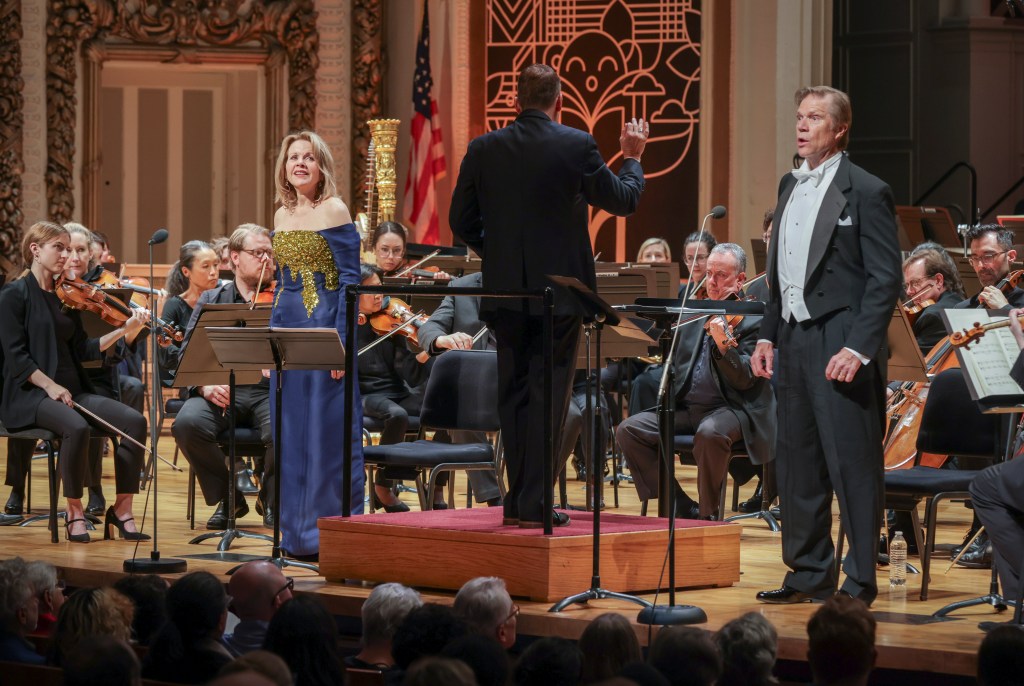
The 45-minute conception chronicles the relationship of Georgia O’Keefe and Alfred Stieglitz — from agent to lovers to married couple, closing at O’Keefe’s final years as a widower in the solitude of the American Southwest. Giving the performance a multimedia dimension, projections by Wendall Harrington featured O’Keefe’s art alongside photographs of the couple through the years. The texts were extracted from the vast trove of letters they exchanged, beginning as professional correspondence that quickly turned to love letters.
Therein lies the fundamental challenge with the work, however, as texts of letters rarely provide the best material for vocalists. Poetic as they sometimes were, matters often veered more discursive and verbose. Nonetheless, Fleming and Gilfry captured the essence of their respective characters, painting a largely sympathetic portrait of these enigmatic figures via this epistolary drama. Puts’ musical language isn’t particularly groundbreaking, but remains appealing and approachable, somewhat reminiscent of the mid-century American composers — and thus stylistically contemporary with the two protagonists. Puts called for a large orchestra, and the Cincinnati Symphony supported the singers with aplomb. The composer exploited the orchestra’s colorful potential, as if expressing the colors of an O’Keefe painting in musical terms. Marshaling these forces was conductor Robert Moody, gracefully stepping in as a last-minute substitute for Juanjo Mena.
O’Keefe was quoted in saying that her first memory “is of the brightness of light, light all around,” hence the work’s title and the text with which it began, tenderly intoned by Fleming. The beginning of their correspondence was of playful, innocent humor, but the tone shifted in “A Soul Like Yours,” wherein gentle touches in the piano and violin gave to way to some deeply impassioned singing from Gilfry. Orchestral interludes served as key inflection points, underscoring the importance of the orchestra to the piece despite the top-billing of the two operatic legends — and I wonder if there’s the potential to extract a standalone orchestral suite.
I particularly liked the twang of the violin to mark the transition to the Southwest, and exploring the ups and downs of this relationship yielded musical variety. Matters culminated with the fittingly valedictory “Sunset,” pensive and reflective, a touchingly beautiful use of Fleming’s voice. Despite the work’s sincerity and the strength of this performance, ultimately I left Music Hall with mixed impressions, but much credit nonetheless to the ambition of the performers and creative team.
The first half was comprised of two shorter works that featured the May Festival Chorus, beginning with Vaughan Williams’ Serenade to Music. Luminous sounds blanketed the hall with the beauty of the harp and strings, and the tender voices of the chorus were a meditation on music itself. Serene and with arching lyricism, it made for the loveliest of openers.
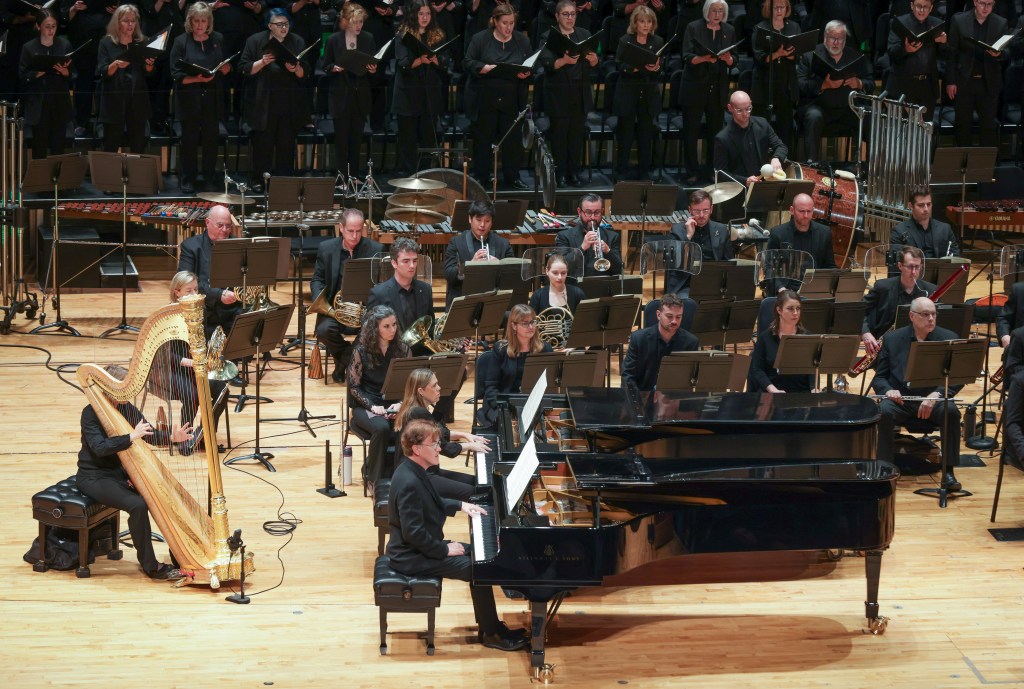
Written in 1930 on a Koussevitsky commission for the fiftieth anniversary of the Boston Symphony, the bristling neoclassicism of Stravinsky’s Symphony of Psalms sharply contrasted. The work sets a trio of psalms against a strikingly idiosyncratic orchestration that even called upon not one but two pianos. In his spoken remarks, Moody noted how it would later influence Orff’s Carmina Burana and Bernstein’s Chichester Psalms. Conducting without baton, Moody perhaps channeled his inner Pierre Boulez (who made a benchmark recording of the work with Berlin), imbuing each gesture with clarity and a strict sense of place.
Following a brassy close of the first psalm, the central selection began with a searching oboe solo, drawing richly contrapuntal textures given with severity and exactitude. Longer than the first two combined, the closing entry was a larger-scale conception with disparate elements seamlessly woven together, in due course arriving at a peaceful resolution.
 quasi-faust