Pollini in recital: magisterial Chopin

Maurizio Pollini, piano
Symphony Center
Chicago, IL
May 28, 2017

Chopin: Two Nocturnes, Op. 27
Chopin: Ballade No. 3 in A-flat Major, Op. 47
Chopin: Ballade No. 4 in F Minor, Op. 52
Chopin: Berceuse in D-flat Major, Op. 57
Chopin: Scherzo No. 1 in B minor, Op. 20
Chopin: Two Nocturnes, Op. 55
Chopin: Piano Sonata No. 3 in B Minor, Op. 58

Encores:
Chopin: Scherzo No. 3 in C-sharp minor, Op. 39
Chopin: Ballade No. 1 in G Minor, Op. 23

The music of Chopin has been inextricably linked to Maurizio Pollini virtually since the beginning of the pianist’s storied career.  Yet Pollini is a man who champions Boulez and Stockhausen just and much as Chopin or Beethoven, and accordingly, his Chopin tends to skirt flowery sentimentality in favor of precision and exactitude.  The results, however, are rarely dry and academic, instead forging a fresh interpretation wherein the composer’s Romantic and modernist propensities are held in an engaging duality, and one was eager to witness this approach in Pollini’s all-Chopin program that traversed a generous helping of the Pole’s major works.

ct-ent-0530-pollini-review-20170529-001
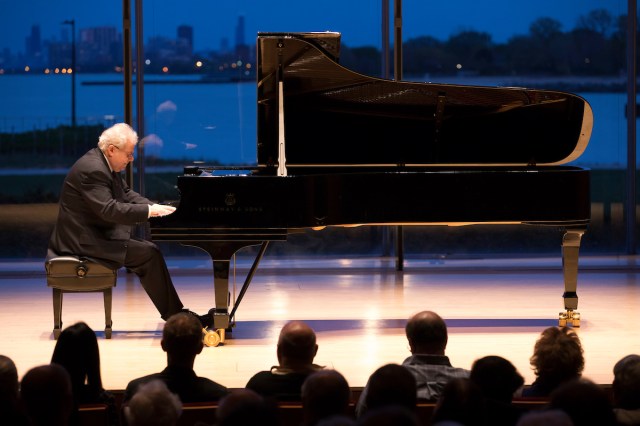
Maurizio Pollini at Symphony Center, photo credit Nuccio DiNuzzo
Both halves of the recital opened with a pair of nocturnes; the sterling examples from Op. 27 were chosen for the first half.  A songful, melancholic melody was emphasized in the C sharp minor, contrasted by a more animated middle section.  In the D flat major nocturne, Chopin’s indebtedness to the Italians was apparent in its graceful bel canto melodies, and Pollini proved that one need not be saccharine to convey genuine emotion.

The latter two of the magnificent ballades followed; the Ballade No. 3 in A flat major was joyous in its sprightly energy.  John Ogdon famously said of the Fourth Ballade that “it is unbelievable that it lasts only twelve minutes, for it contains the experience of a lifetime”.  A true testament to Chopin’s ambition, and Pollini – now at age 75 – imbued his performance with a lifetime of experience.  It opened with an intensely lyrical theme, yet the beauty of sound was often in a tenuous relationship with the work’s exacting counterpoint.  While one could carp that the articulation in the arpeggiated sections wasn’t on par with the legendary technique the pianist boasted in his younger days, it did little to detract from the ballade’s dramatic impact.  A chordal passage heralding the coda was beautifully voiced, the calm before the storm of its cataclysmic conclusion.

The Berceuse, brief as it may be, is a gem from Chopin’s late years.  Delicate and with a sense of fragility, Pollini gave a nuanced reading in its assiduously detailed ornamentation.  It was something of a respite before the tempestuous Scherzo No. 1 in B minor, opening with aggressive energy if somewhat marred by fitful prestidigitation.  There was a wistfulness to the central lyrical section, yet Pollini could have aspired to greater contrast by relaxing the tempo even further prior to the return of the main theme that inexorably leads to the work’s shattering coda.

In revisiting the soundworld of the nocturnes, the F minor work from Op. 55 introduced an elegant, pensive melody, later transformed into a ribbon of flowing triplets.  The following E flat major nocturne was marked by a melody over a rocking, widely spaced accompaniment, and a series of trills announced the resounding final chords.

Piano enthusiasts no doubt heard the Piano Sonata No. 3 in B minor at the beginning of the month in Emanuel Ax’s recital at Northwestern, and it was a welcome opportunity to hear another interpretation by a masterful performer.  The first movement was given a commanding opening, and characterized by an unsettling flux between the declamatory and the flowing.  Adding the sense of proportion of Chopin’s longest work for solo piano, Pollini obliged the repeat of the exposition.  The quicksilver scherzo had élan, while the slow movement was a gorgeous nocturne, erupting into an outpouring of arpeggios.  I had no qualms about Pollini’s technique in the finale, a whirlwind of drama.

A rapturous ovation acknowledged the patrician pianist’s legacy, and he responded in kind with two substantial encores.  The Scherzo No. 3 in C sharp minor was as impressive for its double octaves as for the stentorian chorales, punctuated by leggiero filigree.   And finally, the incomparable Ballade No. 1 in G minor, dark and brooding.
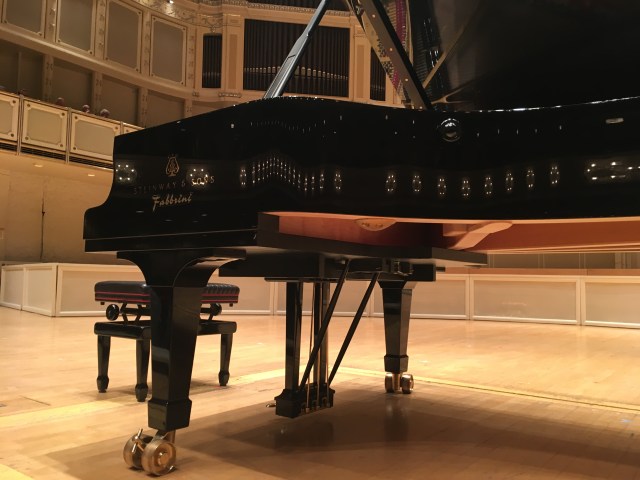
Fabbrini
Pollini’s Fabbrini Steinway at Symphony Center

Ax shows his lyrical gift in Schubert and Chopin

Emanuel Ax, piano
Mary B. Galvin Recital Hall
Evanston, IL
May 3, 2017

Schubert: Four Impromptus, D935
Chopin: Impromptu in A-flat major, Op. 29
Chopin: Impromptu in F-sharp major, Op. 36
Chopin: Impromptu in G-flat major, Op. 51
Chopin: Fantaisie-Impromptu in C-sharp minor, Op. 66
Samuel Adams: Impromptu No. 2, “After Schubert”
Chopin: Piano Sonata No. 3 in B Minor, Op. 58

Encores:
Chopin: Nocturne in F-sharp major, Op. 15 No. 2
Chopin: Waltz in A-flat major, Op. 34 No. 1

Awarded biennially since 2006, Northwestern’s Jean Gimbel Lane Prize in Piano Performance now claims a veritable who’s who of the piano amongst its laureates.  Each recipient spends time in residency on campus, working with music students and presenting a public recital, and 2016 winner Emanuel Ax closed this season’s Skyline Piano Artist Series Wednesday evening.  Ax presented one of his characteristically thoughtful programs, exploring the impromptu in sterling examples by Schubert and Chopin along with a new addition to the genre by Samuel Adams, rounded off by Chopin’s incomparable B minor piano sonata.

Emanuel Ax
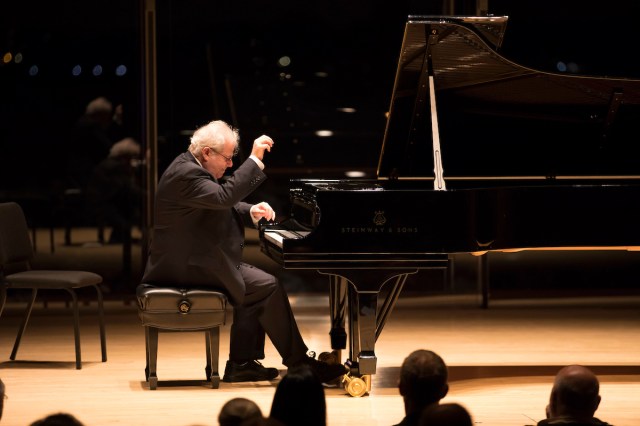
Emanuel Ax at the Galvin Recital Hall, all photos credit Todd Rosenberg
The evening opened with Schubert’s posthumously published set of Four Impromptus, D935 – and piano devotees will note that fellow Lane Prize winner Murray Perahia can be heard in the same work this Sunday at Symphony Center.  An arresting opening began the set, unsettling but calmed in due course by the legato thirds under Ax’s silken tone.  The sudden shifts to the minor gave the piece an unpredictable, mercurial quality, and Ax’s conception was spacious and improvisatory.  The second impromptu was characterized by an intensely lyrical chordal melody complemented by gracefully flowing interludes.  The theme of the B flat impromptu was of a charming refinement, but I felt Ax could have aspired to greater contrast in the ensuing set of five variations, even if the composer provided only one in the minor. While Ax’s sound was exquisite, it felt this was achieved through an unnecessarily cautious approach, and this was much the case in the final impromptu as well – while its folk-like, quasi-Hungarian melody certainly had fire, one still wanted a bit more heft.

Robert Schumann famously described Schubert’s D935 impromptus as a coherent if veiled sonata; Chopin’s four examples of the genre, however, are quite independent of one another, bearing little more in common than the rather vague title.  Nonetheless, Ax presented them as a suite, an interesting approach insofar as it juxtaposed works from various points in the composer’s life.  The Impromptu No. 1 in A flat major was highlighted by its songful middle section, and under Ax’s guidance the circuitous, labyrinthine coda felt entirely purposeful.  In the following work, the deeply felt music yearned and grew to great passions.  While it may be the least played of the Chopin impromptus, Ax made a strong case for the Impromptu No. 3 in G flat major in its arching, appealing melody.  Despite its late opus number owing to posthumous publication, the familiar Fantaisie-Impromptu is the earliest of the four, and Ax gave it an energetic workout with impressive prestidigitation.

The second half opened with a 2016 work of Samuel Adams which Ax himself commissioned, and the attention to Adams’ work is certainly topical as he currently serves as one of the two Mead Composers in Residence at the Chicago Symphony.  In concert with the theme of the first half, the work in question was the second of a set of three impromptus, this selection subtitled “After Schubert”.  As a whole the three are intended to be inserted between each of the D935 impromptus, drawing comparison to Brett Dean’s Hommage á Brahms, which Ax presented in a 2014 recital at Symphony Center, superimposed within Brahms’ Op. 119.  While it certainly would be interesting to hear the Adams in that fashion, No. 2 – a substantial piece, surpassing the 10 minute mark – functioned well independently (although I thought it would have been more logical to program it in between the Schubert and Chopin, and that way it would literally have been “after Schubert”).

Opening with quasi-Schubertian melodic fragments over a rippling accompaniment, it was as if one was experiencing distant, refracted memories of the Schubert impromptus, along with a perhaps more obvious invocation of the elder composer’s final B flat major piano sonata.  Cast in Schubert’s preferred ternary form, the middle section fared somewhat repetitive, but the brief return of the A section rounded off what was generally a very attractive piece.

Departing impromptu territory, Ax concluded the program with Chopin’s Piano Sonata No. 3 in B minor, and it was here he was at his finest.  The first movement was grand yet tautly structured, while the fleeting, quicksilver scherzo put the pianist’s dexterous fingers on full display.  The heart of the work is in the slow movement; its declamatory opening soon melted away into a divinely gorgeous nocturne.  Though filled with bravura runs and effects, the melody was never lost in the busyness of the finale which closed the work with enormous passion and drama.

The warm, enthusiastic reception brought Ax back to the keyboard for two encores, both by Chopin: an elegant account of the Nocturne in F sharp major, along with the Waltz in A flat major, stylish and buoyant.

Emanuel Ax

Hamelin explores the piano sonata in commanding Cleveland recital

Marc-André Hamelin, piano
Gartner Auditorium
Cleveland Museum of Art
Cleveland, OH
March 21, 2017

Haydn: Piano Sonata in C Major, Hob. XVI:48
Feinberg: Piano Sonata No. 1 in A major, Op. 1
Feinberg: Piano Sonata No. 2 in A minor, Op. 2
Beethoven: Piano Sonata No. 23 in F minor, Op. 57, Appassionata
Scriabin: Piano Sonata No. 7, Op. 64, Messe blanche
Chopin: Piano Sonata No. 2 in B flat minor, Op. 35

Encore:
Debussy: Reflets dans l’eau, No. 1 from Images, Book I

Marc-André Hamelin has built much of his reputation on fearless exploration of the byways of the piano repertoire, and his recital at the Cleveland Museum of Art – presented by the Cleveland International Piano Competition – was no exception, juxtaposing the familiar with the obscure.  All the works on the program bore the title “piano sonata”, although none adhered very closely to the standard model of the form, a true testament to the medium’s protean potential.  Hamelin delivered the program with his signature peerless technique, yet this was far from an evening of vapid virtuosity, but one of probing artistic discovery.

hame.lrg
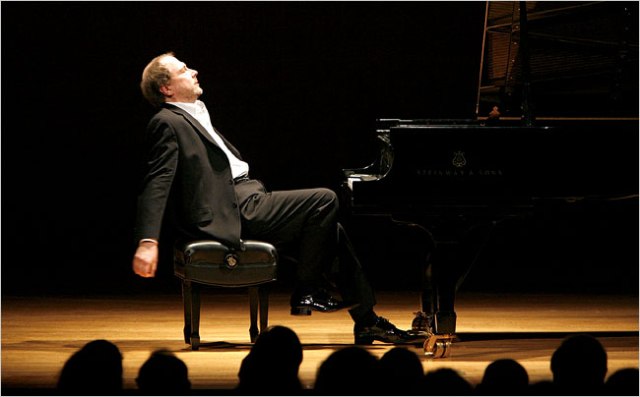
Marc-André Hamelin, photo credit Rachel Papo
The survey of piano sonatas appropriately began with Haydn, in the two movement C major sonata, Hob. XVI:48.  Given Hamelin’s association with the fingerbusting works of the 19th– and 20th-century, Hamelin and Haydn might sound like an unnatural fit, but as he as shown in his extensive recordings of the composer’s sonatas for Hyperion, it’s an inspired coupling to be sure.  From the onset, the performance was marked by deftly nuanced articulation and crisp ornamentation.  There were sporadic moments when matters felt a bit heavy-handed which lesser pedaling perhaps could have ameliorated, but overall this was a study in precision, replete with minor key excursions that foreshadowed Beethoven, and the all too brief finale exuded joie de vivre.

Certified rarities followed, the first two piano sonatas of the Russian composer and pianist Samuil Feinberg.  His cycle of twelve piano sonatas is a remarkable achievement, unjustly neglected, and Hamelin is rumored to be recording them.  These two sonatas, in A major and minor respectively, were of a similar aesthetic, the consecutive opuses hardly demonstrating Feinberg’s eventual compositional developments (both dating from 1915; the final sonata dates from 1962), yet Hamelin presented them with a singular intensity and an unflinching commitment to this little-known music.

The First Sonata was of a brooding Romanticism, while the dense textures would have sounded murky in lesser hands, Hamelin achieved a lucid clarity of voices, and delineated a clear trajectory in spite of the composer’s tendency to meander.  A touchingly lyrical melody characterized the Second Sonata, and a highpoint came in its dramatically cascading climax.

Beethoven’s mighty Appassionata is a recent addition to Hamelin’s concert repertoire; I’ve been eager to hear his take on this durable work, and he certainly didn’t disappoint.  The opening movement built to massive climaxes that carefully avoided bombast.  There was much-needed repose in the slow movement, enhanced by the adroitly voiced chordal melody, while the finale had an unrelenting nervous energy in its breathless race to the tragic end, given at a dangerously brisk tempo.

One of Hamelin’s first recordings of his long and fruitful association with Hyperion was of the complete Scriabin piano sonatas; the arresting Seventh Sonata is a work that has been in his fingers for a very long time.  Explosive and mercurial, the sonata proceeded with inevitability towards the trilling, mystical ending, shrouded in enigma.

Chopin’s B-flat minor sonata concluded the program, and in the passionate first movement Hamelin drew out a fluid melody over an undulating accompaniment.  He eschewed the repeat of the exposition, although in this case I would suggest the repeat is a wise interpretative choice given the movement’s proportions.  There was a menacing determination in the scherzo, while its middle section was indulgent in sumptuous melody, quintessentially Chopinesque.

No empty sentimentality was to be had in the tragic heights of the famous funeral march, and Hamelin had a velvet touch in the contrasting lyrical section.  His utter and absolute command of the keyboard was on full display in the moto perpetuum finale, yet phrases were keenly shaped to make the sonata’s revolutionary ending more than mere volleys of notes.

Hamelin obliged the modest but enthusiastic audience with an encore in Debussy’s Reflets dans l’eau, shimmering and liquescent.