Columbus Symphony closes season in the splendor of Mozart

Columbus Symphony Orchestra
Rossen Milanov, conductor
Aubry Ballarò, soprano
Hilary Ginther, mezzo-soprano
David Walton, tenor
James Eder, bass

Stephen Caracciolo, chorus director
Columbus Symphony Chorus

Ohio Theatre
Columbus, OH
May 24, 2024

Mozart: Mass in C minor, K427, Great (completion by Ulrich Leisinger)

For the final program of the 2023-24 Masterworks season, the Columbus Symphony offered a single work in a brief but affecting program, an evening dedicated to Mozart’s C minor mass. Like the Requiem, Mozart never completed the Mass, and the CSO presented the work in a 2019 realization by Ulrich Leisinger, which eschews a liturgically complete mass in favor of only minimal additions to Mozart’s extant corpus.
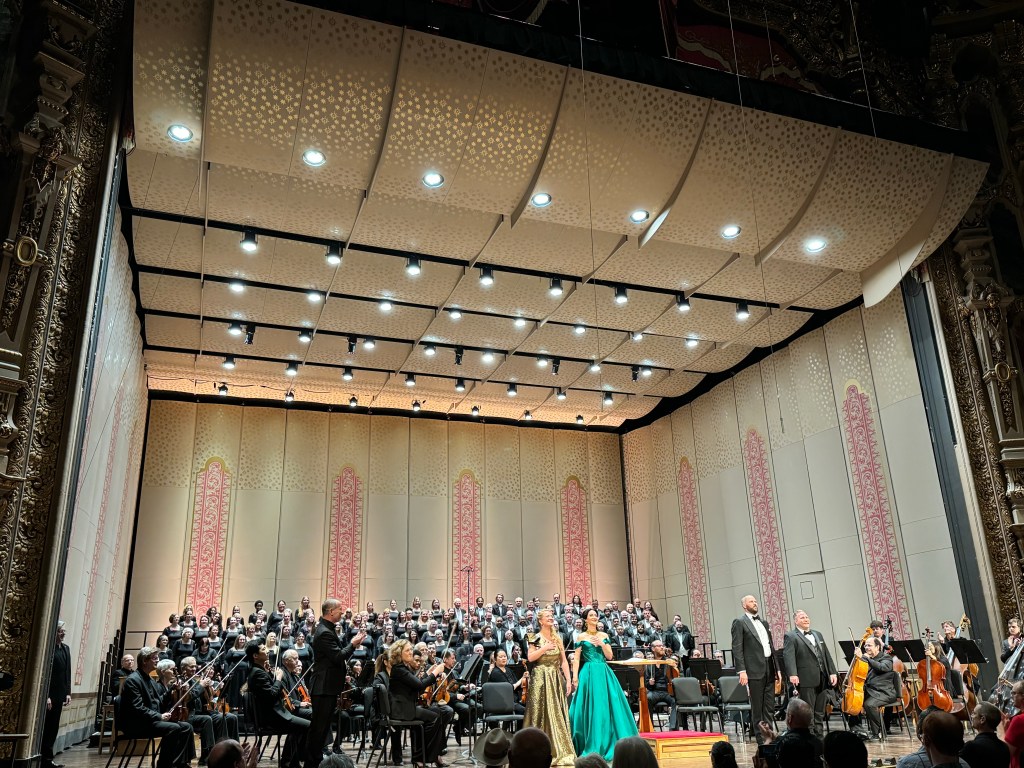
L-R: Rossen Milanov, Aubry Ballarò, Hilary Ginther, David Walton, and James Eder with the Columbus Symphony & Chorus

Under Rossen Milanov’s baton, the opening Kyrie began intimate and inward, quite striking for such a grandiose conception. Matters quickly grew in urgency, however, with the Chorus – prepared by Stephen Caracciolo – filling the cavernous Ohio Theatre. “Christe eleison” was intoned by soprano Aubry Ballarò, with flowing, extended melismas yielding a resonant effect – and I couldn’t help being reminded of the passage’s use in Amadeus.

The extensive Gloria began resplendent and exultant, structured such that the chorus alternated with the soloists, either as individuals or in various combinations. Hilary Ginther offered a second soprano voice in “Laudamus te,” articulate, and in command of the vocal intricacies, while “Dominus Deus” saw her in harmonious blend with Ballarò. In “Qui tollis,” the chorus was rapt and pious in the minor key profundities. The women were combined with tenor David Walton in “Quoniam,” the latter a bit overshadowed, and the final passage of the Gloria was given to the chorus, resplendent in its exacting counterpoint.

In the Credo, a soprano solo (Ballarò) prefaced an orchestral interlude, notable for fine playing from the winds. This was somewhat lighter fare compared to the preceding, but still certainly no trifle. The Sanctus was brightened by the brass – with the trombones especially striking – and the closing Benedictus was given heft with the sole appearance of bass James Eder, though it was the chorus who ultimately brought the work to its resonant close.
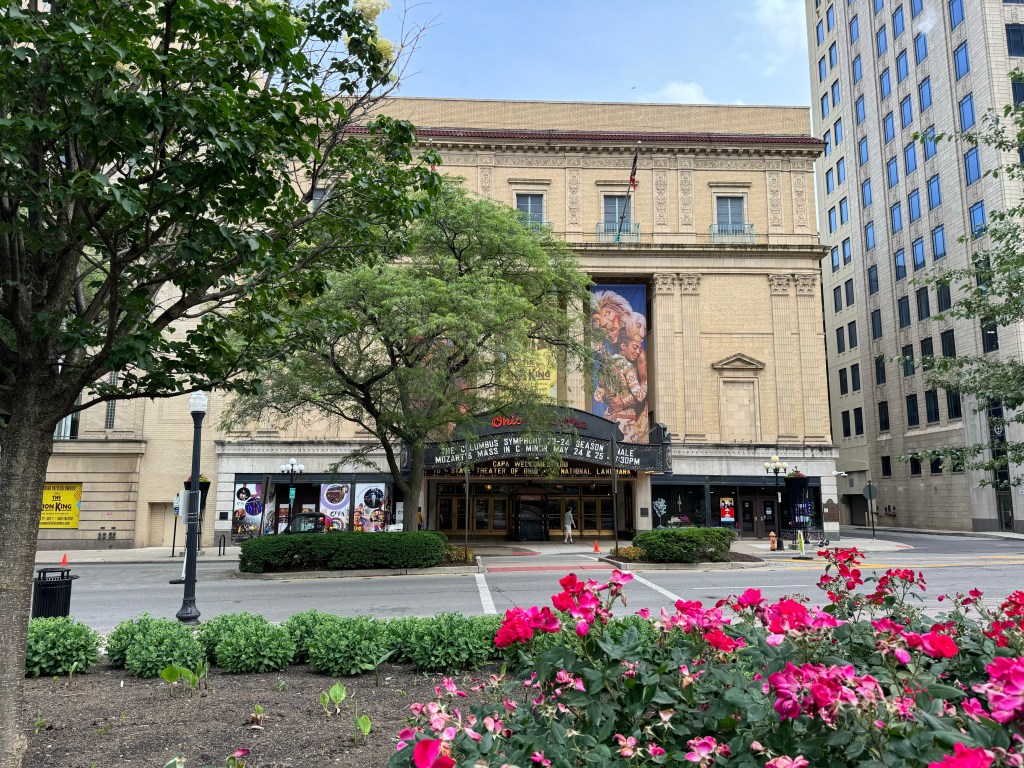

Ohio Theatre ahead of Friday’s performance

Columbus Symphony and Chorus riveting in Frank’s Conquest Requiem

Rossen Milanov, conductor
Columbus Symphony Orchestra

Jessica Rivera, soprano
Andrew Garland, baritone
Stephen Caracciolo, chorus director
Columbus Symphony Chorus

Ohio Theatre
Columbus, OH
November 17, 2023

Beethoven: Symphony No. 6 in F major, Op. 68, Pastoral
Frank: Conquest Requiem

Ahead of the Thanksgiving holiday, the Columbus Symphony offered a substantial program of two highly contrasting works, spaced apart by two centuries: Beethoven’s Pastoral Symphony and a recent work of Gabriela Lena Frank, the latter of which engaged the chorus and a pair of vocal soloists.

Music director Rossen Milanov opened the Pastoral at a relaxed tempo, drawing reserves of resonant sound out of the CSO. A bucolic scene was painted by the slow movement with its graceful, gentle melody inflected by elegant ornamentations. Dialogue between the winds and strings was well-executed, as was the pictorial series of bird calls. A folksy and charming movement followed, quite literally the calm before the storm which offered dark and tumultuous contrast, while the finale calmed matters in its hymn-like paean, some foibles in the horns notwithstanding.

Jessica Rivera, photo credit Tina Gutierrez

An ambitious programming choice occupied the reminder of the program, namely Gabriela Lena Frank’s 2017 Conquest Requiem. Written on commission from the Houston Symphony, it’s a work that has subsequently only been heard in Nashville and Boston ahead of last weekend’s Columbus premiere. The work is concerned with the Spanish conquest of the Aztec empire, and thus functions as a requiem for lost culture. With the broad framework of the Latin requiem mass informing the underlying structure, parts for the vocal soloists were variously in Nahuatl and Spanish – it was regrettable the program books didn’t include the full text by librettist Nilo Cruz, which may be viewed here. The clash of cultures is perhaps a natural subject for Frank, mirroring her own diverse background, inclusive of Chinese, Jewish, Eastern European, Peruvian, Spanish, and Quechua ancestry.

Soprano Jessica Rivera embodied the role of Malinche, an enslaved Nahua woman and mistress of Cortés, with whom she bore a son Martín, sung by baritone Andrew Garland. Both soloists were also engaged for the Houston premiere, and it was clear by the urgency and persuasion of their performances that this is a work they emphatically believe in. A descending gesture opened, with the solemn chorus a present force nearly from the onset, offering the Latin requiem text as a layer of the work’s rich tapestry. Interwoven with the requiem text were the soloists’ exclamations, beginning with Malinche who sang initially in Spanish. Rivera was both impassioned and conflicted, capturing the straddling of cultures.

Frank made effective use of a large orchestra – with some particularly striking scoring for percussion – in a musical language that was approachable without being derivative, especially evident in the strident and rousing Judex ergo or the chilling setting of the Dies irae that followed, wherein Garland introduced Martín with conviction. Material for strings and harp was an orchestral highlight, a calming passage before Rivera sang of Malinche’s inner turmoil in an agonizing climax. A duet saw the soloists blend their voices harmoniously, with the thought-provoking work landing on a plaintive if inconclusive Amen.