Springfield Symphony Orchestra Peter Stafford Wilson, conductor Sarah Chang, violin Kuss Auditorium Clark State Performing Arts Center Springfield, OH January 27, 2024
Martinů: Overture for Orchestra, H345 Bruch: Violin Concerto No. 1 in G minor, Op. 26 Schubert: Symphony No. 4 in C minor, D417, Tragic
Saturday evening’s Springfield Symphony performance was highlighted by a concerto appearance from star violinist Sarah Chang. Before Chang took to the stage, the SSO offered a rather less-familiar score in Bohuslav Martinů’s Overture for Orchestra. An ebullient and effective opener, its festive nature was conceived in celebration of the Mannes College of Music where the composer had taught some years prior. Martinů favored chamber-like subsets of the full orchestra, invoking the Baroque concerto grosso. Concertmaster Sujean Kim offered some fine solo passages, and a serene central section contrasted the overture’s outward ebullience.
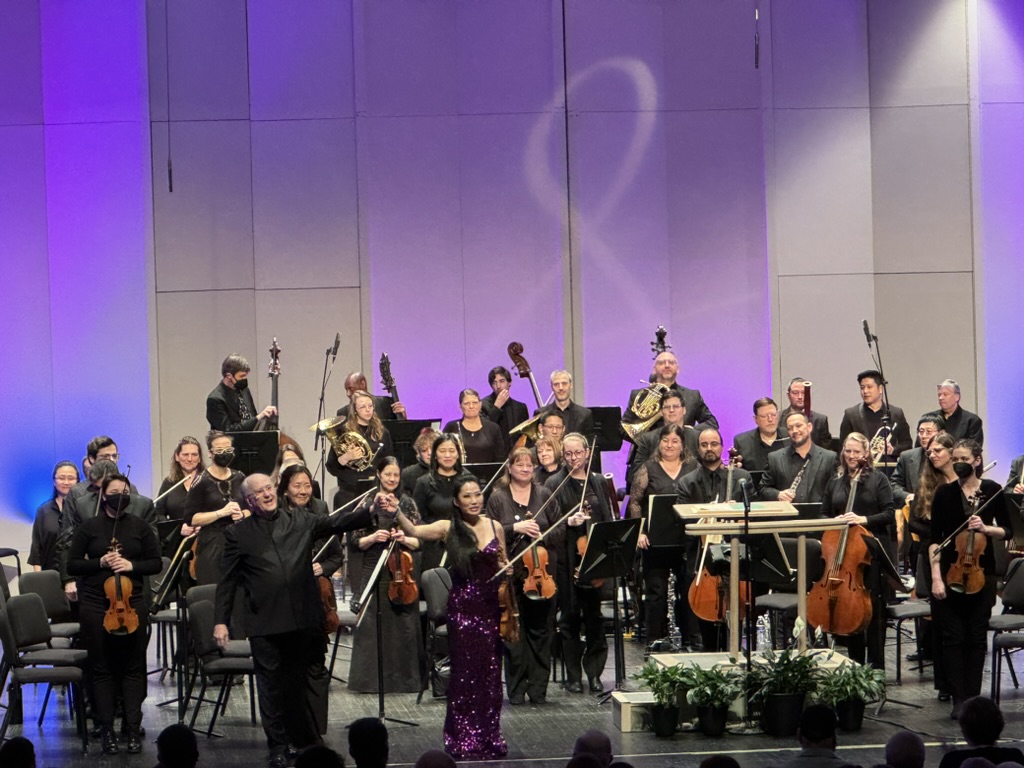
Peter Stafford Wilson, Sarah Chang, and the Springfield Symphony Orchestra
Chang came to Springfield armed with Bruch’s Violin Concerto No. 1, a work which she notably recorded with the great Kurt Masur. She opened with a melodic line articulate and emotive, and one was taken by the supreme purity of her tone, utterly controlled. A long-breathed melody marked the central slow movement, richly resonant and almost without break for the soloist, save for a swelling orchestral interlude; here and elsewhere the SSO generally supported their distinguished colleague with fine accompaniment.
The jocular acrobatics of the finale were exciting to watch but never just for show, and with the music being all but second-nature to Chang, it flowed organically from her bow. In a fascinating tidbit, music director Peter Stafford Wilson mentioned that Isaac Stern once played this same concerto with the SSO – and likely on the very same instrument heard Saturday, now in Chang’s possession.
The program concluded with Schubert’s Fourth Symphony. Its thunderous opening gave way to a measured introduction, and movement’s main theme was given with crisp articulation – though one wanted perhaps a bit more tension and cleaner intonation. The Andante served as a lyrical moment of repose, elegantly played, before the sprightly minuet and energetic finale – ending, like Beethoven’s C minor symphony before him, triumphantly in the major.
ProMusica Chamber Orchestra David Danzmayr, conductor Simone Porter, violin Southern Theatre Columbus, OH October 7, 2023
Simon: Fate Now Conquers Bruch: Violin Concerto No. 1 in G minor, Op. 26 Beethoven: Symphony No. 2 in D major, Op. 36
ProMusica Columbus opened its 45th season with what they do best: a work by a contemporary composer, a concerto with a star soloist, and a cornerstone symphony. Beginning the evening was Carlos Simon’s 2020 piece Fate Now Conquers. Since being premiered by the Philadelphia Orchestra, it’s a work that has quickly made rounds from ensembles across the country (I caught a performance in Indianapolis just about a year ago). The work is an homage to Beethoven, suggesting the harmonies of the Seventh Symphony’s Allegretto, and moreover, its title alludes to a passage from Homer’s Iliad which Beethoven had quoted in his diary.
Simone Porter and David Danzmayr with ProMusica, photo credit ProMusica
Terse, motivic gestures in lieu of singable melody marked the piece, very much à la Beethoven. There was a singular rhythmic drive that purveyed a Beethovenian fury, briefly countered by a lyrical cello before its forceful end – certainly packing a punch in a mere 5-minute duration. Bruch’s evergreen Violin Concerto No. 1 in G minor was vividly brought to life by the talents of Simone Porter. A plaintive, longing orchestral passage set the stage for the violin’s entrance; one was struck by Porter’s burnished tone from the onset, articulate and projected with assuredness. In the stately Vorspiel with which the concerto began, Porter made the technical demands look all but effortless, and conductor David Danzmayr offered an orchestral accompaniment that had just the right spark.
This opening prelude served as preparation for the heart of the work, a lyrical and languid Adagio – one hardly wanted this moment of serenity to end. The sprightly finale resided at the other end of the spectrum, however, given with verve and vivacity, and its Hungarian inflections recalled the finale of Brahms’ violin concerto – heard at ProMusica last season.
In his prefatory remarks, Danzmayr suggested a possible thematic connection between Simon’s Fate Now Conquers and Beethoven’s Second Symphony in that the latter was composed at a time when Beethoven was profoundly grappling with fate, as documented in the heart-wrenching Heiligenstadt Testament. In any case, this early entry in Beethoven’s symphonic corpus was marked by a broad introduction that gave way to buoyant theme – airy and joyous, but not without without an underlying sense of drama not far beneath the surface. Though his maturity as a symphonist began with the Eroica, the present work’s expansive and exploratory development made the case that it can’t be dismissed as merely imitative.
A graceful and delicate Larghetto countered, a finely detailed – a few brass flubs notwithstanding. The witty scherzo showed a certain indebtedness to Haydn, though I found Danzmayr’s tempo a bit brisk; I suspect a bit more breathing room wouldn’t have diminished the drama. The finale was as playful and high spirited as anything Beethoven wrote: it was mentioned that ProMusica recently acquired a new set of timpani modeled after those used in Beethoven’s time, and here they resounded to great effect.
Cleveland Orchestra
Semyon Bychkov, conductor
Katia Labèque, piano
Marielle Labèque, piano
Severance Hall
Cleveland, OH
May 9, 2019
Glanert: Weites Land, Musik mit Brahms
Bruch: Concerto for Two Pianos, Op. 88a
Encore:
Ravel: Le jardin féerique, from Ma mère l’Oye
Smetana: Vyšehrad, Vltava, and Šárka from Má vlast
The Cleveland Orchestra certainly has a knack for presenting programs that resist the tried-and-true, and Thursday’s concert was no exception, another triumph of imaginative programming with both works on the first half receiving their inaugural performances from this ensemble. Guest conductor Semyon Bychkov has championed the works of contemporary composer Detlev Glanert, and opened the evening with the US premiere of the 2013 work Weites Land. Roughly translating to English as Wide Open Land, the work also bears the subtitle Musik mit Brahms. Like Brahms, Glanert hails from Hamburg, and the work of the elder composer has often served as his guiding light – here quite patently so, with the arching primary theme of the Fourth Symphony serving as the present work’s structural backbone. An obvious invocation of the symphony opened, familiar for a fleeting moment, then morphing into dissipated modernity. The Brahms theme served as guideposts at various intervals, while the wide, open spaces between were filled with colorfully dissonant filigree, often unexpected yet still approachable, and ultimately a brief Brahmsian gesture brought matters to a close.
A true rarity followed in the Concerto for Two Pianos by Max Bruch, featuring the acclaimed Labèque sisters (who opted for the Bruch in favor of the initially programmed work for the same forces by Martinů). Bruch completed the work in 1915, near the tail end of his career, in fact with another sibling duo in mind, Rose and Ottilie Sutro. To the composer’s dismay, the dedicatees performed the work in a vastly simplified version, and Bruch’s original version didn’t surface to the public until the 1970s. Bruch’s intentions were certainly respected and challenges easily surmounted Thursday evening; between the two pianists, the opening theme was presented in eight octaves, a commanding beginning saturated in solemnity. An exacting fugue followed, beginning in the pianos, and blossoming to great power when the orchestra joined.
Bychkov and the Labèque sisters’ 1993 recording of the Bruch concerto
A slow introduction marked the next movement, with sweeping arpeggios on the keyboards and gentle touches in the oboe from Frank Rosenwein. The movement proper was of scherzo-like playfulness, contrasted by the lyrical beauty of the succeeding. The octave theme returned in the finale, a passionate last vestige of German Romanticism (indeed, the four movement structure certainly pointed towards the Brahms concertos as inspiration). A work which soloists and conductor clearly believe in (having recorded it some years ago), though to my ears not the most melodically rewarding. The duo encored with the final segment of Ravel’s Ma mère l’Oye – gorgeous playing which said more in those few minutes than in Bruch’s twenty-five.
Bychkov currently serves as music director of the Czech Philharmonic, and accordingly was able to offer penetrating insights to the first three selections of Smetana’s Má vlast. A work central to Czech musical culture, it inaugurates the storied Prague Spring International Music Festival every year on May 12, the anniversary of the composer’s death – coming just days after the present performance. Vyšehrad opened with a pair of harps, lush and rhapsodic, to set the stage for the epic tale of the namesake fortress. The Vyšehrad theme – which reappears throughout the cycle – was first sounded by the horns, warm and mellow. The vicissitudes of the castle through history were depicted, always majestic in the end.
By far the most recognizable of the six tone poems, Vltava began with liquescent flutes in evocation of the confluence of the springs that form the titular river. Matters swelled to a richly lyrical theme, arching, aching, and the picturesque journey of the river was painted in delirious detail. Most memorable was the “night music”, fantastical and sublime, as well as the appearance of the Vyšehrad theme when the river snaked its way through Prague, displaying the full splendor of the Cleveland brass. The ferocity with which Šárka opened portended the darkly murderous tale to come. Folk-inflected material and the lambent clarinet of Afendi Yusuf offered some momentary respite, yet the music inexorably culminated in a violent, gruesome end. One’s appetite was certainly whetted for more Smetana – as noted in the program books, the orchestra hasn’t performed Má vlast complete since 1976, so surely it is high time for a traversal of the full cycle!



 quasi-faust