
Brooklyn Rider
Carnegie Music Hall
Pittsburgh, PA
September 16, 2025
Haydn: String Quartet in F minor, Op. 20 No. 5, Hob. III:35
Byron: String Quartet No. 3
Hearne: We Are Working Tirelessly for a Ceasefire
Negrón: Our Children Speak English and Spanish
Dylan: The Times they are a-changin’ (arr. Colin Jacobsen)
Beethoven: String Quartet No. 9 in C Major, Op. 59 No. 3
Returning to its former home at the Carnegie Music Hall for the first after the extensive renovation, Chamber Music Pittsburgh began its 65th season with the enterprising string quartet Brooklyn Rider. A banner year for the quartet as well, with this being its 20th anniversary. BR has a gift for thought-provoking recital programs that often become the basis for recordings (see my review of a program which touched on their Healing Modes and Four Elements projects). Tuesday’s offering introduced their Citizenship Notes initiative, celebrating democratic ideals through the string quartet, itself a microcosm of a functioning democracy with its four generally equal voices.
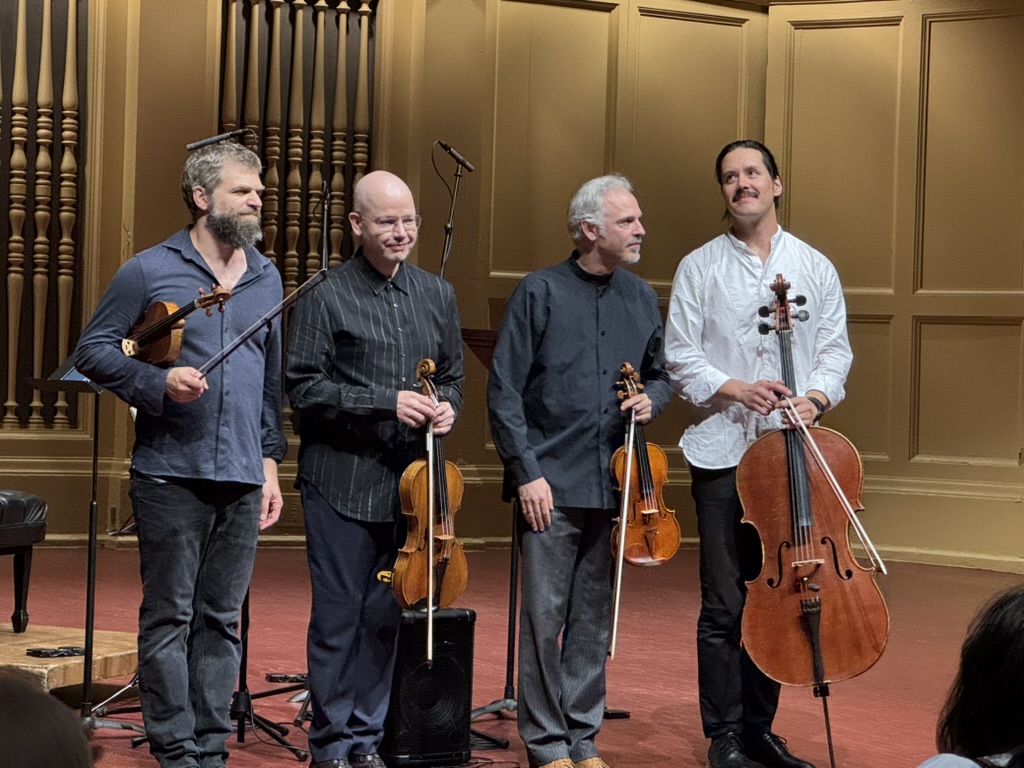
The evening opened with Haydn, whose works bear the ideals of the Enlightenment. The String Quartet in F minor is marked by unusually rich writing from the generally economic classicist, given by BR with ample heft and a refined clarity and balance between the four parts. The slow movement featured some graceful playing in triple meter before the fugal writing of the finale, whisked off with crisp precision. The fugue is perhaps the greatest musical expression of democracy with its lively discourse and equality amongst parts, and the present performance made one wish it was a form Haydn explored more.
A quartet of new commissions followed, all centered around the democratic theme — and the composers engaged were given much latitude on how they wished to express that. Don Byron’s String Quartet No. 3 makes only veiled reference to the theme. Rapid runs in endless succession made for chaotic beginnings, and a colorful employ of pizzicato yielded shifting, contrasting textures. The only overt acknowledgment of the politically charged theme was in the central second movement — denoted “Russian March,” with obvious implications against of the backdrop of the war in Ukraine. An ostinato was used to ominous effect, and the strife was unabated in the finale.
Ted Hearne’s We Are Working Tirelessly for a Ceasefire refers the oft-repeated line from politicians in reference to the Gaza war that amounts to all talk and no action. Incessant repetitions in the music seemed to evoke this deluge of platitudes, and with rhythms out of sync, one perhaps felt the cacophony of a session of Congress. Our Children Speak English and Spanish by Puerto Rican composer Angélica Negrón looked to the children as the surest hope for a democratic future, with pre-recorded bits of children’s voices interwoven with the strings.
Brooklyn Rider violinist Colin Jacobsen offered his own transcription of Bob Dylan’s anthem The Times they are a-changin’, and it was a remarkable way to hear a classic afresh. Much more ambitious than a straightforward transcription, it took the Dylan tune in a multitude of directions as members of the quartet sang the familiar lyrics.
The third and final of Beethoven’s so-called Razumovsky quartets closed the program, neatly bookending the contemporary works with masters of the form. A prolonged and rather static introductory passage was quite striking before a gently cascading main theme took shape, resonating with the brightness of C major. The first two of the Razumovsky quartets explicitly contain a Russian theme — although no such designation is made in the third, the captivating theme of the slow movement is likely of Russian origin (perhaps a connection to the Byron work heard earlier). Winding and wistful, the melodic line was underpinned by pizzicato cello. Like the selected Haydn quartet, Beethoven too closed with a fugue — indeed, the most appropriate way to conclude this program. Blazing by in a whirlwind, it made for one of Beethoven’s most thrilling finales.

 quasi-faust