Isidore String Quartet makes Chamber Music Columbus debut in wide-ranging program

Isidore String Quartet
Southern Theatre
Columbus, OH
February 24, 2024

Dinuk Wijeratne: The Disappearance of Lisa Gherardini
Aida Shirazi: umbra
Bach: Contrapunctus I-IV from The Art of Fugue, BWV 1080
Britten: String Quartet No. 2 in C Major, Op. 36

Chamber Music Columbus’ February program introduced the youthful Isidore String Quartet. All recent Juilliard grads, the quartet has already been acknowledged with an Avery Fisher Career Grant and first prize at the Banff International String Quartet Competition. Their Saturday night program at the Southern Theatre was refreshingly diverse and enterprising.
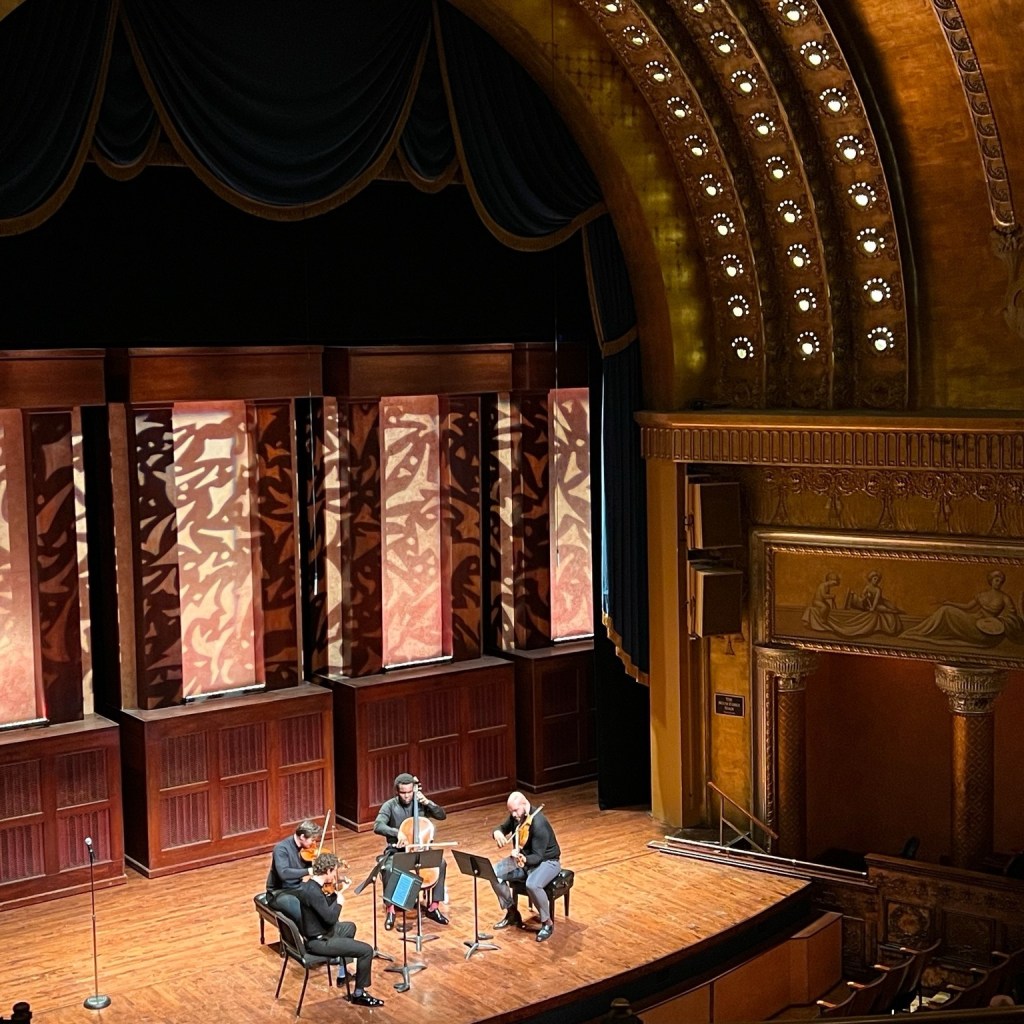
Isidore Quartet at the Southern Theatre, photo credit Chamber Music Columbus

A 2022 work from Sri Lankan composer Dinuk Wijeratne opened, a quantity this ensemble first encountered at the Banff Competition. The Disappearance of Lisa Gherardini recounts in musical – and quite theatrical – terms the 1911 heist of the Mona Lisa from Louvre. A cello melody opened, suggesting the genesis of the painting, with the others dispersed around the stage, playing gestures that in the composer’s own words “evoke gentle brushstrokes.” A central section suggested the heist, scheming and unsettling, while the cello resounded again in the concluding material, signifying the painting at last returned to its rightful place.

Iranian composer Aida Shirazi was represented with the 2011 work umbra, a title meant to evoke “a process in which the musical events unfold glacially.” Extensive use was made of extended techniques – harmonics and quarter-tones which painted an otherworldly soundscape, all but dissipating into the ether upon its conclusion.

Though generally performed on the keyboard, Bach’s crowning Art of Fugue has a long tradition of being appropriated for other instruments. The first four Contrapunctus were given in exacting transcription for string quartet. The second violin introduced the stately theme, with the transcriptions arranged in such a way that each instrument rotated giving the first presentation of the subject. The quartet boasted a sharp contrapuntal clarity, particularly evident in the fearsome complexities of the final selection. The string quartet is a medium that came after the composer’s time, but Isidore certainly made a compelling case for listening to Bach through this lens.

The program closed with Britten’s String Quartet No. 2, dating from 1945 – a watershed year in British history as well as the 250th anniversary of Henry Purcell’s death, both of which are central to the quartet. Wide-spaced texturing characterized the opening movement, a plaintive atmosphere in due course interrupted by more energetic material. The scherzo movement was in turn a ferocious if brief affair, putting Isidore’s virtuosity on full display.

The closing Chacony (as chaconne would have been spelled in Purcell’s time and place) is the most overt nod to the elder composer, and the heart of the work, clocking in at more than the first two movements combined. Its theme was derived from Purcell’s Chacony in G minor, Z730, and three groups of six variations respectively explored the source material’s harmony, rhythm, and counterpoint. Solo cadenzas punctuated each grouping, and a final set of three variations offered a lush chordal finale.

Milanov and Columbus Symphony make compelling case for Liszt’s Dante Symphony

Columbus Symphony Orchestra
Rossen Milanov, conductor
Brian Mangrum, horn

Women of the Columbus Symphony Chorus
Ronald J. Jenkins, chorus director

Ohio Theatre
Columbus, OH
March 18, 2022

Britten: Four Sea Interludes from Peter Grimes, Op. 33a
Strauss: Horn Concerto No. 1 in E flat major, Op. 11
Liszt: Dante Symphony, S109

Though Franz Liszt is rightly remembered as chiefly a composer for the piano, he produced a vast body of orchestral works – including virtually inventing the tone poem – that should not be overlooked. In some particularly ambitious programming, the Columbus Symphony offered the first local performances of the Dante Symphony, an orchestral portrait of The Divine Comedy. An informative pre-concert conversation between music director Rossen Milanov and Jonathan Combs-Schilling from Ohio State’s Italian department gave thoughtful insight into both the music and its literary inspiration. A visual element was added with Gustave Doré‘s iconic illustrations to accompany the text – produced in 1857, the same year as the symphony – projected along with the music. Though an intriguing idea, the stage lights largely diluted the projections, rendering them more a distraction than an enhancement.

Gustave Doré’s illustration to Dante’s Inferno. Plate VIII: Canto III: The gate of Hell. “Abandon all hope ye who enter here”, photo credit Wikimedia Commons

The first movement Inferno began with an imposing descent to the hell in the low brass – trombones in particular have long been associated with depictions of the underworld, dating back to Monteverdi’s Orfeo. A wound-up tension was purveyed in music that was unrelenting, often overwhelming in ferocity, but Milanov had a thorough grasp of the large-scale form, serving as an incisive guide. Secondary material depicted the doomed love affair of Francesca and Paolo, a languid contrast. A skeletal recitative-like passage in the bass clarinet was quite striking, and Liszt made use of richly chromatic, Wagernian harmonies, sounding at times like a page out of Tristan. Milanov rightly reined in the bombast during the coda, but still yielded a close that was powerfully unforgiving.

The second movement Purgatorio provided some much needed peace after the preceding, with some especially touching scoring for the harp and oboe. This was fittingly music of stasis, held in contemplative limbo, although a triumphant passage and a thorny fugue gave matters both variety and perhaps a glimmer of hope. Liszt had originally envisioned concluding the work with a Paradiso movement, mirroring the source material, but conceded that depicting heaven would be all but impossible. Instead, he provided a lovely Magnificat as something of a pendant to previous movement. It’s a hymn of sorts wherein we manage just a glimpse of the entrance to paradise. It was a magical moment when the women of the Columbus Symphony Chorus appeared practically out of the ether, offering an angelic vision of what lies beyond in the most deeply moving music of the work. The performance was a laudable achievement, and I hope Milanov and the CSO will continue to explore Liszt’s lesser-known orchestral pieces.

The program began with Britten’s Four Sea Interludes from Peter Grimes, a quantity which amazingly hasn’t appeared on a CSO program since 1979. High strings opened with an almost mystical evocation of dawn, though the intonation left something to be desired. “Sunday Morning” saw a brassy awakening, replete with tolling church bells. “Moonlight” was tranquil though not without foreboding as matters took a darker turn in the closing “Storm.”

The ensemble afforded the spotlight to one of its own in Strauss’ Horn Concerto No. 1 in bringing Brian Mangrum front and center, the CSO’s principal horn since 2018. Written when the composer was a precocious 18 year old, the regal E flat major tonality set the stage for a decisive solo entrance, and Mangrum offered a warm, rich tone. A lyrical slow movement saw the horn in dialogue with a rising gesture in the strings, a moment of repose before the jaunty and limber finale.

Rossen Milanov, Brian Mangrum, and the Columbus Symphony. Photo credit Columbus Symphony

Chicago Symphony’s return marked by a jovial program with Bramwell Tovey

Chicago Symphony Orchestra
Bramwell Tovey, conductor
Symphony Center
Chicago, IL
February 4, 2017

Walton: Orb and Sceptre
Britten: The Young Person’s Guide to the Orchestra, Op. 34
Tchaikovsky: The Sleeping Beauty, Op. 66 – Act II

After devoting January to an extensive and triumphant European tour, the Chicago Symphony returned to Symphony Center last weekend in their first concert on home turf since mid-December.  This also marked the subscription debut of the talented British conductor Bramwell Tovey, who currently serves as music director of the Vancouver Symphony.  The repertoire choices spanned the European continent from a British first half to a Russian finale, alluring in their ebullience.

tovey
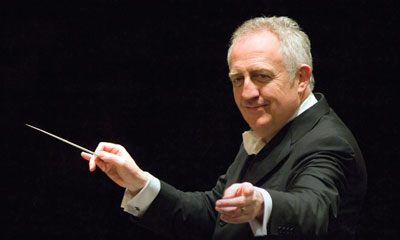
Bramwell Tovey

A rarity (and first performance for the CSO) opened in Walton’s Orb and Sceptre, a spirited coronation march he wrote for the crowning of Elizabeth II in 1953.  It began with extrovert playing in brass, sounding not unlike the ubiquitous Wedding March from Mendelssohn’s A Midsummer Night’s Dream.  The score called for an organ which gave matters a particularly ceremonial quality.  The work’s showstopping moment came in the contrasting lyrical theme which invoked the nobility of Elgar, and returned in the concluding peroration – the CSO’s energetic playing bordering on the overzealous.

Britten’s The Young Person’s Guide to the Orchestra began with a stately presented of the Baroque theme, derived from the Rondeau of Purcell’s incidental music to Abdelazer.  Opening with the force of the full orchestra, the variations are distilled to each of the constituent instruments, teaching the titular young listener to identify the characteristic sound of each.  Among the highpoints were Keith Buncke demonstrating the lyrical potential of the bassoon, and the trumpet duet between Mark Ridenour and Tage Larsen.  The closing fugue was innocently initiated in the piccolo by Jennifer Gunn (though regrettably, not without a few missed notes), building up to the thrilling climax in which Purcell’s original melody is superimposed over Britten’s fugue subject.  The dignified manner in which the musicians presented the work made the case that only the subtitle – “Variations and Fugue on a Theme of Purcell” – was necessary, this being a work of much more than mere didacticism.

The latter half was devoted the entire second act of Tchaikovsky’s seminal ballet score, The Sleeping Beauty.  Despite the act’s abundance of first-rate music, it’s also some of the ballet’s least-known as none appears in the familiar suite the composer extracted (and of which Muti conducted during a memorable all-Tchaikovsky program in Millennium Park at the beginning of the 2014-15 season).  Tovey provided the audience with a spoken introduction, detailing the act’s plot and brimming with his characteristic British wit.

A rustic atmosphere drew the audience into Tchaikovsky’s fairy tale world, as portrayed by the brilliance of the horns.  Tovey suggested that the harp represents the realm of the supernatural, and it was beautifully played by Sarah Bullen, a noteworthy addition to the score’s rich colors.  Stefán Ragnar Höskuldsson’s silvery flute vividly brought the Lilac Fairy to life.  The farandole was another delightful moment, though Tchaikovsky imbued it with an ineffable Eastern tinge, à la the mazurka.  John Sharp’s cello solo truly yearned in the Pas d’action, only to be outdone by concertmaster Robert Chen’s extended passagework in the Entr’acte that heralds the act’s finale (and originally composed for Leopold Auer).  Heretofore silent, the percussionists finally had their due in the concluding moments, Cynthia Yeh’s gong dramatically signifying the long-awaited awakening of Aurora, and the act concluded in rousing fashion.

Van Zweden, Trifonov, and the Cleveland Orchestra find fresh inspiration in Mozart and Beethoven

Cleveland Orchestra
Jaap van Zweden, conductor
Daniil Trifonov, piano
Severance Hall
Cleveland, OH
November 27, 2016

Britten: Sinfonia da Requiem, Op. 20
Mozart: Piano Concerto No. 23 in A major, K488
Beethoven: Symphony No. 5 in C minor, Op. 67

Over the Thanksgiving weekend, the Cleveland Orchestra presented a sumptuous program anchored by seminal works of Mozart and Beethoven.  After being heralded earlier this year as the New York Philharmonic’s music director-designate, all eyes have been on Jaap van Zweden.  The program played on his strengths, and even the most familiar of repertoire sounded dynamic and anew under his probing guidance.

Antwerp_JvZ1-263x200.jpg
Jaap van Zweden, photo credit Bert Hulselmans

The afternoon began in somewhat less familiar territory with Britten’s Sinfonia da Requiem, a work the orchestra has not performed since the 1970s.  A triptych of succinct, interconnected movements, it encapsulates the composer’s pacifist leanings and is an important precursor to the watershed War Requiem.  The opening Lacrymosa began quite strikingly in the timpani and piano, keyboardist Joela Jones providing an unrelenting, anxious ostinato.  The oboe passages of principal Frank Rosenwein were strained and pained in a texture that built to surging brass climaxes in its ethos of despair.

Nervous flutes opened the Dies irae but the heart of the piece was in the concluding Requiem aeternam.  While in lesser hands it can sound like a plodding passacaglia, under van Zweden’s baton it was peaceful and plaintive, building to an arching lyricism in serene resolution, worlds apart from the austerity of the opening.

Mozart’s Piano Concerto No. 23 brought forth the remarkable young pianist Daniil Trifonov, who has an important connection to the city having studied at the Cleveland Institute of Music.  The concerto opened in the airy textures of the strings, with a gesture as gentle as an exhale, and it was with that naturalness the music flowed.  Trifonov’s entrance was unassuming and graceful, and he emphasized the work’s lyrical beauty and dramatic contrasts as per his propensity to the Romantic repertoire, though never in excess.  The cadenza was fleet and deftly balanced, displaying Trifonov’s astonishing dexterity.

7714
Daniil Trifonov

Cast in the relative key of F sharp minor, the slow movement was filled with longing, and the winds were almost decadent in the splendor of their singing lines.  Trifonov would often glance heavenward as if seeking some divine inspiration, fitting for music this sublime.  The sprightly rondo finale is inherently familiar to many Clevelanders, in its frequent appearances as theme music on WCLV.  Although there were shades of darkness in its minor key episodes, the overall mood was of pure joie de vivre.

Perhaps the greatest interpretative challenge of Beethoven’s Fifth Symphony is making one of the most popular pieces in the literature sound anything but trite and clichéd.  Van Zweden proved amply up to the challenge as was apparent right from the crispness of the arresting opening, in a first movement that was lean and taut.  Its violent contrasts were emphasized, keeping the audience on the edge of their seats as it seemingly could devolve into wild abandon at any moment, yet matters were always tightly controlled.

The slow movement began with some especially lovely tones in the cellos, and the interplay between the martial and lyrical themes was cleanly delineated.  I was especially struck by the clarity of the third movement’s fugato section, the contrapuntal lines weaving in and out of the strings.  The finale was an exuberant and joyous affair, and the noteworthy addition of the trombone and the piccolo heightened its sense of drama to bring the concert to a rousing close.