Hrůša reintroduces Czech symphony to Cleveland

Cleveland Orchestra
Jakub Hrůša, conductor
Sergey Khachatryan, violin
Severance Hall
Cleveland, OH
April 5, 2018

Brahms: Violin Concerto in D major, Op. 77
 Encore:
 Komitas: Apricot Tree
Suk: Symphony No. 2 in C minor, Op. 27, Asrael

While the remainder of The Cleveland Orchestra’s centennial season is being devoted to the Tristan Festival and Prometheus Project, Thursday night saw one final standalone program, juxtaposing a familiar concerto with a forgotten symphony. The weekend’s performances also served as a return of the remarkable young conductor Jakub Hrůša, a podium presence I’ve been keen to see again since attending his Chicago Symphony debut not a year ago.

Brahms’ genial Violin Concerto began the evening, with soloist Sergey Khachatryan. Its gentle, triadic opening recalled Beethoven’s sole work in the medium as well as Brahms’ own Second Symphony, written nearly concurrently – and all three works in question share the sunny key of D major, doubtlessly more than mere coincidence. Despite the initial calm, Khachatryan’s entrance was fiery and passionate, but in due course melted into lyricism. Khachatryan displayed astonishing command of his instrument, from the stratospherically high to the guttural low. The virtuosity of the cadenza was pyrotechnics of substance, never just for show. An uncoordinated orchestral reentry fortunately did little to detract from the serenity of the moments that followed, and expansive movement drew to a close, majestic in its capaciousness.

An oboe melody of simply grandeur highlighted the Adagio, very finely played by assistant principal Jeffrey Rathbun, and later echoed by Khachatryan. A handful of brass flubs were regrettable distractions from this otherwise great statement of repose, as was an audience coughing with a particular zealousness. The finale burst with a Hungarian flare, a nod to the nationality of the concerto’s dedicatee and first performer, Joseph Joachim. Here at last such a stately work became increasingly unbuttoned, and a striking meter change allowed matters to turn even folksier.

Khachatryan returned to the stage with an arresting encore that continued the folk music theme, this time from his homeland of Armenia: “Apricot Tree” by the Armenian priest, composer, and ethnomusicologist Komitas (and also namesake of the conservatory in Yerevan). A dignified theme of modal harmony was countered by writing in the highest registers of the instrument, otherworldly and hardly sounding like a violin, and the work faded away via a sequence of rapid tremolos.

The real discovery came in the second half, devoted to Josef Suk’s hour-long Asrael Symphony. It’s a work which Hrůša knows intimately, having recorded it with the Tokyo Metropolitan Symphony Orchestra and conducting without score, yet TCO has performed it only twice before, the most recent appearance almost three decades ago. Asrael is the Angel of Death in the Old Testament, and accordingly, it’s a dark and somber work, intended by Suk as an elegy for his teacher (and father-in-law) Dvořák, and later also memorializing his wife (i.e. Dvořák’s daughter), Otilie, who died during the work’s gestation.

The symphony is a five-movement affair, symmetrical in conception, with a central scherzo encapsulated by two funereal slow movements, and bookended on each end with an extensive movement of weight and gravitas – thoughtfully constructed, though at times a bit unwieldy. Stylistically, it’s of a post-Wagnerian sumptuousness and chromaticism – in that regard, a fine prelude to the Tristan Festival. And parenthetically, Suk’s grandson of the same name was a noted violinist who made his American debut here in Cleveland at the behest of George Szell.

The symphony opened in desolation, with a statement of the imposing and recurring Asrael theme presented shortly thereafter. Hrůša skillfully articulated the movement’s vast sonata form, clarifying the dense textures – from the powerful, unforgiving brass climaxes, to the pounding of the bass drum, all of which died away into the nebulous whispers that opened. The following Andante was the work’s tribute to Dvořák, with an incessant stepwise gesture that suggested the elder composer’s Requiem. Long-held notes in the principal winds gave an especially powerful effect, as if suspended in time. A stark contrast was had in the scherzo, nearly in jest, and most memorable was the lovely central section, boasting very fine playing from the harp as well as concertmaster William Preucil, and it built to a statement of great sweep and power. The scherzo material resurfaced and led to a dramatic statement of the Asrael theme.

The Adagio, written for Otilie, was perhaps the heart of the symphony, heartfelt and deeply tragic, highlighted by Preucil’s solos that reached heavenward. Rambunctious timpani marked the energetic finale, with the shrillness of the E flat clarinet among the many colors of its kaleidoscopic tapestry. The movement’s extended coda was Suk at his most original, with its stirring brass chorales and hypnotic trills, and the final moments oscillated between the serenity of the upper registers and the unsettling of the low, with the former getting the final word. Thanks are due to Hrůša for his passionate advocacy of a remarkable work that deserves to be heard.
Perlman delights in Lyric Opera recital

Itzhak Perlman, violin
Rohan De Silva, piano
Civic Opera House
Chicago, IL
April 23, 2017

Vivaldi: Sonata in A Major for Violin and Continuo, Op. 2 No. 2, RV 31
Beethoven: Violin Sonata No. 5 in F major, Op. 24, Spring
Schumann: Fantasiestücke, Op. 73
Ravel: Violin Sonata No. 2 in G major

Encores:
Kreisler: Sicilienne and Rigaudon in the style of Francœur
Tchaikovsky, transcribed Auer: Lensky’s Aria from Eugene Onegin
Wieniawski: Etude-Caprice in A minor, Op.18 No. 4
Williams: Theme from Schindler’s List
Brahms, transcribed Joachim: Hungarian Dance No. 1 in G minor
Franz Ries: Perpetuum mobile, from Suite No. 3 in G major, Op. 34

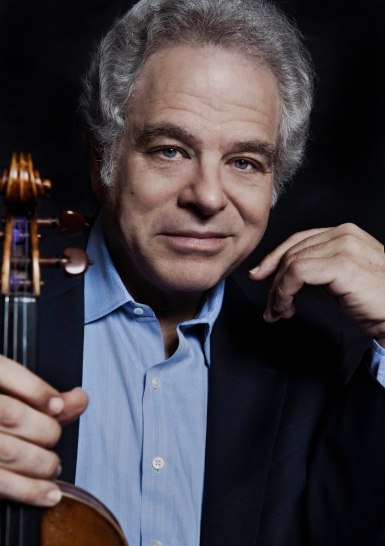
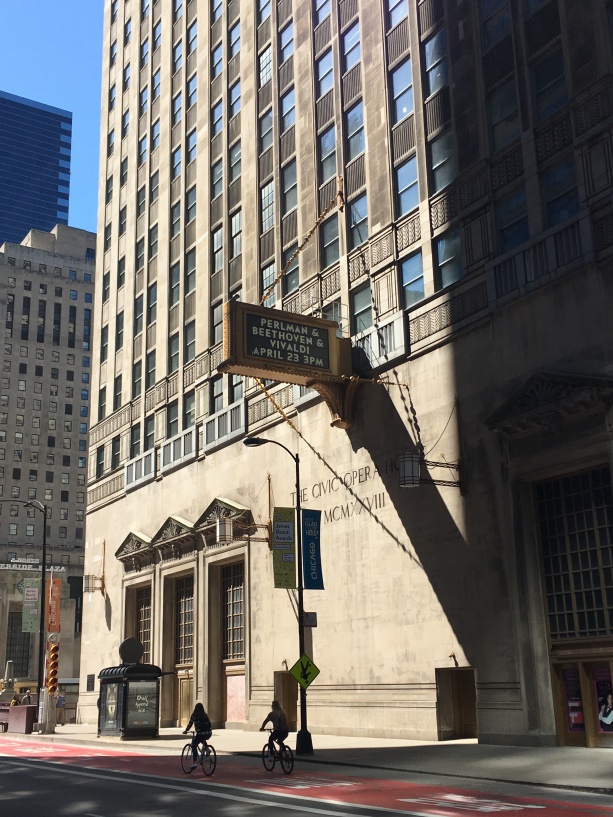
An Itzhak Perlman recital is always a major event, as evidenced by the near-capacity crowd he drew at the cavernous Civic Opera House.  With an opera season ending in March, the venue was certainly put to good use in an enjoyable afternoon from Perlman and long-time recital partner, the Sri Lankan pianist Rohan De Silva.  A stage set of classical pillars provided an elegant backdrop (the advantages of performing in an opera house), and video screens showing close-up views in real time flanked the stage, helping to create a sense of intimacy in a large hall.

Exclusive-press-shot-Itzhak-3253-new_by-Lisa-Marie-Mazzucco
Itzhak Perlman, photo credit Lisa-Marie Mazzucco
Perlman arranged his program chronologically, beginning with the Sonata in A major for Violin and Continuo by Vivaldi.  An energetic presto opened, effectively serving as a warmup to the sprightly second movement.  The slow movement was brief but genuinely expressive, and a joyful finale rounded off this compact work of a mere seven minutes.

In an unannounced change from the printed program which suggested Beethoven’s first violin sonata (Op. 12 No. 1), Perlman elected for the more seasonally appropriate though well-worn Spring sonata (Op. 24).  It opened with a wonderfully bucolic grace, although Perlman’s intonation was regrettably suspect at times.  A languid Adagio molto espressivo followed with some especially lovely playing from De Silva.  The two closing movements both were marked by a delightful interplay between violin and piano, and an elegant melody heightened the finale.

Schumann’s Fantasiestücke, Op. 73 offered some Romantic fervor, with Perlman presenting them in the continuous, unbroken cycle that the composer intended, rather than three separate works.  I was struck by the rippling of the first and the fire of the last, yet in these works originally envisioned for cello or clarinet, they sounded somewhat timid on the violin, requiring more vigor to compensate than Perlman managed to muster.

Ravel’s relatively brief Violin Sonata No. 2 in G major was the only work programmed for the second half in what was surely a calculated move to allow ample time for encores.  Beginning with a single note line in the solo piano, the first movement was one of coloristic writing, pitting the violin and piano on more austere terms with one another than the previous works which favored conviviality.  Ravel’s own take on American musical traditions came to light in the second movement “Blues”, much like in the Piano Concerto of a few years later, replete with blue notes and slides.

Perlman played the accented pizzicatos with his bow hand and the others were plucked up on the fingerboard, but in the former one wished for a greater abrasiveness.  The last movement was acutely virtuosic, yet the delivery was rather dry and detached – but certainly not enough not to garner an enormous standing ovation, as much a recognition for Perlman’s extraordinary career as for Sunday afternoon’s performance.

And ample encores there were – no fewer than six.  While the four sonatas fared a bit lackluster, it was during the encores that the violinist truly sprung to life, and Perlman became Perlman.  With a charismatic stage presence, he explained to the audience that he brought with him a list of every work he’s played in Chicago – humorously suggesting it dated back to 1912 – so as to avoid duplication.  No Perlman recital would be complete without a work of Kreisler, and he offered the illustrious composer-violinist’s Sicilienne and Rigaudon in the style of Francœur, once erroneously thought to be a bona fide work of its namesake.  Perlman exuded an effortless charm in the Sicilienne; the Rigaudon proved that his remarkable prestidigitation is still very much intact.

“Lensky’s Aria” from Tchaikovsky’s Eugene Onegin followed – quite appropriate as Lyric Opera presented the complete work on the same stage just a few months prior – in a transcription by the legendary Leopold Auer.  A work of rich melancholy, it proved to be surprisingly well-suited to the violin.  The Wieniawski Etude-Caprice in A minor came next; a signature work of Perlman, it never fails to impress.  This was only outdone by the Theme from Schindler’s List – one of John William’s finest film scores, it should be remembered that Perlman played in the original soundtrack.  His deeply moving performance had particular poignancy on Sunday given the proximity to Holocaust Remembrance Day.

Two briefer works brought the afternoon to an agreeable close: the searing passion of the first of Brahms’ rousing Hungarian Dances, and the dizzying acrobatics of Franz Ries’ Perpetuum mobile.

Perlman Lyric
Civic Opera House

Simon Rattle and the Berlin Philharmonic: in Mahler’s wake

Berliner Philharmoniker
Sir Simon Rattle, conductor
Hill Auditorium
Ann Arbor, MI
November 13, 2016

Schoenberg: Fünf Orchesterstücke, Op. 16
Webern: Sechs Stücke für Orchester, Op. 6b
Berg: Drei Orchesterstücke, Op. 6
Brahms: Symphony No. 2 in D major, Op. 73

Sunday afternoon’s concert picked up right where Saturday’s left off, with the first half comprised of the sets of orchestral pieces of Schoenberg and his disciples Webern and Berg.  These three composers were faced with the not insubstantial question of what one could possibly write in the wake of Mahler, and while it erred dangerously close to an overdose of the Second Viennese School, programming all three sets gave the listener an intriguing look at the direction Mahler might have gone had he lived a few more years.  Rattle elected to perform them without pause between, and in his spoken introduction invited the audience to conceive of it as “a 14 movement suite” or “Mahler’s eleventh symphony.”

Each of the 14 pieces are relatively brief, as if a shard of broken Romanticism, distilled to its essential meaning.  Schoenberg’s Five Pieces were given with an intensity that rivaled that of James Levine’s performance I saw in Chicago just the previous week.  The repeated figure in the celesta made the titular reminiscences of Vergangenes all the more unnerving, and Farben was a shimmering exposé in orchestral color.  A calmer moment in Peripetie was given by principal flutist Mathieu Dufour, a familiar face to this listener as he previously held that position with the Chicago Symphony.

Webern’s Six Pieces were presented in the revised 1928 version, scored for a somewhat slimmer orchestra.  Surprising lyricism was to be found in the otherwise terse and aphoristic opening selection while the third was characterized by a viola solo.  The fourth was the most extended, with rumbling percussion building to a massive, unrelenting crescendo, contrasted by the clarinet passagework of principal Wenzel Fuchs.

Berg’s Three Pieces were the most patently Mahlerian.  The opening Präludium, while otherwise impressionistic, began and ended with the percussion evoking a military band, a familiar device from a Mahler symphony.  Daishin Kashimoto assumed concertmaster duties for the Sunday performance and was prominent in Reigen, obliquely suggesting the waltz and the ländler as obfuscated through the distorted lens of expressionism.  The ferocious Marsch was firmly in the realm of the grotesque, ending with a cataclysmic hammer blow, suggesting Mahler’s Sixth Symphony of which Berg was a staunch admirer.

More familiar territory – and a welcome relief – came after intermission with Brahms’ genial Second Symphony.  While Brahms is often thought of as a dean of conservatism, this was another clever programming choice as an article from Schoenberg’s pen once provocatively christened Brahms a progressive.  It began unassumingly with a gentle dip in the cellos, unhurried and basking in its pastoral beauty.  Rattle eschewed the repeat of the exposition, instead opting for a tauter structure.  The lushness of the low strings opened the slow movement, and music of gorgeous serenity poured from the orchestra.  The winds were in top form during the scherzo, contrasted by the quicksilver energy of the strings which set the stage for the exultant finale, leaving Sunday’s audience uplifted in its celestial radiance.