Carpe Diem String Quartet Jacob Shack, viola First Unitarian Universalist Church Columbus, OH December 16, 2023
Tucker: Ravenous Bunch: String Circle Brahms: String Quintet No. 2 in G major, Op. 111
Carpe Diem String Quartet began their December program in enterprising fashion with two contemporary works – including a world premiere. The premiere was a product of their 15 for 15 initiative, in which they have commissioned fifteen works to honor their fifteenth anniversary. Composer Akshaya Avril Tucker was on hand to introduce her piece entitled Ravenous, inviting the audience to picture a place without life – and then to imagine its return to life in ravenous regrowth. The piece followed the trajectory suggested by those remarks, beginning desolate, almost disembodied, steadily growing in vigor and fervor.
Guest violist Jacob Shack – who currently serves as associate principal of the Baltimore Symphony – was introduced for the next two selections. Kenji Bunch – also a violist – is a composer whose folk and populist influences abound, readily apparent in the 2005 work String Circle. Described as something of a chamber music “jam session”, the opening Lowdown began gently but not without rhythmic thrust. Syncopations decorated Shuffle Step, while the languorous central Ballad seemed to suggest Gershwin’s “Summertime”. Pointillist pizzicato made Porch Picking a fun listen, and the appropriately titled Overdrive closed the piece in exciting fashion.
Brahms’ String Quintet No. 2 was almost symphonic in heft – it was quite striking how the addition of just a single viola buttressed the quartet. Tremolos underpinned a warm cello melody, and the quintet did much to bring out the richness of the scoring, cutting into the heart of the spacious opening movement. The Adagio was beautifully resonant, with elegant ornamentations atop a stately chordal procession. Brahms’ individual stamp wandered through the penultimate movement, a downtempo affair in lieu of the more traditional scherzo; a further favorite device of the composer came in the Hungarian inflections of the vigorous finale. Shack gelled with Carpe Diem like an old friend, and the diversion into the string quintet literature was most welcome.
Seasonally appropriate, the evening concluded with a generous helping of ten or so holiday selections in skillfully crafted arrangements for quartet.
ProMusica Chamber Orchestra David Danzmayr, conductor Caroline Shaw, vocals Southern Theatre Columbus, OH May 13, 2023
Shaw: Blueprint Shaw: Is a Rose Shaw: Entr’acte Brahms: Symphony No. 1 in C minor, Op. 68
Ever keen to celebrate living composers, ProMusica’s final performance of the season explored the work of the remarkable Caroline Shaw. In addition to being featured as composer, the multi-faceted Shaw was additionally seen as vocalist in one of her own works, and as violinist, joining ProMusica’s ranks for the Brahms symphony which closed the evening. Originally scheduled to take place prior to the pandemic, it was well worth the wait, and further to the convivial spirit of the evening, Shaw revealed a few touching Columbus connections: she had studied violin with ProMusica concertmaster Katherine McLin, and her mother sang in the Columbus Opera chorus in the 1970s.
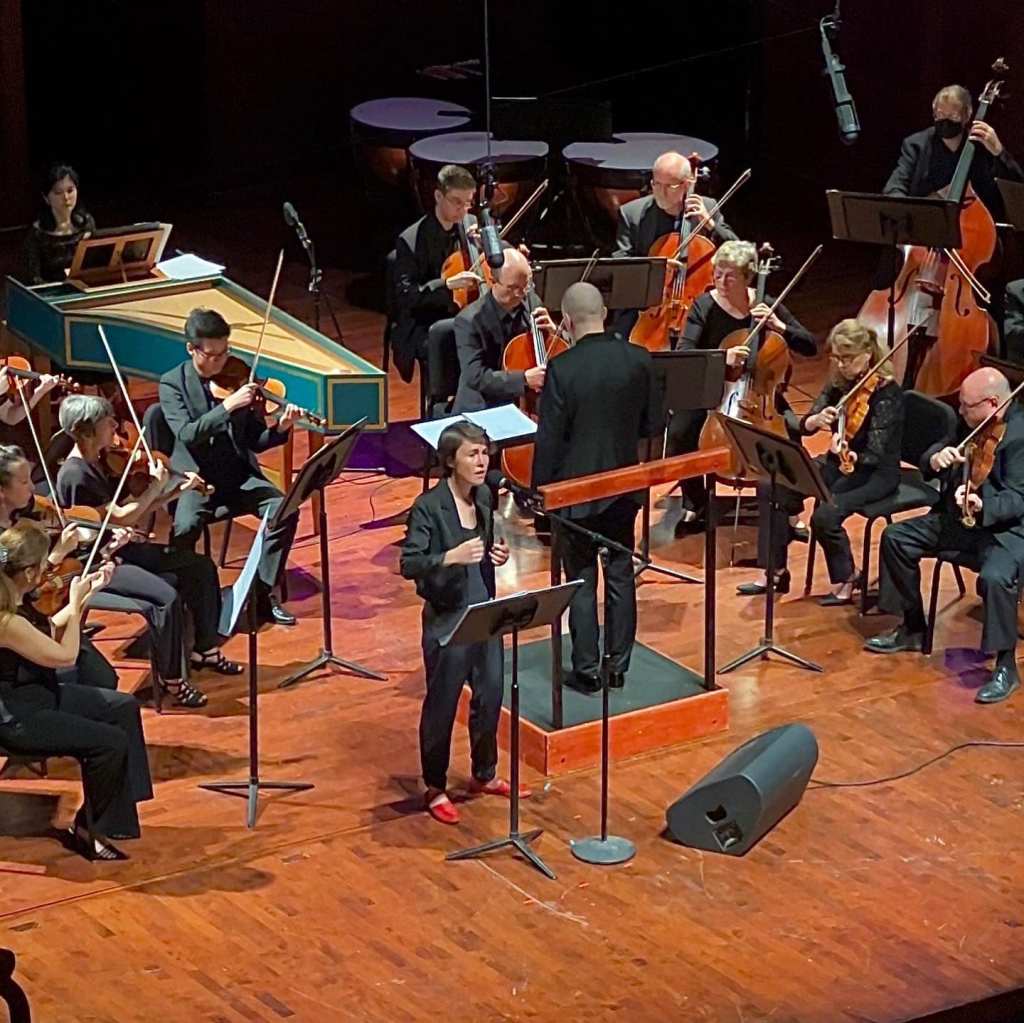
Caroline Shaw performing Is a Rose with David Danzmayr and ProMusica, photos credit ProMusica
Scored for string quartet, Blueprint featured McLin along with Jennifer Ross, Mary Harris, and Cora Kuyvenhoven. Inspired by Beethoven, it captured the spirit of the elder composer indirectly and obliquely, not relying on obvious allusions. Snappy pizzicatos gave variety to the texture, and much was made of the empty space that separated its terse gestures, a sure sign of the quartet’s seamless cohesion.
Is a Rose constitutes a short song cycle, intriguingly scored for string orchestra with the addition of oboe and harpsichord. The three songs respectively set texts by Jacob Polley, Shaw herself, and Robert Burns, and it was really treat to hear Shaw sing her own work, an adept performer offering the insight of a composer. In “The Edge,” the oboe complemented the richness of the strings, with a gentle vocal line rising in intensity in mirror of the text. The harpsichord opened “And So,” here, the lyricism of Shaw’s voice complemented her lyrical text. In a clever orchestration, the words “borrowed time” were marked with pizzicato strings, sounding like a ticking clock. The closing setting of Burns’ “Red, Red Rose” made for a melancholy farewell.
As Blueprint looked towards Beethoven, Entr’acte drew inspiration from Haydn, take the minuet rhythm – a key element of much of Haydn’s output – as a departure point. Cast for string orchestra, its crunchy dissonances and use of harmonics offered Haydnesque wit fit for the 21st century – very much in Shaw’s own voice, but no less charming.
Conductor David Danzmayr noted that one may be surprised to see a Brahms symphony on a program from the chamber-sized ProMusica, but explained that Meiningen Hofkapelle that premiered some of Brahms’ symphonies was comparable in size. Thunderous, brooding beginnings opened this C minor First Symphony, though perhaps still a bit thinner sounding to contemporary areas accustomed to much larger ensembles. The first movement’s primary theme was articulated crisp and dramatic, taken at a rather brisk tempo.
The Andante sostentuo was a lyrical look inward, though it could have benefitted from greater dynamic contrast had Danzmayr brought down the dynamics down a bit more. Mellifluous clarinet marked the scherzo, but I felt the movement’s rustic charm needed to breathe more and a less-hurried tempo choice would have better suited. Gleaming brass opened the weighty finale, with lyrical strings intoning a melody that bore more than a passing resemblance to Beethoven’s Ode to Joy – a fitting nod to the evening’s beginning which saw students from ProMusica’s admirable Play Us Forward program performing a string arrangement of the Ode to Joy. Intense and articulate, Danzmayr guided the orchestra to a bold finish.
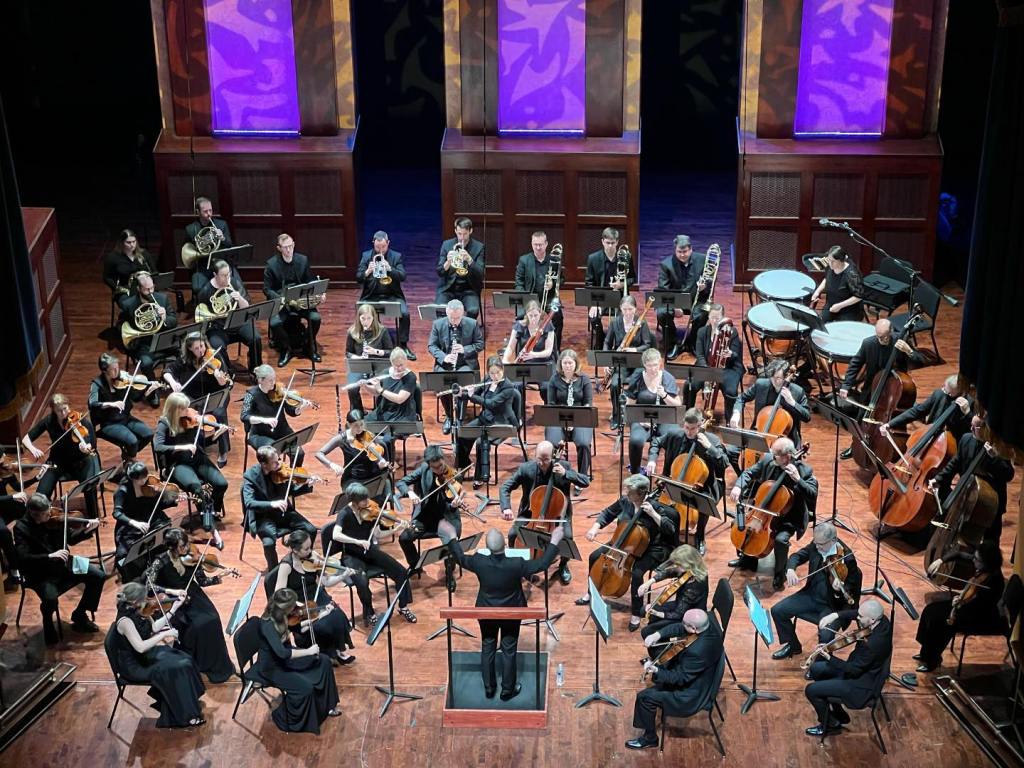
ProMusica performs Brahms’ Symphony No. 1 (spot Shaw on the far left!)
Columbus Symphony Orchestra Rossen Milanov, conductor David Thomas, clarinet Ohio Theatre Columbus, OH February 18, 2023
Price: Andante ma non troppo from Symphony No. 3 in C minor Berio/Brahms: Op. 120 No. 1 Schubert: Symphony No. 4 in C minor, D417, Tragic
It has been deeply gratifying to see renewed attention given to the formidable work of Florence Price in the past few years. Last year’s Grammy for best orchestral performance went to the Philadelphia Orchestra’s warmly recommended recording of her First and Third symphonies under Yannick Nézet-Séguin – an ensemble of which Rossen Milanov served as assistant conductor for almost a dozen years before coming to Columbus. Last weekend’s Columbus Symphony program opened with the slow movement of the Third Symphony.
David Thomas, photo credit Columbus Symphony
A plaintive choir of winds began, with a tuneful melody gently unfolding. Like Dvorák before her (as in the New World symphony, heard here two weeks prior), Price purveyed a language steeped in folk tradition without making use of specific quotations. A passage for brass chorale was particularly affecting and distinctly American in character before the movement reached a serene ending, aided by a touch of harp. It certainly whetted one’s appetite for more, and I hope the complete symphony can be programmed in an upcoming season.
Though at the forefront of the avant-garde, Luciano Berio had a knack for faithfully transcribing other composers’ works for various media (including a particularly delightful selection of Beatles songs). A 1986 commission from the Los Angeles Philharmonic saw him transcribe Brahms’ late Clarinet Sonata in F minor, Op. 120 No. 1 for soloist and orchestra. Championing the work was David Thomas, serving as the CSO’s principal clarinet since 1989.
Passionate, brooding beginnings were had, with Berio’s orchestration inimitably Brahmsian as he left his iconoclastic proclivities far behind – the work sounded almost as the clarinet concerto Brahms never wrote. Thomas’ rich tone was well-suited to this autumnal work, finely balanced with the larger ensemble, and conveying a natural chemistry with his orchestral colleagues. The slow movement proceeded as a long-breathed song without words – really gorgeous – while an Allegretto grazioso charmed with its inflections of the ländler in both rhythm and spirit. A repeated motif marked the closing Vivace, a finale of appropriate vigor.
Another C minor symphony closed the program, namely Schubert’s Tragic. Weighty introductory material announced the minor tonality in no uncertain terms; the movement proper brimmed with Sturm und Drang in this early expression of Romanticism. The primary theme was deftly articulated in the strings, and a development section traversed distant keys before the movement landed – quite surprisingly – in the major.
The Andante boasted one of Schubert’s loveliest melodies, first presented in the strings with a touching countermelody in the oboe, searching for peace amidst the tumult of the rest of the work. The minor key shading gave the minuet added vigor, a contrast heightened by the lilting trio. Milanov leapt right in the to the finale – perhaps in reaction to some of the audience’s insistence on applauding after every movement. Matters felt a tad rushed, but this was an energetic outing nonetheless, leading to a dramatic finish.
ProMusica Chamber Orchestra David Danzmayr, conductor Vadim Gluzman, violin Southern Theatre Columbus, OH December 10, 2022
Chin: subito con forza Brahms: Violin Concerto in D major, Op. 77 Encore: Gluck: “Dance of the Blessed Spirits” from Orfeo ed Euridice (trans. Kreisler) MacMillan: One Mendelssohn: Symphony No. 5 in D major, Op. 107, Reformation
The final ProMusica program of the year presented two major scores from the 19th century (both in D major!), each prefaced by a brief but fitting contemporary work. Unusk Chin’s 2020 work subito con forza certainly made for an energetic opening. An homage of sorts to Beethoven, the opening gesture invoked the Coriolan overture before veering in a different direction, and powerful writing for the piano hinted at the Emperor piano concerto.
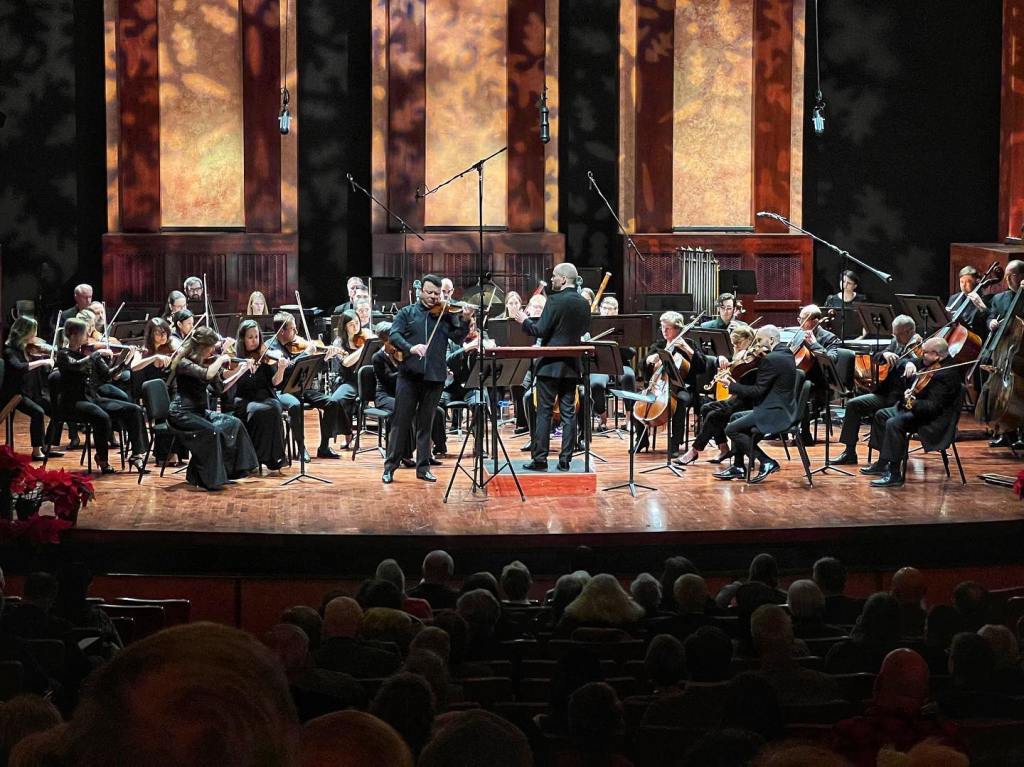
Vadim Gluzman, David Danzymar, and ProMusica, photo credit ProMusica
In her opening remarks, ProMusica CEO Janet Chen noted that this marks ten years since David Danzmayr and Vadim Gluzman assumed their current roles of music director and creative partner respectively. What followed was a veritable celebration of this now decade-long collaboration in Brahms’ Violin Concerto. The orchestral introduction was marked by an arching lyricism, and a fiery contrasting theme provided set up for the violin’s entrance. More lyrical material saw Gluzman sailing into the upper range of his instrument with a tone limber and flexible. The partnership between conductor, soloist, and orchestra certainly paid its dividends in convincingly conveying the large-scale architecture of the expansive opening movement.
A choir of winds opened the plangent Adagio, and Gluzman responded with a songful lyricism of his own. The Hungarian-inflected finale was a jocular affair, given with authentic flair. Gluzman returned with an encore in Gluck’s “Dance of the Blessed Spirits” from the opera Orfeo ed Euridice – presented in Kreisler’s transcription for violin with a touch of orchestral accompaniment. Its gorgeous, long-bowed melody was a lovely pendant to the Brahms.
As the title suggests, James MacMillan’s 2012 essay One explores single-line melodies, monastic in its starkness and somewhat suggestive of Gregorian chant. The religious orientation was apropos as it led without pause to Mendelssohn’s Reformation symphony – a fitting follow up to last season’s performances of the Scottish and Italian symphonies (perhaps a future ProMusica season could offer the rarely heard First and Second symphonies?). The slow introduction saw a rich invocation in the strings of the divine Dresden amen; the movement proper took shape with vigor in the stormier minor, delivered with momentum and precision.
The Allegro vivace was playful, lighter fare by contrast, and the gentle Andante was noted for its languid melody in the strings. The finale introduced the Lutheran hymn Ein feste Burg ist unser Gott in the flute (Nadine Hur) with matters building to a climax of both contrapuntal intricacy and festive exuberance.
Columbus Symphony Orchestra Rossen Milanov, conductor Shai Wosner, piano Ohio Theatre Columbus, OH November 5, 2022
Montgomery: Starburst Brahms: Piano Concerto No. 2 in B-flat major, Op. 83 Encore: Schubert: Hungarian Melody, D817 Dvořák: Symphony No. 6 in D major, Op. 60
Jessie Montgomery is a contemporary composer that has rightfully garnered much attention in recent years, and the Columbus Symphony opened their program with her 2012 work Starburst – a welcome further foray into her work after their inclusion of Bannerlast season (a program which in fact paired Montgomery with the same composers here). Starburst quite literally bursted with infectious, sparkling energy. One only wished this was sustained longer than its 5-minute duration, and I hope Montgomery is a composer the CSO continues to visit.
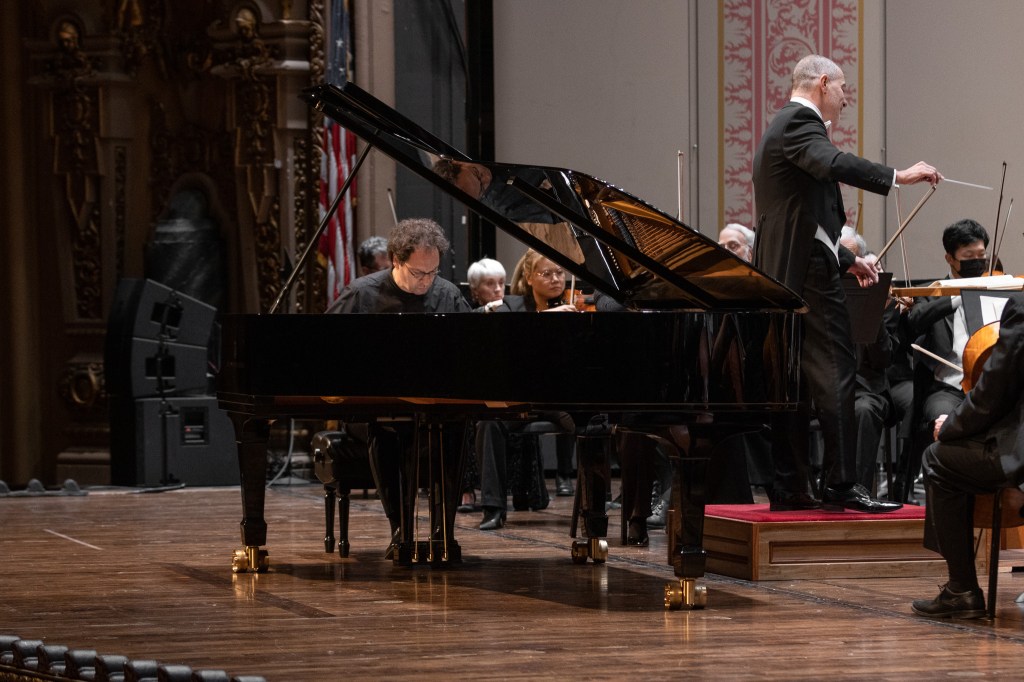
Shai Wosner with Rossen Milanov and the Columbus Symphony, photo creditt Corinne Mares
Brahms’ vast Second Piano Concerto made for a heavier contrast, and featured Israeli pianist Shai Wosner. A mellow horn call from principal Brian Mangrum made for a majestic opening to the weighty first movement. Wosner performed with intense, singular focus, though I felt his playing veered a bit too cautious and restrained. Although his technique wasn’t flawless, it nonetheless served well the daunting demands of the work. Both pianist and conductor Rossen Milanov seemed aligned in their conception of the grand, sweeping arc of the movement.
The scherzo that followed was hardly a trifle, still bearing much of the weight of the preceding, but sprightlier material contrasted. A deeply lyrical cello solo (Luis Biava) opened the Andante, and the piano entered with a gentle, song-like touch. The payoff came in the finale with its folk-inflected abandon, though hardly short on drama. As an encore, Wosner offered a lovely account of Schubert’s Hungarian Melody.
Dvořák’s Sixth Symphony was a milestone for the composer in that it was the first to published, and shows him blossoming into a mature symphonist. The spacious, expansive Allegro non tanto opened with a gentle, bucolic theme over pulsating accompaniment. It was certainly apposite to precede the symphony with Brahms as it bears the elder composer’s influence (particularly from Brahms’ own D major symphony), yet not without Dvořák’s individual hallmarks.
A touching moment of repose was to be had in the Adagio, its thematic material charmingly introduced in the winds. The composer unmistakably revealed in his Czech origins in the lively furiant that followed, and the orchestra deftly negotiated the ever-changing meters, an energetic warmup of sorts for the jubilant finale.
Columbus Symphony Orchestra Rossen Milanov, conductor Claire Huangci, piano Ohio Theatre Columbus, OH November 12, 2021
Williams: The Dream Deferred Liszt: Piano Concerto No. 2 in A major, S125 Encore: Gulda: Piano Play No. 6 Brahms: Symphony No. 2 in D major, Op. 73
As with the previous entry in the Masterworks series, the Columbus Symphony’s program on Friday night thoughtfully opened with a socially-relevant work by a contemporary African-American composer. Here, the work in question was the 2017 composition The Dream Deferred by Chicago native Evan Williams. Alluding to the Langston Hughes poem, the present work contends with how the American dream is all too often deferred for the Black and Latino communities, particularly amongst young males in what is chillingly referred to as the school-to-prison pipeline. Scored for string orchestra and harp, the piece is bifurcated into two brief movements, “it explodes” and “it dries up” respectively. The harp textures in particular showed the composer’s skill as the unsettled, ominous music proceeded until the titular dream eventually faded away into darkness.
A preconcert conversation between Claire Huangci and Rossen Milanov
The preconcert talk featured an informative conversation between music director Rossen Milanov and guest pianist Claire Huangci. The two first collaborated in Philadelphia when Huangci was just 12 years old. She was featured this weekend in Liszt’s Piano Concerto No. 2, a rather more lyrical foil to its more frequently heard predecessor. Plaintive winds were answered by gentle cascades in the piano, and the pianist’s elegant, sensitive playing captured one’s attention. Though certainly more subdued than the First Concerto, there were nonetheless ample opportunities for flair and virtuosity which Huangci delivered with aplomb, particularly in the riveting march. A ravishingly beautiful duet between the pianist and principal cellist Luis Biava offered a moment of calm before the big-boned finish. Huangci indulged the appreciative audience with an encore in Friedrich Gulda’s Piano Play No. 6, thoroughly entertaining in its jazz inflections and rapid-fire repeated notes.
The so-called “War of the Romantics” was a defining feature of nineteenth-century music, pitting against each other two vastly different approaches to composition. The present program intriguingly explored that by contrasting the Liszt with the latter half devoted to Brahms’ Second Symphony. The first movement opened gentle and genial, though it sounded as if it could have benefitted from additional rehearsal time. The trajectory of this expansive movement was not always clear as matters plodded along, with interjections from the brass fitfully uncoordinated and out of tune. Nonetheless, I found the slow movement more convincing with a serenity encouraged by the resonant cellos, and Milanov led the orchestra to a fiery passion before peacefully subsiding. Milanov aptly referred to the Allegretto grazioso as a “stylized minuet”, and it provided much charm ahead of the finale, certainly one of the most jubilant in the repertoire – just what was needed on a cold November night.
Columbus Symphony Orchestra Rossen Milanov, conductor Stefan Jackiw, violin Ohio Theatre Columbus, OH October 22, 2021
Montgomery: Banner Brahms: Violin Concerto in D major, Op. 77 Encore: Bach: Largo from Violin Sonata No. 3 in C major, BWV 1005 Dvořák: Symphony No. 8 in G major, Op. 88
Friday marked opening night of the Columbus Symphony’s Masterworks series, the core of its landmark 70th season. As is standard practice from most American orchestras, the CSO would typically open the season with a rendition of the national anthem. Extraordinary times, however, make business as usual ring hollow, and a thoughtful opener was to be had in Jessie Montgomery’s 2014 work Banner. Written in 2014, two hundred years after Francis Scott Key’s indelible poem, the work pits the Star-Spangled Banner against a wealth of melodies from other cultures, depicting in musical terms the vast array of cultures that comprise the United States today. While the contours of the Star-Spangled Banner form the backbone of the work, no less than seven other songs are woven together into a single multicultural fabric, often yielding a spiky polytonality. A deeply engaging opener, and I hope the CSO continues to explore Montgomery’s work in future seasons.
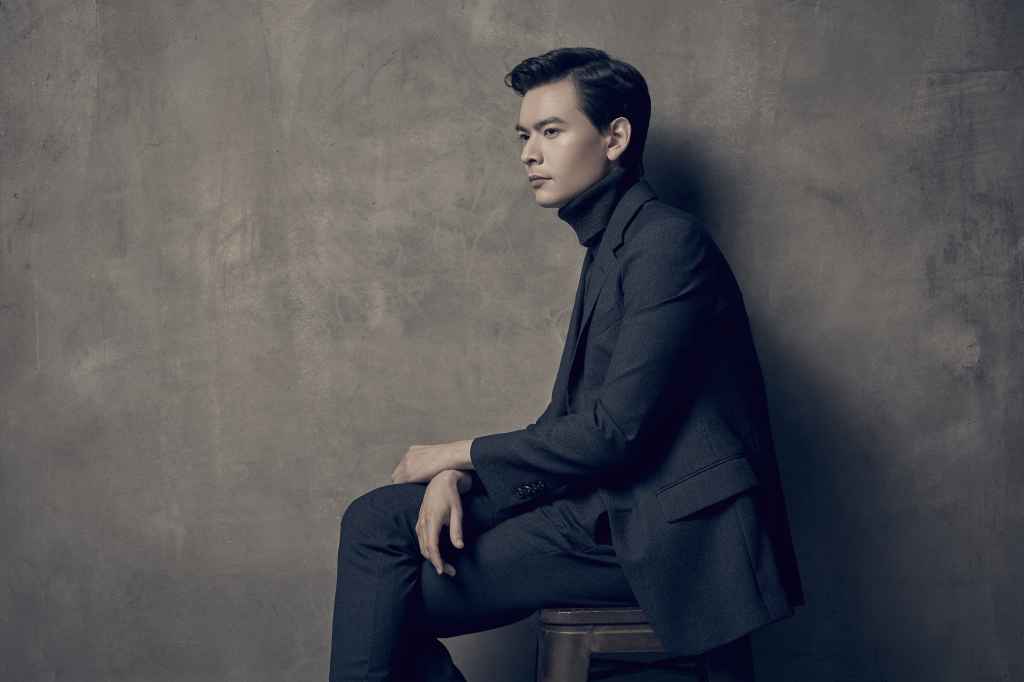
Stefan Jackiw, photo credit stefanjackiw.com
The remainder of the program retreated to more familiar territory in seminal works of Brahms and Dvořák. Stefan Jackiw served as a commendable soloist in the Brahms Violin Concerto. The graceful and genial opening gave way to the dramatic, punctuated by Jackiw’s jagged entrance. He displayed an accomplished virtuosity, delivering the extended cadenza with flair, but never without sensitivity, continually drawing focus towards the work’s lyrical heart. A rapturous oboe solo opened the central Adagio, answered in the rich lyricism of the solo violin. The Hungarian finale was given with both effervescence and drama, and the orchestra matched Jackiw’s high spirits. As an encore, Jackiw offered the Largo from Bach’s C major sonata – a lovely pendant.
Dvořák’s Symphony No. 8 closed the evening, and here, Milanov opted to conduct from memory. The work saw brooding beginnings, but rays of sunlight quickly broke through. The principal winds – the flute in particular – were the standouts here. A second movement Adagio proceeded as calm and untroubled affair, while the lilting penultimate movement had a dancing charm – though one wanted perhaps even more emphasis on the insouciant dance rhythms. Clarion trumpet calls heralded the boisterous finale. All in all, a very satisfying start to the season.
Gartner Auditorium Cleveland Museum of Art Cleveland, OH July 29 – August 1, 2021
Inevitably postponed last summer due to the pandemic, the Cleveland International Piano Competition has made a remarkable comeback here in 2021, a wonderfully exciting return to in-person performances. An initial pool of over 250 applicants from more than 40 countries was pared down to 26 contestants, all of whom performed in the Competition’s first two rounds. Owing to the travel and health restrictions that still persist, these rounds were conducted virtually, filmed at venues across the world – and available for free viewing on YouTube. Eight outstanding semi-finalists were selected to proceed onsite in Cleveland, a cohort to be further narrowed down to four finalists who will perform a chamber music round with the Escher Quartet and a concerto round with The Cleveland Orchestra under the baton of Jahja Ling.
Gartner Auditorium before Session 1 of the Semi-Final Round
Compared to the relative brevity of the first two rounds, the semi-finals offer an even more in-depth portrait of each artist, performing a recital of approximately 40 minutes. A few new and welcome additions for this year’s edition: each semi-finalist included in their program a popular song transcription commissioned from composer Alexey Kurbatov. Four selections were available, namely “America” from Bernstein’s West Side Story, Queen’s “Bohemian Rhapsody”, themes from Mission Impossible, and John Williams’ Olympic Fanfare. Regrettably, none of the eight selected the Williams piece, but perhaps a recording can be posted in due course. I also hope publication of these scores is imminent as they undoubtedly can serve as particularly enjoyable encore pieces.
Also for the first time was the inclusion of piano duets – the two performers from each session teamed up following their solo material for either the Fantasie in F minor by Schubert or Mozart’s Sonata for Two Pianos in D major. A lovely addendum that not only tested the contestants’ ability to collaborate with another pianist, but encouraged a spirit of camaraderie. Finally, excellent program notes for every piece performed – from the first round to the finals – were provided by Marissa Glynias Moore, Anna M. O’Connell, and Marco Ladd. Indispensable reading for attendees and a veritable crash course in piano literature. Below are some brief impressions I had of each semi-finalist.
Session 1 July 29, 2021
Ying Li Mozart: Piano Sonata No. 13 in B-flat Major, K. 333 Grainger: “Ramble on Love” from Der Rosenkavalier Bartók: Piano Sonata, Sz. 80 Schifrin: Themes from Mission Impossible (arr. Kurbatov)
Honggi Kim Schifrin: Themes from Mission Impossible (arr. Kurbatov) Chopin: Twelve Etudes, Op. 25
Schubert: Fantasie in F Minor, D. 940
Ying Li (China) opened the semi-final round with a Mozart sonata, delicate and balanced, exuding the pearly classical style. I found her pacing of the slow movement a bit hard to follow but was quite taken by the sprightly finale. Grainger’s so-called Ramble on Love, paraphrasing themes from Strauss’ Rosenkavalier, gave sumptuous treatment to the source material’s lush and languid melody. Bartók’s Piano Sonata was for me the highlight of her performance, opening with a manic energy – and the live video screens did much to enhance the audience experience, offering close-ups of the intricate hand-crossings.
Honggi Kim (South Korea) opened with the same piece with which Li closed, namely the Kurbatov Mission Impossible transcription. Kim was perhaps a bit more percussive than Li; both displayed how the composer brilliantly interpolated the familiar themes. All contestants are required to present a Chopin etude in the first two rounds – here in the semi-finals, Kim offered all twelve etudes from Op. 25. An ambitious undertaking to be sure, though I found his playing fitfully uneven. No. 2, for instance, would have benefitted from greater clarity, although I did like the way he brought out melodic material in the left hand. In No. 5, one wanted more accentuated contrast between the dissonant sections and the lyrical. The rapid double thirds of No. 6 were quite impressive, however. Op. 25 is certainly an end-weighted set, and perhaps one’s performance should be judged primarily on the final three which concluded on a high note: the rapid octaves of No. 10, a chillingly dramatic “Winter Wind”, and a rather marvelous finish in the intense depths of the “Ocean” etude.
Li and Kim were impressive four-hands partners in the Schubert Fantasie, bringing out contrasts from the brooding to the dancing.
Session 2 July 30, 2021
Jiarui Cheng Scarlatti: Sonata in B Minor, K. 87 Chopin: Barcarolle in F-sharp Major, Op. 60 Rachmaninov: Variations on a Theme of Corelli, Op. 42 Bernstein: “America” from West Side Story (arr. Kurbatov)
Yedam Kim Chopin: Polonaise-Fantaisie in A-flat Major, Op. 61 Prokofiev: Sonata No. 4 in C Minor, Op. 29 Mercury: Bohemian Rhapsody (arr. Kurbatov)
Mozart: Sonata for Two Pianos in D Major, K. 448
Jiarui Cheng (China) selected one of the more introspective of the Scarlatti sonatas, emphasizing its lyrical quality. Continuing the thread, he did much to bring out the wistful melancholy in Chopin’s late gem, the Barcarolle. In Rachmaninov’s Corelli Variations, Cheng sculpted an individual character in each variation – an excellent performance. Kurbatov’s transcription of Bernstein’s “America” ended matters on a jovial note.
Yedam Kim (South Korea) opened with a mesmerizing account of Chopin’s Polonaise-Fantaisie – contemporaneous with the previously-heard Barcarolle – the composer’s crowning achievement in the polonaise form. A commanding performance of Prokofiev’s Fourth Sonata followed, with searching, unsettling material leading to a bright and brilliant finale. In the Queen original, “Bohemian Rhapsody” is something of a mini tone poem with its wealth of thematic material and operatic narrative and dramatic flow – qualities very much brought out in Kim’s performance, perhaps the most impressive of the Kurbatov transcriptions.
Session 3 July 31, 2021
Rafael Skorka Bernstein: “America” from West Side Story (arr. Kurbatov) Leighton: Fantasia Contrappuntistica, Op. 24 (“Homage to Bach”) (1956) Brahms: Sieben Fantasien, Op. 116
Martín García García Schubert: Wanderer-Fantasie in C Major, D. 760 Liszt: “Les cloches de Genève (Nocturne)” from Années de Pèlerinage I, S. 160 Liszt: Étude de Concert, S. 145, No. 2 (“Gnomenreigen”) Liszt: Transcendental Etude, S. 139, No. 10 Mercury: Bohemian Rhapsody (arr. Kurbatov)
Schubert: Fantasie in F Minor, D. 940
Rafael Skorka (Israel) had confident beginnings with a memorable account of Bernstein’s “America”. The most intriguing discovery during the semi-final round came in the shape of Kenneth Leighton’s Fantasia Contrappuntistica, a 1956 homage to Bach (and to Busoni, given the elder composer’s monumental work of the same title). A virtuosic opening gave way to a pensive chorale and a pair of fugues rounded off the work. Skorka deftly negotiated the contrapuntal intricacies to bring matters to a vigorous close. The pianist continued to make a strong showing in Brahms’ Fantasies, Op. 116, just as convincing in the lyrical selections (nos. 2, 4, and the touching chorale of no. 6) as the more extrovert ones, giving the first piece an energetic workout and reserving the most overt virtuosity for the seventh and final fantasy.
Martín García García (Spain) offered an arresting account of Schubert’s ingenious Wanderer-Fantasie. While his tone at times veered a bit too percussive for my taste, he did much to bring out a wide dynamic and dramatic contrast and a keen sense of the work’s large-scale architecture. An interesting selection of three Liszt pieces followed. Deft use of the pedal did much to bring out the sonorities of the titular bells in Les cloches de Genève while García conveyed much charm in the impish legerdemain of Gnomenreigen. The Transcendental Etude No. 10 was technically impressive, although I found myself longing for even more firepower.
Session 4 August 1, 2021
Byeol Kim C. Schumann: Notturno in F Major, Op. 6, No. 2 Schumann: Arabeske in C Major, Op. 18 Mendelssohn: Fantasie in F-sharp Minor, Op. 28 Mercury: Bohemian Rhapsody (arr. Kurbatov) Jalbert: Toccata (2001) Gottschalk: The Union, Op. 48
Lovre Marušić Scarlatti: Sonata in E Major, K. 380 Schumann: Kreisleriana, Op. 16 Mercury: Bohemian Rhapsody (arr. Kurbatov)
Mozart: Sonata for Two Pianos in D Major, K. 448
Byeol Kim (South Korea) assembled the most diverse and wide-ranging semi-final program, beginning with music from both the Schumanns. Clara’s Notturno boasted a haunting, Chopinesque melody, a performance which should put Kim in the running for the Female Composer Prize, one of over a dozen special prizes being offered. A limpid account of Robert’s Arabeske followed, and Mendelssohn’s Fantasie in F sharp minor was given a passionate and dramatic performance. I really enjoyed the way Kim brought out the sweeping lyrical main theme in her take on the “Bohemian Rhapsody” transcription. Jalbert’s Toccata was a breathless study in perpetual motion, and Gottschalk’s Union, a wonderfully inventive cornucopia of Americana, put Kim’s searing virtuosity and vast dynamic range on full display. A clear audience favorite, she was the only one of the eight to receive a standing ovation.
Lovre Marušić (Croatia) began with a stately account of Scarlatti’s K380 sonata. Schumann’s extensive Kreisleriana followed. I felt Marušić’s reading would have been even more engaging with sharper contrasts between the wide range of expressions the work explores, but I certainly sensed the pianist becoming increasingly self-assured as the work progressed. Sunday’s session was a high note on which to conclude the semi-finals as we await the jury’s announcement of the four finalists, and the fine level of pianism we can expect from them in the subsequent chamber and concerto rounds.
Roderick Williams, baritone
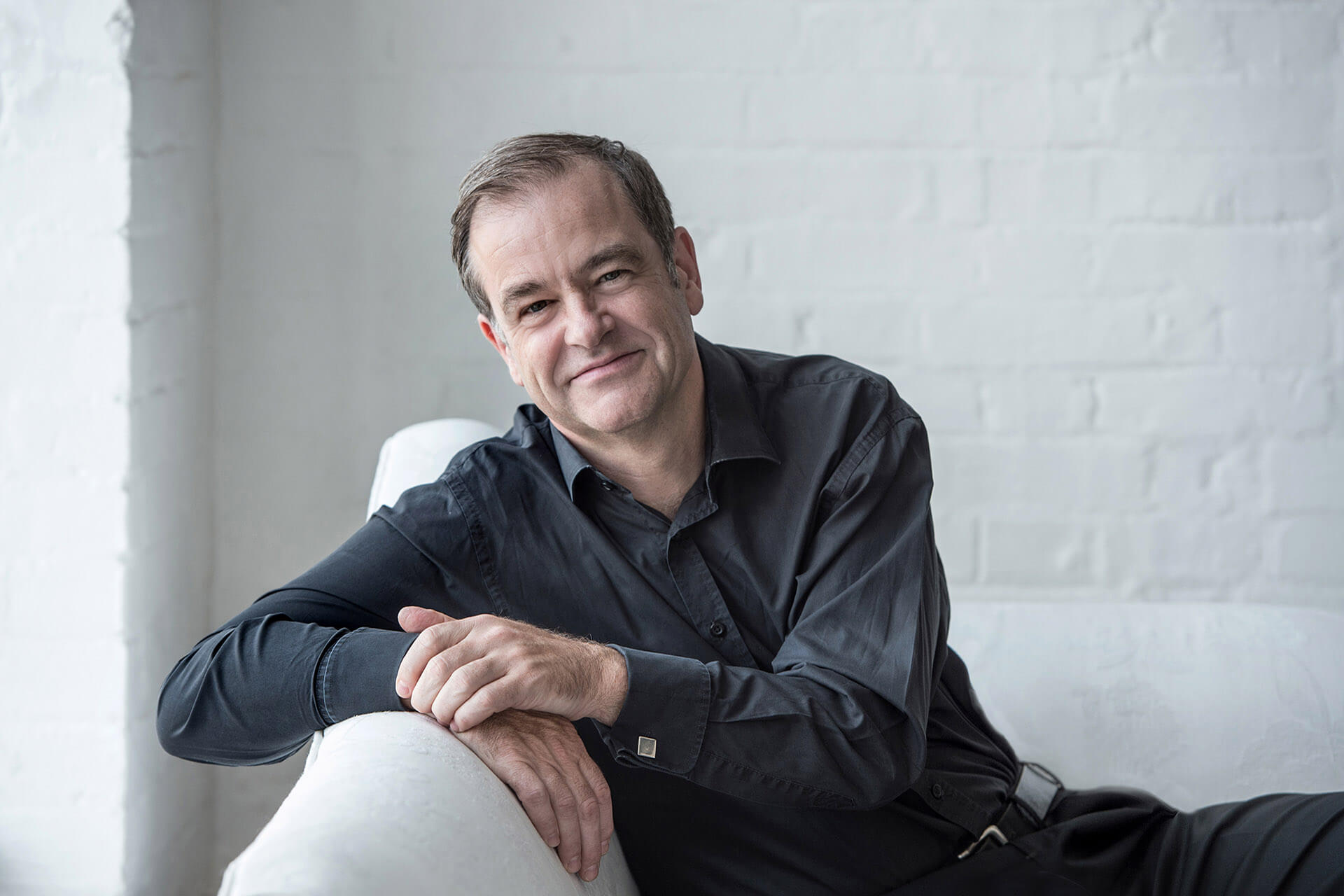
Julius Drake, piano
Adam Gopnik, narrator
Cristina Garcia Martin, animations
Theresa L. Kaufmann Concert Hall
92nd Street Y
New York, NY
January 22, 2020
Beethoven: An die ferne Geliebte, Op. 98
Brahms: Romanzen aus L. Tieck’s Die schöne Magelone, Op. 33
If Beethoven didn’t invent the song cycle, surely he was the first great composer to embrace such a structure with his modest yet nonetheless epochal An die ferne Geliebte. In this 250th anniversary of Beethoven’s birth year, all the installments of 92Y’s vocal series include the aforementioned in concert with an entry from the immense body of work it spawned: Roderick Williams and Julius Drake’s Wednesday evening recital paired it with Brahms’ Die schöne Magelone. Before diving in to the Beethoven archetype, the affable Williams addressed the audience with some musings about what constitutes a song cycle, humorously noting that one such distinction is the point at which one applauds.
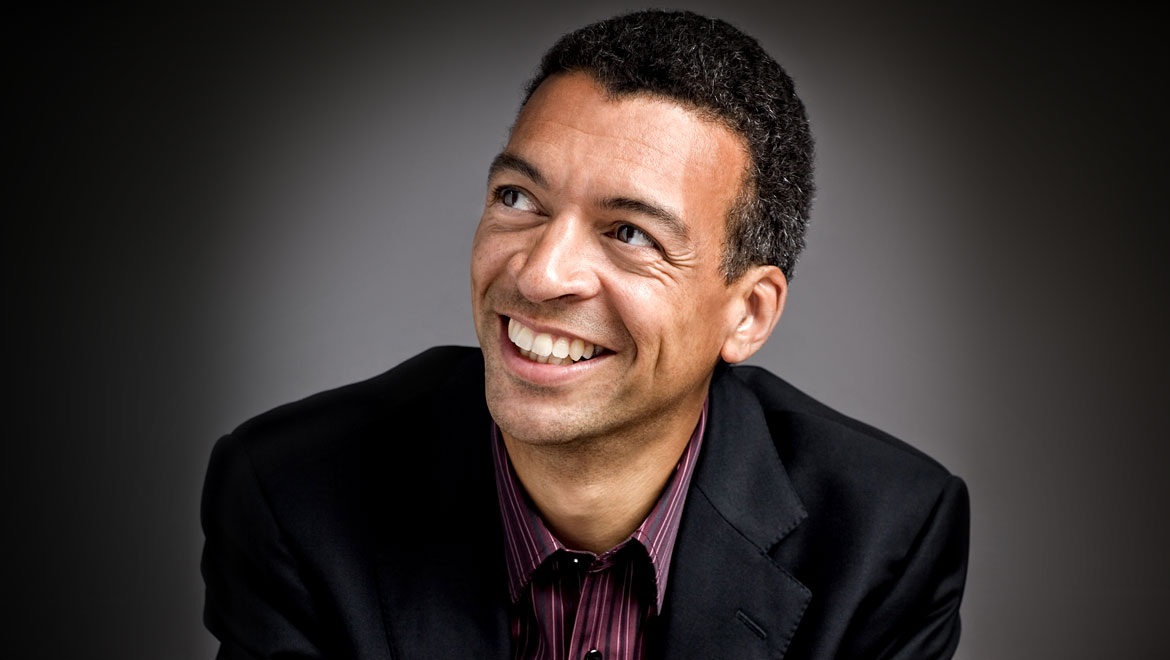
Roderick Williams, photo credit Groves Artists
The six songs that comprise An die ferne Geliebte barely stretch a quarter hour, but they say much in little – tautly constructed, and with ingenious transitions in the piano to connect each song to its successor in a continuous arc. Williams’ razor-sharp German diction served to convey the wistfulness in the opening Auf dem Hügel sitz ich spähend, as did the longing appoggiaturas from the keyboard. A texture of roiling triplets marked Leichte Segler in den Höhen, delivered with a lightness of touch though matters grew darker along with the clouds depicted. The closing Nimm sie hin denn, diese Lieder counted as a further highlight in its sonorous resound in conveyance of deep Sehnsucht, with a recurrence of the material from the first song bringing things to a satisfyingly cyclical close.
The rather more extensive Magelone songs – which the program notes rightfully called a “neglected masterpiece” – were given an ambitious multimedia treatment. Brahms asked for portions of Tieck’s prose (published in the late 18th century, drawing on a legend that dates from medieval France) to be read between songs – in many regards, a necessity given the cumbersome narrative and that not all songs are from the protagonist’s point of view. Writer and essayist Adam Gopnik served as a fine narrator, delivering Tieck’s florid text in an English translation by Williams. Additionally, during the narrations, animations by Cristina Garcia Martin were projected, illustrating the tale on a colorful and stylish canvas, and at their best, obviating the need for the audience to meticulously follow along with texts and translations.
The opening Keinen hat es noch gereut was a courtly affair of rollicking energy, while the succeeding Traun! Bogen und Pfeil showed the performers at their most defiant, with Drake offering some extrovert playing, handily surmounting Brahms’ thorny piano writing. Wie soll ich die Freude was a touchingly lyrical expression of bliss and joy – this fairy tale with an eventual happy ending so much the opposite of the tragic depths favored in the Romantic era song cycles – and served as a logical break before the intermission. Wir müssen uns trennen offered delicate imitation of the lute, and here was a clear case where the narration and animation helped frame the song in context – otherwise one might well have been left wondering why at this point the protagonist was singing a heartfelt goodbye to a lute.
By the same token, given the improbability of this fairy tale narrative, I couldn’t help but wonder if these extramusical interjections were altogether necessary – perhaps it is more fruitful to eschew any distractions from a convoluted plot and instead allow the audience to zero in on the exquisitely crafted music in of itself. Wie schnell verschwindet was the first real instance of melancholy, and quite movingly so, but countered in due course by the coquettishness of Sulima. Williams and Drake gave the penultimate Wie froh und frisch mein its requisite heroism, and the closing Treue Liebe dauert lange was a hymn to the power of true love, with Williams’ rich baritone resonating stately and pensive.
Cleveland Orchestra
Herbert Blomstedt, conductor
Severance Hall
Cleveland, OH
July 27, 2018
Brahms: Symphony No. 4 in E minor, Op. 98
The opening Summers@Severance evening for this season saw the return of Herbert Blomstedt, remarkably now 91 years old but hardly flagging in vitality. Draped in a white coat, he dressed the part of the elder statesman that he is, masterfully leading the orchestra in a single work, namely Brahms’ Fourth Symphony. Tonight sees him reprise the program at Blossom with the addition of Mozart’s Jupiter – while I wished that or at least an overture could have padded out Friday’s brief program, the gripping performance certainly mitigated the desire for more music.
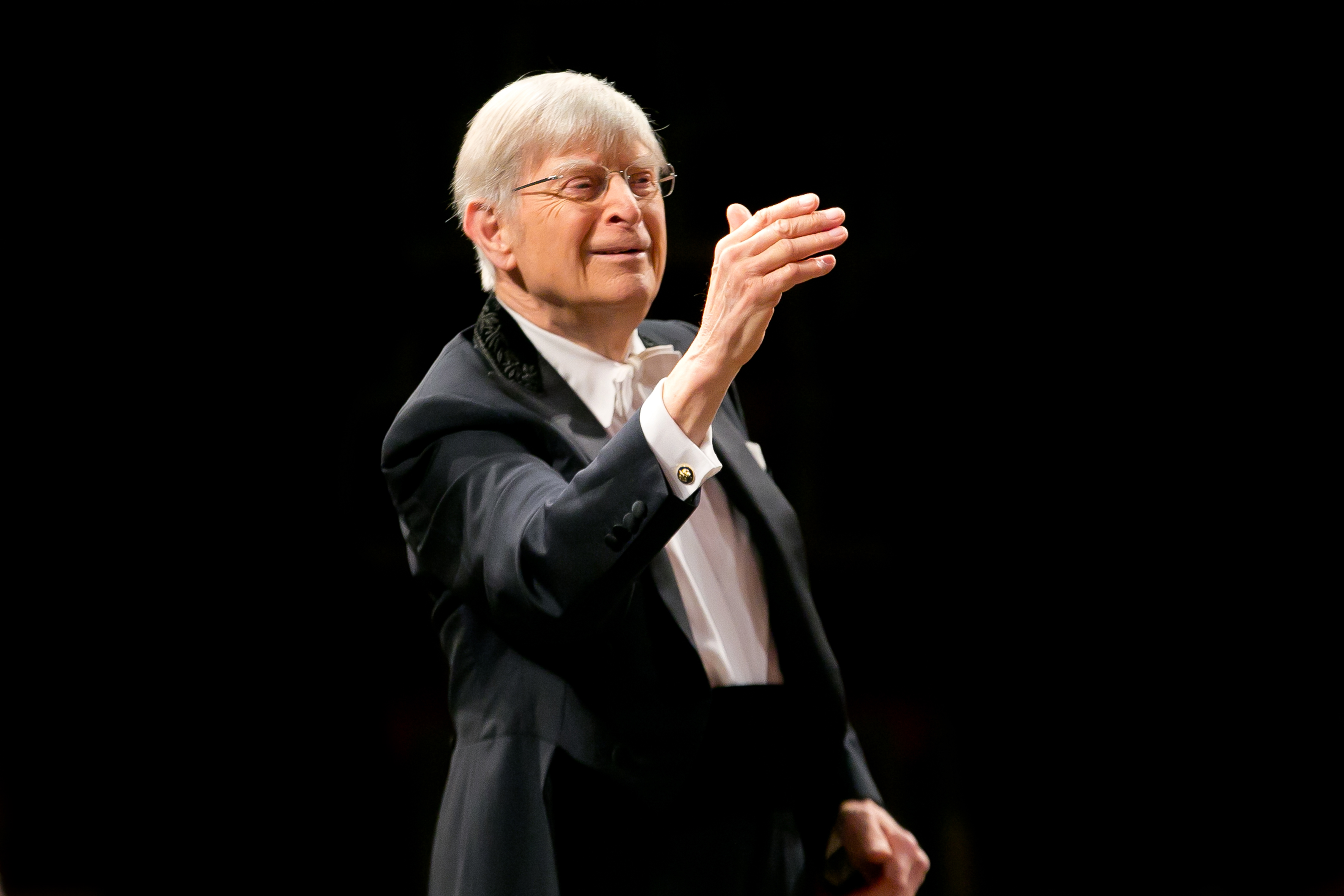
Herbert Blomstedt, photo credit Gert Mothes
Blomstedt’s graceful, batonless conducting produced the gentle rise and fall of the primary theme, and the balance he achieved was quite idiosyncratic – rather than opting for a homogenized sound, each instrument family was clearly delineated in a striking array of coloristic variety. During the development, the main theme resurfaced as a stentorian skeleton of itself to mesmerizing effect, and matters built to searing passion and heightened drama. An arresting horn call opened the slow movement, only to give way to graceful and peaceful plodding, rallying to vigor as needed. A fine clarinet solo from Daniel McKelway was a memorable highlight.
The scherzo was given a spirited workout, gleaming with brassy exuberance and the unmistakable ring of the triangle. A progression of eight deftly sculpted chords served as the bedrock of the imposing passacaglia finale. Prominent roles for each instrument abounded in the movement’s intricacies, almost like a concerto for orchestra, and Blomstedt guided his colleagues to a blistering conclusion.
In other Cleveland Orchestra news, concertmaster William Preucil was officially suspended earlier in the day in response to multiple allegations of sexual assault, right on the heels of a major exposé in The Washington Post detailing assault in classical music circles. As noted in the linked article, some of these allegations have been public for over a decade – I was relieved to hear of some decisive action taking place, overdue as it might be.




 quasi-faust