Masterful Brahms and completion of Prokofiev cycle at The Cleveland Orchestra

Cleveland Orchestra
Franz Welser-Möst, conductor
Daniil Trifonov, piano
Mandel Concert Hall
Severance Music Center
Cleveland, OH
October 9, 2025

Prokofiev: Symphony No. 7 in C-sharp minor, Op. 131
Brahms: Piano Concerto No. 2 in B-flat major, Op. 83

Encore:
Prokofiev: No. 20 from Visions fugitives, Op. 22

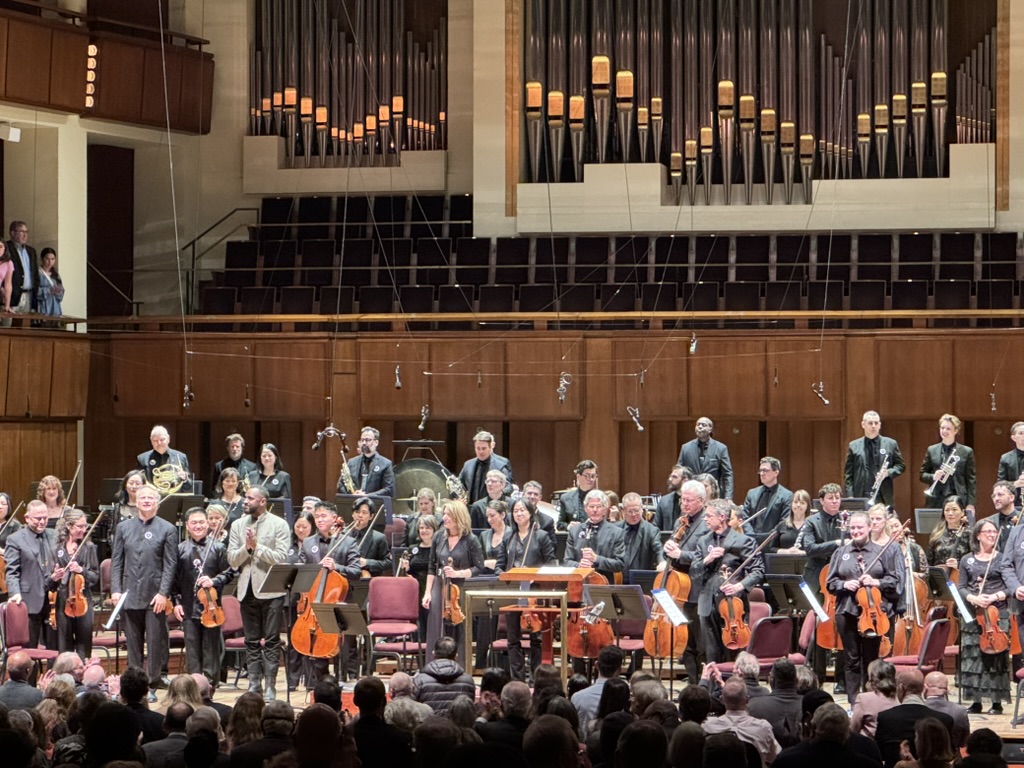
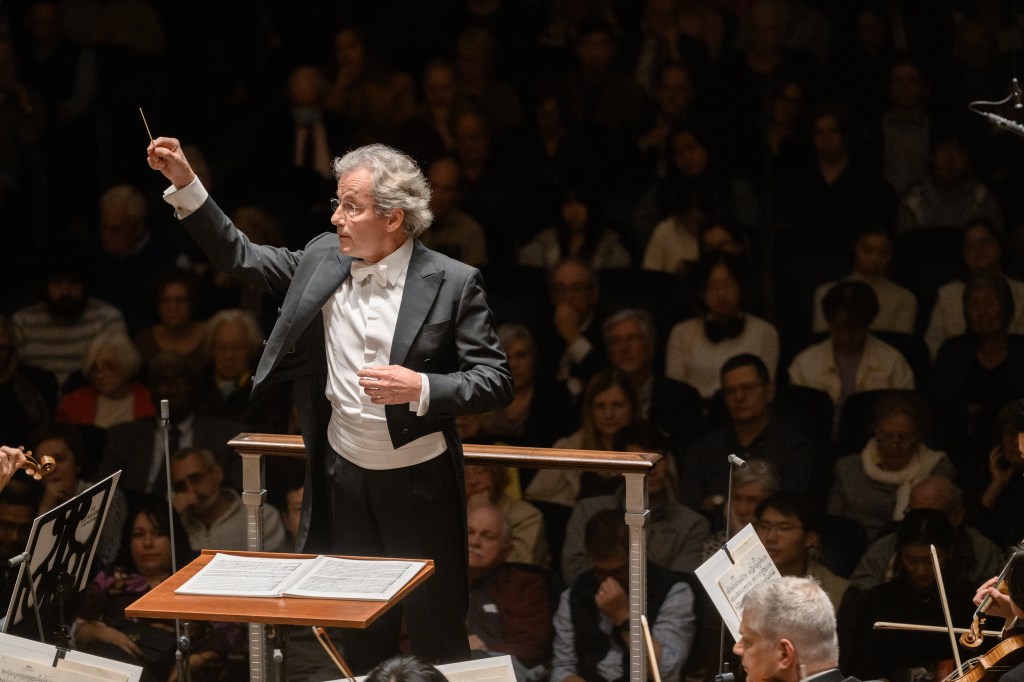
I’ve been intrigued by Franz Welser-Möst’s endeavor to perform and record all seven of the Prokofiev symphonies with The Cleveland Orchestra. After some eight years, that cycle came to fruition this weekend with the enigmatic Seventh Symphony, the last major work the composer completed. Only the First and Fifth of these symphonies are performed with any regularity, so it’s been a welcome opportunity to discover the rest — though the quality can be uneven.

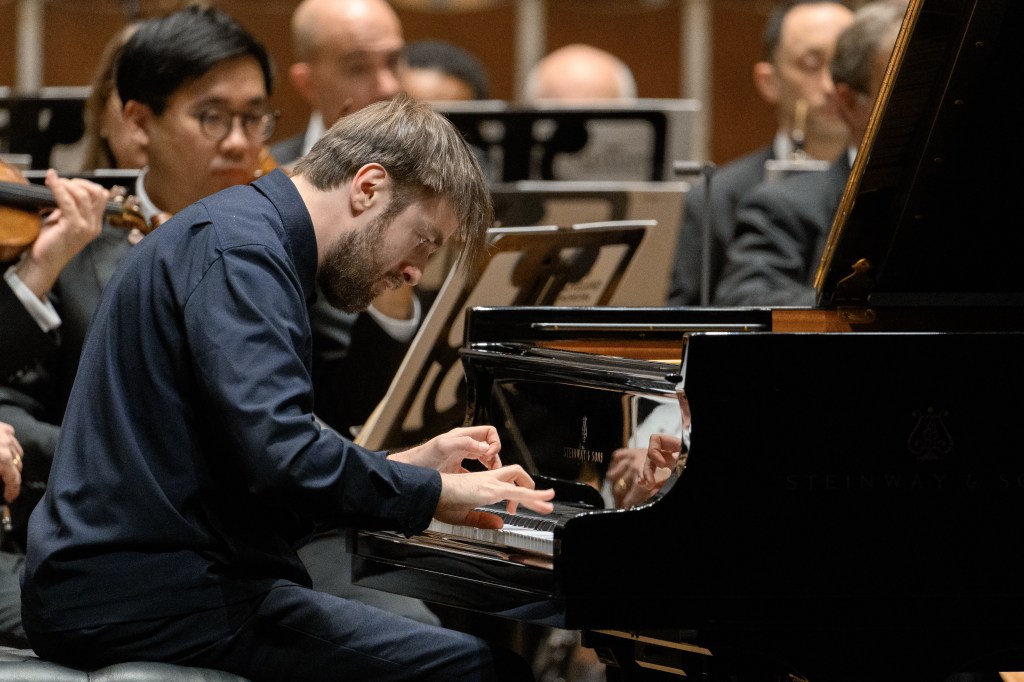
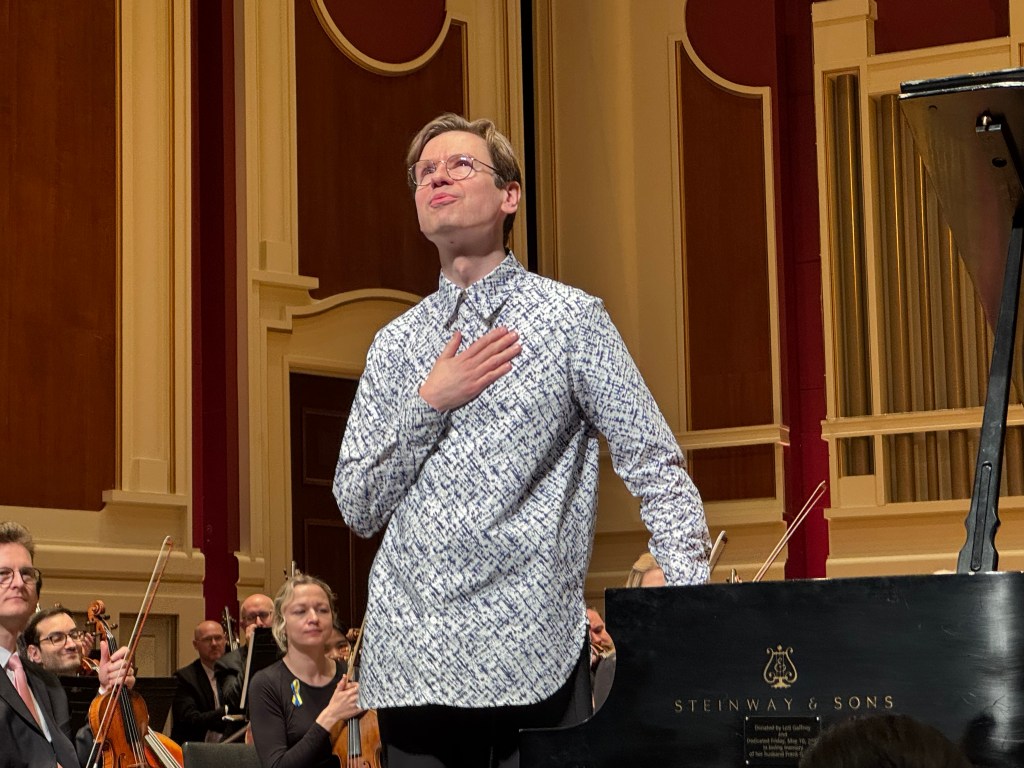
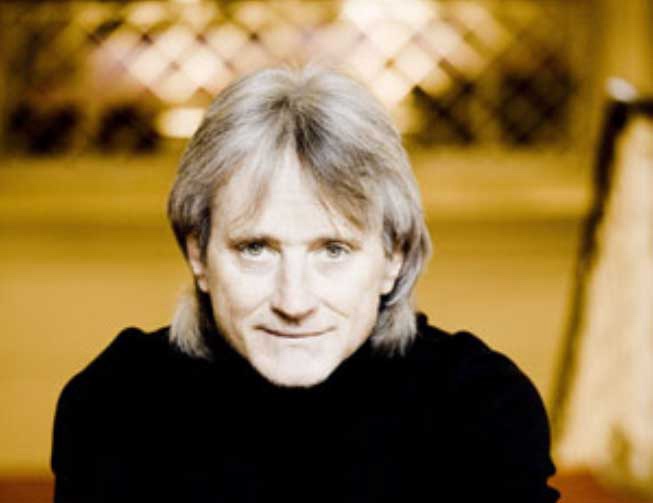
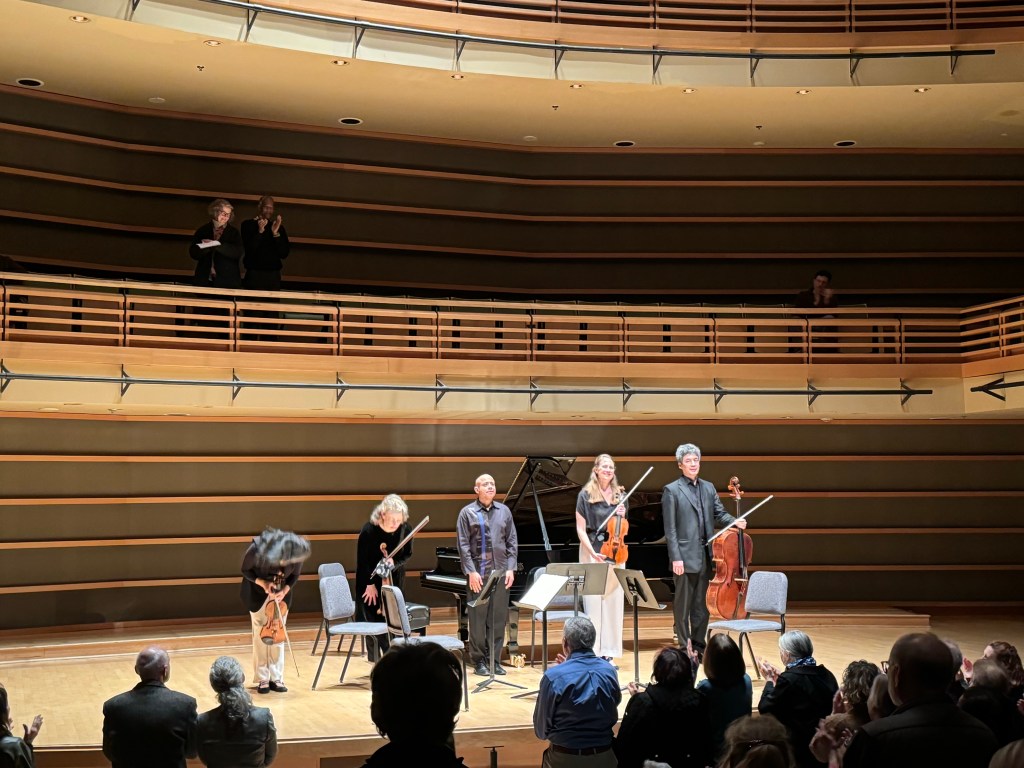
Daniil Trifonov performs Brahms with The Cleveland Orchestra. Photos credit Human Artist / Yevhen Gulenko

Moderately-paced material opened the work in the unusual key of C-sharp minor (common in the piano literature, rare for the orchestra), somewhat mysterious in character in the way that composers’ late works often are. The lyricism was straightforward and unadorned, but what stood out were the striking instrumental combinations, spattered with liberal use of the glockenspiel. A scherzo followed with vestiges of a waltz. A bit spikier than the restrained opening, it was still generally reserved until the boisterous close.

In the Andante espressivo, one was reminded of the poignant lyricism in Prokofiev’s ballet scores, contrasted by the playful and rather sardonic finale. The composer revised the original quiet ending for a bombastic one in an attempt to better appease the Soviet authorities, but was to said to have preferred the original — a preference which Welser-Möst rightfully respected in these performances.

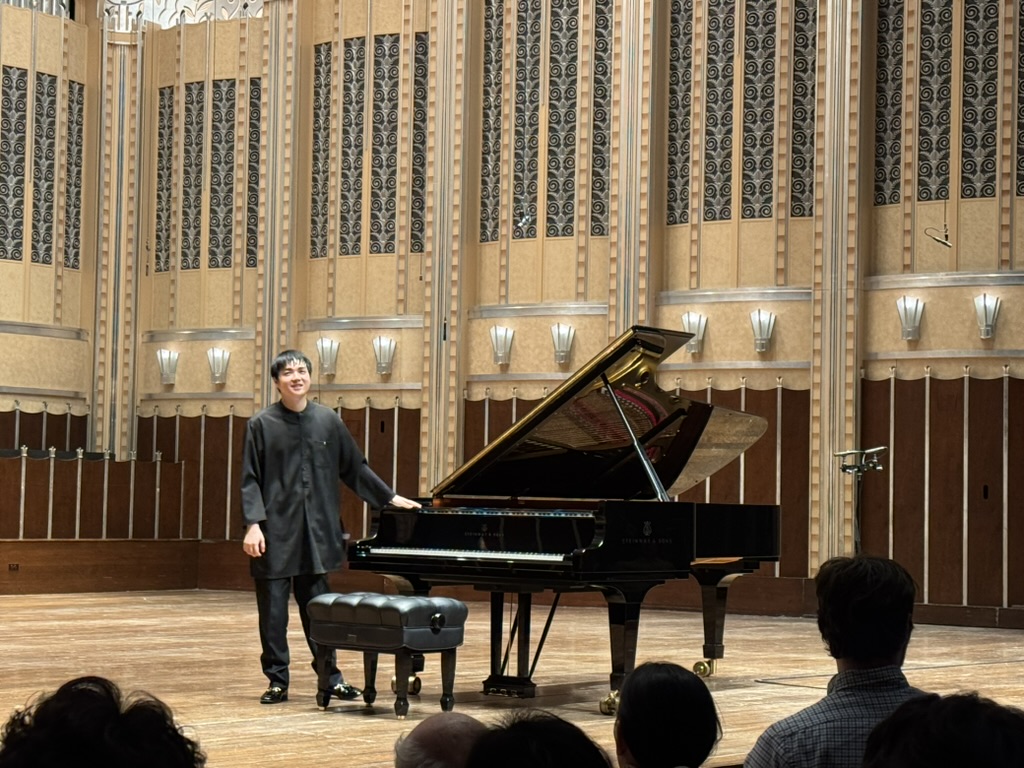
Having been educated at the Cleveland Institute of Music on the precipice of his meteoric rise, pianist Daniil Trifonov remains a local favorite. He served as a probing soloist in Brahms’ daunting Second Piano Concerto (a follow up to his performance of the First two seasons ago — so effectively, another cycle came to a close Thursday evening). An amber horn call opened to herald the gentle arpeggios that rolled across the keyboard. Right at the beginning there was a solo cadenza which put Trifonov’s bold sound and rich tone on full display. An impassioned performance, he conceived the spacious first movement in broad strokes, with piano and orchestra functioning as equal partners in a work that’s perhaps more symphony than concerto.

Though the two works on this program had little in common, they mirrored each other in terms of structure, so as with the Prokofiev, a scherzo followed ahead of the slow movement. Brahms’ was generally a sunny affair though not without discord, played with a driving intensity that was briefly abated during the gentler trio and a passage of ravishing lyricism. Principal cellist Mark Kosower opened the Andante with a gorgeous solo, also serving to give the pianist a momentary but well-earned rest. This slow movement made for a serene moment in an otherwise energetic work. And despite the weight and seriousness of the preceding, the closing movement was of joyous abandon.

As an encore, Trifonov fittingly returned to the composer that opened the evening in Prokofiev, namely the last of the Visions fugitives, a suite of twenty artfully crafted miniatures for piano (the pianist performs the whole set on his recital programs this season). A touching way to bring the evening full-circle.

Víkingur Ólafsson makes magnificent Pittsburgh Symphony debut with impassioned Brahms

Pittsburgh Symphony Orchestra
Manfred Honeck, conductor
Víkingur Ólafsson, piano
Heinz Hall
Pittsburgh, PA
April 27, 2025

Jani: Flare
Beethoven: Symphony No. 1 in C major, Op. 21
Brahms: Piano Concerto No. 1 in D minor, Op. 15

Encores:
Rameau/Ólafsson: The Arts and the Hours
Rameau: Le Rappel des oiseaux

With a Grammy award, an extensive discography, and appearances with the world’s leading orchestras and at the most prestigious concert halls, it’s a bit surprising it’s taken until 2025 for Icelandic pianist Víkingur Ólafsson to debut with the Pittsburgh Symphony. It was worth the wait, however, as he treated Pittsburgh audiences to an arresting, majestic performance of Brahms’ brooding First Piano Concerto (though he was originally scheduled to perform the Second Concerto).

Víkingur Ólafsson at the Pittsburgh Symphony

There was dramatic tension from bar one, with a dark and impassioned orchestral introduction. Ólafsson entered by way of a dulcet chorale, scaling to ferocious tremolos. He purveyed a bold and commanding tone, showing that music of great technical demands can be wholly devoid of showy virtuosity. A thoughtful and probing interpreter, Ólafsson’s absorption in the music was absolute, even bobbing his head during the orchestral interludes like a bona fide rockstar before the expansive first movement reached a bleak, uncompromising close.

The central Adagio was plaintive and filled with longing, and the pianist’s deft voicing and phrasing brought out a resonant lyricism. A ferocious fugato marked the closing rondo finale, with both pianist and orchestra seemingly running on endless reserves of dramatic energy. From the piano bench, Ólafsson eyed his orchestral colleagues with joy and admiration — there was some impressive contrapuntal playing to be heard — and the long journey pointed to a triumphant end.

With charismatic charm, Ólafsson addressed the audience and expressed his gratitude to be in Pittsburgh, reminiscing how impressed he was by the PSO’s playing when he caught them during a performance in Berlin in 2013 (reviewed by a colleague here). He generously offered a pair of encores, both by Rameau — his own transcription styled as The Arts and the Hours from Rameau’s final opera (Les Boréades), and the intricate gem Le Rappel des oiseaux. An impressive way to cap off the most significant local debut of the season.

The program began with the 2021 work Flare by German composer Sophia Jani. Loosely drawing inspiration from the poetry of Mary Oliver, Flare was of a colorful soundscape. Clangorous brass formed the backbone of the work, building to bold climaxes in a style that seemed to be a nod towards film scores.

Beethoven’s First Symphony rounded off the program — if there’s a connective thread, all three works program were by German composers, and all counted as one of their composers’ earliest forays into writing for orchestra. A work very much in Manfred Honeck’s wheelhouse, the weight of the introductory material in the youthful C major symphony gave way to buoyant textures that effervesced — though the development was not without fire and drama. The slow movement was articulate with careful detailing of the rhythmic inflections. Wholly at peace and untroubled, but contrasts were sharpened to add tension. A minuet sparkled with exuberance, a warmup for the boisterous finale, with perhaps the occasional hint to the dramatic style the composer would soon develop.

Ólafsson and Wang dazzle in spectacular two piano recital

Yuja Wang, piano
Víkingur Ólafsson, piano
Mandel Concert Hall
Severance Music Center
Cleveland, OH
February 23, 2025

Berio: Wasserklavier (No. 3 from Six Encores)
Schubert: Fantasie in F minor, D940
Cage: Experiences No. 1
Nancarrow: Study No. 6 (arr. Adès)
Adams: Hallelujah Junction
Pärt: Hymn to a Great City
Rachmaninoff: Symphonic Dances, Op. 45

Encores:
Brahms: Waltz in A-flat major, Op. 39 No. 15
Dvořák: Slavonic Dance in E minor, Op. 72 No. 2
Brahms: Hungarian Dance No. 1 in G minor
Brahms: Waltz in E major, Op. 39 No. 2
Brahms: Waltz in G-sharp major, Op. 39 No. 3

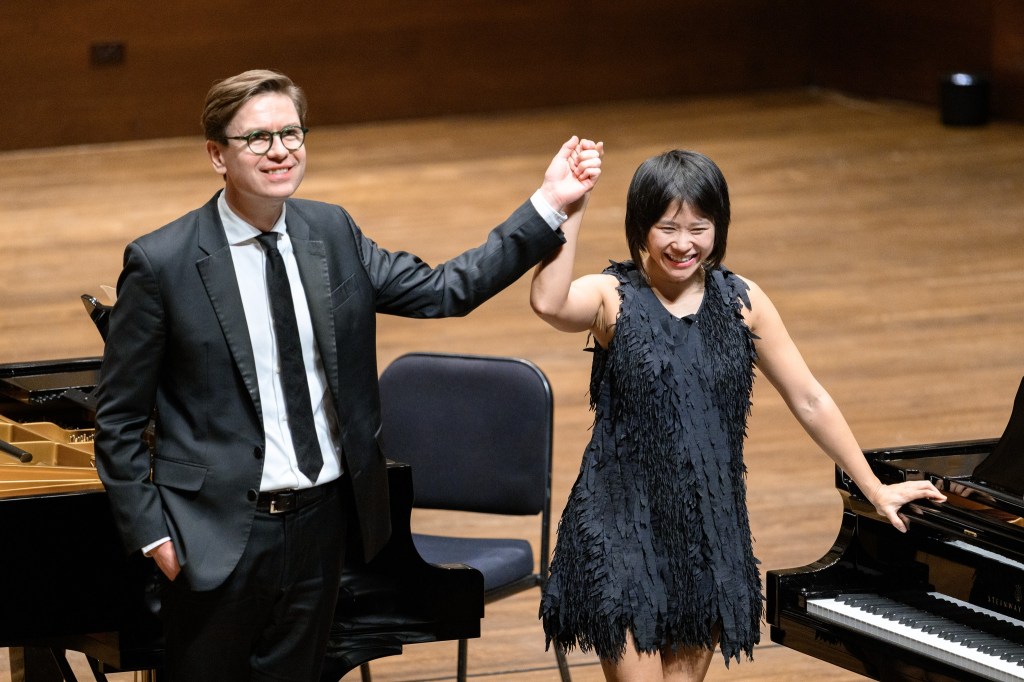
Sunday afternoon marked a remarkable high point in The Cleveland Orchestra’s immensely rewarding recital series, with pianists Yuja Wang and Víkingur Ólafsson joining forces in a stop at Severance Hall on a brief US tour. Both superstar soloists in their own right, it was truly electrifying seeing these two band together. Yet this was more than just a celebrity pairing calculated to maximize box office receipts: their artistic temperaments complemented each other well, showing the whole can be greater than the sum of its parts.

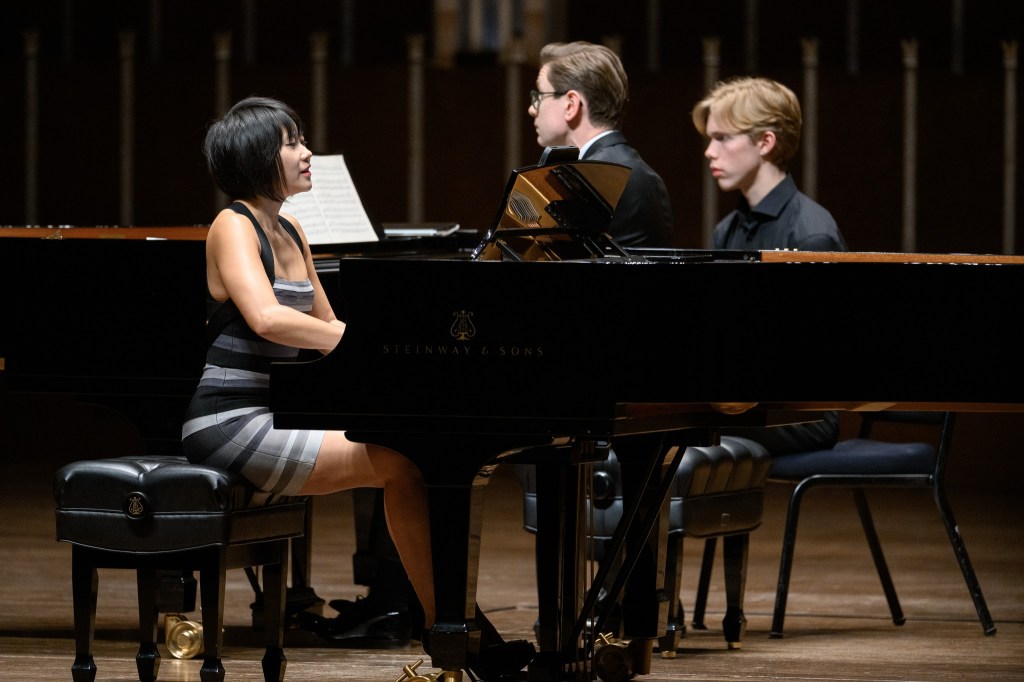
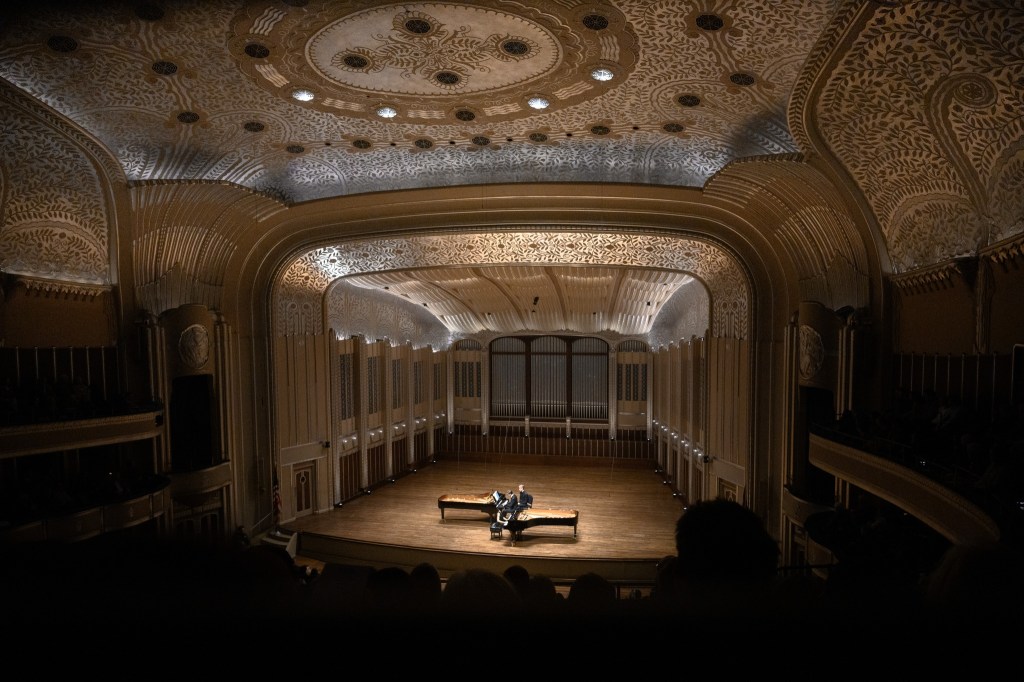
Víkingur Ólafsson and Yuja Wang at Severance Hall, photos credit Human Artist Photography + Cinema 

The program was ripe with discovery, skirting some of the more commonly played fare for two pianos. Luciano Berio’s Wasserklavier began, a meditative opening with liquescent textures freely flowing. The piece made subtle nods to Brahms and Schubert, and fittingly, the pianists artfully segued directly into the latter’s own Fantasie in F minor. Usually played four hands on a single piano, hearing it spread across two instruments gave the work a greater resonance and depth of sound.

Crisply articulated dotted rhythms began, plunging into penetrating drama — rarely will one hear Schubert played with such intensity. Dance-like sections contrasted, exuding joy with the twenty fingers at work, intricately choreographed. A fascinating selection of works from the late 20th-century followed, beginning with John Cage’s Experiences No. 1. The composer’s characteristic minimalist textures were piquantly harmonized, punctuated by silence.

The sixth of Conlon Nancarrow’s 49 studies for player piano followed, made humanly playable in its two-piano arrangement by Thomas Adès (who local concertgoers had the chance to see conduct a remarkable Cleveland Orchestra program just the night before). In this case, the two pianos seemed to be at odds with one another, yet the jagged rhythms fit together in interlocking fashion.

The first half closed with John Adams’ Hallelujah Junction, to my mind, the highlight of the program. Pulsating energy filled Severance Hall with pianistic brilliance. Music of almost perpetual motion — quite a contrast to the minimalism of Cage — gave a larger-than-life portrayal of the namesake town on the California-Nevada border, and demonstrated in no uncertain terms the electric chemistry between these two pianists. The more lyrical pulses of a downtempo section captivated in their rhythmic intricacies, only to build back up to a dazzling density of sound.

Arvo Pärt’s Hymn to a Great City was marked by Wang’s playing in the upper register that rang with the purity of bells, and some delicate filigree that decorated the otherwise barren textures. Rachmaninoff’s Symphonic Dances — his final work — closed the printed program. Hammering out the main theme with pile-driving intensity, an almost manic energy between the two created a rich orchestral sonority. Yet matters were still clear and articulate, with a contrasting theme of haunting lyrical beauty. Sultry waltz rhythms in the central dance were given with stylish playing, and the finale was bold and grandiose, with broad gestures cascading spectacularly.

No less than five encores followed, a delightful selection of dances by Brahms and Dvořák, performed on a single piano, four hands. A charming, convivial close to a memorable afternoon.

Escher Quartet and Jordan Bak open Chamber Music Pittsburgh season

Escher Quartet
Jordan Bak, viola
PNC Theatre
Pittsburgh Playhouse
Pittsburgh, PA
October 21, 2024

Barber: String Quartet in B minor, Op. 11
Price: String Quartet No. 2 in A minor
Brahms: String Quintet No. 2 in G major, Op. 111

Opening the 2024-25 season of Chamber Music Pittsburgh was the New York-based Escher Quartet — an ensemble whose last local appearance was a streamed performance without audience during the covid lockdown. Euro-centric a tradition as the string quartet may be, the Escher’s program interesting opened with two American works, beginning with Samuel Barber’s youthful entry in B minor.

Escher Quartet with Jordan Bak, photo credit Chamber Music Pittsburgh

Terse, rapid gesture were given with singular intestity, interspersed with more lyrical material. The central Molto adagio would later become the iconic, standalone Adagio for Strings — and how fascinating it was to hear it in its original context, blanketed by contrasting outer movements. Far less saturated than the later expansion for string orchestra, it allowed one to better take note of its intricacies, particularly the melody for viola. The music grew to the impassioned, only to fade to somber quietude. Barber here was at his most neo-Romantic, sharply diverging from the stark modernism that opened. A brief finale followed without pause, at first recalling the gestures of the beginning, but then taking a life of its own in a brief but blistering coda.

The opening of Florence Price’s Second Quartet had a distinctive, recognizably American sound, balancing erudite sophistication with a certain down-to-earth abandon. A genial and gracious melodic line was tinged with folk tradition, and the slow movement that followed was a songful interlude, seemingly at peace with the world. A Juba movement is a device Price often used, and here it took the usual place of the Scherzo. Given without inhibition, bluesy harmonies and vibrant syncopations made for a delightful listen. The finale saw heightened drama, showcasing Price’s compositional skill with its coruscating counterpoint. An impressive close to the American half of the recital, and the Eschers served as strong advocates for Price.

Quartet then became quintet with the addition of violist Jordan Bak, affording the Pittsburgh audience the opportunity to hear Brahms’ expansive G major string quintet. The composer originally envisioned the work as his fifth symphony, and the vestiges of symphonic heft were evident from the grand sweep of the opening. A singing theme added contrast, with the addition of the second viola making matters all the more lovely. Bak blended well with the quartet, and the combined forces offered mastery of the work’s large-scale form.

A pizzicato bass line from the cello was a striking effect in the serene Adagio, as was a richly articulated melodic line in the first violin. The hesitating gesture in the penultimate movement gave it a certain autumnal quality, fitting for a work from late in the composer’s life, but the finale was a playful affair, hardly dour, with a bold and bracing finish fitting for a work of such proportion.

ProMusica celebrates a decade of artistic partnership to close season

ProMusica Chamber Orchestra
David Danzmayr, conductor
Vadim Gluzman, violin
Southern Theatre
Columbus, OH
May 11, 2024

Silvestrov: Hymn – 2001
Tchaikovsky: Violin Concerto in D major, Op. 35
 Encore:
 Bach: Sarabande from Violin Partita No. 2 in D minor, BWV 1004
Brahms: Symphony No. 2 in D major, Op. 73

There was a celebratory air to ProMusica’s closing performances of their 45th season in marking a decade of having both David Danzmayr and Vadim Gluzman in the fold as music director and creative partner respectively. As has become tradition, the final weekend was opened with a short performance by students from the Play Us Forward program – this year, an excerpt from Vivaldi’s Autumn – celebrating ProMusica’s impact in the greater Columbus community.

Vadim Gluzman performs with David Danzmayr and ProMusica, photo credit ProMusica

Valentin Silvestrov’s Hymn – 2001 began ProMusica’s program with a lush essay for string orchestra. There were fine solo passages from concertmaster Katherine McLin and principal second violin Jennifer Ross. Meaning was also drawn from punctuated moments of silence, with the Ukrainian composer acknowledging Cage’s 4’33” as an inspiration for this lyrical paean.

Tchaikovsky’s evergreen Violin Concerto served as the evening’s centerpiece, and put on full display the collaborative spark between Danzmayr and Gluzman. It’s a particular pleasure to see Gluzman play this work as he performs on a violin once owned by Leopold Auer, the concerto’s original dedicatee – in other words, the very violin this concerto was written for. I have fond memories of Gluzman performing this work with The Cleveland Orchestra and the late Michail Jurowski a few years ago – a privilege to hear this instrument in this work again.

Matters began with graceful charm, and the violinist filled the Southern with a resonantly lyrical tone. Gluzman gave an impassioned performance, and I was often simply in awe of the sound he drew from his storied instrument (Tchaikovsky must have liked it too!). Fleet fingers pulled off the more rapid passegework, further encouraged by a taut communication with Danzmayr, the product of a fruitful decade.

A choir of winds opened the central slow movement, and Gluzman answered with a long-bowed, somber melody, an articulate dialogue between soloist and orchestra. The finale was of rapid fire excitement, though a downtempo section of distinctly Slavic inflection contrasted before the blistering finish. An enthusiastic ovation brought the violinist back for an encore by Bach, a lovely pendant to the concerto, with Gluzman noting it an apropos choice given Silvestrov’s affinity for Bach.

Last season closed with a Brahms symphony, a feat reprised this past weekend with attention turned to the sunny Second. Once again, ProMusica, buttressed by an expanded string section, proved that the Brahms symphonies can be convincingly performed by a chamber-sized orchestra. A dip in the strings opened, warmly answered by horns and winds, with a particularly rich theme in the cellos to follow. Danzmayr opted out of the long repeat of the exposition, delving right into the energetic development. The slow movement proceeded as a beautifully lyrical paragraph, though seemingly all cares were left behind for the Allegretto grazioso, given with an abandon that was only a warmup for the jubilant finale.

Goerne and Kissin join forces for an afternoon of song

Matthias Goerne, baritone
Evgeny Kissin, piano
Mandel Concert Hall
Severance Music Center
Cleveland, OH
April 14, 2024

Schumann: Dichterliebe, Op. 48
Brahms: Four Ballades, Op. 10
Brahms: Sommerabend, Op. 85 No. 1 
Brahms: Mondenschein, Op. 85 No. 2 
Brahms: Der Tod, das ist die kühle Nacht, Op. 96 No. 1 
Brahms: Meerfahrt, Op. 96 No. 4
Brahms: Lieder und Gesänge, Op. 32

Encore:
Schumann: Mein Wagen rollet langsam, Op. 142 No. 4

In the this season’s final installment of Severance Music Center’s admirable recital series, two artists who exemplify their instruments came together for an intimate lieder recital: baritone Matthias Goerne and pianist Evgeny Kissin. On a side note, it’s lovely to see Kissin become a more regular presence in Cleveland following his return after a long absence – and he is on tap for next season’s recital series as well.

Evgeny Kissin and Matthias Goerne at Severance Music Center

The first half was devoted to Schumann’s epochal song cycle Dichterliebe. Sixteen songs go by in a flash as quicksilver vignettes, each occupying a rarefied state that we only get to visit for a fleeting moment. Goerne’s vocal command showed this to be a work firmly in his repertoire, and Kissin responded in kind with probing accompaniment. Though a month premature, the opening Im wunderschönen Monat Mai began matters gentle and longing, only to be upended by the subsequent Aus meinen Tränen sprießen which contrasted in its melancholy. The thunderous Im Rhein, im heiligen Strome was a standout, answered by the familiar Ich grolle nicht, given an exultant and impassioned reading, anchored by the pianist’s bass octaves. As the most extended song of the set, the closing Die alten, bösen Lieder was powerful and bracing, only to close with pensive postlude for piano alone.

The latter half gave Kissin a moment in the spotlight, opening with Brahms’ four Ballades for solo piano – and for this listener, the highlight of the afternoon. The first, nicknamed Edward after the eponymous Scottish poem, was a stately, almost royal, processional, building to a powerful climax – especially so for such a brief work. In the chordal passages, Kissin’s nuanced voicing yielded a wondrous effect. The second followed a similar trajectory, with gentle beginnings giving way an animated, march-like central section. The following ballade was rather more animated, inflected by Hungarian rhythms (a Brahms favorite), while the final piece was Schumannesque in its poetry, languorous and lyrical, rapturously beautiful under Kissin’s hands.

Lieder by Brahms filled out the balance of the program, a composer whose path used Schumann’s influence as a signpost to discover his own individual voice. Four settings of Heinrich Heine (the poet of Dichterliebe) were culled from opp. 85 and 96. The pair captured the sultry atmosphere of Sommerabend; the closing line “Schimmern in dem Mondenscheine” made for a seamless segue to Mondenschein wherein the luminous moonlight dispelled the darkness. Meerfahrt, by comparison, was a stormier affair.

The nine Lieder und Gesänge of opus 32 were given a deeply expressive reading, evident from the opening Wie rafft’ ich mich auf in der Nacht, further conveyed by the substantial piano accompaniment. Two distinct poets were traversed across the set (August von Platen and Georg Friedrich Daumer), making it not quite as cyclical and coherent as Dichterliebe, but arguably a work which probed greater range and variety. Wehe, so willst du mich wieder made for an emphatic midpoint ahead of the sorrowful Du sprichst, daß ich mich täuschte. Peace was found, however, in the closing Wie bist du, meine Königin, arriving at a blissful state not unlike where the recital began with Im wunderschönen Monat Mai.

The duo returned full circle to Schumann for the lone encore of the late song Mein Wagen rollet langsam, wherein gently flowing textures were countered by more urgent martial material.

Pianist Claire Huangci returns to Columbus Symphony with Tchaikovsky

Columbus Symphony Orchestra
Carl St. Clair, conductor
Claire Huangci, piano
Ohio Theatre
Columbus, OH
February 23, 2024

Wineglass: Alone Together
Tchaikovsky: Piano Concerto No. 1 in B-flat minor, Op. 23
 Encore:
 Gershwin/Wild: Embraceable You
Brahms: Symphony No. 4 in E minor, Op. 98

Last weekend’s Columbus Symphony concerts brought forth guest conductor Carl St. Clair, currently – and remarkably – in his 34th season as music director of the Irvine, California-based Pacific Symphony. Headlining the performance was pianist Claire Huangci, returning to the Ohio Theatre following a memorable debut two seasons ago. Prefacing the pianistic centerpiece was a local premiere by John Wineglass, perhaps best known for his work in television scoring – most notably for All My Children, garnering him six Emmy nominations.

Carl St. Clair, photo credit pacificsymphony.com

Alone Together dates from 2021, in the throes of the pandemic, and was premiered virtually by St. Clair and his California ensemble on the first anniversary of the murder of George Floyd. Scored for strings, harp, and percussion, it documents a challenging time in recent history (a recording may be heard here). The opening “Strange Pandemic Times” was marked by unsettling harmonics, though generally lushly tonal and reflective. A pulsating drum ominously sounded, taking a darker turn before the closing “A Ray of Hope.” The harp had a calming effect and introduced an appealing melody, but ultimately felt to this listener more akin to “feel-good” music than a work that fully captured the depth of the subject matter.

Tchaikovsky’s evergreen First Piano Concerto was a fitting platform for Huangci’s virtuosity. A bold, brassy opening pointed to the thunderous chords in the piano, but I found the pianist’s approach perplexing at best. She was wont to rapidly release her hands from the keyboard, almost as if the keys were hot to the touch. Not only did this make for an odd visual, but the tone yielded was rarely more than surface-level, inadequate to project over the large orchestra and throughout the cavernous theater – especially apparent in the rapid double octaves which came off rather feeble. Still, I found her technique impressive and effective in the elegant cadenza.

The Andantino semplice opened with pizzicato strings and a lovely flute solo. The pianist seemed at her finest in these more lyrical and restrained moments, including a touching bit of dialogue with cellist Luis Biava. The fiery finale was at heart a lively folk dance, likely of Ukrainian origin. As an encore, Huangci offered the great Earl Wild’s transcription of Gershwin’s Embraceable You – impressive fingerwork colored by sweet, jazz-inflected harmonies.

Brahms’ Fourth Symphony concluded the program. The work’s long journey embarked with a gentle dip in the strings. St. Clair had a keen sense of structure and pacing, though there was something to be desired with regard to balance, given that the brass were often too much in the foreground. The slow movement boasted some lovely string playing, contrasting the stentorian brass, while the scherzo saw jubilation amidst the work’s severity. Eight powerful chords made the spine of the closing passacaglia, its variations unfolding with dignified purpose.

Stewart Goodyear joins forces with the Daedalus Quartet at Philadelphia Chamber Music Society

Daedalus Quartet
Stewart Goodyear, piano
Perelman Theater
Kimmel Center for the Performing Arts
Philadelphia, PA
February 11, 2024

Haydn: String Quartet in D Major, Op. 1 No. 3, Hob. III:3
Goodyear: Piano Quintet, Hommage a Beethoven
Brahms: Piano Quintet in F Minor, Op. 34

Sunday afternoon at the Perelman Theater saw the Philadelphia Chamber Music Society present the Daedalus Quartet. Their program began with an early entry of Haydn’s vast series of sixty-eight string quartets. Cast in five movements, the D major quartet from opus 1 is in some ways more akin structurally to the Baroque suite with its alternating tempos than the form the composer would later crystallize. The opening Adagio was given with transparency and balance. A stylish triple meter marked the pair of minuets. The central and final movements bore a Presto tempo indication; rapid, buoyant energy made them spirited if brief affairs.

Stewart Goodyear and Daedalus Quartet at the Perelman Theater

String quartet subsequently blossomed to piano quintet with the addition of Stewart Goodyear, donning the dual mantle of pianist-composer. In its Philadelphia premiere, Goodyear’s own Piano Quintet filled the balance of the first half. Subtitled Hommage a Beethoven, the work is filled with a panoply of allusions to the earlier composer. The opening Passacaglia was built around a theme from the Ninth Symphony. Tremolos punctuated the bass line on which the variations were built, and matters were skillfully textured such that the bold piano didn’t outsize the string players.

Mercurial fragments coalesced in the Scherzo, alluding to the Bagatelle, Op. 126 No. 4. A central Air was cast for strings alone – something of a lamentation, it was rather un-Beethovenian in its long-bowed melody, but looked back to the composer’s Baroque inspirations. This was followed by a Minuet, coloristic and chromatic, an almost impressionistic deconstruction of the venerable dance form. A wide-ranging and kinetic Toccata closed the work. Eclectic in inspiration, I caught nods to the Moonlight and Appassionata sonatas among others, varied by some unusual timbres inclusive of tapping the cello body, col legno strings, and plucking the piano.

One of the exemplary works in the form closed the recital, namely Brahms’ Piano Quintet in F minor, Op. 34. A broad theme grew in impassioned urgency, with the ensemble yielding a quasi-orchestral sonority. Almost Schubertian in its spaciousness, the movement pointed towards a forceful coda. All was suddenly at peace in the slow movement, with the richly lyrical piano decorated by the strings.

The Scherzo saw hypnotically repeated figures building to searing intensity, contrasted by its songful trio. Brahms extensively makes use of syncopation here, and my thoughts turned to the recently-departed Peter Schickele: in a memorable episode of his inimitable radio program Schickele Mix, he colorfully illustrated how this movement can be seen as a precursor to American ragtime. Soul-searching introductory material opened the finale. Its primary theme first surfaced sumptuously in the cello, proceeding sprightly but lyrical at heart, and the bold, uncompromising close evidenced Goodyear and the Daedalus as polished collaborators.

Carpe Diem joins forces with guest violist

Carpe Diem String Quartet
Jacob Shack, viola
First Unitarian Universalist Church
Columbus, OH
December 16, 2023

Tucker: Ravenous
Bunch: String Circle
Brahms: String Quintet No. 2 in G major, Op. 111

Carpe Diem String Quartet began their December program in enterprising fashion with two contemporary works – including a world premiere. The premiere was a product of their 15 for 15 initiative, in which they have commissioned fifteen works to honor their fifteenth anniversary. Composer Akshaya Avril Tucker was on hand to introduce her piece entitled Ravenous, inviting the audience to picture a place without life – and then to imagine its return to life in ravenous regrowth. The piece followed the trajectory suggested by those remarks, beginning desolate, almost disembodied, steadily growing in vigor and fervor.

Guest violist Jacob Shack – who currently serves as associate principal of the Baltimore Symphony – was introduced for the next two selections. Kenji Bunch – also a violist – is a composer whose folk and populist influences abound, readily apparent in the 2005 work String Circle. Described as something of a chamber music “jam session”, the opening Lowdown began gently but not without rhythmic thrust. Syncopations decorated Shuffle Step, while the languorous central Ballad seemed to suggest Gershwin’s “Summertime”. Pointillist pizzicato made Porch Picking a fun listen, and the appropriately titled Overdrive closed the piece in exciting fashion.

Brahms’ String Quintet No. 2 was almost symphonic in heft – it was quite striking how the addition of just a single viola buttressed the quartet. Tremolos underpinned a warm cello melody, and the quintet did much to bring out the richness of the scoring, cutting into the heart of the spacious opening movement. The Adagio was beautifully resonant, with elegant ornamentations atop a stately chordal procession. Brahms’ individual stamp wandered through the penultimate movement, a downtempo affair in lieu of the more traditional scherzo; a further favorite device of the composer came in the Hungarian inflections of the vigorous finale. Shack gelled with Carpe Diem like an old friend, and the diversion into the string quintet literature was most welcome.

Seasonally appropriate, the evening concluded with a generous helping of ten or so holiday selections in skillfully crafted arrangements for quartet.

ProMusica closes season with celebration of Caroline Shaw

ProMusica Chamber Orchestra
David Danzmayr, conductor
Caroline Shaw, vocals
Southern Theatre
Columbus, OH
May 13, 2023

Shaw: Blueprint
Shaw: Is a Rose
Shaw: Entr’acte
Brahms: Symphony No. 1 in C minor, Op. 68

Ever keen to celebrate living composers, ProMusica’s final performance of the season explored the work of the remarkable Caroline Shaw. In addition to being featured as composer, the multi-faceted Shaw was additionally seen as vocalist in one of her own works, and as violinist, joining ProMusica’s ranks for the Brahms symphony which closed the evening. Originally scheduled to take place prior to the pandemic, it was well worth the wait, and further to the convivial spirit of the evening, Shaw revealed a few touching Columbus connections: she had studied violin with ProMusica concertmaster Katherine McLin, and her mother sang in the Columbus Opera chorus in the 1970s.

Caroline Shaw performing Is a Rose with David Danzmayr and ProMusica, photos credit ProMusica

Scored for string quartet, Blueprint featured McLin along with Jennifer Ross, Mary Harris, and Cora Kuyvenhoven. Inspired by Beethoven, it captured the spirit of the elder composer indirectly and obliquely, not relying on obvious allusions. Snappy pizzicatos gave variety to the texture, and much was made of the empty space that separated its terse gestures, a sure sign of the quartet’s seamless cohesion.

Is a Rose constitutes a short song cycle, intriguingly scored for string orchestra with the addition of oboe and harpsichord. The three songs respectively set texts by Jacob Polley, Shaw herself, and Robert Burns, and it was really treat to hear Shaw sing her own work, an adept performer offering the insight of a composer. In “The Edge,” the oboe complemented the richness of the strings, with a gentle vocal line rising in intensity in mirror of the text. The harpsichord opened “And So,” here, the lyricism of Shaw’s voice complemented her lyrical text. In a clever orchestration, the words “borrowed time” were marked with pizzicato strings, sounding like a ticking clock. The closing setting of Burns’ “Red, Red Rose” made for a melancholy farewell.

As Blueprint looked towards Beethoven, Entr’acte drew inspiration from Haydn, take the minuet rhythm – a key element of much of Haydn’s output – as a departure point. Cast for string orchestra, its crunchy dissonances and use of harmonics offered Haydnesque wit fit for the 21st century – very much in Shaw’s own voice, but no less charming.

Conductor David Danzmayr noted that one may be surprised to see a Brahms symphony on a program from the chamber-sized ProMusica, but explained that Meiningen Hofkapelle that premiered some of Brahms’ symphonies was comparable in size. Thunderous, brooding beginnings opened this C minor First Symphony, though perhaps still a bit thinner sounding to contemporary areas accustomed to much larger ensembles. The first movement’s primary theme was articulated crisp and dramatic, taken at a rather brisk tempo.

The Andante sostentuo was a lyrical look inward, though it could have benefitted from greater dynamic contrast had Danzmayr brought down the dynamics down a bit more. Mellifluous clarinet marked the scherzo, but I felt the movement’s rustic charm needed to breathe more and a less-hurried tempo choice would have better suited. Gleaming brass opened the weighty finale, with lyrical strings intoning a melody that bore more than a passing resemblance to Beethoven’s Ode to Joy – a fitting nod to the evening’s beginning which saw students from ProMusica’s admirable Play Us Forward program performing a string arrangement of the Ode to Joy. Intense and articulate, Danzmayr guided the orchestra to a bold finish.

ProMusica performs Brahms’ Symphony No. 1 (spot Shaw on the far left!)