Takács Quartet Cultural Arts Center Disciples Church Cleveland Heights, OH November 11, 2025
Haydn: String Quartet in G minor, Op. 74, No. 3, Hob. III:74, Rider Bartók: String Quartet No. 3 Dvořák: String Quartet No. 13 in G major, Op. 106
Encore: Debussy: String Quartet in G minor – 2nd mvt.
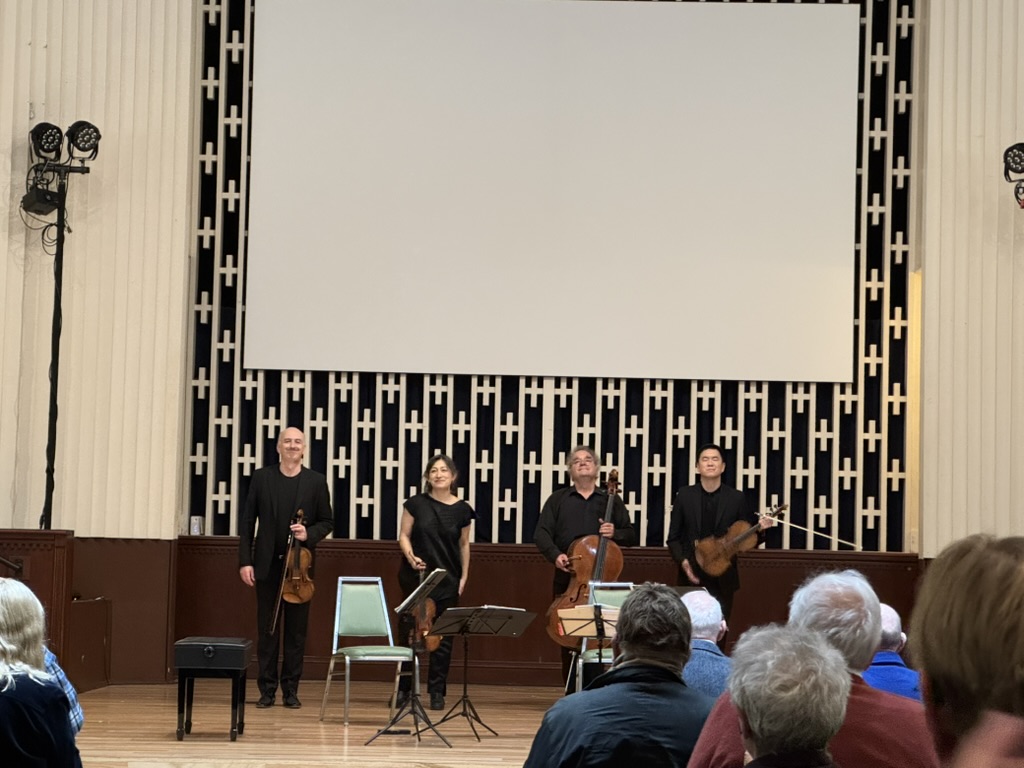
Founded in 1975 while students at the Liszt Academy in Budapest, half a century later the Takács Quartet continues to offer a gold standard of string quartet playing — and remarkably, still counts one original member in its ranks (cellist András Fejér). Tuesday night marked a welcome return to the Cleveland Chamber Music Society (which celebrated its own 75th anniversary last season) where they have long been regular guests — in recent years, performing with Marc-André Hamelin and in a memorable Grieg/Shostakovich program.
Takács Quartet at the Cleveland Chamber Music Society
The so-called father of the string quartet, Haydn is always a rewarding composer with which to begin a string quartet recital. Tuesday’s selection was the Rider quartet in its bristling G minor. It opened in quintessential Haydnesque fashion with its delicate ornamentations and sudden pauses. This genteel material was given with tight cohesion, carefully conveying its layered textures with clarity. Some striking modulations were heard in the slow movement before an elegant minuet countered by a rather stormy trio (usually it’s the trio that’s the calmer one). The fiery, galloping finale is what gave this work its epithet, and Haydn had the last laugh with its humorously deceptive close.
Of Bartók’s six iconoclastic quartets, the Third is the shortest but also the most concentrated. It’s quite unusual in form, too, with two contrasting parts subsequently repeated in a loose mirror of their initial presentation. Protean strands began, organically growing in weight and intensity — preconcert lecturer Kevin McLaughlin aptly compared this soundscape to Stravinsky’s Rite of Spring. A panoply of extended techniques were deployed, yielding an array of captivating sounds. Melodically, harmonically, and rhythmically intricate, the second part was blistering in its driving appropriation of folk song. The so-called Ricapitulazione of first part surfaced like a distant dream of the opening before the work’s uncompromising close.
It was lovely to hear Dvořák on a string quartet program in a piece that isn’t the justly famous American quartet. The Takács instead offered the Bohemian composer’s penultimate work in the genre: no. 13 in G major, Op. 106 (I was also reminded the Apollon Musagète Quartet presenting Dvořák’s final quartet on a CCMS program in February 2020, just ahead of the covid shutdown). In these last two works in the form, Dvořák sailed to new heights, only to then turn his attention away from chamber music and to opera and the tone poem.
Gentle gestures opened to set an intoxicatingly bucolic mood, only to grow in dramatic tension and orchestral heft. First violinist Edward Dusinberre had a soaring melodic line, and the broad first moment movement drew to particularly robust coda. Rich textures were layered on top of each in the angelic slow movement, somewhat reminiscent of Beethoven’s Heiliger Dankgesang. At its conclusion, some earthy pentatonicism reminded us this came from the same pen as the man wrote the New World symphony.
Even more quintessential Dvořák came in the following, wherein the composer proudly displayed his Czech origin in the shape of a spunky furiant. I was struck by the Takács intense physicality here, playing with their whole bodies. The bold, wide-ranging finale was given with unified direction for a powerful close.
As an encore, the quartet turned to the second movement of Debussy’s sole work in the medium in a show of their versatility, equally adept in the Frenchman’s impressionist enigma.
Bridget Kibbey, harp Alexi Kenney, violin Southern Theatre Columbus, OH November 5, 2022
Saint-Saëns: Fantaisie in A major, Op. 124 Hu: Chamber Music Columbus Fanfare CPE Bach: Sonata in G Minor, H 542.5 Bartók: Romanian Folk Dances Larsen: Sun Strider Biber: Mystery Sonata No. 1 (“Annunciation”) Messiaen: Vocalise-étude Dowland: Flow my Teares Rodrigo: Madrigales amatorios Falla: Siete canciones populares españolas Currier: Night Time
Appealing as the combination may seem, music for harp and violin duo is an uncommon occurrence. Leave it Bridget Kibbey and Alexi Kenney to make a strong case for the medium in lovely program of duets at Chamber Music Columbus. Most of the selections performed were by necessity arrangements of other works, but the duo highlighted a few pieces written expressly for this combination, including a world premiere from Libby Larsen.
Alexi Kenney and Bridget Kibbey, photo credit Chamber Music Columbus
One such work with this instrumentation in mind was Saint-Saëns’ Fantaisie in A major. Graciously lyrical, the musical synergy between Kibbey and Kenney was apparent from the first bars. Impressive virtuosity served well the fantasy, improvisatory-like elements of the piece. Following was Ching-chu Hu’s Fanfare, a mainstay of all Chamber Music Columbus performances this season. After previously hearing it cast for brass quintet, it was quite fascinating to hear it undertaken by such vastly different forces.
A transcription of a sonata by CPE Bach opened with extravagant material for harp alone, and the violin later joined in imitation. A long-bowed violin melody over harp filigree made a touching Adagio, and the rapid finale was given with seamless cohesion. In place of the Clara Schumann Romances, Op. 22 listed on the program, the duo opted for the livelier Romanian Folk Dances of Bartók, a series of six miniatures (originally for piano, Sz. 56) boasting a folksy flair.
A co-commission from Chamber Music Columbus and the Schubert Club of Saint Paul, Minnesota (an ever older organization than CMC – celebrating 140 years this season!), Libby Larsen’s Sun Strider opened the second half. Matters gradually amassed, gathering energy, and the different characteristics of the strings of each instrument were exploited for contrast (a subject Larsen discussed during my interview with her). Novel sounds were drawn from the harp, taking full advantage of Kibbey’s peerless technique, and the work was at heart deeply lyrical – and generously so. The title evokes the sun’s journey across the sky; when sunset arrived, the music faded away, leaving only the vibrations of the strings.
A varied selection of shorter works followed, beginning with the first of Biber’s mystical Mystery Sonatas. Though separated by a few centuries. Messiaen’s Vocalise-étude occupied a similar sense of religious wonderment. For a Spanish sojourn, Rodrigo’s Madrigales amatorios were interwoven with selections from Falla’s Siete canciones populares españolas, works by turn feisty and jaunty or sultry and seductive.
Sebastian Currier’s 1998 work Night Time closed the recital – along with the Saint-Saëns and the new Hu and Larsen pieces, the only other work on the program conceived originally for harp and violin. Depicting the enigma of the night, its striking musical language seemed to be Currier’s response to Bartók’s “night music.” The second movement “Sleepless” was appropriately filled with jarringly irregular accents, though calm arrived in the concluding “Starlight” wherein matters drifted off into the depths of night.
Theofanidis: Valley of Detachment from Conference of the Birds Haydn: Allegro di molto from String Quartet in A major, Op. 20 No. 6, Hob. III:36 Haydn: Allegro from String Quartet in A major, Op. 20 No. 6, Hob. III:36 Bartók: Andante from String Quartet No. 5, Sz. 102 Wolf: Italian Serenade Tchaikovsky: Andante funebre from String Quartet No. 3 in E-flat minor, Op. 30 Mendelssohn: Andante espressivo from String Quartet No. 3 in D major, Op. 44 No. 1 Schulhoff: Alla Czeca from Five Pieces for String Quartet Schulhoff: Alla Tarantella from Five Pieces for String Quartet Randall Thompson: Alleluia, Amen (arr. Ying Quartet) Dvořák: Allegro ma non troppo from String Quartet No. 12 in F major, Op. 96, American
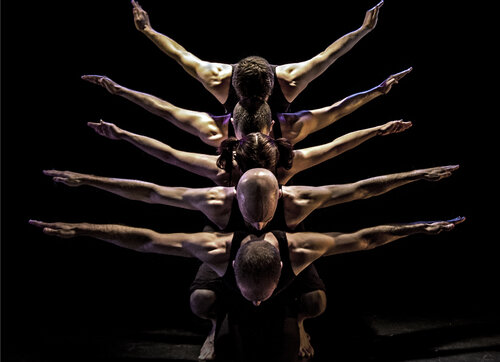
At Chamber Music Columbus, the Ying Quartet teamed up with PUSH Physical Theatre – both ensembles of which are based in Rochester, New York – to breathe fresh air into the vaunted sting quartet recital. A wide-ranging sampling of the string quartet literature was intriguingly presented in tandem with physical theater, with each group of selections centered on a particular theme to invoke a narrative arc. At the heart of this creative collision was the art of storytelling, which as violist Philip Yang noted in his spoken remarks, lies central to who we are as human beings.
Ying Quartet, photo credit Tim Greenway
A movement from Christopher Theofanidis’ Conference of the Birds opened, with the gestures from the dance troupe mirroring the ebb and flow of the music. Two movements from Haydn followed; in this case, the elegance of the music was contrasted by the rather more risqué dance. The Andante from Bartók’s great Fifth Quartet took us into the realm of the surreal, a prime example of the Hungarian composer’s rarefied night music. Hugo Wolf’s lovely Italian Serenade was brought to life by a laugh-out-loud routine from PUSH, bringing humor and levity to what is usually a serious affair. At the opposite end of the spectrum was the doleful Andante funebre from Tchaikovsky’s Third Quartet – a tender wistfulness which served to depict the human cost of war.
Randall Thompson’s 1940 “Alleluia, Amen” – given in an arrangement by the Ying Quartet – served as a plaintive contrast to the gritty perpetuum mobile of the Schulhoff that preceded. The performance came to a close with the spacious opening movement of Dvořák’s American quartet. It’s a piece that resonates deeply with the Ying Quartet – just as the composer found solace and inspiration while spending a summer in the small town of Spillville, Iowa, the Ying Quartet found similar stimulus and connection during an extended residency in Jesup, Iowa in the 1990s. The performers gave Dvořák’s music with a natural fluency and affinity – lyrical, gracious, and generous. For this audience member, the highlight was certainly the quartet’s fine playing, but I applaud their efforts to push the boundaries of the way we experience chamber music, and seek connections from one artistic discipline to another.
PUSH Physical Theatre, photo credit Avi Pryntz-Nadworny
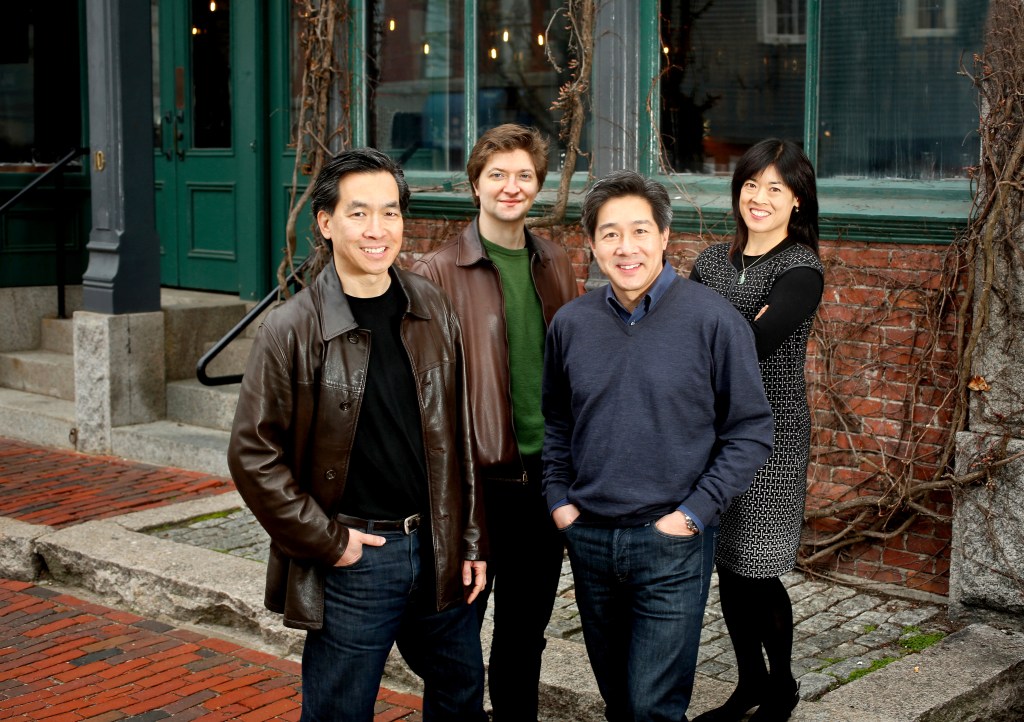
Victoria Moreira, violin Joel Becktell, cello Renee Keller, marimba & percussion The Fives Columbus, OH February 18, 2022
Piazzolla: Fugata Piazzolla: Mumuki Barilari: The Mysteries Kodály: Duo for Violin and Cello, Op. 7 Diz: Poema Bachiano Granados: Danzas españolas, Op. 37 – No. 2 “Orientale” Bartók/arr. Kraeuter – Selected Hungarian Folk Melodies Piazzolla: Milonga del Angel Piazzolla: Lo que vendrá
Friday evening saw the first of a series of three chamber music performances featuring various combinations of players from ProMuscia. The venue of choice was The Fives, ProMusica’s home last season wherein they found a way to perform even in the midst of the pandemic. Friday brought forth Victoria Moreira, Joel Becktell, and Renee Keller in music for violin, cello, and marimba – an intriguing if unusual combination. There’s a paucity of repertoire for these forces as one might expect; most of the selections were thus presented in arrangements or adaptations to fit the ensemble at hand. The program was refreshingly offbeat, with the common thread being each composers’ engagement with the folk music traditions of their respective homelands. Additionally, there was acknowledgement of Astor Piazzolla’s centenary (last year) with two pairs of the Argentine’s works framing the recital.
L-R: Victoria Moreira, Renee Keller, and Joel Becktell, photo credit ProMusica
Piazzolla’s Fugata opened the program, its contrapuntal intricacies tinged with a distinctive Latin flavor. From the onset, we were introduced to the appealing sound of this novel instrumentation and the fluid chemistry of the three musicians on stage. Mumuki was touchingly lyrical, and the scoring put the often stratospherically high cello in the spotlight. A world premiere followed, namely a three movement suite titled The Mysteries by Uruguayan composer Elbio Barilari, currently on the faculty at the University of Illinois at Chicago. Barilari was on hand to introduce the work and noted his inspiration from ancient Greece, which he aptly called the “cradle of civilization.” The opening “Delphic Dance” featured an incessant, pulsating dance rhythm, and some passing references to Greek scales. “Adonic Dance” was marked by a busy part for the violin, while the closing “Eleusinian Dance” was grounded by the beating drum and pizzicato cello. I wasn’t convinced the work probed as deep as the title suggested, but the music was as good-natured as the composer himself.
The first half closed with the most substantial work on the program, Kodály’s Duo for Violin and Cello. Cast in three movements, the first was commanding and big-boned, making much of the resources of the duo. One was taken by the resonant cello in the middle movement, often blending with high register of the violin for striking combinations, and the rapid-fire finale showcased the consummate virtuosity of these two string players. The most interesting discovery of the evening to my ears opened the latter half: Poema Bachiano, a 2008 work by Argentine composer Ezequiel Diz. A duet for marimba and violin, the work alludes to Bach’s D minor keyboard concerto in gesture and inflection. The complexities of the work were delivered with aplomb in this compelling reimagining of its Bachian influences, and perhaps something of a response to Villa-Lobos’ Bachianas Brasileiras. A second work of the same title was composed in 2020, a piece I suspect would be worth exploring on a future chamber music program.
A series of short pieces by Granados and Bartók followed, presented in arrangements for cello and percussion – thereby exhausting all combinatorial possibilities of the instruments available. A pulsating accompaniment in the marimba made a touching backdrop for the wistful cello melody of Granados’ “Orientale.” The three Bartók arrangements employed the vibraphone as the percussion of choice – its metallic brilliance was quite striking, further encouraging a piquant, folksy charm. Two Piazzolla selections reunited all members of the trio and brought us back full circle. Milonga del Angel was dreamy and evocative, while Lo que vendrá (“What is to come,” suggesting a sense of possibility after the composer’s formative studies with Boulanger) made for a rousing finish.
Gartner Auditorium Cleveland Museum of Art Cleveland, OH July 29 – August 1, 2021
Inevitably postponed last summer due to the pandemic, the Cleveland International Piano Competition has made a remarkable comeback here in 2021, a wonderfully exciting return to in-person performances. An initial pool of over 250 applicants from more than 40 countries was pared down to 26 contestants, all of whom performed in the Competition’s first two rounds. Owing to the travel and health restrictions that still persist, these rounds were conducted virtually, filmed at venues across the world – and available for free viewing on YouTube. Eight outstanding semi-finalists were selected to proceed onsite in Cleveland, a cohort to be further narrowed down to four finalists who will perform a chamber music round with the Escher Quartet and a concerto round with The Cleveland Orchestra under the baton of Jahja Ling.
Gartner Auditorium before Session 1 of the Semi-Final Round
Compared to the relative brevity of the first two rounds, the semi-finals offer an even more in-depth portrait of each artist, performing a recital of approximately 40 minutes. A few new and welcome additions for this year’s edition: each semi-finalist included in their program a popular song transcription commissioned from composer Alexey Kurbatov. Four selections were available, namely “America” from Bernstein’s West Side Story, Queen’s “Bohemian Rhapsody”, themes from Mission Impossible, and John Williams’ Olympic Fanfare. Regrettably, none of the eight selected the Williams piece, but perhaps a recording can be posted in due course. I also hope publication of these scores is imminent as they undoubtedly can serve as particularly enjoyable encore pieces.
Also for the first time was the inclusion of piano duets – the two performers from each session teamed up following their solo material for either the Fantasie in F minor by Schubert or Mozart’s Sonata for Two Pianos in D major. A lovely addendum that not only tested the contestants’ ability to collaborate with another pianist, but encouraged a spirit of camaraderie. Finally, excellent program notes for every piece performed – from the first round to the finals – were provided by Marissa Glynias Moore, Anna M. O’Connell, and Marco Ladd. Indispensable reading for attendees and a veritable crash course in piano literature. Below are some brief impressions I had of each semi-finalist.
Session 1 July 29, 2021
Ying Li Mozart: Piano Sonata No. 13 in B-flat Major, K. 333 Grainger: “Ramble on Love” from Der Rosenkavalier Bartók: Piano Sonata, Sz. 80 Schifrin: Themes from Mission Impossible (arr. Kurbatov)
Honggi Kim Schifrin: Themes from Mission Impossible (arr. Kurbatov) Chopin: Twelve Etudes, Op. 25
Schubert: Fantasie in F Minor, D. 940
Ying Li (China) opened the semi-final round with a Mozart sonata, delicate and balanced, exuding the pearly classical style. I found her pacing of the slow movement a bit hard to follow but was quite taken by the sprightly finale. Grainger’s so-called Ramble on Love, paraphrasing themes from Strauss’ Rosenkavalier, gave sumptuous treatment to the source material’s lush and languid melody. Bartók’s Piano Sonata was for me the highlight of her performance, opening with a manic energy – and the live video screens did much to enhance the audience experience, offering close-ups of the intricate hand-crossings.
Honggi Kim (South Korea) opened with the same piece with which Li closed, namely the Kurbatov Mission Impossible transcription. Kim was perhaps a bit more percussive than Li; both displayed how the composer brilliantly interpolated the familiar themes. All contestants are required to present a Chopin etude in the first two rounds – here in the semi-finals, Kim offered all twelve etudes from Op. 25. An ambitious undertaking to be sure, though I found his playing fitfully uneven. No. 2, for instance, would have benefitted from greater clarity, although I did like the way he brought out melodic material in the left hand. In No. 5, one wanted more accentuated contrast between the dissonant sections and the lyrical. The rapid double thirds of No. 6 were quite impressive, however. Op. 25 is certainly an end-weighted set, and perhaps one’s performance should be judged primarily on the final three which concluded on a high note: the rapid octaves of No. 10, a chillingly dramatic “Winter Wind”, and a rather marvelous finish in the intense depths of the “Ocean” etude.
Li and Kim were impressive four-hands partners in the Schubert Fantasie, bringing out contrasts from the brooding to the dancing.
Session 2 July 30, 2021
Jiarui Cheng Scarlatti: Sonata in B Minor, K. 87 Chopin: Barcarolle in F-sharp Major, Op. 60 Rachmaninov: Variations on a Theme of Corelli, Op. 42 Bernstein: “America” from West Side Story (arr. Kurbatov)
Yedam Kim Chopin: Polonaise-Fantaisie in A-flat Major, Op. 61 Prokofiev: Sonata No. 4 in C Minor, Op. 29 Mercury: Bohemian Rhapsody (arr. Kurbatov)
Mozart: Sonata for Two Pianos in D Major, K. 448
Jiarui Cheng (China) selected one of the more introspective of the Scarlatti sonatas, emphasizing its lyrical quality. Continuing the thread, he did much to bring out the wistful melancholy in Chopin’s late gem, the Barcarolle. In Rachmaninov’s Corelli Variations, Cheng sculpted an individual character in each variation – an excellent performance. Kurbatov’s transcription of Bernstein’s “America” ended matters on a jovial note.
Yedam Kim (South Korea) opened with a mesmerizing account of Chopin’s Polonaise-Fantaisie – contemporaneous with the previously-heard Barcarolle – the composer’s crowning achievement in the polonaise form. A commanding performance of Prokofiev’s Fourth Sonata followed, with searching, unsettling material leading to a bright and brilliant finale. In the Queen original, “Bohemian Rhapsody” is something of a mini tone poem with its wealth of thematic material and operatic narrative and dramatic flow – qualities very much brought out in Kim’s performance, perhaps the most impressive of the Kurbatov transcriptions.
Session 3 July 31, 2021
Rafael Skorka Bernstein: “America” from West Side Story (arr. Kurbatov) Leighton: Fantasia Contrappuntistica, Op. 24 (“Homage to Bach”) (1956) Brahms: Sieben Fantasien, Op. 116
Martín García García Schubert: Wanderer-Fantasie in C Major, D. 760 Liszt: “Les cloches de Genève (Nocturne)” from Années de Pèlerinage I, S. 160 Liszt: Étude de Concert, S. 145, No. 2 (“Gnomenreigen”) Liszt: Transcendental Etude, S. 139, No. 10 Mercury: Bohemian Rhapsody (arr. Kurbatov)
Schubert: Fantasie in F Minor, D. 940
Rafael Skorka (Israel) had confident beginnings with a memorable account of Bernstein’s “America”. The most intriguing discovery during the semi-final round came in the shape of Kenneth Leighton’s Fantasia Contrappuntistica, a 1956 homage to Bach (and to Busoni, given the elder composer’s monumental work of the same title). A virtuosic opening gave way to a pensive chorale and a pair of fugues rounded off the work. Skorka deftly negotiated the contrapuntal intricacies to bring matters to a vigorous close. The pianist continued to make a strong showing in Brahms’ Fantasies, Op. 116, just as convincing in the lyrical selections (nos. 2, 4, and the touching chorale of no. 6) as the more extrovert ones, giving the first piece an energetic workout and reserving the most overt virtuosity for the seventh and final fantasy.
Martín García García (Spain) offered an arresting account of Schubert’s ingenious Wanderer-Fantasie. While his tone at times veered a bit too percussive for my taste, he did much to bring out a wide dynamic and dramatic contrast and a keen sense of the work’s large-scale architecture. An interesting selection of three Liszt pieces followed. Deft use of the pedal did much to bring out the sonorities of the titular bells in Les cloches de Genève while García conveyed much charm in the impish legerdemain of Gnomenreigen. The Transcendental Etude No. 10 was technically impressive, although I found myself longing for even more firepower.
Session 4 August 1, 2021
Byeol Kim C. Schumann: Notturno in F Major, Op. 6, No. 2 Schumann: Arabeske in C Major, Op. 18 Mendelssohn: Fantasie in F-sharp Minor, Op. 28 Mercury: Bohemian Rhapsody (arr. Kurbatov) Jalbert: Toccata (2001) Gottschalk: The Union, Op. 48
Lovre Marušić Scarlatti: Sonata in E Major, K. 380 Schumann: Kreisleriana, Op. 16 Mercury: Bohemian Rhapsody (arr. Kurbatov)
Mozart: Sonata for Two Pianos in D Major, K. 448
Byeol Kim (South Korea) assembled the most diverse and wide-ranging semi-final program, beginning with music from both the Schumanns. Clara’s Notturno boasted a haunting, Chopinesque melody, a performance which should put Kim in the running for the Female Composer Prize, one of over a dozen special prizes being offered. A limpid account of Robert’s Arabeske followed, and Mendelssohn’s Fantasie in F sharp minor was given a passionate and dramatic performance. I really enjoyed the way Kim brought out the sweeping lyrical main theme in her take on the “Bohemian Rhapsody” transcription. Jalbert’s Toccata was a breathless study in perpetual motion, and Gottschalk’s Union, a wonderfully inventive cornucopia of Americana, put Kim’s searing virtuosity and vast dynamic range on full display. A clear audience favorite, she was the only one of the eight to receive a standing ovation.
Lovre Marušić (Croatia) began with a stately account of Scarlatti’s K380 sonata. Schumann’s extensive Kreisleriana followed. I felt Marušić’s reading would have been even more engaging with sharper contrasts between the wide range of expressions the work explores, but I certainly sensed the pianist becoming increasingly self-assured as the work progressed. Sunday’s session was a high note on which to conclude the semi-finals as we await the jury’s announcement of the four finalists, and the fine level of pianism we can expect from them in the subsequent chamber and concerto rounds.
Cleveland Orchestra
Matthias Pintscher, conductor
Kirill Gerstein, piano
Severance Hall
Cleveland, OH
November 1, 2018
Rachmaninov: Piano Concerto No. 3 in D minor, Op. 30
Encore:
Chopin: Waltz in A flat major, Op. 42
Bartók: The Wooden Prince, Op. 13, Sz. 60
A return appearance from former Daniel R. Lewis Young Composer Fellow Matthias Pintscher is always a welcome sight at Severance Hall. Pintscher’s program was comprised of two large-scale works, both from Eastern Europe, and both from the first decades of the 20th-century. Rachmaninov’s enduring Third Piano Concerto made for a meaty first half with Gilmore Artist Award winner Kirill Gerstein at the keyboard. The opening melody was haunting in its monastic simplicity, and never sentimentalized. Gerstein took matters at a fairly brisk tempo – at times feeling a bit rushed, but he always maintained a certain elegance. His commanding tone and massive dynamic range made the lasting impact, however – an unflagging intensity which paid its dividends especially in the cadenza. Gerstein elected for the larger of the two the composer supplied; beginning with a rumbling in the bass it built to immense power. The cadenza quite ingeniously also served as the movement’s recapitulation; without much left to say after that monstrosity the movement ended quietly, almost impressionistically.
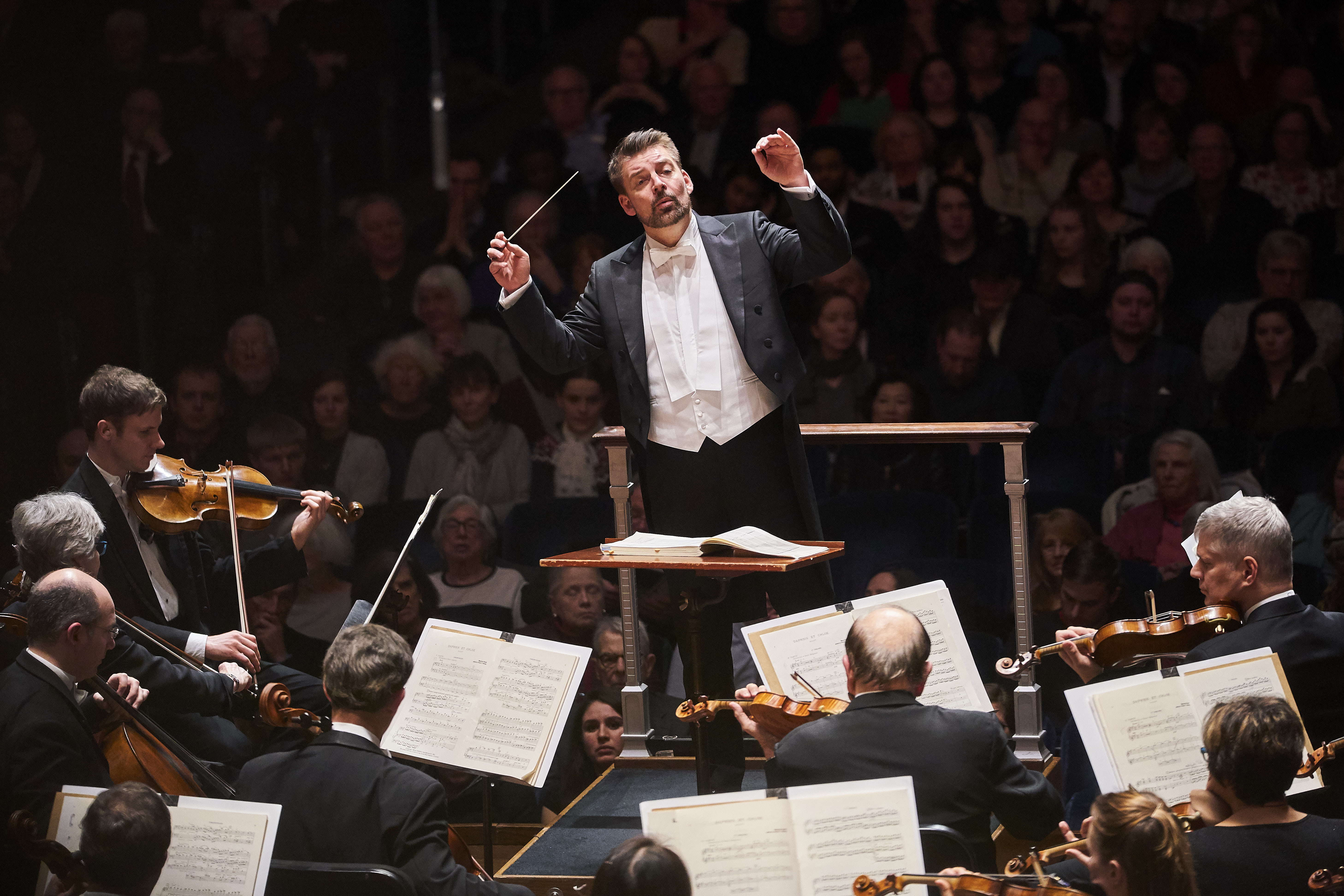
Mathias Pintscher and The Cleveland Orchestra, photo credit Roger Mastroianni, Courtesy of The Cleveland Orchestra
A doleful lament marked the slow movement, encouraged by the choir of winds and long-bowed strings. Gerstein’s line was initially distressed but soon gave way to display his lyrical gift, and a multitude of moods were traversed, in turns scherzo-like, impassioned, and the sudden yet seamless transition to the finale. A vigorous march, bright and brilliant, offered no respite for Gerstein’s prodigious stamina and technical arsenal, up to and including the triumphant major-key ending in cascading glory. An encore was nearly demanded; Gerstein obliged with a Chopin waltz of effortless elegance.
Bartók’s The Wooden Prince, in only its third Cleveland Orchestra performance, was a foray into much less familiar territory. A one-act ballet spanning the continuum of nearly an hour, it is scored for an astonishingly large orchestra (some highlights: quadruple woodwinds – including two contrabassoons and two saxophones – an extensive percussion section, and four-hands celesta). The work began with a mysterious sounding drone (perhaps echoing Wagner’s Das Rheingold), firmly in a late-Romantic idiom. In many ways, this is a work in the tradition of Stravinsky’s groundbreaking scores for the Ballets Russes, with the intensity of some passages rivaling even that of the Rite.
The story of The Wooden Prince is a bit convoluted, but certain instruments representing specific characters served as a loose roadmap. The sweetly playful tone Afendi Yusuf’s clarinet deftly brought the princess’s coquettishness to life, and a folk melody in the low strings that would later resurface was quite striking. The dance between the princess and titular wooden prince (much to the chagrin of the real prince) was given with a relentless drive and folksy authenticity, with clever scoring emphasizing the prince’s wooden composition – castanets, xylophone, and col legno strings. Robert Walters’ fine English horn solo brought forth an apotheosis, buttressed by heavenly high strings (to my ears, another nod to Wagner, namely the prelude to Lohengrin). A happily-ever-after ending was achieved, marked by peaceful resolution and a sparkling celesta. Like the Rachmaninov that preceded, this was a supreme test of stamina and energy which Pintscher and the orchestra surmounted admirably. By happy coincidence (or smart programming), those interested in Pintscher’s other persona as a composer will have a chance to hear one of his works next week.
Cleveland Orchestra
Franz Welser-Möst, conductor
Yefim Bronfman, piano
Severance Hall
September 30, 2018
Prokofiev: Symphony No. 1 in D major, Op. 25, Classical
Bartók: Piano Concerto No. 2 in G major, Sz. 95
Prokofiev: Symphony No. 3 in C minor, Op. 44
Franz Welser-Möst has expressed an interest in devoting part of the next few seasons to exploring works – particularly those lesser known – of both Prokofiev and Schubert. The first installment came last weekend, with a program bookended by Prokofiev symphonies. Of Prokofiev’s seven works in the genre, only the First and the Fifth are played with any regularity, the remainder being brushed to the periphery. While the remaining five are admittedly somewhat uneven in quality, an opportunity to discover them – particularly at the level of playing witnessed over the weekend – is emphatically welcomed.
Yefim Bronfman, photo credit Oded Antman
Familiar territory opened the program, however, with the composer’s First Symphony, the so-called Classical for its patent inspiration to Haydn but as through the wit of a 20th-century modernist. It opened with a burst of energy capped by its classical charm, with transparent textures balancing a classical economy and Prokofiev’s piquant harmonies. The Larghetto was gentle and untroubled, evidencing a side of the composer wholly different than the enfant terrible as he is often characterized. The gavotte glanced back in time even further with its roots in the Baroque; here a stately theme was spiked with sweet dissonances, a creation that must have satisfied the composer as he re-used the material in Romeo and Juliet. Although I did find the flutes to be a bit overzealous, the dynamics in the movement’s conclusion were brought down to a whisper, setting the stage for the high-spirited finale.
The rarely-heard Third Symphony closed the afternoon, with the orchestra blossoming substantially, no longer in classical proportions for this daunting, unwieldy work. Some its material was taken from the composer’s ill-fated opera The Fiery Angel, here completely reimagined as a symphony (the Fourth Symphony was also based on material from a stage work, namely The Prodigal Son). The clangorous opening movement was an affair of overwhelmingly dense texture, in some semblance of sonata form, difficult to follow yet the orchestra had a keen sense of its architecture. Striking orchestrations yielded unforgiving sonorities, and matters closed with an extended passage in the contrabassoon leading down to the grave.
A strained wistfulness opened the Andante, less unrelenting than the previous but still filled with a pervasive unease. There were notable solo contributions from concertmaster Peter Otto and clarinetist Afendi Yusuf, and eerie glissandos added to the restlessness. The third movement overflowed with a motoric drive and bizarre effects, not the least of which were the rapid yet quiet glissandos that dotted the score’s dense pages. A more measured B section offered momentary respite, only for matters to end with an eruption in the brass. The finale was shrouded in the darkness of the low brass, merciless in its shrill bombast inexorably leading to a crashing ending.
Situated between the two symphonies was Bartók’s second piano concerto, a formidable work notorious for its technical demands, here conquered by one its greatest champions, Yefim Bronfman (incidentally, the last soloist to perform the work here was Lang Lang who graced the same stage during the previous night’s gala). The opening flourish saw Bronfman in counterpoint with the brass, and the pianist delivered with a kinetic drive, this work ideal for his supersized virtuosity and steel-fingered playing. The movement continued apace with relentlessness but yet a sheer brilliance of sound, and Bronfman was in fine balance with his orchestral colleagues, never at the risk of getting swallowed by their expansiveness.
Plaintive strings – their first appearance – opened the central movement, sounding almost incorporeal after the mechanistic physicality of the preceding. A simple, direct melody in the piano offered utter clarity of tone, while the contrasting Presto was rapid and unsettling. The slow passage returned, filled with spectral trills, evidencing Bartók’s idiosyncratic “night music.” A bass drum initiated the finale, and matters exploded with a nervous energy, dashing any hopes of a peaceful conclusion – and Bronfman’s flurry of double octaves had to be seen to be believed.




 quasi-faust