Members of the Pittsburgh Symphony Orchestra and Carnegie Mellon School of Music Carnegie Music Hall Pittsburgh, PA November 24, 2025
Bach: Brandenburg Concerto No. 3 in G major, BWV 1048 Bach: Brandenburg Concerto No. 1 in F major, BWV 1046 Bach: Brandenburg Concerto No. 2 in F major, BWV 1047 Bach: Brandenburg Concerto No. 5 in D major, BWV 1050 Bach: Brandenburg Concerto No. 6 in B-flat major, BWV 1051 Bach: Brandenburg Concerto No. 4 in G major, BWV 1049
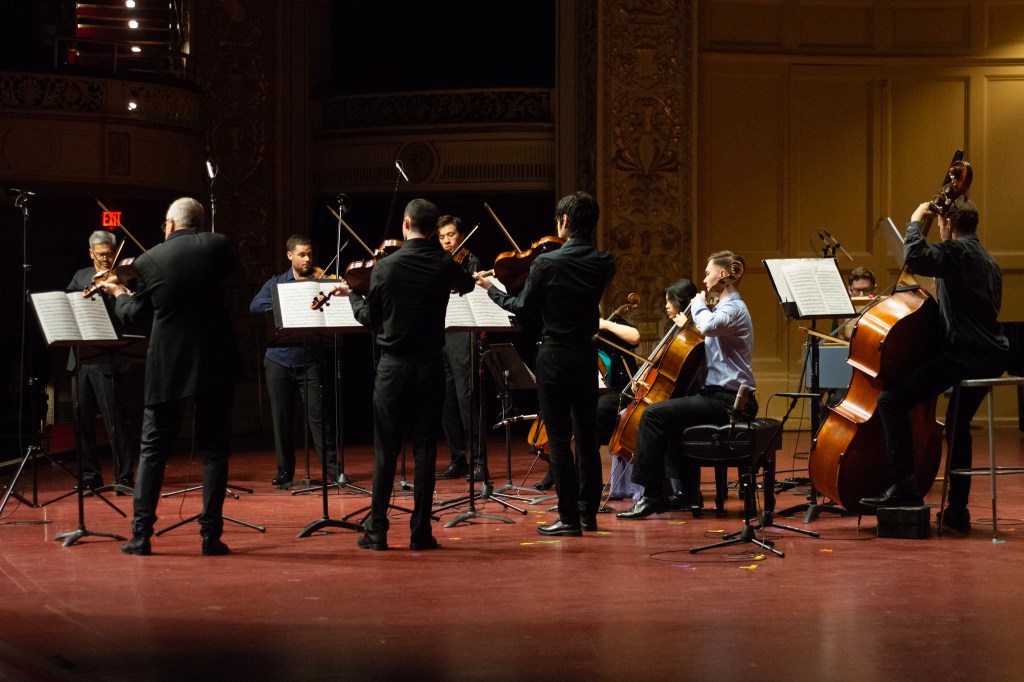
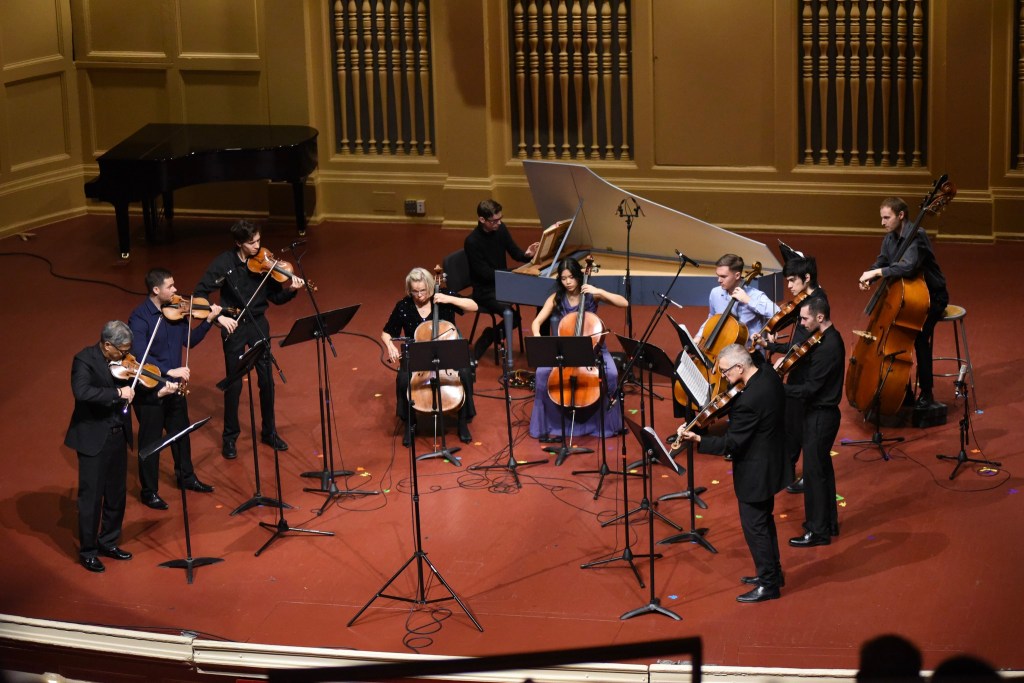
Bach’s six Brandenburg Concertos have nothing to do with the holidays, yet their cheery, celebratory spirit makes them a favorite this time year. A survey of the complete series made for a satisfying evening at Chamber Music Pittsburgh during the week of Thanksgiving. No two of these concertos are scored for the same instrumentation, and a wide panoply of performers were culled from the ranks of the Pittsburgh Symphony Orchestra and the Carnegie Mellon School of Music.
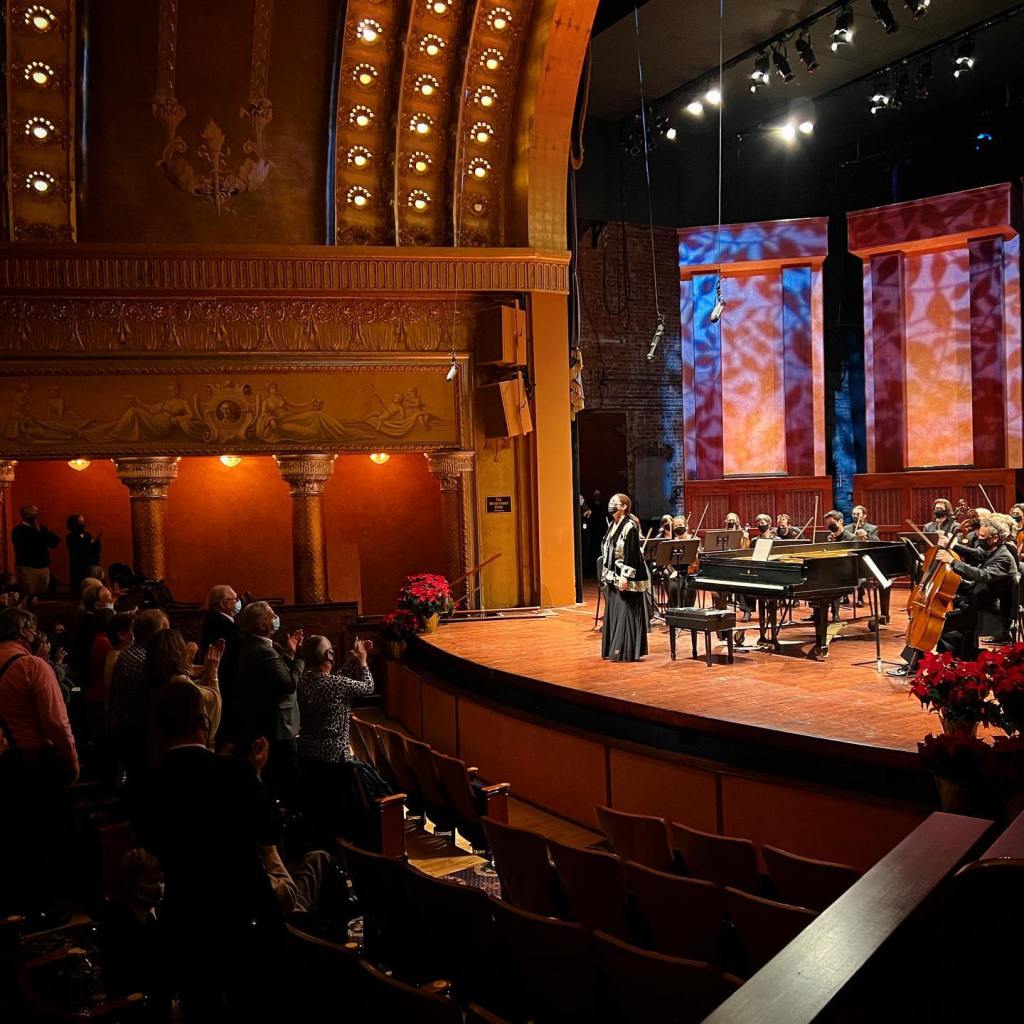
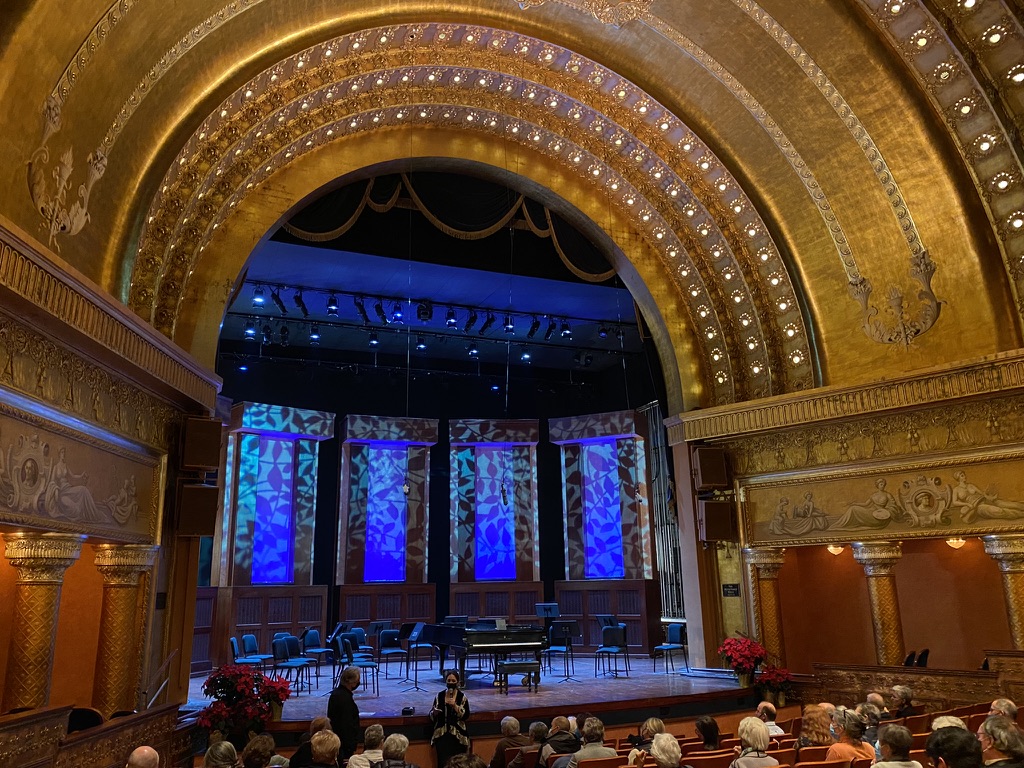
Brandenburg Concertos at Carnegie Music Hall, photos credit Michael Canton
No conductor was engaged (and nod to historical practice), and modern orchestral instruments were used (a nod to contemporary practice). And instead of proceeding in strictly numerical order, thoughtful contrasts and complements were suggested. The evening began with No. 3, a slighter work cast for strings alone, but charming and radiant nonetheless.
In No. 1, the strings were in mellifluous blend with the winds and brass (although the intonation of the horns left something to be desired). Under the astute leadership of violinist Callum Smart, the ensemble was in tight cohesion, culminating in the regal rhythms of the closing polonaise. Concerto No. 2 was marked by the resound of the clarion trumpet, in an impossibly high register.
No. 5 is a pianist’s dream with its outsized role for the keyboard. The remarkable Frederic Chiu was featured as soloist, playing on a modern Steinway rather than a harpsichord or fortepiano. He had a sparkling chemistry with the ensemble, with self-assured playing that rippled across the keyboard, and offered a mesmerizing take on the massive cadenza. No. 6 is perhaps the most intimate and understated of them all, and I liked the rich, husky tone the musicians conveyed. With a pair of flutes (used in place of recorders) and a complement of strings, the gentle and pastoral No. 4 drew the set to a spirited, heartfelt close.
Pittsburgh Symphony Orchestra Juraj Valčuha, conductor Pablo Ferrández, cello Heinz Hall Pittsburgh, PA November 14, 2025
Wolfe: Liberty Bell Saint-Saëns: Cello Concerto No. 1 in A minor, Op. 33 Encore: Bach: Sarabande from Cello Suite No. 3 in C major, BWV 1009 Strauss: Ein Heldenleben, Op. 40
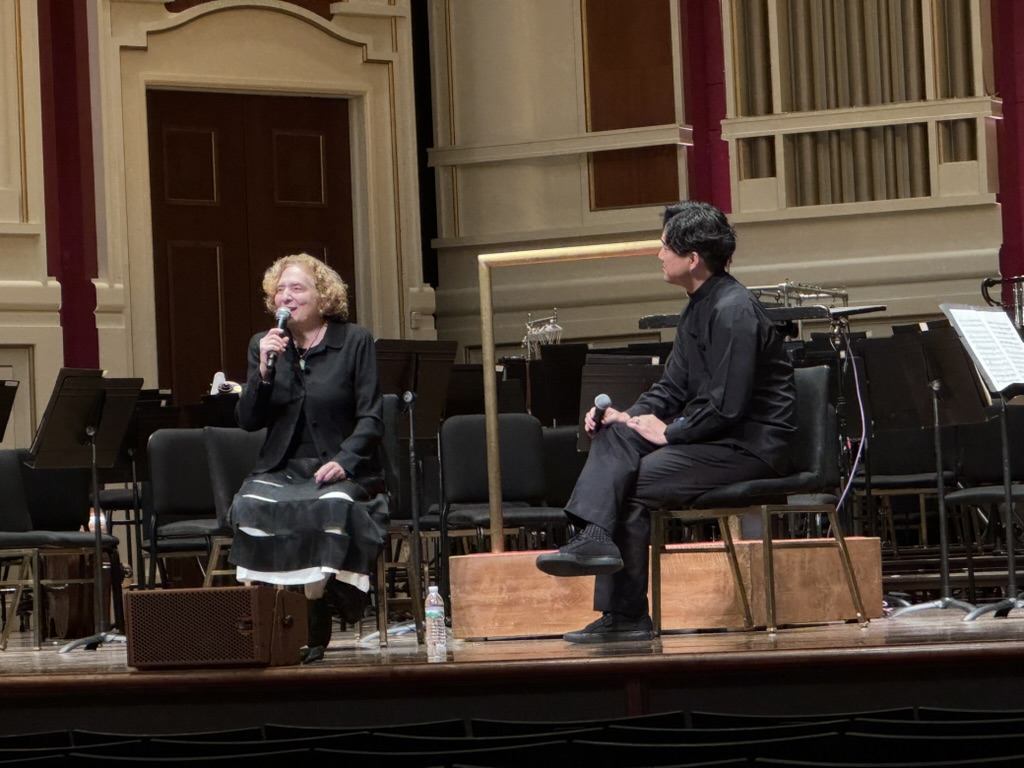
Featuring a return to the Heinz Hall podium of Juraj Valčuha, this weekend’s PSO program opened with another entry in this season’s survey of American orchestral works. Receiving just its second performance was Julia Wolfe’s Liberty Bell, premiered in September at the Houston Symphony where Valčuha serves as music director. Based in the titular bell’s home of Philadelphia, Wolfe was on hand to introduce the piece in person (I liked how she described Philly and Pittsburgh as “the two pillars of Pennsylvania”).
Preconcert interview with Julia Wolfe and assistant conductor Moon Doh
The 10 minute work opened with the clangor of vigorously tolling bells. Perhaps suggested the Liberty Bell’s iconic crack, the jagged, interlocking rhythms conveyed a fractured texture. The orchestration was brilliantly colored, celebratory yet conscious of the struggle to arrive there. At moments, matters paused as if to provide moments of reflection. Drawing on a diversity of traditions, there was even a raucous rock and roll beat, leading to a bold climax splashed with the resonance of the bell.
Saint-Saëns’ Cello Concerto No. 1 in A minor saw the return of Spanish cellist Pablo Ferrández (who will also be featured in this season’s first PSO360 performance). Cast in three compact, interconnected movements, the cellist opened with a lyrical, burnished tone, achieving long-bowed, artful phrasing. The orchestra supported him with a supple, sympathetic accompaniment. The central slow movement opened with a hushed passage in the strings, and Ferrández joined in an intimate dialogue with the orchestra. The robust finale was filled with technical fireworks, yet still lyrical at heart. As an encore, Ferrández offered a Bach sarabande, stately and pure.
Strauss’ great orchestral showpiece Ein Heldenleben opened the second half with bold and heroic beginnings. Yet the conductor thoughtfully didn’t begin too loud, allowing ample room for the muscular brass to grow. “The Hero’s Adversaries” which follows depicts the cranky music critics that bedeviled Strauss — listening to this from the vantage point of being a critic is always a delightfully uncomfortable experience. “The Hero’s Companion” was a passionate and affecting portrait of the composer’s wife, the singer Pauline de Ahna. It featured an extensive and demanding passage for solo violin, played by concertmaster David McCarroll with wide-ranging emotion and variegated color.
A battle was heralded by offstage brass in the fourth section, music that really gets one’s blood flowing before devolving into utter cacophony. The final two sections were rather more restrained, in the twilight of the hero’s life, a retrospective on a life’s work. The music faded into graceful triumph, but not without revisiting the iconic opening of Also sprach Zarathustra.
Sheku Kanneh-Mason, cello David McCarroll, violin Anne Martindale Williams, cello Dale Jeong, cello Bronwyn Banerdt, cello Alexandra Lee, cello Additional Strings and Harp of the Pittsburgh Symphony
Heinz Hall Pittsburgh, PA March 22, 2025
Bach: Komm, süßer Tod, komm selge Ruh, BWV 478 (arr. Kanneh-Mason) Bach: Nun komm, der Heiden Heiland, BWV 659 (arr. Kanneh-Mason) Bach: Adagio from Toccata, Adagio and Fugue in C major, BWV 564 (arr. Kanneh-Mason) Finnis: Five Preludes for Solo Cello Villa-Lobos: Prelude from Bachianas Brasileiras No. 1 (arr. Simon Parkin) Clapton: Layla (arr. Parkin) Ravel: Sonata for Violin and Cello, M. 73 Dvořák: Nocturne in B major for String Orchestra, Op. 40 Bloch: From Jewish Life (arr. Christopher Palmer)
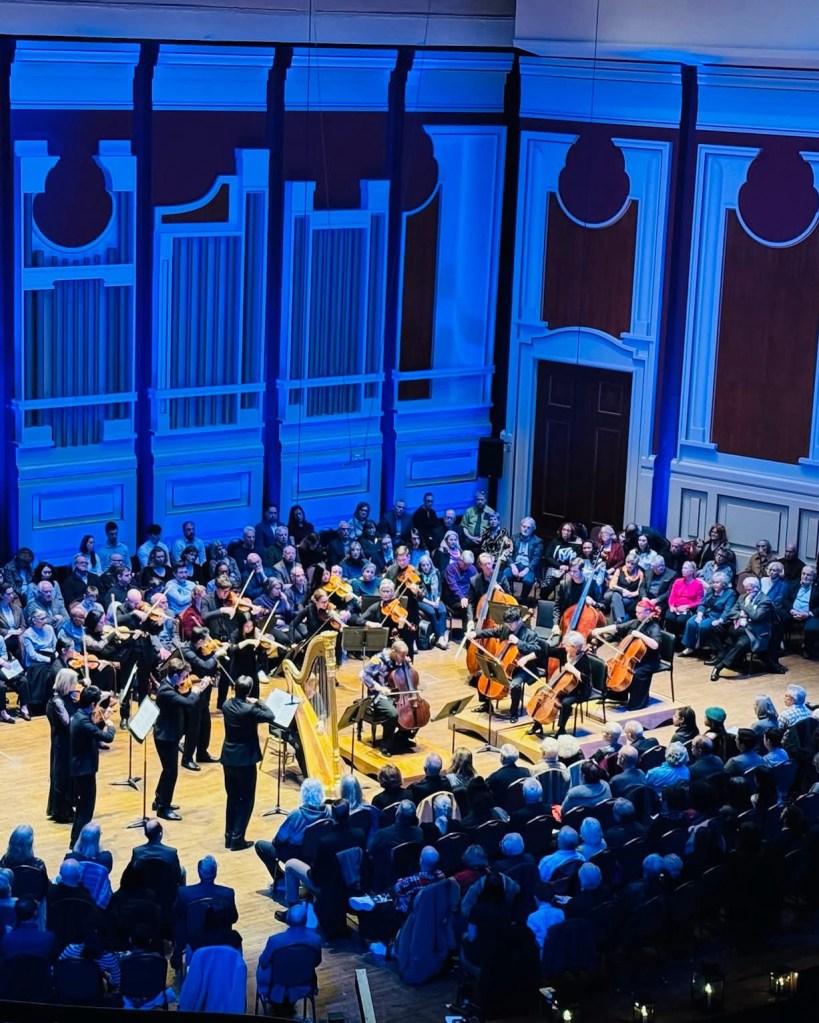
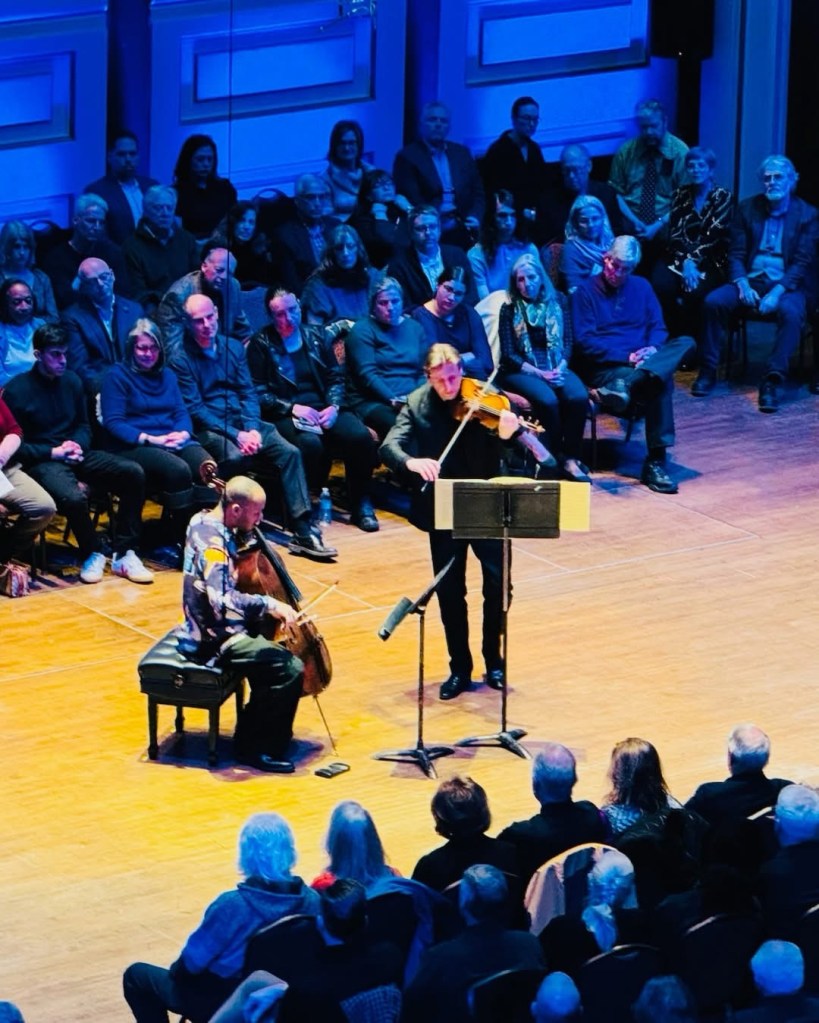
Following the Pittsburgh Symphony debut of Sheku Kanneh-Mason the night before, local concertgoers got to see many more sides of the cellist during an entry of the innovative and intimate PSO360 series. An indispensable offering at the PSO, for those who haven’t been, a guest artist bands together with select PSO musicians, and a small audience is seated in the round on the Heinz Hall stage. Entitled Soul of the Cello, the enterprising program showed the diverse potential of the instrument, and leaned heavily into music originally for other forces transcribed for cello — several of which were recorded on Kanneh-Mason’s Song album.
Sheku Kanneh-Mason with members of the PSO, photos credit Sheku Kanneh-Mason on Facebook
A trio of works by J.S. Bach began, all in transcriptions by Kanneh-Mason himself. The chorale prelude Komm, süßer Tod, komm selge Ruh opened, cast for a quintet of cellos. Deeply felt, and the resonance of five cellos was quite striking. A further chorale prelude in Nun komm, der Heiden Heiland followed — this one scored for four cellos — showing that this is music so universal it transcends the medium on which it is performed (the Busoni transcription for piano is a favorite of this writer). A pensive Adagio extracted from an organ work thoughtfully capped of this unique exploration of Bach.
Written for Kanneh-Mason in 2021 were the Five Preludes for Solo Cello by British composer Edmund Finnis. Each one of these pearls achieved a captivating expressive range in just a short span. Melodic contours were deftly shaped in the opening prelude, the second, marked Fleeting, was of minimalist gestures à la Philip Glass. The penultimate piece was underpinned by a drone, surfacing as a calming presence.
Returning to scoring for cello quintet, a pair of widely contrasting works rounded off the first half. In the remarkable suites titled Bachianas Brasileiras, composer Heitor Villa-Lobos wove Brazilian musical tradition into the style of Bach. Each is for a different combination of instruments; the first is for eight cellos. Redistributed amongst the five players on stage, it was like listening in on a close conversation amongst friends, a sentiment further encouraged by the cello’s proximity to the human voice. An energetic transcription of Eric Clapton’s Layla followed, filled with glissandos and other techniques to capture the effects of Clapton’s electric guitar. A sheer delight to see Kanneh-Mason rock out with the PSO cello section!
Opening the second half was Ravel’s remarkable duo sonata for violin and cello, a work the composer dedicated to the memory of Debussy. Kanneh-Mason teamed up with PSO concertmaster David McCarroll in a work that explored the different personalities of these string instruments. Taut communication between the two negotiated the score’s complexities. Textures in the second movement were strikingly spiked with pizzicato, and I was taken by the drive and vitality with which the work closed.
Dvořák’s Nocturne for string orchestra was sole work performed without the participation of Kanneh-Mason, affording the cellist a well-earned respite. An expanded version of the slow movement from his G major string quintet (the first movement of which was heard following a recent PSO performance), the PSO strings offered a serene, arching lyricism in this loveliest of creations.
Closing the memorable evening was Ernest Bloch’s From Jewish Life, a work originally for cello and piano. An arrangement by Christopher Palmer thoughtfully rescored the piece for solo cello buttressed by string orchestra and harp. A powerful “Prayer” began, showing the beauty of the cello and richness of the harp (Gretchen Van Hoesen). The central “Supplication” was of growing urgency, marked by a long cello line inflected by Jewish folk gestures; “Jewish Song” closed the piece in a manner more reflective than celebratory.
ProMusica Chamber Orchestra David Danzmayr, conductor Vadim Gluzman, violin Southern Theatre Columbus, OH May 11, 2024
Silvestrov: Hymn – 2001 Tchaikovsky: Violin Concerto in D major, Op. 35 Encore: Bach: Sarabande from Violin Partita No. 2 in D minor, BWV 1004 Brahms: Symphony No. 2 in D major, Op. 73
There was a celebratory air to ProMusica’s closing performances of their 45th season in marking a decade of having both David Danzmayr and Vadim Gluzman in the fold as music director and creative partner respectively. As has become tradition, the final weekend was opened with a short performance by students from the Play Us Forward program – this year, an excerpt from Vivaldi’s Autumn – celebrating ProMusica’s impact in the greater Columbus community.
Vadim Gluzman performs with David Danzmayr and ProMusica, photo credit ProMusica
Valentin Silvestrov’s Hymn – 2001 began ProMusica’s program with a lush essay for string orchestra. There were fine solo passages from concertmaster Katherine McLin and principal second violin Jennifer Ross. Meaning was also drawn from punctuated moments of silence, with the Ukrainian composer acknowledging Cage’s 4’33” as an inspiration for this lyrical paean.
Tchaikovsky’s evergreen Violin Concerto served as the evening’s centerpiece, and put on full display the collaborative spark between Danzmayr and Gluzman. It’s a particular pleasure to see Gluzman play this work as he performs on a violin once owned by Leopold Auer, the concerto’s original dedicatee – in other words, the very violin this concerto was written for. I have fond memories of Gluzman performing this work with The Cleveland Orchestra and the late Michail Jurowski a few years ago – a privilege to hear this instrument in this work again.
Matters began with graceful charm, and the violinist filled the Southern with a resonantly lyrical tone. Gluzman gave an impassioned performance, and I was often simply in awe of the sound he drew from his storied instrument (Tchaikovsky must have liked it too!). Fleet fingers pulled off the more rapid passegework, further encouraged by a taut communication with Danzmayr, the product of a fruitful decade.
A choir of winds opened the central slow movement, and Gluzman answered with a long-bowed, somber melody, an articulate dialogue between soloist and orchestra. The finale was of rapid fire excitement, though a downtempo section of distinctly Slavic inflection contrasted before the blistering finish. An enthusiastic ovation brought the violinist back for an encore by Bach, a lovely pendant to the concerto, with Gluzman noting it an apropos choice given Silvestrov’s affinity for Bach.
Last season closed with a Brahms symphony, a feat reprised this past weekend with attention turned to the sunny Second. Once again, ProMusica, buttressed by an expanded string section, proved that the Brahms symphonies can be convincingly performed by a chamber-sized orchestra. A dip in the strings opened, warmly answered by horns and winds, with a particularly rich theme in the cellos to follow. Danzmayr opted out of the long repeat of the exposition, delving right into the energetic development. The slow movement proceeded as a beautifully lyrical paragraph, though seemingly all cares were left behind for the Allegretto grazioso, given with an abandon that was only a warmup for the jubilant finale.
ProMusica Chamber Orchestra Vadim Gluzman, violin & leader Donna Conaty, oboe Nadine Hur, flute Aya Hamada, harpsichord
St Mary Catholic Church Columbus, OH February 25, 2024
Bach: Concerto for Oboe and Violin in C minor, BWV 1060 Silvestrov: Excerpts from Silent Music Bach: Brandenburg Concerto No. 5 in D major, BWV 1050 Mendelssohn: String Symphony No. 10 in B minor
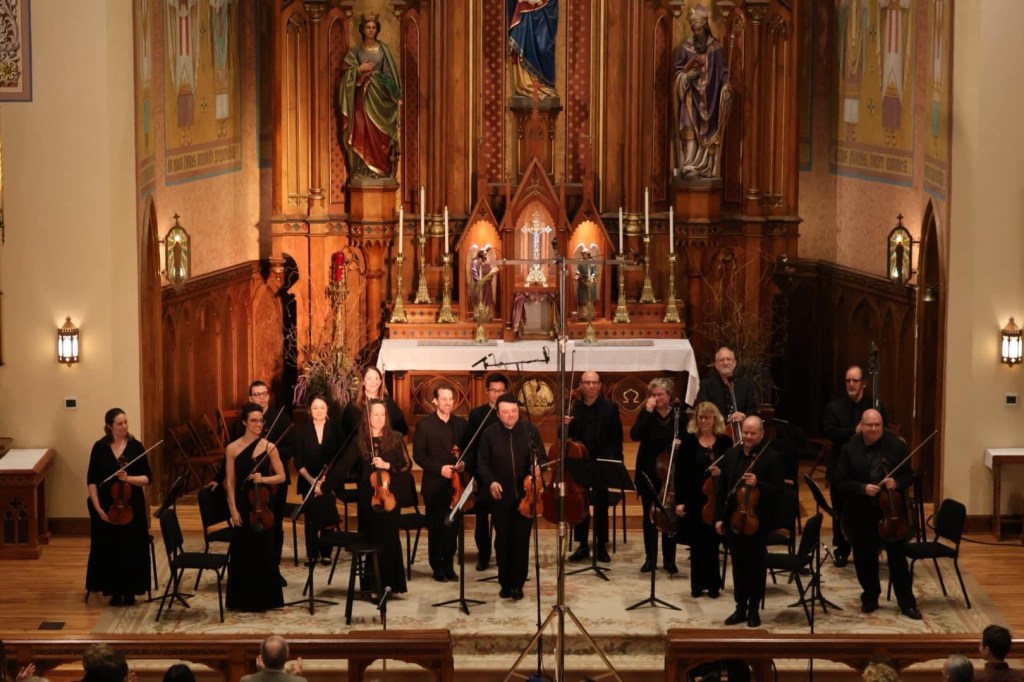
In his first appearance of the current concert season, ProMusica’s creative partner Vadim Gluzman led the ensemble in the Neighborhood Series, an event that sees the group perform outside the confines of their usual home in the Southern Theatre. Sunday’s afternoon performance in German Village drew a capacity crowd for a program that featured ProMusica players as soloists in Bach concertos, interspersed with works scored for string orchestra.
ProMusica at St Mary, photos credit ProMusica
Bach’s Double Concerto for Oboe and Violin brought forth Gluzman along with oboist Donna Conaty. Gluzman served dual role as a dynamic leader and charismatic soloist, sparking a fine chemistry with Conaty. The pair gave the piece an energetic workout, though perhaps most touching was the slow movement’s singing line in the oboe deftly answered by the violin.
This weekend marked the two year anniversary of the Russian invasion of Ukraine, and meaningfully, a work from Gluzman’s Ukrainian compatriot Valentin Silvestrov followed, as the conductor-violinist put it, “in hope of a better tomorrow.” The deeply reflective Silent Music dates from 2002, and is cast in three movements – though ProMusica opted to play only the first two. Solemn strings opened the Waltz of the Moment, and a wistful waltz gesture eloquently took shape. Evening Serenade occupied a similar space, marked by a melody gently cascading.
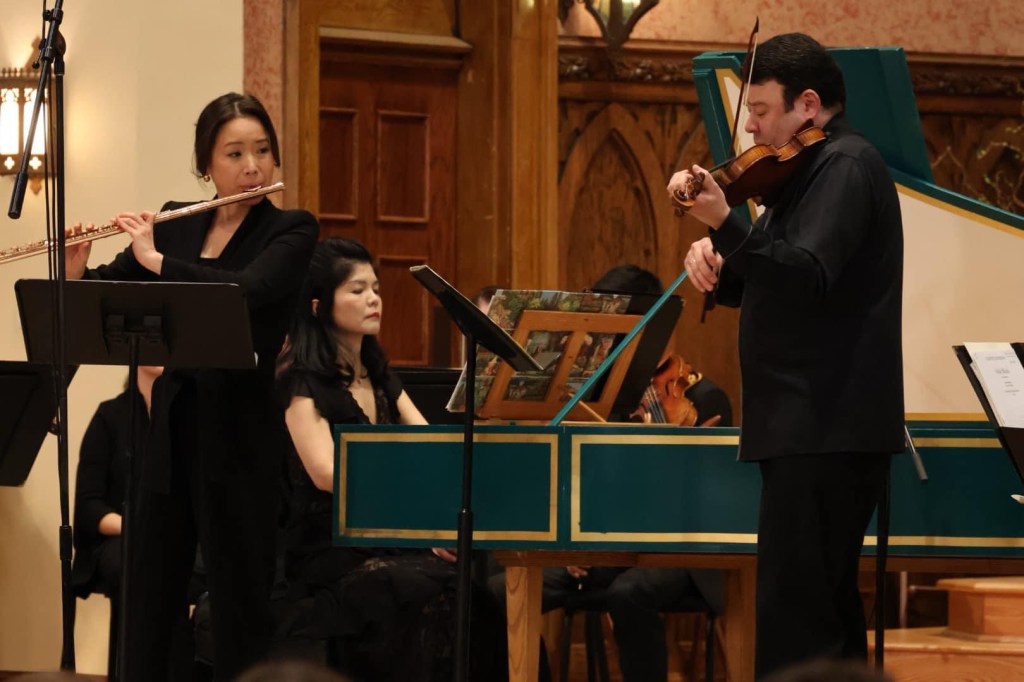
Bach’s Brandenburg Concerto No. 5 was quite a contrast, being in the highest of spirits. It boasted substantial solo parts for flute (Nadine Hur) and harpsichord (Aya Hamada). The flute offered a lyrical presence throughout, and the sparkling, bright effect of the harpsichord captured one’s attention, above all, in the cadenza. One of the single most impressive moments in all of Bach’s keyboard writing (which is saying a lot!), Hamada purveyed a self-assured virtuosity.
Between the ages of twelve and fourteen, the astonishingly precocious Mendelssohn wrote a set of twelve string symphonies. No. 10 closed the afternoon’s program, a single movement conception that opened in the lushness of the strings. More animated material took flight, providing glimmers of the gossamer textures that would come to define the very word Mendelssohnian.
Nadine Hur, Aya Hamada, and Vadim Gluzman perform Bach
Isidore String Quartet Southern Theatre Columbus, OH February 24, 2024
Dinuk Wijeratne: The Disappearance of Lisa Gherardini Aida Shirazi: umbra Bach: Contrapunctus I-IV from The Art of Fugue, BWV 1080 Britten: String Quartet No. 2 in C Major, Op. 36
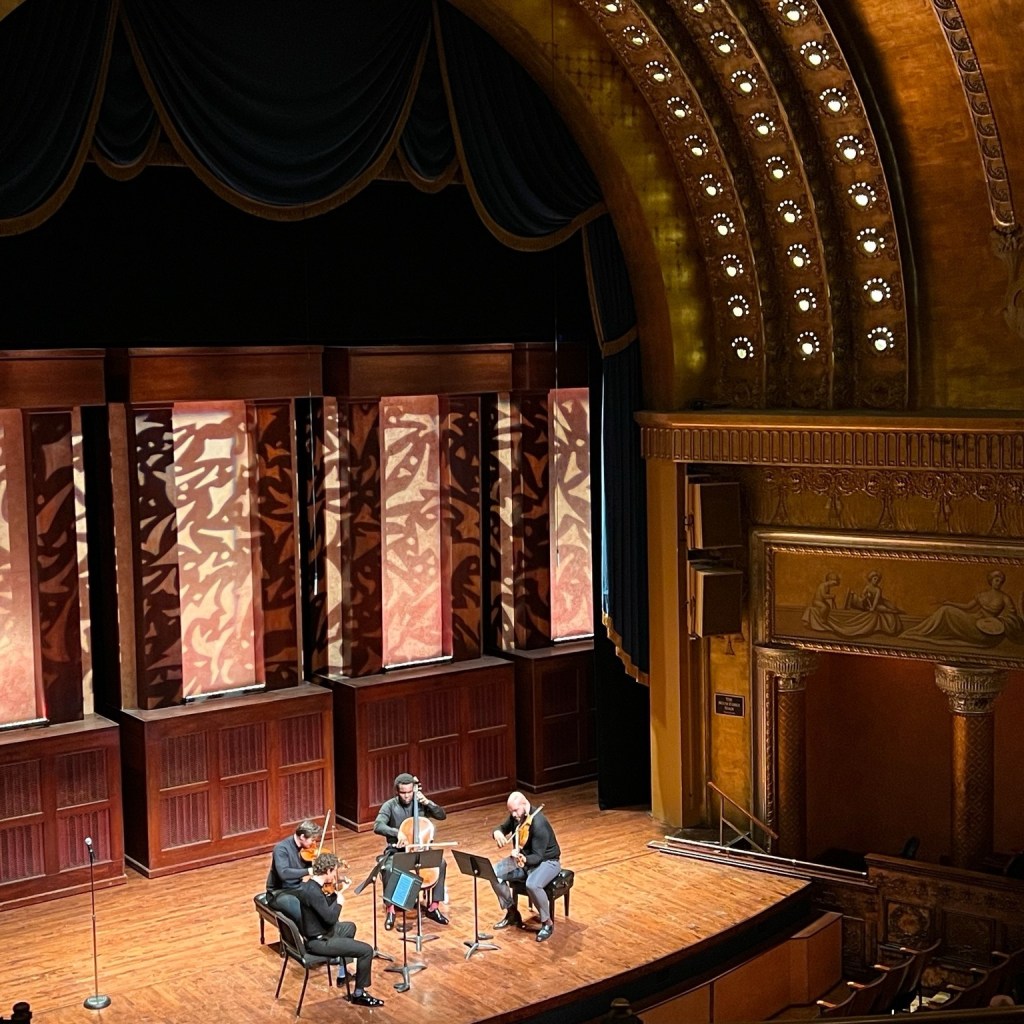
Chamber Music Columbus’ February program introduced the youthful Isidore String Quartet. All recent Juilliard grads, the quartet has already been acknowledged with an Avery Fisher Career Grant and first prize at the Banff International String Quartet Competition. Their Saturday night program at the Southern Theatre was refreshingly diverse and enterprising.
Isidore Quartet at the Southern Theatre, photo credit Chamber Music Columbus
A 2022 work from Sri Lankan composer Dinuk Wijeratne opened, a quantity this ensemble first encountered at the Banff Competition. The Disappearance of Lisa Gherardini recounts in musical – and quite theatrical – terms the 1911 heist of the Mona Lisa from Louvre. A cello melody opened, suggesting the genesis of the painting, with the others dispersed around the stage, playing gestures that in the composer’s own words “evoke gentle brushstrokes.” A central section suggested the heist, scheming and unsettling, while the cello resounded again in the concluding material, signifying the painting at last returned to its rightful place.
Iranian composer Aida Shirazi was represented with the 2011 work umbra, a title meant to evoke “a process in which the musical events unfold glacially.” Extensive use was made of extended techniques – harmonics and quarter-tones which painted an otherworldly soundscape, all but dissipating into the ether upon its conclusion.
Though generally performed on the keyboard, Bach’s crowning Art of Fugue has a long tradition of being appropriated for other instruments. The first four Contrapunctus were given in exacting transcription for string quartet. The second violin introduced the stately theme, with the transcriptions arranged in such a way that each instrument rotated giving the first presentation of the subject. The quartet boasted a sharp contrapuntal clarity, particularly evident in the fearsome complexities of the final selection. The string quartet is a medium that came after the composer’s time, but Isidore certainly made a compelling case for listening to Bach through this lens.
The program closed with Britten’s String Quartet No. 2, dating from 1945 – a watershed year in British history as well as the 250th anniversary of Henry Purcell’s death, both of which are central to the quartet. Wide-spaced texturing characterized the opening movement, a plaintive atmosphere in due course interrupted by more energetic material. The scherzo movement was in turn a ferocious if brief affair, putting Isidore’s virtuosity on full display.
The closing Chacony (as chaconne would have been spelled in Purcell’s time and place) is the most overt nod to the elder composer, and the heart of the work, clocking in at more than the first two movements combined. Its theme was derived from Purcell’s Chacony in G minor, Z730, and three groups of six variations respectively explored the source material’s harmony, rhythm, and counterpoint. Solo cadenzas punctuated each grouping, and a final set of three variations offered a lush chordal finale.
Cleveland Orchestra Klaus Mäkelä, conductor Nikolaj Szeps-Znaider, violin Mandel Concert Hall Severance Music Center Cleveland, OH April 23, 2022
Sibelius: Violin Concerto in D minor, Op. 47 Encore: Bach: Partita No. 2 in D minor, BWV 1004 – Sarabande Shostakovich: Symphony No. 10 in E minor, Op. 93
Following one of the most memorable debuts in recent seasons, the amazingly youthful Finnish conductor Klaus Mäkelä made a much-anticipated return to Cleveland in a meaty program of Sibelius and Shostakovich. Sibelius was represented by way of his towering Violin Concerto, a work first performed in Cleveland in 1922 by Ferenc Vecsey, the concerto’s dedicatee. The work opened shrouded in mysterious tremolos, with soloist Nikolaj Szeps-Znaider pointing the way with resonant lyricism. Thornier material swiftly multiplied virtuoso demands, played with aplomb and searing passion – and the energetic orchestral accompaniment evidenced Mäkelä’s innate understanding of his fellow Finn.
Nikolaj Szeps-Znaider, Klaus Mäkelä, and The Cleveland Orchestra, photo credit Roger Mastroianni, courtesy of The Cleveland Orchestra
Szeps-Znaider’s command of his instrument was on full display in the extended cadenza, intriguingly placed in the center of the movement in emphasis of its structural significance. Much-need repose was to be had in the central Adagio di molto, noted for its wonderfully long-breathed melody. Contrast was once again found in the finale with its foot-tapping polonaise rhythms. As an encore, the violinist offered a deeply poignant Bach sarabande which he noted to be his token of gratitude for being back in Cleveland for the first time post-pandemic.
Quiet rumblings began Shostakovich’s mighty Tenth Symphony, reaching towards ponderous depths. A forlorn clarinet solo – which has been astutely compared to Mahler’s Urlicht – was profoundly moving, and the climaxes scaled cataclysmic heights – a pacing that benefitted from the conductor’s singular sense of architecture. An unexpected physical manifestation of the intensity with which he conducted came when he inadvertently knocked over the concertmaster’s music stand! The brief Allegro, often thought to be a portrait of Stalin, was unrelenting and uncompromising, not in the least during the machine gun fire of the percussion.
Rather flippant by comparison, the Allegretto introduced the DSCH motive, with the politically engaged composer ever keen to willingly inject himself into the commentary. The gleaming Elmira motive in the horn further solidified the composer’s personal connection to the work. A slow introduction – the closest thing to a proper slow movement in this symphony – opened the finale, as if the composer was gathering together his final thoughts. The DSCH returned in incessant prominence, hammered home for a powerhouse conclusion. Just a stunning performance from this dynamic podium presence.
Mahan Esfahani, harpsichord Huntington Recital Hall Capital University Bexley, OH February 25, 2022
Bach: French Suite No. 5 in G major, BWV 816 Bach: Goldberg Variations, BWV 988
Encore: Stölzel: Bist du bei mir (attr. Bach, BWV 508)
The Goldberg Variations is an evening’s worth of music in its own right – and a generous one at that – but for Mahan Esfahani’s ambitious harpsichord recital at Early Music in Columbus, it was merely the second half. In addition to providing his own program notes, Esfahani was on hand for an engaging preconcert discussion, showing himself to be a deep thinker on the music in question. The program began with the French Suite No. 5. Esfahani took the opening Allemande at a relaxed tempo, seemingly relishing in its elegance. The Courante that followed offered sprightly contrast, and each subsequent dance was imbued with individual charm, perhaps none more so than stylishly virtuosic Gigue that closed.
Mahan Esfahani, photo credit Kaja Smith
Few pieces in the repertoire are as life-affirming as the Goldberg Variations. The Aria on which the work is based was pure and deeply felt, a nuanced reading of an outwardly simple melody. The first variation offered more forward motion in contrast to the stasis of the source material, pointing towards the multitude of directions the work would explore, and the composer’s fertile inventiveness. Variation 3, the first of the canons, plumbed the richness of the instrument, and Esfahani purveyed an exacting clarity in the contrapuntal textures. Variation 5 employed an impressive virtuosity in thoroughly utilizing both the instrument’s keyboards.
A pensive, unresolved close to Variation 15 marked the halfway point, and the subsequent variation, a brilliant overture, made for a powerful statement to herald the even more ambitious latter half of the work. Striking contrast was had in Variation 19, wherein Esfahani made use of his instrument’s plucked timbres. Time seemingly stood still in the otherworldly Variation 25 – the so-called “Black Pearl” – yet the following was once again bright and effervescent. Variation 28 is always a highlight for this listener, and here Esfahani’s playing was sparkling and radiant, replete with elaborate hand-crossings rivaling anything in a Scarlatti sonata. I was further struck by the blazing technique in Variation 29 as well as the irresistible charm of the Quodlibet, given with exultant abandon. The Aria da Capo concluded where matters began, a welcome return home after a long journey.
“What does one play after that?” Esfahani quipped. Nonetheless, he mustered the energy for a lovely encore, a transcription of the aria Bist du bei mir from Gottfried Heinrich Stölzel’s opera Diomedes. For a long time falsely attributed to Bach, it was included in the Notebook for Anna Magdalena Bach – as was the aria to the Goldbergs. Certainly a recital for the books, though perhaps it is best to close with Esfahani’s own assessment:
I feel like after thirteen years of playing them, last night in Columbus I gave the first performance of the Goldberg Variations that matches closely with what I’ve always felt in my heart and head. I hope this isn’t a once-every-thirteen-years sort of thing.
ProMusica Chamber Orchestra Simone Dinnerstein, piano and leader Southern Theatre Columbus, OH December 11, 2021
Bach: Keyboard Concerto No. 7 in G minor, BWV 1058 Bach: Erbarm’ dich mein, o Herre Gott, BWV 721 (arr. Lasser) Bach: Orchestral Suite No. 2 in B minor, BWV 1067 Glass: Piano Concerto No. 3
Encore: Glass: Etude No. 6
The spotlight shone on Simone Dinnerstein during this weekend’s ProMusica performances in which she served dual role as pianist and conductor. This was an event that was originally on the calendar a year ago, inevitably cancelled due to the pandemic – during which time Dinnerstein was involved in bringing to life Richard Danielpour’s monumental tribute to the heroes of the pandemic (see my interview with her on that project). Ever keen to draw out thoughtful connections between composers, Dinnerstein curated a poignant program comprised of Bach and Glass. It’s an inspired coupling, to be sure: Dinnerstein noted that Glass was intensely immersed in Bach during his studies with Nadia Boulanger, and moreover, one can draw parallels in the two composers’ musical languages, for instance, in their extensive use of motivic repetition.
Simone Dinnerstein with ProMusica Chamber Orchestra, photo credit ProMusica
Bach’s Keyboard Concerto No. 7 in G minor is a reworking of his Violin Concerto in A minor, transposed down a tone to better suit the harpsichord used at the time. Dinnerstein purveyed a seamless, flowing playing, leading the orchestra – just as the composer would have done – as if an extension of herself. The vigor of the opening movement offered little respite until the central Andante, a lovely moment, delicate and carefully judged. A crisp contrapuntal vigor opened the finale, and Dinnerstein’s stylish playing, punctuated by rippling chains of sixteenth notes, made full use of the resources of the modern concert grand.
The chorale prelude Erbarm’ dich mein, o Herre Gott was presented in a transcription for piano and strings, an arrangement made for Dinnerstein by Philip Lasser – a composer with whom she has had numerous collaborations. Much was said in the work’s brief duration. The resonant reserves of the piano were tastefully aided and abetted by the strings, yielding a touching gravitas, and matters built to a stentorian climax.
The Orchestral Suite No. 2 in B minor followed without break, allowing the previous work to function quite literally as a prelude. It’s a well-known quantity, but Dinnerstein heightened one’s interest by imbuing the work with her own individual stamp and making subtle alterations to the score, for instance, adding some pizzicatos and playing an octave higher in certain places. The overture opened in stately fashion, with its dotted rhythms sharply delineated. Dinnerstein offered a lively and incisive continuo (along with cellist Marc Moskovitz) while adeptly directing her orchestral colleagues – and it was quite striking hearing a modern piano rather than harpsichord play the role. A contrasting series of dances ensued, among them, a languid sarabande, a lively bourée, and a regal polonaise. The suite culminated in the much-loved badinerie, bringing principal flute Nadine Hur front and center. Her rapid-fire playing made for an exhilarating close.
Philip Glass dedicated his 2017 Piano Concerto No. 3 to Dinnerstein – indeed, half the works on the program were written with Dinnerstein in mind. He intended the work to be paired with the Bach concerto that opened the program (as it also is on her recording of the work). The work opened with a meditative solo statement from the pianist, instantly recognizable as coming from Glass’ pen. This was music deeply lyrical and affecting, showing minimalism not as just a cold experiment but an aesthetic that can have a real heart to it. The last movement made perhaps the strongest impression. Written for fellow minimalist Arvo Pärt (though both composers have resisted such labeling), it opened with a monastic done in the bass, alluding to the Estonian’s idiosyncratic use of bell-like textures. This gesture was repeated incessantly yet purposefully, eventually fading away into the ether. As an encore, Dinnerstein offered Glass’ Etude No. 6, a fitting pendant to the concerto, and her reading was as dramatic as it was mesmerizing.
Post-concert Q&A with Dinnerstein and WOSU’s Boyce Lancaster
Columbus Symphony Orchestra Rossen Milanov, conductor Stefan Jackiw, violin Ohio Theatre Columbus, OH October 22, 2021
Montgomery: Banner Brahms: Violin Concerto in D major, Op. 77 Encore: Bach: Largo from Violin Sonata No. 3 in C major, BWV 1005 Dvořák: Symphony No. 8 in G major, Op. 88
Friday marked opening night of the Columbus Symphony’s Masterworks series, the core of its landmark 70th season. As is standard practice from most American orchestras, the CSO would typically open the season with a rendition of the national anthem. Extraordinary times, however, make business as usual ring hollow, and a thoughtful opener was to be had in Jessie Montgomery’s 2014 work Banner. Written in 2014, two hundred years after Francis Scott Key’s indelible poem, the work pits the Star-Spangled Banner against a wealth of melodies from other cultures, depicting in musical terms the vast array of cultures that comprise the United States today. While the contours of the Star-Spangled Banner form the backbone of the work, no less than seven other songs are woven together into a single multicultural fabric, often yielding a spiky polytonality. A deeply engaging opener, and I hope the CSO continues to explore Montgomery’s work in future seasons.
Stefan Jackiw, photo credit stefanjackiw.com
The remainder of the program retreated to more familiar territory in seminal works of Brahms and Dvořák. Stefan Jackiw served as a commendable soloist in the Brahms Violin Concerto. The graceful and genial opening gave way to the dramatic, punctuated by Jackiw’s jagged entrance. He displayed an accomplished virtuosity, delivering the extended cadenza with flair, but never without sensitivity, continually drawing focus towards the work’s lyrical heart. A rapturous oboe solo opened the central Adagio, answered in the rich lyricism of the solo violin. The Hungarian finale was given with both effervescence and drama, and the orchestra matched Jackiw’s high spirits. As an encore, Jackiw offered the Largo from Bach’s C major sonata – a lovely pendant.
Dvořák’s Symphony No. 8 closed the evening, and here, Milanov opted to conduct from memory. The work saw brooding beginnings, but rays of sunlight quickly broke through. The principal winds – the flute in particular – were the standouts here. A second movement Adagio proceeded as calm and untroubled affair, while the lilting penultimate movement had a dancing charm – though one wanted perhaps even more emphasis on the insouciant dance rhythms. Clarion trumpet calls heralded the boisterous finale. All in all, a very satisfying start to the season.




 quasi-faust