Honeck leads lavish program of varied Viennese repertoire in Pittsburgh

Pittsburgh Symphony Orchestra
Manfred Honeck, conductor
Emanuel Ax, piano
Heinz Hall
Pittsburgh, PA
February 21, 2025

Ishizaki: Spin
Mozart: Piano Concerto No. 25 in C major, K503
 Encore:
 Chopin: Nocturne No. 7 in C-sharp minor, Op. 27 No. 1
Korngold: Symphony in F-sharp major, Op. 40

All three works on Manfred Honeck’s generous Pittsburgh Symphony engaged in some fashion with the rich musical heritage of Vienna. The opening turned to a local voice, 24-year-old Pittsburgh area native Hannah Ishizaki, currently a doctoral student in music composition at Princeton (see NEXTpittsburgh for a lovely interview). Receiving its world premiere was Spin, a five-minute curtain-raiser that drew on dance traditions as disparate as Viennese waltz and electronic dance music.
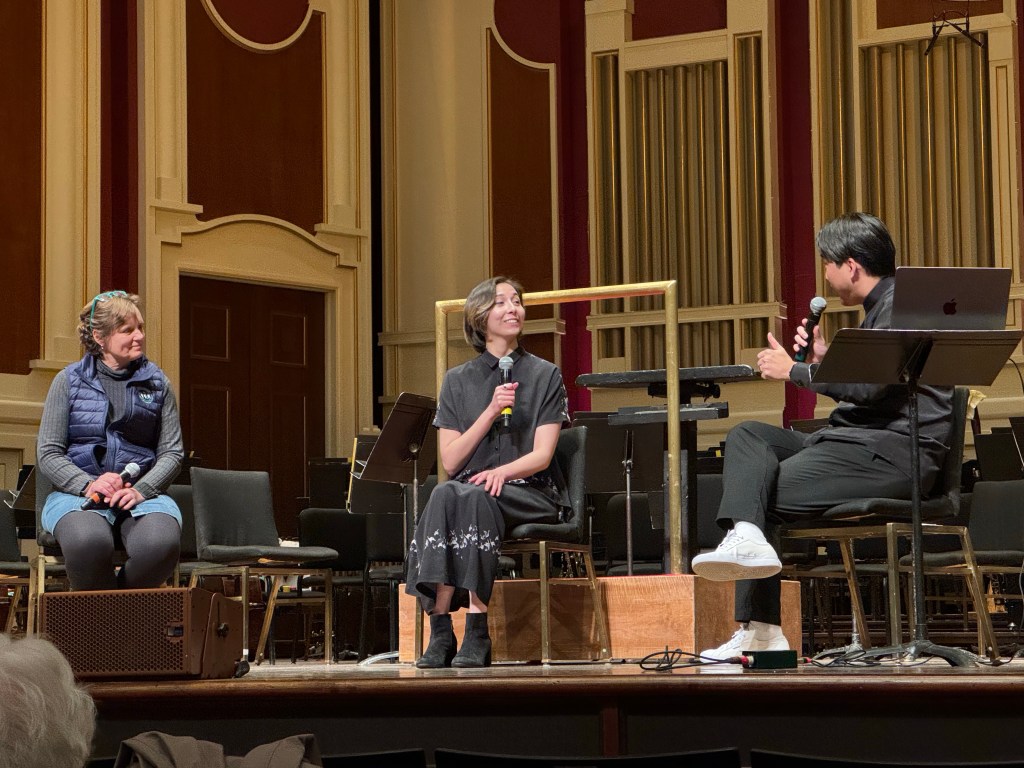
Pre-concert interview with piccolo Rhian Kenny, composer Hannah Ishizaki, and assistant conductor Moon Doh

The work began almost in media res, as if it had always been in motion, dropping the needle in the thick of things. Driving rhythms made for an exciting listen, and Ishizaki made skillful use of the large orchestra she employed. A homecoming for the composer, writing for this orchestra in this hall is not without deep personal significance. A solo passage invoking a kinetic dance club beat was given to the contrabassoon, whom the composer counts as a mentor.

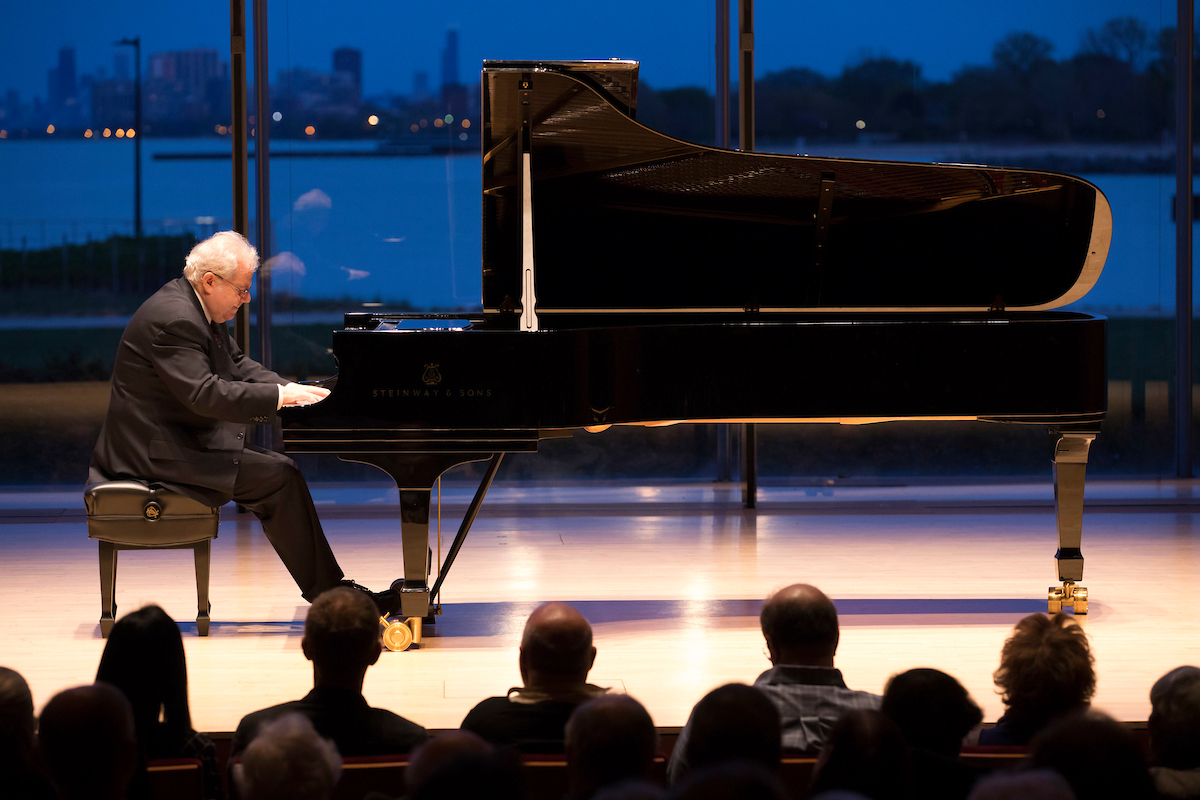
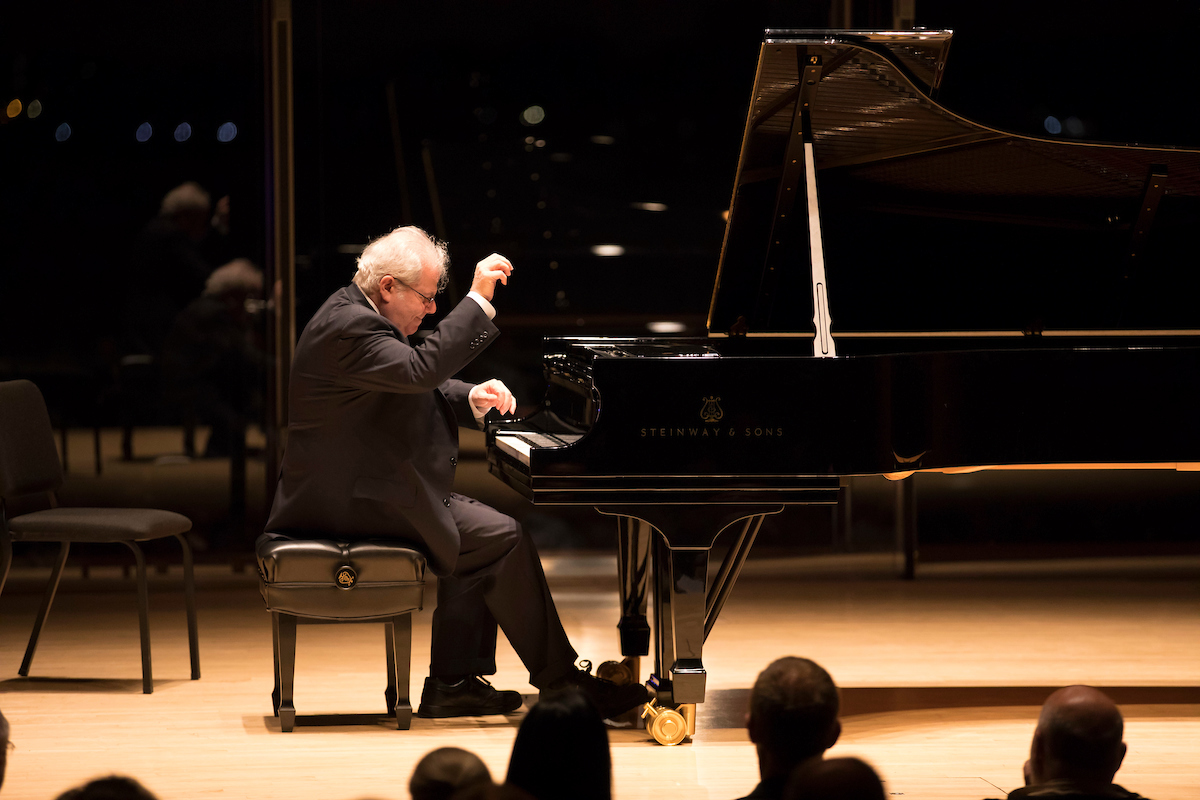
There’s hardly a more choice soloist in a Mozart piano concerto than Emanuel Ax, and the regal no. 25 in C major was a particularly fine vehicle for the pianist’s pearly technique and refined interpretation. A bold opening was fitting for one of the composer’s grandest conceptions in the medium, and the orchestra offered a nuanced reading, with detailed inflections and attention to the inner voices. The pianist’s entry was in the shape of just a single line, hesitant at first, before its full flourishing, displaying the crystalline, rippling playing of this masterful Mozartean.

Easily surmounting the decorative trills, rapid scales, and other technical demands, Ax also offered his own cadenza, an essay artfully expressive and wide-ranging. The central Andante served as a songful blending of piano and orchestra, and the finale brimmed with Viennese elegance, pointed and articulate. More so than the typical Mozart finale, it also probed the lyrical, particularly when Ax was in a lovely dialogue with the winds. A warmly enthusiastic reception — Ax seemed visibly moved — brought him back for an encore in a Chopin nocturne, a quantity which starkly contrasted the languid and the dramatic.

Something of a Mozart of his day, Erich Wolfgang Korngold was a prodigy in Vienna of extraordinary precocity. Fleeing the Nazis, he then found fame and fortune in Hollywood where he became one of the first major composers of film scores (John Williams cites him as a major influence). His sole symphony dates from the mid-1950s and is cast in the unusual key of F-sharp major. It’s not a work one encounters in concert often, but seems to have had a resurgence lately — a performance by the Berlin Philharmonic was quite memorable for this listener, and The Cleveland Orchestra has also programmed it in a recent season.

A jagged primary theme took shape in the clarinet, teetering on the brink of tonality, but firmly residing in the late Romantic tradition. Honeck and the PSO delivered a bracing, razor-sharp reading of this dense score with singular drama. As sumptuous as it gets, it’s almost to the point of excess and — as if one perhaps had a few too many slices of sachertorte. A high-octane scherzo followed, further showing the variegated color spectrum, with particularly piquant splashes from the piano and celesta. Matters were at the very edge of control without ever falling into chaos, and the brass passages had the cinematic effect of a film score.

Korngold looked towards Austrian compatriot Anton Bruckner in the towering slow movement, conceived in this case as a memorial to FDR. Brass and strings resounded through Heinz Hall, swelling to lush textures, though a solo passage for flute was delicately forlorn. The finale returned to the vigor and angular gestures of the opening, and militant brass fanfares threaded George M. Cohan’s Over There into the score. A welcome opportunity to hear a major if infrequently performed work — and certainly a highlight of the PSO season thus far.

In a brief post-concert performance, a quintet of PSO string players offered the first movement of Dvořák’s String Quintet No. 2, Op. 77. The use of double bass gives this work an orchestral heft, and made for a delightful capstone to the Dvořák heard the previous week.

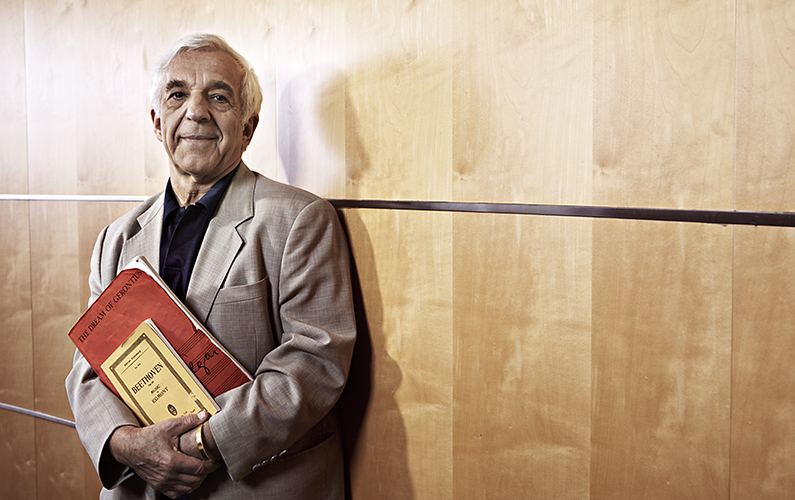
Manfred Honeck, Emanuel Ax, and the Pittsburgh Symphony

Ashkenazy and Ax in an inspired partnership with the Cleveland Orchestra

Cleveland Orchestra
Vladimir Ashkenazy, conductor
Emanuel Ax, piano
Severance Hall
Cleveland, OH
November 3, 2017

Elgar: Serenade for String Orchestra in E minor, Op. 20
Beethoven: Piano Concerto No. 1 in C major, Op. 15
 Encore:
 Schumann: Des Abends, No. 1 from Fantasiestücke, Op. 12
Elgar: Enigma Variations, Op. 36

In the Cleveland Orchestra’s first concert on home turf since returning from an extensive – and by all accounts, highly successful – European tour, the stage of Severance Hall boasted the distinguished presence of two of their most veteran collaborators. Serving as the orchestra’s principal guest conductor from 1987-94, Vladimir Ashkenazy made his first podium appearance in Cleveland since 2010. A pair of works by Elgar framed an early Beethoven piano concerto, the central work bringing forth the much-admired Emanuel Ax.

Vladimir Ashkenazy
Vladimir Ashkenazy, photo credit Keith Saunders

Elgar’s Serenade in E minor for String Orchestra is the work of burgeoning yet not fully formed talent, but as attractive as it is compact at just over ten minutes in duration. The lilting first movement sounded quite literally piacevole (“pleasant”) in the Cleveland strings, highlighted by a solo passage from concertmaster William Preucil. The songful Larghetto was the heart of the work, and a sure sign of all that was to come for the composer, while the brief finale recalled the opening in its return to triple meter to neatly bookend the work.

A gentle outlining of the tonic C major triad opened Beethoven’s Piano Concerto No. 1, and grew in urgency to introduce Ax’s sparkling entry in the solo piano. Ax’s graceful playing flowed with an effortless charm, while there was much heightened drama in the development as Beethoven began to break away from Mozart’s model of the classical concerto, and the extended cadenza showed Ax as a fiery virtuoso. In the slow movement, one was immediately struck by the inclusion of the piano in the opening breaths, and this music of great beauty was further enhanced by the singing clarinets. At the other end of the spectrum was the jocular concluding rondo which bordered on the rambunctious. Ax responded to the warmly enthusiastic reception that followed with an deeply lyrical account of Schumann’s Des Abends (incidentally, a favorite encore of the pianist, having been his choice for the two previous concerto appearances of his I’ve seen – see here and here).

Emanuel Ax_by Lisa Marie Mazzucco
Emanuel Ax, photo credit Lisa Marie Mazzucco

Written only a few years after the Serenade, Elgar’s Enigma Variations show him at the height of his compositional powers, and was a work that ensured his enduring fame. The theme was presented not without a shroud of mystery – enigmatic indeed – while the first variation was a loving portrait of the composer’s wife, Alice. A variegated chromaticism made the second variation a more pedantic affair, while interjections from the bassoon gave the following a childlike, impish humor. A rich viola solo marked the Ysobel variation in a nod towards the titular violist, and its successor (“Troyte”) was boisterous and big-boned.

The famous “Nimrod” variation was predictably a highpoint, its lush textures building to a cathedral-like resound. Given his long association with several of the London orchestras, it seemed Ashkenazy was able to offer particularly keen insight into this quintessentially British music, “Nimrod” being perhaps the British equivalent of Copland’s Fanfare for the Common Man. In contrast, the “Dorabella” variation was featherlight and stammering. A wistful cello solo made for a somber tribute to Elgar’s cellist fried Basil Nevinson, and the penultimate variation featured a fine clarinet solo from Afendi Yusuf in an invocation of Mendelssohn’s Calm Sea and Prosperous Voyage. The last variation was Elgar’s portrait of himself, grandiose, and with the self-assurance of a composer utterly convinced of his abilities (albeit a bit more modest than Strauss’ Ein Heldenleben). Surely a high mark of the banner centennial season, let us hope Ashkenazy’s next appearance does not entail another seven year wait!

Ax shows his lyrical gift in Schubert and Chopin

Emanuel Ax, piano
Mary B. Galvin Recital Hall
Evanston, IL
May 3, 2017

Schubert: Four Impromptus, D935
Chopin: Impromptu in A-flat major, Op. 29
Chopin: Impromptu in F-sharp major, Op. 36
Chopin: Impromptu in G-flat major, Op. 51
Chopin: Fantaisie-Impromptu in C-sharp minor, Op. 66
Samuel Adams: Impromptu No. 2, “After Schubert”
Chopin: Piano Sonata No. 3 in B Minor, Op. 58

Encores:
Chopin: Nocturne in F-sharp major, Op. 15 No. 2
Chopin: Waltz in A-flat major, Op. 34 No. 1

Awarded biennially since 2006, Northwestern’s Jean Gimbel Lane Prize in Piano Performance now claims a veritable who’s who of the piano amongst its laureates.  Each recipient spends time in residency on campus, working with music students and presenting a public recital, and 2016 winner Emanuel Ax closed this season’s Skyline Piano Artist Series Wednesday evening.  Ax presented one of his characteristically thoughtful programs, exploring the impromptu in sterling examples by Schubert and Chopin along with a new addition to the genre by Samuel Adams, rounded off by Chopin’s incomparable B minor piano sonata.

Emanuel Ax
Emanuel Ax at the Galvin Recital Hall, all photos credit Todd Rosenberg
The evening opened with Schubert’s posthumously published set of Four Impromptus, D935 – and piano devotees will note that fellow Lane Prize winner Murray Perahia can be heard in the same work this Sunday at Symphony Center.  An arresting opening began the set, unsettling but calmed in due course by the legato thirds under Ax’s silken tone.  The sudden shifts to the minor gave the piece an unpredictable, mercurial quality, and Ax’s conception was spacious and improvisatory.  The second impromptu was characterized by an intensely lyrical chordal melody complemented by gracefully flowing interludes.  The theme of the B flat impromptu was of a charming refinement, but I felt Ax could have aspired to greater contrast in the ensuing set of five variations, even if the composer provided only one in the minor. While Ax’s sound was exquisite, it felt this was achieved through an unnecessarily cautious approach, and this was much the case in the final impromptu as well – while its folk-like, quasi-Hungarian melody certainly had fire, one still wanted a bit more heft.

Robert Schumann famously described Schubert’s D935 impromptus as a coherent if veiled sonata; Chopin’s four examples of the genre, however, are quite independent of one another, bearing little more in common than the rather vague title.  Nonetheless, Ax presented them as a suite, an interesting approach insofar as it juxtaposed works from various points in the composer’s life.  The Impromptu No. 1 in A flat major was highlighted by its songful middle section, and under Ax’s guidance the circuitous, labyrinthine coda felt entirely purposeful.  In the following work, the deeply felt music yearned and grew to great passions.  While it may be the least played of the Chopin impromptus, Ax made a strong case for the Impromptu No. 3 in G flat major in its arching, appealing melody.  Despite its late opus number owing to posthumous publication, the familiar Fantaisie-Impromptu is the earliest of the four, and Ax gave it an energetic workout with impressive prestidigitation.

The second half opened with a 2016 work of Samuel Adams which Ax himself commissioned, and the attention to Adams’ work is certainly topical as he currently serves as one of the two Mead Composers in Residence at the Chicago Symphony.  In concert with the theme of the first half, the work in question was the second of a set of three impromptus, this selection subtitled “After Schubert”.  As a whole the three are intended to be inserted between each of the D935 impromptus, drawing comparison to Brett Dean’s Hommage á Brahms, which Ax presented in a 2014 recital at Symphony Center, superimposed within Brahms’ Op. 119.  While it certainly would be interesting to hear the Adams in that fashion, No. 2 – a substantial piece, surpassing the 10 minute mark – functioned well independently (although I thought it would have been more logical to program it in between the Schubert and Chopin, and that way it would literally have been “after Schubert”).

Opening with quasi-Schubertian melodic fragments over a rippling accompaniment, it was as if one was experiencing distant, refracted memories of the Schubert impromptus, along with a perhaps more obvious invocation of the elder composer’s final B flat major piano sonata.  Cast in Schubert’s preferred ternary form, the middle section fared somewhat repetitive, but the brief return of the A section rounded off what was generally a very attractive piece.

Departing impromptu territory, Ax concluded the program with Chopin’s Piano Sonata No. 3 in B minor, and it was here he was at his finest.  The first movement was grand yet tautly structured, while the fleeting, quicksilver scherzo put the pianist’s dexterous fingers on full display.  The heart of the work is in the slow movement; its declamatory opening soon melted away into a divinely gorgeous nocturne.  Though filled with bravura runs and effects, the melody was never lost in the busyness of the finale which closed the work with enormous passion and drama.

The warm, enthusiastic reception brought Ax back to the keyboard for two encores, both by Chopin: an elegant account of the Nocturne in F sharp major, along with the Waltz in A flat major, stylish and buoyant.

Emanuel Ax