
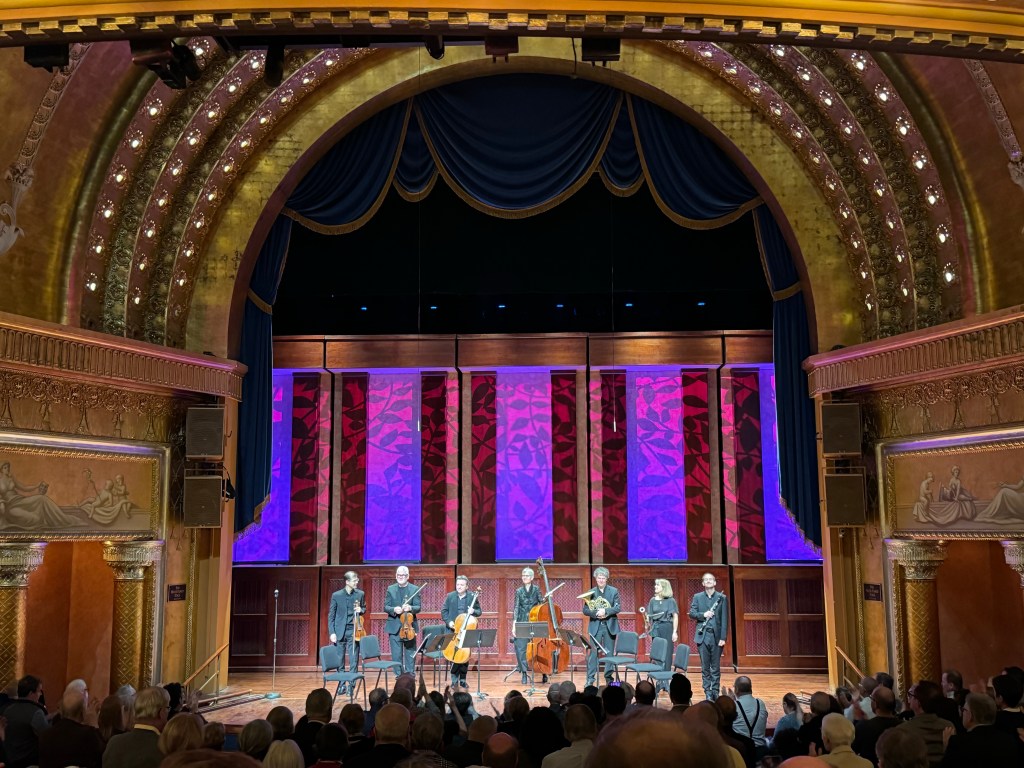
Academy of St. Martin in the Fields Chamber Ensemble
Tomo Keller, violin
Harvey De Souza, violin
Robert Smissen, viola
Richard Harwood, cello
Lynda Houghton, double bass
Timothy Orpen, clarinet
Julie Price, bassoon
Stephen Stirling, horn
Southern Theatre
Columbus, OH
November 4, 2023
Nielsen: Serenata in vano, FS 68
Dvořák: String Quintet No. 2 in G major, Op. 77
Beethoven: Septet in E-flat major, Op. 20
Eight members of the illustrious Academy of St. Martin in the Fields made their way to Columbus Saturday evening for a varied program of chamber music. Matters began with Carl Nielsen’s Serenata in vano (“Serenade in Vain”), a quintet scored for the unusual combination of clarinet, bassoon, horn, cello, and double bass – an instrumentation that intentionally overlaps with that of the Beethoven Septet with which it was written to be paired, as was indeed the case at present.
Pizzicato strumming in the strings underpinned the dominant clarinet (Timothy Orpen) melody (Nielsen was certainly a composer who knew how to write for clarinet, as epitomized by the significant Clarinet Concerto). The cello (Richard Harwood) was later granted a richly singing melody, enhanced by the warmth of the horn (Stephen Stirling). A lovely opener that showcased the individual personality of each instrument.
Dvořák’s String Quintet No. 2 in G major was a watershed work for the composer, capturing the attention of Brahms and vastly expanding his reputation. Like the Eighth Symphony in the same key that would follow some years later, it’s a warm and bucolic work, the jovial first movement in particular being given with flexible abandon, and always lyrical at heart – even during the heightened drama and tension of the development. The inclusion of double bass in place of the a second viola or cello as is more typical for a string quintet gave the work an added heft.
The scherzo was noted for its Bohemian inflections in its rhythmic vitality – a device that would become one of Dvořák’s signatures. The flowing, lyrical melody of the slow movement showed the quintet in deft balance, as they were perhaps even more so in the joyous finale that brought the first half to an energetic close.
Like the preceding, Beethoven’s Septet was a work that did much to enhance its composer’s renown. Following a bold, quasi-orchestral introduction, delicate filigree from violinist Tomo Keller served to bridge the elegant main theme. The Adagio cantabile boasted a long-breathed melody, first in the clarinet and then answered by the violin, while the horn and bassoon interlocked with an intricately-crafted countermelody. A bouncy minuet followed, perhaps more familiar from its use in the Op. 49 No. 2 piano sonata.
A theme and variations comprised the fourth movement, with a stately presentation of the theme preceding an increasingly florid set of embellishments. The mournful intro of the finale took the manner of a funeral march (a style the composer would often revisit), but quickly gave way following some fiery violin work, with the ensemble offering cohesion and chemistry even at its blistering Presto.
 quasi-faust