Leif Ove Andsnes contrasts Chopin with Norwegian piano sonatas in Cleveland recital

Leif Ove Andsnes, piano
Mandel Concert Hall
Severance Music Center
Cleveland, OH
March 27, 2025

Grieg: Piano Sonata in E minor, Op. 7
Tveitt: Piano Sonata No. 29, Op. 129, Sonata etere
Chopin: Preludes, Op. 28

Encore:
Debussy: La cathédrale engloutie, from Préludes Book I

The first half of Leif Ove Andsnes’ Thursday night piano recital in Cleveland plunged into wholly unfamiliar territory in an exploration of the Norwegian piano sonata. The pianist proved to be an incisive guide to the music of his home country, beginning with the Piano Sonata in E minor from the pen of a 22-year-old Edvard Grieg.
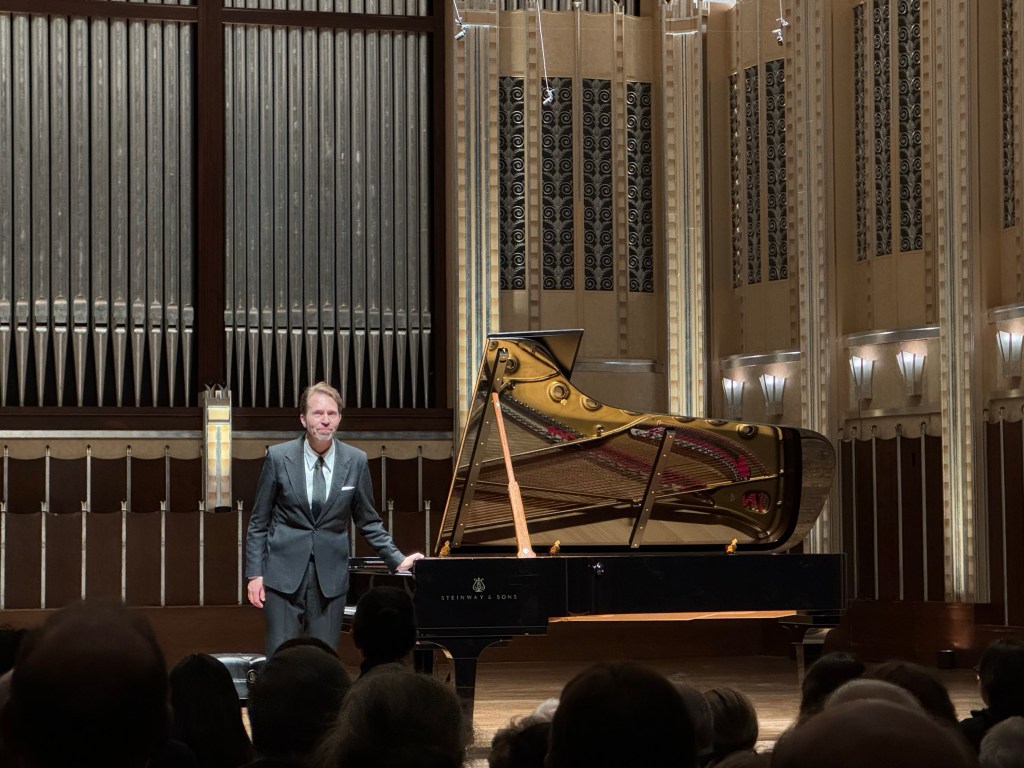
Leif Ove Andsnes at Severance Hall

Brimming with youthful energy, the piece balanced both the lyrical and the dramatic. A slow movement was delicate in its simplicity, though it built in density and traversed some striking harmonic modulations. The sonata very much bore the influence of Schumann above all, but the brief third movement was quite original, showing the composer finding his individual voice. The finale capped off this attractive work with a bravura march.

The real rarity came in the Piano Sonata No. 29 of Geirr Tveitt. Like Grieg, Tveitt studied in Leipzig, but returned to Norway where he developed his unique style. He settled in an isolated area in Norway’s Hardanger region, though tragedy would strike when a fire in 1970 would destroy nearly 300 of his unpublished manuscripts, the majority of his body of work. The Sonata etere (“Ethereal Sonata”) is the only surviving piano sonata — astonishingly, number 29 out of an unknown quantity lost to the flames.

A startlingly original work, there are perhaps nods to Prokofiev or Bartók in its percussive gestures or the French impressionists in its coloristic writing, but one imagines the composer writing in isolation, free from outside influences. A large-scale, 35-minute conception, the first movement (titled In cerca di — “In search of”) was propelled forward with driving energy — and I found Andsnes even more compelling than the composer’s own recording.

The central Tono Etereo in Variazoni consisted of 19 variations, most strikingly featuring a cluster of notes depressed with the pianist’s entire left arm, an ethereal resonance that would recur throughout. Overtop this were spiky jabs in the right hand the drew out the skeleton of a theme on which the variations were based. The variations were largely lyrical, and with subtle yet captivating effects. The closing Tempo di Pulsazione was virtuosic and bracing, though not purely percussive with its lyrical interludes, in due course fading away into the ether.

Chopin’s magnificent set of 24 preludes comprised the second half. Andsnes gave each one of these gems loving attention to detail, bringing out their unique personalities and sharpening contrasts across the set. I was struck by the majestic take on #9 and the ferocious energy given to #12, only outdone by the chillingly dramatic closing prelude. I loved the way he deftly voiced the chords in #20, and the warmly poetic readings he gave to #13 and #17 were deeply rewarding.

Andsnes offered a single encore from another great cycle of preludes in Debussy’s Sunken Cathedral, painting a wondrous soundscape.

While several artists have justly announced boycotts of the US in response to the current political climate, upon his arrival in this country, Andsnes thoughtfully mused on the potential music has to bring people together. A further post saw him marveling at the beauty of the Severance Hall stage. The pianist certainly proved that a captivating performance in a gorgeous venue can offer much-needed solace.
A devilish afternoon at the Pittsburgh Symphony

Pittsburgh Symphony Orchestra
Manfred Honeck, conductor
Leif Ove Andsnes, piano

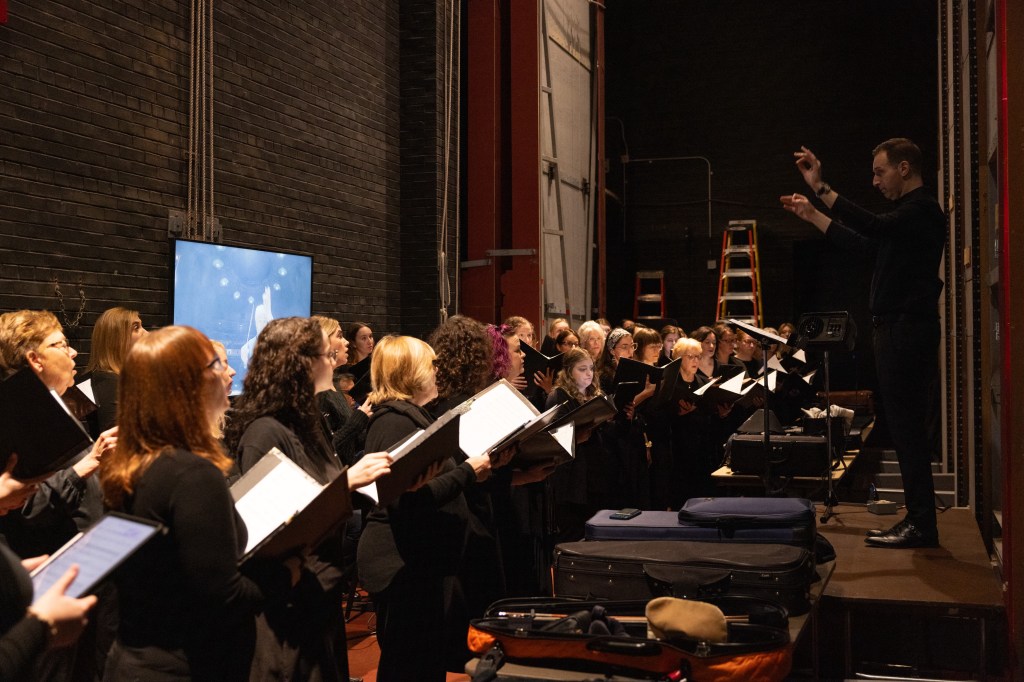
Women of the Mendelssohn Choir of Pittsburgh
Daniel Singer, director

Heinz Hall
Pittsburgh, PA
April 21, 2024

Rachmaninoff: Piano Concerto No. 3 in D minor, Op. 30
 Encore:
 Chopin: Mazurka in D major, Op. 33 No. 2
Liszt: Dante Symphony, S109

Sunday afternoon’s Pittsburgh Symphony performance began on a somber note, with a moment of silence in memoriam of Sir Andrew Davis, who served as the PSO’s artistic advisor from 2005-07. Music director Manfred Honeck offered a few words and dedicated the performance to Davis’ memory. On a personal note, I have fond memories of seeing Davis often during his two decade stint at Lyric Opera of Chicago, and caught him in robust form as recently as last June with the Minnesota Orchestra.

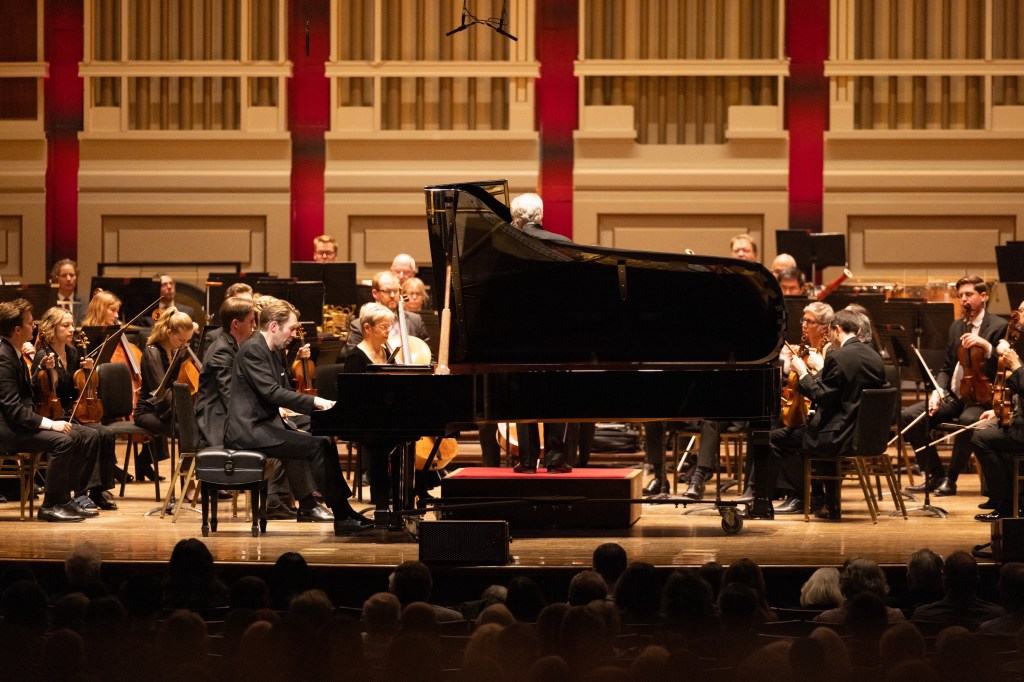
Leif Ove Andsnes with Manfred Honeck and the Pittsburgh Symphony, photos credit George Lange

The first half of the program was devoted to Rachmaninoff’s fiendishly difficult Third Piano Concerto, calling upon Leif Ove Andsnes as soloist. A barren, monastic melody opened, direct and undiluted in its expression before complexities multiplied. Andsnes drew a bold and robust tone, amply projecting through the hall and over the large orchestra. The PSO was a fine partner to the pianist, with some particularly sturdy playing from the brass. Andsnes opted for the larger of the two cadenzas the composer supplied, cresting to a thunderous climax.

The opening of the central intermezzo offered a rare respite for the piano, a strained paragraph for strings and winds to introduce a ravishing melody in the piano, increasingly impassioned. The finale proceeded as an electric march, with a grand, sweeping melody at the heart. One was kept at the edge of their seat through the sparkling coda in this bombshell of a performance. Andsnes returned for an encore in Chopin’s D major mazurka (op. 33 no. 2), bringing out the dance’s stylish rhythms and ineffable charm.

Matters went from warhorse to rarity with the latter half seeing a rare outing of Liszt’s Dante Symphony, an extensive work the composer wrote moved by his reading of the Divine Comedy (and a companion of sorts to the better-known Dante Sonata). This weekend marked the belated Pittsburgh premiere of the work, though I’ve had the unexpected fortune of seeing it elsewhere over the last few years – Chicago (2017) and Columbus (2022). Two large movements represent the Inferno and Purgatorio respectively; not feeling music could adequately represent Paradisio, Liszt instead opted to close with a brief Magnificat that employs a female choir.

Low brass opened in an uncompromising descent to hell, with thundering timpani further conjuring the inferno in no uncertain terms. A bit overblown, perhaps, but Honeck and the PSO were strong advocates of the work and offered a compelling interpretation. A lyrical contrast was provided in material that represented Francesca da Rimini, conveyed by the bass clarinet and harp. With a certain inevitability, the movement was brought to a bleak, crashing close – with all hope duly abandoned.

Purgatorio was far more at peace in music that appropriately suggested a sense of stasis. A fine passage for oboe was a highlight, as well as a moving chorale for low brass – here, no longer a menacing force. The closing Magnificat offered a spiritual glimpse of the divine, with the angelic voices of the women of the Mendelssohn Choir coming from backstage. High strings and harp further conveyed the celestial in this closing hymn, a touchingly beautiful statement that Wagner no doubt looked towards when writing the final moments of Parsifal.

Daniel Singer leads the Women of the Mendelssohn Choir from backstage

Andsnes and Hamelin dazzling in two piano recital

Leif Ove Andsnes, piano
Marc-André Hamelin, piano
Symphony Center
Chicago, IL
April 30, 2017

Mozart: Larghetto and Allegro in E-flat Major for Two Pianos
Stravinsky: Concerto for Two Pianos
Debussy: En blanc et noir
Stravinsky: The Rite of Spring

Encores:
Stravinsky: Madrid for Two Pianos from Four Studies for Orchestra (transc. Soulima Stravinsky)
Stravinsky: Circus Polka for Two Pianos (transc. Babin)
Stravinsky: Tango for Two Pianos (transc. Babin)

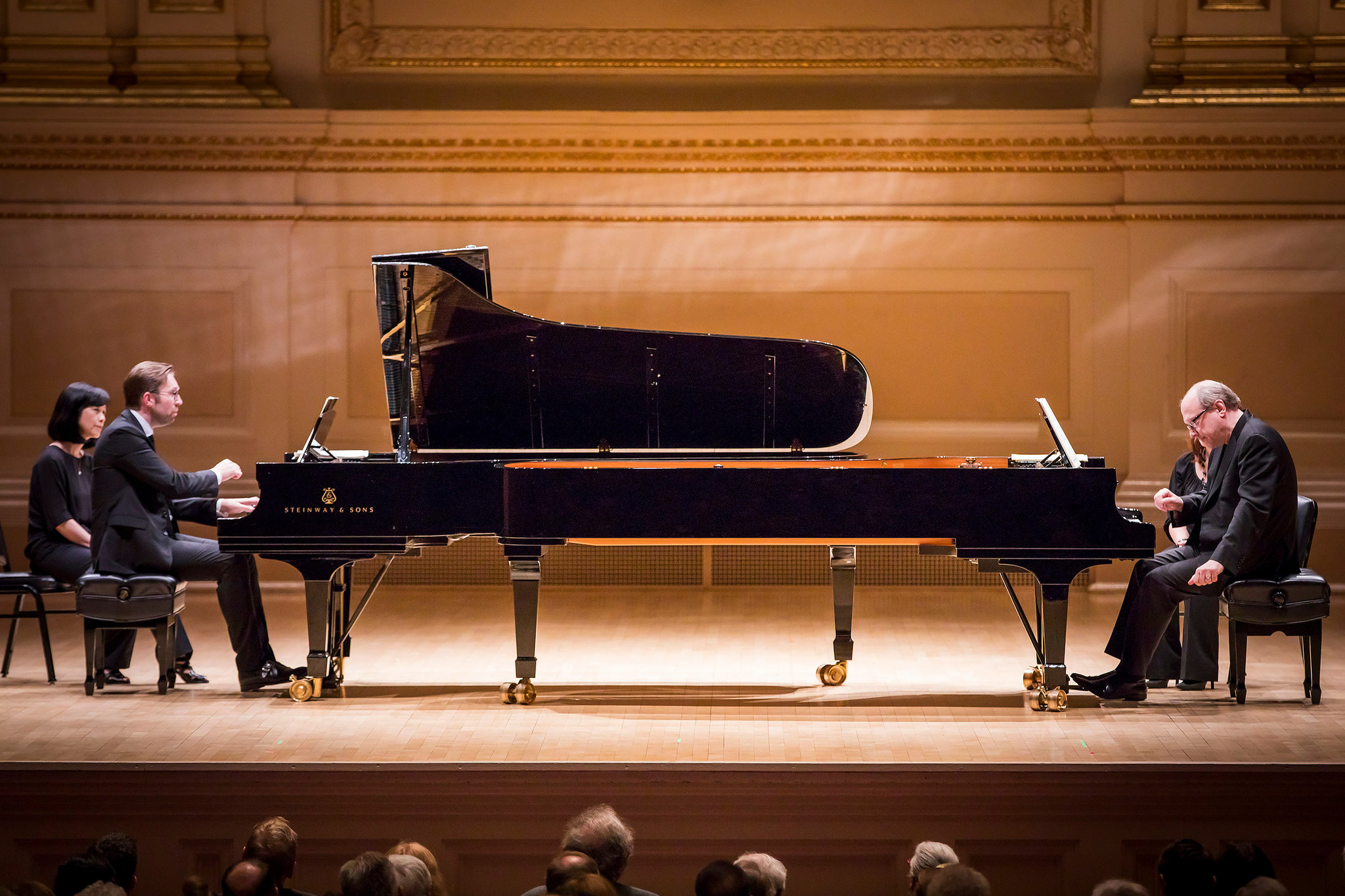
It is a rare opportunity indeed to see not one, but two of the world’s leading concert pianists on stage together.  This was fortunately the case Sunday afternoon, when Marc-André Hamelin and Leif Ove Andsnes stopped at Symphony Center as part of a 13-city tour of a bracing program that explored music for two pianos.  Their partnership goes back a decade when they performed the two piano version of The Rite of Spring at the Risør Chamber Music Festival, where Andsnes served as artistic director.  Not three weeks prior to the Chicago performance, the pair finally recorded the piece for Hyperion along with additional works of Stravinsky for the same medium also featured in the recital, and one is grateful this inspired collaboration has been preserved on disc given the pair’s absolutely electric chemistry.

01ANDSNES-superJumbo
Andsnes and Hamelin presenting the same program at Carnegie Hall, two days prior to their Symphony Center appearance, photo credit Chris Lee
The program opened unassumingly with Mozart’s Larghetto and Allegro in E flat major, with Andsnes taking the primo part in the whole of the first half.  The Larghetto was graceful but not without shades of melancholy, as in the best of the Mozart’s slow movements.  Cast in sonata form, the Allegro remained unfinished at the time of the composer’s death, and was presented in a completed version by Paul Badura-Skoda.  The sprightly main theme evidenced the duo’s rapport from the start, in what was an energetic warmup for all that was to follow.

Stravinsky’s Concerto for Two Pianos is a substantial if neglected work from his neoclassical period, written for him and his son Soulima to play together, and one couldn’t have asked for better advocates in Andsnes and Hamelin.  The first movement was of bold, sweeping gestures, delivered with a knife-edged acerbity.  The delicate ornamentation in the ensuing “Notturno” gave it a mysterious charm, while contrasting sections were more march-like.  Spiky dissonances characterized much of the “Quattro variazioni”, while the finale opened with a brief but declamatory prelude to set up an intricate fugue.  The theme of the preceding variations was not heard until it was presented as the subject of the fugue – the composer had originally intended for the last two movements to be in reverse, but settled on the present ordering to give the work a more forceful ending.  And a forceful ending it certainly had!

Written in 1915, Debussy’s En blanc et noir is very much a product of the First World War.  The angular themes of the opening movement made for a striking visual effect with Andsnes and Hamelin perfectly in sync as a mirror image of each other.  The somberness of wartime was particularly apparent in the central movement, which made dissonant allusions to the Lutheran chorale “Ein’ feste Burg ist unser Gott” to depict the German enemy.  The final movement – which, perhaps significantly, was dedicated to Stravinsky – was fleet and mercurial, a stark departure in its apparent playfulness.

Stravinsky’s Rite of Spring has been heard on the same stage innumerable times from the Chicago Symphony, but hearing it on two pianos was a refreshing and altogether different experience.  It was in this version that the seminal work was first heard – an early performance involved the composer with Debussy: what a sight that must have been.  The work is actually carefully written such that it can be performed on one piano, four hands, but the decision to split it across two pianos was a wise one, not just for obvious logistical concerns, but the resonance of two instruments along with two separate sets of pedals allowed for a much greater range of orchestral effect.

Hamelin commanded the primo from here to the end of the program, opening with the famous bassoon line.  In spite of Hamelin’s attention to nuance, what’s striking in the bassoon sounded admittedly pedestrian on the piano.  This was quickly allayed, however, as “The Augers of Spring” built to electrifying orchestral sonority and power.  Despite the orchestral score not calling for piano (as Petrushka does, and quite prominently), the work sounded very natural pianistically.  The memorable performance was by and large a steel-fingered assault with hurricane-like intensity, continuing unmitigated through the final, crashing flourish.

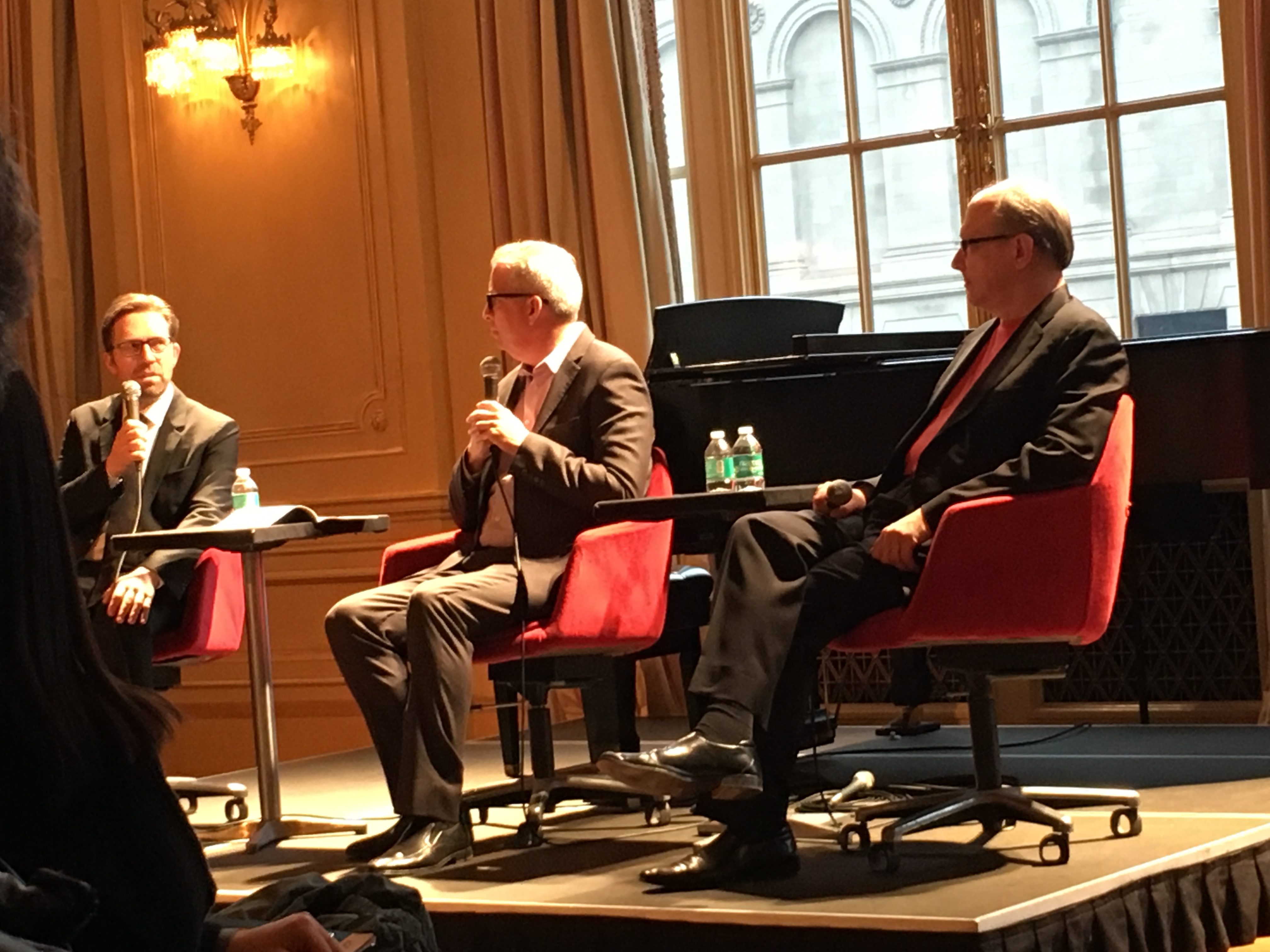
A rousing, well-deserved ovation brought the pair back for three encores, all by Stravinsky.  “Madrid” appropriately had an irresistible Spanish tinge, with a hint of the jota.  The “Circus Polka” (“we’ve prepared all these lovely things for you”, noted Hamelin in his introduction to the delight of the audience) was Stravinsky at his wittiest, replete with bitonalities (and perhaps an inspiration for Hamelin’s own “Circus Galop”).  Lastly, the “Tango” was sultry, yet not without the composer’s unmistakable stamp.  Thanks are due to both for being on hand for an engaging Q&A session following the concert, and their chemistry there was just as palpable as it was on stage.

Hamelin Andsnes
Leif Ove Andsnes, James Fahey (Director of Programming, Symphony Center Presents), and Marc-André Hamelin during the post-concert Q&A