Ólafsson and Wang dazzle in spectacular two piano recital

Yuja Wang, piano
Víkingur Ólafsson, piano
Mandel Concert Hall
Severance Music Center
Cleveland, OH
February 23, 2025

Berio: Wasserklavier (No. 3 from Six Encores)
Schubert: Fantasie in F minor, D940
Cage: Experiences No. 1
Nancarrow: Study No. 6 (arr. Adès)
Adams: Hallelujah Junction
Pärt: Hymn to a Great City
Rachmaninoff: Symphonic Dances, Op. 45

Encores:
Brahms: Waltz in A-flat major, Op. 39 No. 15
Dvořák: Slavonic Dance in E minor, Op. 72 No. 2
Brahms: Hungarian Dance No. 1 in G minor
Brahms: Waltz in E major, Op. 39 No. 2
Brahms: Waltz in G-sharp major, Op. 39 No. 3

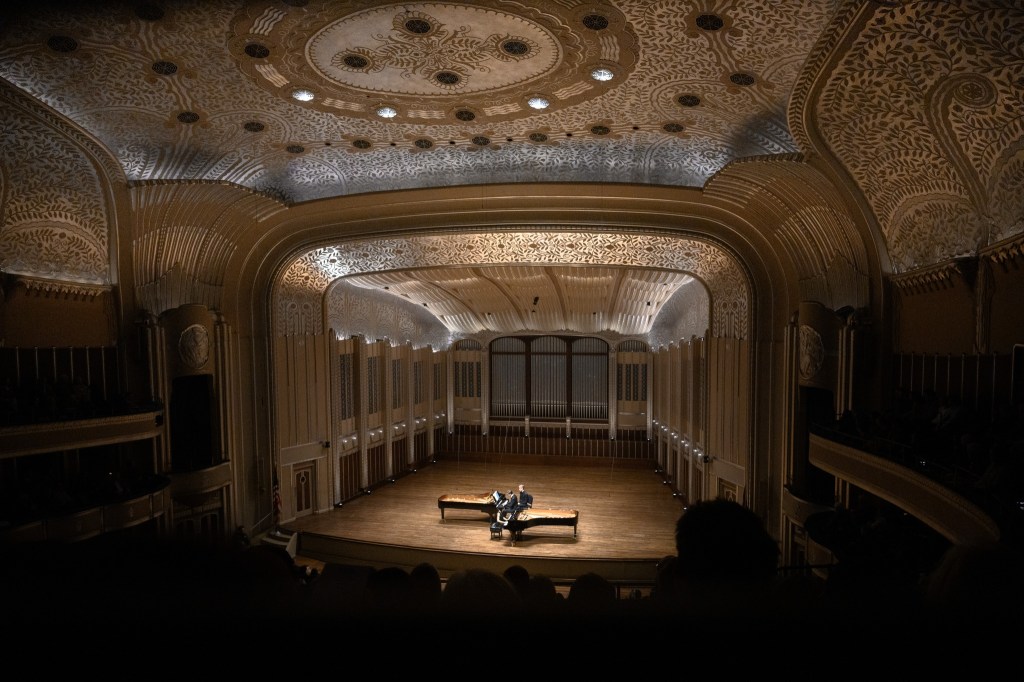
Sunday afternoon marked a remarkable high point in The Cleveland Orchestra’s immensely rewarding recital series, with pianists Yuja Wang and Víkingur Ólafsson joining forces in a stop at Severance Hall on a brief US tour. Both superstar soloists in their own right, it was truly electrifying seeing these two band together. Yet this was more than just a celebrity pairing calculated to maximize box office receipts: their artistic temperaments complemented each other well, showing the whole can be greater than the sum of its parts.
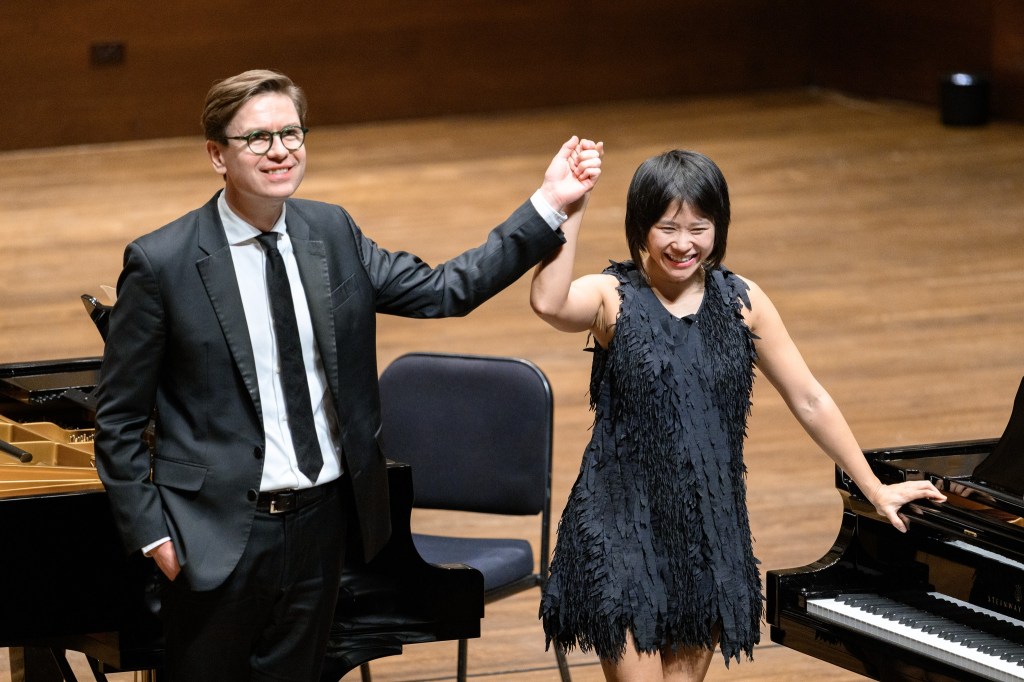
Víkingur Ólafsson and Yuja Wang at Severance Hall, photos credit Human Artist Photography + Cinema 

The program was ripe with discovery, skirting some of the more commonly played fare for two pianos. Luciano Berio’s Wasserklavier began, a meditative opening with liquescent textures freely flowing. The piece made subtle nods to Brahms and Schubert, and fittingly, the pianists artfully segued directly into the latter’s own Fantasie in F minor. Usually played four hands on a single piano, hearing it spread across two instruments gave the work a greater resonance and depth of sound.

Crisply articulated dotted rhythms began, plunging into penetrating drama — rarely will one hear Schubert played with such intensity. Dance-like sections contrasted, exuding joy with the twenty fingers at work, intricately choreographed. A fascinating selection of works from the late 20th-century followed, beginning with John Cage’s Experiences No. 1. The composer’s characteristic minimalist textures were piquantly harmonized, punctuated by silence.

The sixth of Conlon Nancarrow’s 49 studies for player piano followed, made humanly playable in its two-piano arrangement by Thomas Adès (who local concertgoers had the chance to see conduct a remarkable Cleveland Orchestra program just the night before). In this case, the two pianos seemed to be at odds with one another, yet the jagged rhythms fit together in interlocking fashion.
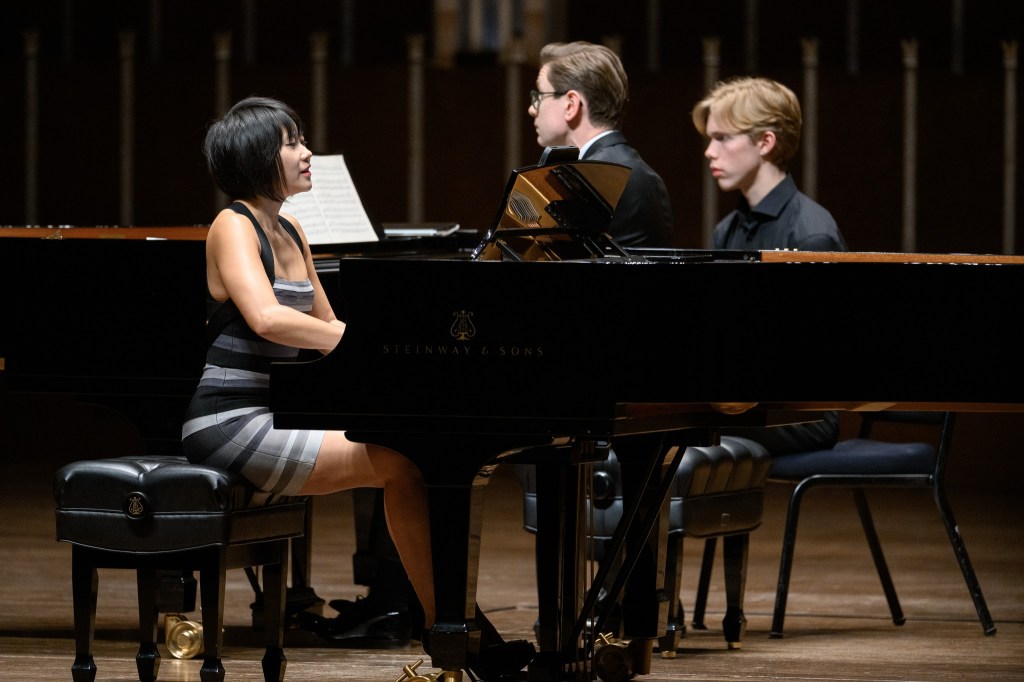
The first half closed with John Adams’ Hallelujah Junction, to my mind, the highlight of the program. Pulsating energy filled Severance Hall with pianistic brilliance. Music of almost perpetual motion — quite a contrast to the minimalism of Cage — gave a larger-than-life portrayal of the namesake town on the California-Nevada border, and demonstrated in no uncertain terms the electric chemistry between these two pianists. The more lyrical pulses of a downtempo section captivated in their rhythmic intricacies, only to build back up to a dazzling density of sound.

Arvo Pärt’s Hymn to a Great City was marked by Wang’s playing in the upper register that rang with the purity of bells, and some delicate filigree that decorated the otherwise barren textures. Rachmaninoff’s Symphonic Dances — his final work — closed the printed program. Hammering out the main theme with pile-driving intensity, an almost manic energy between the two created a rich orchestral sonority. Yet matters were still clear and articulate, with a contrasting theme of haunting lyrical beauty. Sultry waltz rhythms in the central dance were given with stylish playing, and the finale was bold and grandiose, with broad gestures cascading spectacularly.

No less than five encores followed, a delightful selection of dances by Brahms and Dvořák, performed on a single piano, four hands. A charming, convivial close to a memorable afternoon.
Hrůša explores the end of life through Adams and Mahler

Cleveland Orchestra
Jakub Hrůša, conductor
Joélle Harvey, soprano

Cleveland Orchestra Chorus
Lisa Wong, director
Cleveland Orchestra Children’s Chorus
Ann Usher, director
Cleveland Orchestra Youth Chorus
Daniel Singer, director

Severance Hall
Cleveland, OH
November 14, 2019

Adams: On the Transmigration of Souls
Mahler: Symphony No. 4 in G major

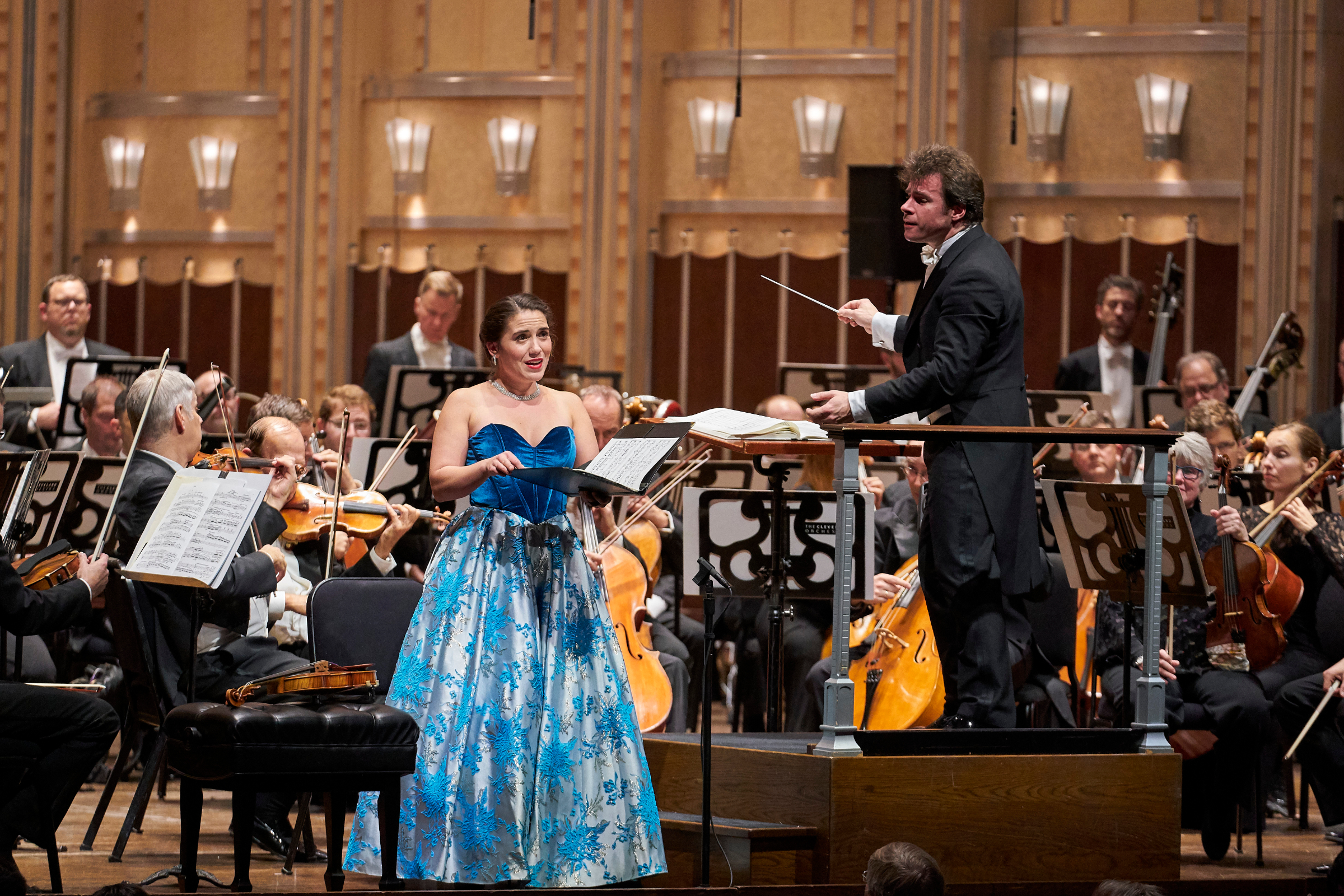
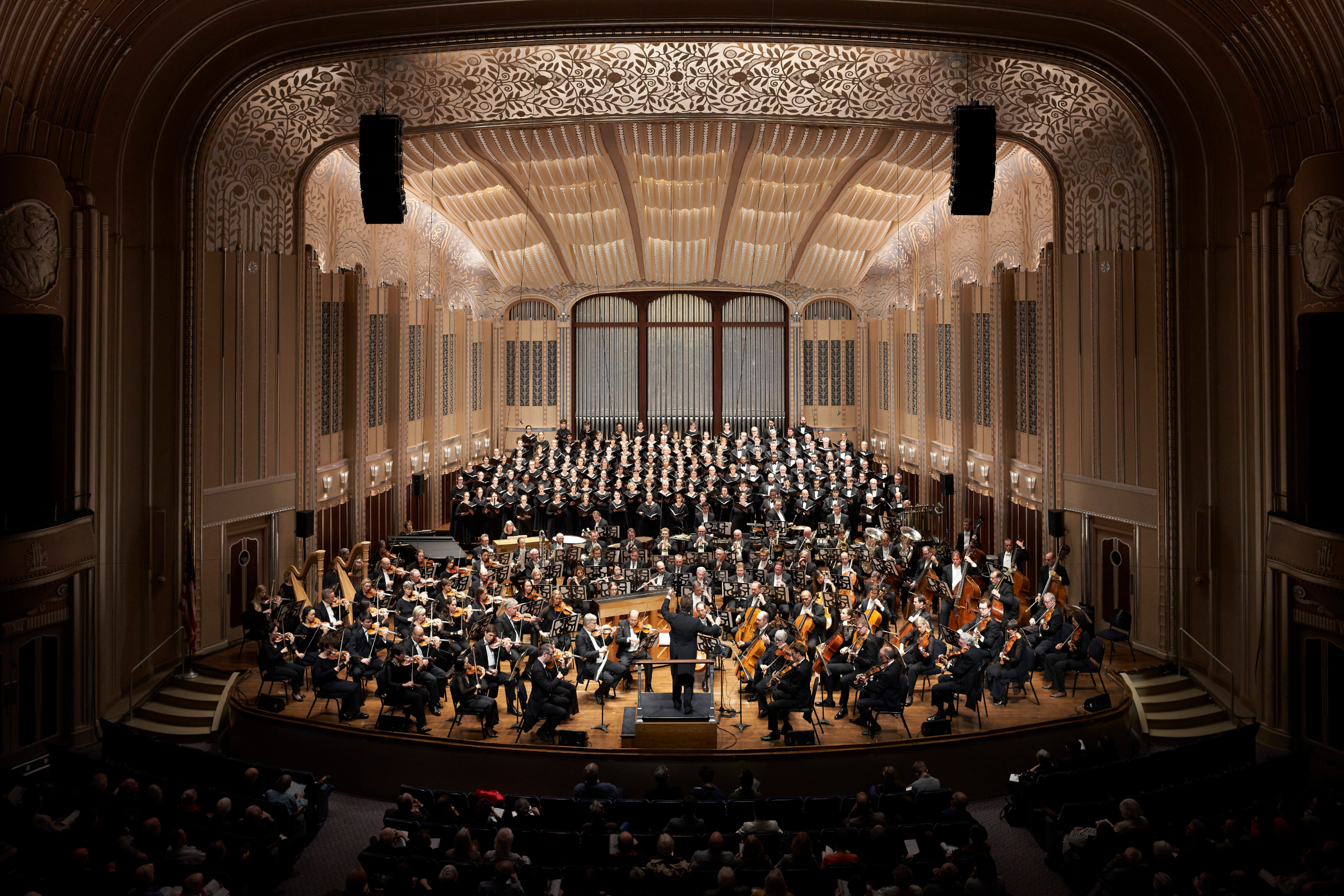
Following up on last week’s juxtaposition of Shostakovich and Beethoven, Jakub Hrůša offered a second week of incisive contrasts in Adams and Mahler. Both works were concerned in some fashion with the end of life, though of vastly different orientations. Written as a tombeau for the victims of 9/11, Adams’ On the Transmigration of Souls received its belated Cleveland premiere this week. Conceived almost immediately in the wake of the events memorialized, the work was first performed in New York in September 2002, and earned Adams the Pulitzer Prize for Music the following year.

151730-clo111419-508-credit-roger-mastroianni-courtesy-of-the-cleveland-orchestra
Jakub Hrůša and Cleveland Orchestra and choruses perform On the Transmigration of Souls. Photos credit Roger Mastroianni, Courtesy of The Cleveland Orchestra

In addition to large orchestra, chorus, and children’s chorus, the work makes extensive use of pre-recorded electronica, with an elaborate array of speakers wrapping the hall in surround sound. Ambient sounds of the city opened the piece, initially sounding as business as usual, but quickly giving way to sirens and boy’s repeated incantation of “missing.” The choir entered, ethereal and wordless, and strident trumpet solo was heard from an offstage Michael Sachs. It’s a daunting task to adequately capture the emotions of this subject matter in music, and to that end, Adams took pains to eschew any conventional notions of a requiem, instead producing a work with almost no narrative structure, allowing for a multitude of individual responses to its entrancing and mournful solemnity.

Particularly poignant were the recordings of brief tributes to certain victims – one who was described as having “a voice like an angel”: and such a voice we were to hear in the subsequent Mahler. About two-thirds of the way in came a caustic climax, and one could viscerally feel the weight of the events of that day. I would suggest another parallel to Mahler in that it follows a similar arc to the first movement of the Tenth Symphony, spanning roughly the same length, and of autumnal feeling until the shattering crest at about the same point. The music waned, especially doleful as names were read, and matters faded once again into the fabric of the cityscape.

Mahler’s Fourth Symphony has been called the most Viennese of his symphonies, following a more traditional four movement structure and of modest proportions in length and orchestration (by Mahler’s standards, at least). It’s a piece thus particularly well-suited to this orchestra, noted for their classical precision and balance as well as a strong Mahler tradition – and documented in a noted recording of this symphony with Pierre Boulez. The sleigh bells that opened made for a fantastical, almost fairy-tale like atmosphere, countered by graceful strings. The apparent naïveté ran only surface-deep, however, with Hrůša probing beyond its appealing veneer. The winds were in fine form, especially principal flute Joshua Smith, bright and bucolic, and the trumpets hinted at what would become the iconic opening of the Fifth. The more impassioned sections could have benefited from greater clarity, but there was a wonderful moment of serenity before the movement’s boisterous end.

Announced by the horns, the second movement was rooted in the ländler, but as through a distorted lens. Concertmaster Peter Otto coarsely played a detuned violin, emulating a folksy fiddle, and Daniel McKelway’s contributions on the clarinet were shrill yet stylish. The ensuing Ruhevoll opened in a divine simplicity, the strings of the orchestra playing with the intimacy of a quartet. In his pre-concert lecture, Bryan Gilliam keenly noted that Mahler created a nostalgia for a world that never was. The brass were particularly warm in the climactic opening of heaven’s gates, with the strings reaching higher and higher, grounded by the angelic harp. A silky clarinet marked the finale, introducing soprano Joélle Harvey, who previously sang Mahler with this orchestra in last season’s performance of the Second. Her limpid and fluid voice offered the Wunderhorn setting much character, closing each stanza with a profundity that gave weight and authenticity to this child’s depiction of heaven.

151728-clo111419-390-credit-roger-mastroianni-courtesy-of-the-cleveland-orchestra
Joélle Harvey in Mahler’s Fourth Symphony