Apollo’s Fire violinists shed light on Biber’s Mystery Sonatas

Musicians from Apollo’s Fire:
Johanna Novom, violin
Adriane Post, violin
Karina Schmitz, violin
Carrie Krause, violin
William Simms, theorbo
Brian Kay, lute and guitar
René Schiffer, cello
Jeffrey Grossman, organ and harpsichord

St. Paul’s Episcopal Church
Cleveland Heights, OH
February 2, 2019

Biber: Selections from Sonatas on the Mysteries of the Rosary – 

Sonata No. 1 in D minor, The Annunciation
Sonata No. 4 in D minor, The Presentation of Jesus
Bach: Prelude in C minor, BWV 999
Sonata No. 6 in C minor, The Agony in the Garden
Sonata No. 7 in F major, The Scourging at the Pillar
Sonata No. 10 in G minor, The Crucifixion
Bach: Cello Suite No. 5 in C minor, BWV 1011 – Sarabande
Johann Kerll: Toccata No. 8 in G major
Sonata No. 11 in G major, The Resurrection
Sonata No. 12 in C major, The Ascension
David Kellner: Campanella in D major
Sonata No. 14 in D major, The Assumption of Our Lady
Kaspar Förster: Motet in G minor, Dulcis amor Jesu

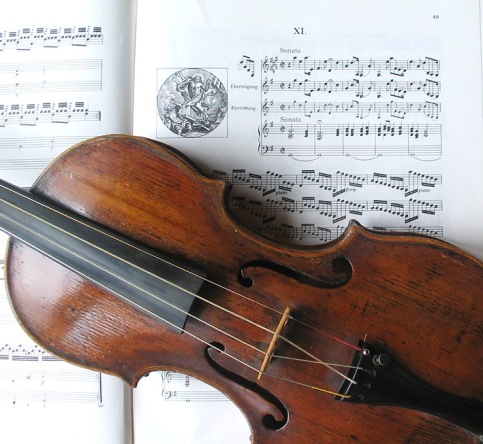
One of the most perplexing and endlessly fascinating instrumental works of the Baroque, Heinrich Biber’s Sonatas on the Mysteries of the Rosary (variously know as simply the Mystery Sonatas or Rosary Sonatas) served as the focus of this weekend’s Apollo’s Fire concerts. The complete cycle consists of fifteen sonatas for violin and continuo followed by a passacaglia for violin unaccompanied. Each of the fifteen sonatas evokes a scene from the Catholic Rosary, further divided into three sets of five, respectively, the Joyful, Sorrowful, and Glorious Mysteries. Despite the moniker of sonata, each embody a markedly unique structure from one another, and most remarkably, employ a different tuning through extensive use of scordatura. Only the opening sonata and closing passacaglia are scored for standard tuning, adding to the technical – and logistical – challenges of performing the work.

biber_mysterien
Tuning for Sonata No. 11, photo credit Wikipedia

Eight of the fifteen sonatas were programmed, with four violinists each responsible for two. The instrumentation for the continuo is open to interpretation; the present performances opted for theorbo, lute, cello, keyboard, and various combinations thereof. Sonata No. 1 (“The Annunciation”) featured associate concertmaster Adriane Post. Beginning contemplative and rhapsodic, its centerpiece was a graceful aria which lent itself to elegant variations. Karina Schmitz offered sweeping power and a wide-ranging color palette to No. 4 (“The Presentation of Jesus”), a single-movement chaconne. At various intervals, solo works by other composers were offered as “meditations”, affording each of the continuo players a moment in the spotlight. The first such was lutenist Brian Kay in a prelude by Bach, a meditative work of understatement to which Kay offered deft control of the contrapuntal voices.

Co-concertmaster Johanna Novom was soloist in the dark No. 6 (“The Agony in the Garden”), digging into the depths of her instrument in this lament. No. 7, given by Carrie Krause, began with an unassuming allemande in congenial counterpoint with the organ, almost defiantly peaceful given its subject matter (“The Scourging at the Pillar”). A sarabande followed with dramatic flourishes – rather uncharacteristic of the form – and a striking central section wherein motion was all but suspended. Post offered a gripping reading of No. 10 (“The Crucifixion”), with the sharp snap of dotted rhythms eerily suggested the nails going in; a set of variations followed, impressive for the rapid passagework. Cellist René Schiffer closed the first half with a Bach sarabande, stately in its directness.

To open the final section – The Glorious Mysteries – was keyboardist Jeffrey Grossman (who was also on hand for an informative pre-concert lecture) in the Toccata No. 8 by Johann Kerll – a work of bright and brilliant virtuosity that presaged the light to come. Sonata No. 11 (“The Resurrection”) brought back Novom, and featured perhaps the most striking tuning of all – two Gs an octave apart, and two Ds also spaced by an octave, with the two middle strings forming a cross over the bridge for obvious symbolism (see picture above). The heart of the sonata was a chorale of resonant richness, at one point presented in octaves, readily achieved via the aforementioned tuning. Krause gave No. 12 (“The Ascension”) a commanding Intrada, contrasted by the joyful dance suite followed. William Simms presented David Kellner’s Campanella on the lute, a piece of perpetual arpeggiated figures. Schmitz concluded the Biber offerings with No. 14 (“The Assumption of Our Lady”), a rollicking final selection, especially in the concluding gigue. As a pendant to the Biber, the eight musicians at last joined forces simultaneously in an instrumental arrangement of a motet by Kaspar Förster – a moving blend of pathos and joy.

Welser-Möst and Cleveland Orchestra score another operatic success in Ariadne auf Naxos

Cleveland Orchestra
Franz Welser-Möst, conductor
Severance Hall
Cleveland, OH
January 13, 2019

Strauss: Ariadne auf Naxos, Op. 60

Tamara Wilson, soprano (Ariadne/Diva)
Andreas Schager, tenor (Bacchus/Tenor)
Daniela Fally, soprano (Zerbinetta)
Kate Lindsey, mezzo-soprano (Composer)
Wolfgang Brendel, speaking role (Major-Domo)

Hanno Müller-Brachmann, baritone (Music Master)
Jonas Hacker, tenor (Dance Master)
Julie Mathevet, soprano (Naiad)
Daryl Freedman, mezzo-soprano (Dryad)
Ying Fang, soprano (Echo)
Ludwig Mittelhammer, baritone (Harlequin)
James Kryshak, tenor (Scaramuccio)
Anthony Schneider, bass (Trufffaldino)
Miles Mykkanen, tenor (Brighella)

Frederic Wake-Walker, director
Alexander V. Nichols, lighting, projection, and set design
Dominic Robertson & Lottie Bowater, collage, animation, and video content design
Jason Southgate, costume design
Mallory Pace, hair and makeup design

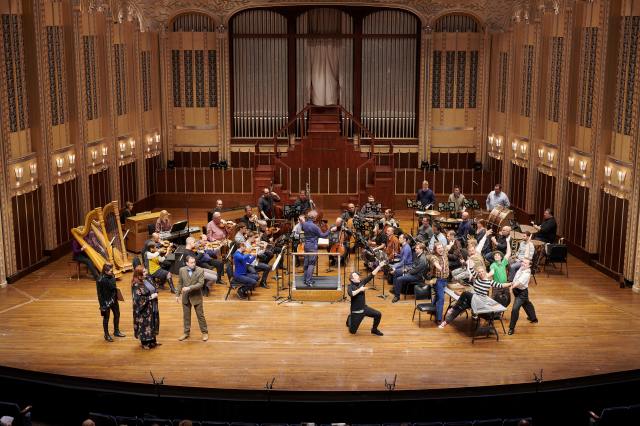
In what has become an essential part of The Cleveland Orchestra’s Severance Hall season, music director Franz Welser-Möst led his ensemble in a staged opera production, this season turning attention towards Richard Strauss in Ariadne auf Naxos. A wholly unique work in the operatic canon, Ariadne is preceded by a prologue wherein a cast of characters plan and prepare an evening’s musical program, debating whether it should be serious art or comedic entertainment, and what follows is the resultant product – effectively, an opera with an opera. The new production was designed by Frederic Wake-Walker, who made much of Severance’s small stage and deftly incorporated motifs of the hall into his design.

RICHARD STRAUSS - Ariadne auf Naxos
The ensemble of Ariadne auf Naxos at Severance Hall, with The Cleveland Orchestra led by Music Director Franz Welser-Möst. Photo by Roger Mastroianni.

Welser-Möst eschewed the usual conductor entrance, with the prologue opening practically in medias res with conductor and orchestra in casual dress as perhaps in the middle of a rehearsal: the musicians thus became characters themselves. The instrumental introduction evidenced the finely-tuned Strauss playing of this ensemble. Strauss scored it for the rather modest force of about 35, although owing to the composer’s mastery of orchestration it often sounded as much more. While the scoring was thinner in the winds – particularly given what one might expect for Strauss – it was fleshed out by three keyboard instruments (piano, harmonium, celeste), and the clear textures allowed for the solos of the Cleveland principals to be rendered in sharper focus – notable were passages from the flute, clarinet, oboe, cello, and concertmaster Peter Otto.

As the Major Domo, Wolfgang Brendel was both imposing and avuncular in his spoken role (the character purportedly being tone deaf), explaining to the Composer that the latter’s opera would coincide with a performance by a comedy troupe, setting up the prologue’s central conflict. Dressed in the glam of a rock star, Kate Lindsey brought enormous vigor and defiance to the firebrand Composer, scored for mezzo to portray his youth, which involved an artistic idealism he hardly wanted to yield to comedians. As the Prima Donna (and slated to play title role in the Composer’s opera), soprano Tamara Wilson captured the essence of the stereotypical diva (and incidentally, Wilson is to reprise the role with Welser-Möst at La Scala later this season). When it was announced an inflexibly scheduled fireworks display would necessitate the opera and the comedy to be performed simultaneously, the singers and the comics exchanged ideas in a humorous mashup of the comical and the serious.

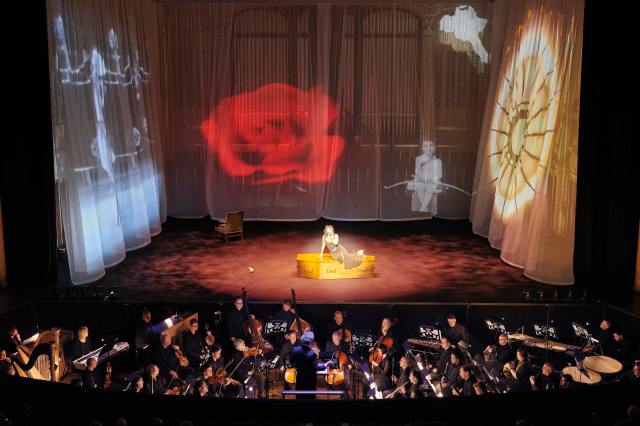
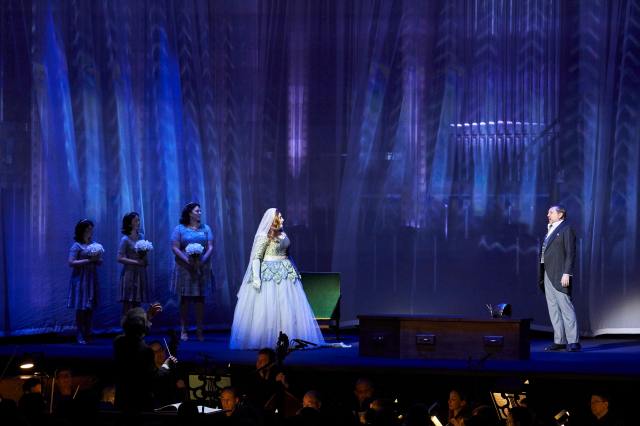
After the prologue’s minimalist staging, Severance Hall underwent a miraculous transformation to host the opera proper. The orchestra was lowered down to the pit, and a curtain draped around the stage’s perimeter served as a canvas for a nearly continuous stream of video projection. In adoration of the production’s venue, patterns reflective of the Severance ceiling were displayed on the curtain, and Ariadne’s dress would invoke the same pattern. While I was impressed with the production being truly made for Cleveland, perhaps the sight lines of the hall could have further been considered during design – particularly in the prologue, some of the action was obscured from my vantage point on the side of the balcony.

RICHARD STRAUSS - Ariadne auf Naxos
Daniela Fally (Zerbinetta) in Ariadne auf Naxos at Severance Hall, with The Cleveland Orchestra led by Music Director Franz Welser-Möst. Photo by Roger Mastroianni.

Following another finely-played orchestral prelude, the celestial voices of the three nymphs were heard from above, reaching out to Wilson now refashioned as Ariadne. In a nod towards (somewhat) contemporaneous comedy, the comedians were costumed as the four Marx Brothers (is there any evidence that Strauss ever saw a Marx Brothers film?!). Additionally, clips from various comedies were projected, including scenes of Charlie Chaplin during the Harlequin’s aria, Lieben, Hassen, Hoffen, Zagen. Ludwig Mittelhammer gave a deeply lyrical and affecting reading of the Harlequin, and during his excellent pre-concert lecture, Prof. Bryan Gilliam observed that the aria in question bears a more than passing resemblance to the first movement theme from Mozart’s piano sonata K331 – a composer who Strauss profoundly admired.

The second half’s centerpiece, Zerbinetta’s extensive Großmächtige Prinzessin, saw Daniela Fally – donning a flapper dress – shining brilliantly in this coloratura tour de force. The ensemble piece Töne, töne, süße Stimme, given by the nymphs in concert with Ariadne, was of sublime beauty as well as another musical homage – in this case, to Schubert (the Wiegenlied, D498). Tenor Andreas Schager entered as Bacchus, stretching to the extremities of his vocal range with great power but always lyrical first and foremost. A transcendent transformation occurred on stage with the darkened hall becoming filled with light as Ariadne gave thought to life with Bacchus outside her cave on the titular Naxos, perhaps alluding to the quest for enlightenment in Plato’s allegory of the cave. Bacchus and Ariadne closed with a duet of luscious lyricism: in the wake of the earlier debates of high art vs. populism, the sublime firmly had the final word.

RICHARD STRAUSS - Ariadne auf Naxos
Tamara Wilson (Ariadne) and Andreas Schager (Bacchus) in Ariadne auf Naxos at Severance Hall, with The Cleveland Orchestra led by Music Director Franz Welser-Möst. Photo by Roger Mastroianni.


Vivaldi features prominently on Cleveland Orchestra’s Thanksgiving menu

Cleveland Orchestra
Nicholas McGegan, conductor
Peter Otto, violin
Severance Hall
Cleveland, OH
November 23, 2018

Vivaldi: Le quattro stagioni
Mozart: Ballet Music for Idomeneo, K367 – Chaconne
Haydn: Symphony No. 94 in G major, Hob. I:94, Surprise

The Cleveland Orchestra’s Thanksgiving weekend concerts were an ample serving of comfort food, with the first half devoted to Vivaldi’s The Four Seasons – a follow up of sorts to last season’s traversal of another seasonal quadriptych, namely Haydn’s oratorio The Seasons. Initially published as part of the composer’s The Contest Between Harmony and Invention (Op. 8), The Four Seasons comprise the first four and certainly best known selections. These concerts were not without some controversy, however, as the violin soloist was originally slated to be the ousted William Preucil (whom I saw perform the work on this stage back in February 2007, coincidentally also under the baton of McGegan). First associate concertmaster Peter Otto was on hand to more than capably take the reins.

CLO112318_160
Peter Otto, all photos credit Roger Mastroianni, Courtesy of The Cleveland Orchestra

The immediately familiar strains of Spring featured Otto in some sprightly interplay with second violin chair Stephen Rose. Some minor intonation issues were apparent initially but soon resolved. The Largo was of long-bowed repose while the closing was a joyous dance filled with rapid passagework. A minor-key haze marked Summer, taking flight in due course in evidence of the orchestra’s tight chemistry under McGegan’s expert direction from the harpsichord. A remarkable expressiveness was achieved in the finale, while the fire returned in the breathless finale.

Autumn boasted the rustic charm of the harvest, given with an authentic rhythmic snap. An affecting melody played over undulating arpeggios in the harpsichord made the Adagio molto a standout, while the closing Allegro was – appropriately – a joyful Thanksgiving. Winter introduced dissonances that must have been shocking to audiences in Vivaldi’s day; the songful Largo, however, was enough to warm even the coldest of winter days.

The Viennese classicism of Haydn and Mozart rounded off the program. Mozart’s opera Idomeneo is thought of as his first fully mature operatic foray. The composer produced a fine suite of ballet music to accompany the work as per the French tradition, likely owing to the French origins of the original libretto. McGegan offered the opening chaconne; although satisfying I would have preferred inclusion of the modest remainder of the ballet score. Apparent from the declamatory opening onward was the immediate charm of a Mozart opera, here with the intimacy of communication fostered through the reduced-sized orchestra in playing of sparkling transparency and clarity.

Last on the menu was Haydn’s Symphony No. 94 in G major, known by its memorable moniker Surprise. A graceful and leisurely introduction set the stage for the vigor of the movement proper. Under McGegan, the orchestra operated as a single organism, achieving a wide range of expression in the development even within classical proportions. The Andante is what earned the work its nickname, full of tongue-in-cheek wit, and McGegan maximized the dynamic contrasts to further its irresistible appeal. A fine oboe solo from Jeffrey Rathbun counted as another highlight; the penultimate movement carried the swagger of an Old World minuet while the finale was a whirlwind of effervescence – one only wished it could have lasted longer.

CLO112318_214
Peter Otto and Nicholas McGegan


Altinoglu leads Cleveland Orchestra in Ravel, Debussy, and Pintscher

Alain Altinoglu, conductor
Joshua Smith, flute
Cleveland Orchestra
Severance Hall
Cleveland, OH
November 8, 2018

Debussy: Suite from Pelléas et Mélisande (arr. Altinoglu)
Pintscher: Transir
Ravel: Rapsodie espagnole
Ravel: Pavane pour une infante défunte
Ravel: Boléro

Following last week’s podium appearance from Matthias Pintscher, this week’s Cleveland Orchestra programs afforded the opportunity to hear from Pintscher as composer albeit under the capable baton of Alain Altinoglu. The work in question was Transir, a 2006 composition for flute and chamber orchestra, originally conceived for Emmanuel Pahud, principal flute of the Berlin Philharmonic. Last month, principal cello was Mark Kosower was afforded a concerto appearance; the present program passed the reins to another distinguished principal, namely Joshua Smith who has served as principal flute since 1990, when he was appointed at a mere twenty years old.

6G5MGMMWPJARTLF5WA7TZ77OGI
Joshua Smith, Alain Altinoglu, and The Cleveland Orchestra, photo credit Roger Mastroianni, Courtesy of The Cleveland Orchestra

Thursday’s performance counted as the American premiere of Transir. The French title suggests a state of paralysis due to cold, and it’s a work that certainly occupies a rarefied soundworld and atmosphere. In the spirit of the Debussy that preceded it, Pintscher favored a language that gave primacy to suggestion over directness. Unfamiliar – and quite unsettling – timbres were present without respite from the opening, and the score required Smith to engage in extended techniques to the extreme, including breathy sounds in the high register scarcely recognizable as emanating from a flute. Smith was supported by a chamber-sized orchestra which in spite of its modest dimensions included a substantial percussion section, offering garish contrasts. Sustained soprano notes in the violins were another important part of the fabric, in a sense presenting the melody one would think the flute should be doing in a more traditional piece. While I applaud The Cleveland Orchestra’s commitment to programming contemporary works – and Smith’s far-reaching virtuosity – I found the present work unconvincing, a bizarre though intriguing study in extended technique, novel timbres, and intense concentration.

Opening the evening was a twenty-minute suite drawn by Altinoglu himself from Debussy’s opera Pelléas et Mélisande – a fitting follow-up to TCO’s reading of Schoenberg’s work on the same subject a few weeks prior. The aura was immediately enigmatic with the orchestra offering a warm tone yet never fully disclosing. Altinoglu’s suite was chiefly comprised of the opera’s orchestral interludes, preserving much fine music while necessarily omitting much more. A solo from the concertmaster was of deep yearning, and flourishes in the harps were painted with impressionistic watercolors. The music grew in urgency only to ultimately shy away to a serene ending, tragic yet obfuscated.

Following the somewhat uneven first half was a generous sampling of Ravel, bringing to mind last season’s all-Ravel evening (which while not including a work by Pintscher, was conducted by Pintscher) – although the playing on Thursday, alluring as it was, rather fell short of the inspired level witnessed then. A descending four-note motif opened Rapsodie espagnole, serving as a binding element for the work as a whole. The hazy mystery of the night gave way to the comparatively livelier Malagueña, picking up energy but still generally subdued, and heightened by an extended English horn solo from Robert Walters. Initially written well before the rest of the work, the Habanera that followed was dreamy and sultry before daybreak came suddenly in the brilliant Feria. Fluid playing in the winds set the stage for the conclusion of brassy and percussive exuberance.

The Pavane pour une infante défunte served as a calming interlude of sumptuous orchestration. The gorgeous main theme appeared in various instrumental combinations, beginning in the horns – mellow yet not quite the liquid gold one might hope for – and most touchingly in the strings and harp. Boléro made for an ebullient close (not to mention an endurance test for the snare drum), giving virtually all the instruments a chance in the spotlight, beginning with the silvery flute – a fine test for the freshly appointed Jessica Sindell. An exercise in repetition as refracted through an orchestral kaleidoscope, the perpetual crescendo never fails to excite.

Pintscher and Gerstein join Cleveland Orchestra in big-boned Rachmaninov, Bartók

Cleveland Orchestra
Matthias Pintscher, conductor
Kirill Gerstein, piano
Severance Hall
Cleveland, OH
November 1, 2018

Rachmaninov: Piano Concerto No. 3 in D minor, Op. 30
 Encore:
 Chopin: Waltz in A flat major, Op. 42
Bartók: The Wooden Prince, Op. 13, Sz. 60

A return appearance from former Daniel R. Lewis Young Composer Fellow Matthias Pintscher is always a welcome sight at Severance Hall. Pintscher’s program was comprised of two large-scale works, both from Eastern Europe, and both from the first decades of the 20th-century. Rachmaninov’s enduring Third Piano Concerto made for a meaty first half with Gilmore Artist Award winner Kirill Gerstein at the keyboard. The opening melody was haunting in its monastic simplicity, and never sentimentalized. Gerstein took matters at a fairly brisk tempo – at times feeling a bit rushed, but he always maintained a certain elegance. His commanding tone and massive dynamic range made the lasting impact, however – an unflagging intensity which paid its dividends especially in the cadenza. Gerstein elected for the larger of the two the composer supplied; beginning with a rumbling in the bass it built to immense power. The cadenza quite ingeniously also served as the movement’s recapitulation; without much left to say after that monstrosity the movement ended quietly, almost impressionistically.

Mathias Pintscher by Roger Mastroianni 1
Mathias Pintscher and The Cleveland Orchestra, photo credit Roger Mastroianni, Courtesy of The Cleveland Orchestra

A doleful lament marked the slow movement, encouraged by the choir of winds and long-bowed strings. Gerstein’s line was initially distressed but soon gave way to display his lyrical gift, and a multitude of moods were traversed, in turns scherzo-like, impassioned, and the sudden yet seamless transition to the finale. A vigorous march, bright and brilliant, offered no respite for Gerstein’s prodigious stamina and technical arsenal, up to and including the triumphant major-key ending in cascading glory. An encore was nearly demanded; Gerstein obliged with a Chopin waltz of effortless elegance.

Bartók’s The Wooden Prince, in only its third Cleveland Orchestra performance, was a foray into much less familiar territory. A one-act ballet spanning the continuum of nearly an hour, it is scored for an astonishingly large orchestra (some highlights: quadruple woodwinds – including two contrabassoons and two saxophones – an extensive percussion section, and four-hands celesta). The work began with a mysterious sounding drone (perhaps echoing Wagner’s Das Rheingold), firmly in a late-Romantic idiom. In many ways, this is a work in the tradition of Stravinsky’s groundbreaking scores for the Ballets Russes, with the intensity of some passages rivaling even that of the Rite.

The story of The Wooden Prince is a bit convoluted, but certain instruments representing specific characters served as a loose roadmap. The sweetly playful tone Afendi Yusuf’s clarinet deftly brought the princess’s coquettishness to life, and a folk melody in the low strings that would later resurface was quite striking. The dance between the princess and titular wooden prince (much to the chagrin of the real prince) was given with a relentless drive and folksy authenticity, with clever scoring emphasizing the prince’s wooden composition – castanets, xylophone, and col legno strings. Robert Walters’ fine English horn solo brought forth an apotheosis, buttressed by heavenly high strings (to my ears, another nod to Wagner, namely the prelude to Lohengrin). A happily-ever-after ending was achieved, marked by peaceful resolution and a sparkling celesta. Like the Rachmaninov that preceded, this was a supreme test of stamina and energy which Pintscher and the orchestra surmounted admirably. By happy coincidence (or smart programming), those interested in Pintscher’s other persona as a composer will have a chance to hear one of his works next week.

Kirill GersteinPhoto: Marco Borggreve
Kirill Gerstein, photo credit Marco Borggreve

Metzmacher and Tetzlaff in coloristic evocation of fin de siècle Vienna

Cleveland Orchestra
Ingo Metzmacher, conductor
Christian Tetzlaff, violin
Severance Hall
Cleveland, OH
October 27, 2018

Webern: Passacaglia, Op. 1
Berg: Violin Concerto
 Encore:
 Bach: Violin Sonata No. 3 in C major, BWV 1005 – Largo
Schoenberg: Pelleas und Melisande, Op. 5

Vienna at the turn of the 20th-century was the site of seismic changes in culture, with the birth of the modern, wary consciousness brought on by the likes of Freud, Klimt, and Schnitzler – and the revolutions in music were no less consequential. Branded as the Second Viennese School, Schoenberg and his disciples – principally Berg and Webern – upended the common practice period harmony that had been foundational to Western music for centuries. The Cleveland Orchestra’s program this week, with guest conductor Ingo Metzmacher at the helm, included a work from each of the triptych of iconoclastic Viennese composers for a noticeably underpopulated but raptly attentive Severance Hall.

5b243fd129f4c
Ingo Metzmacher, photo credit Opera Musica

Webern’s Passacaglia served as beguiling opener. Dubbed his opus 1, it was certainly not his inaugural work, but the first major composition to result from his studies with Schoenberg. An eight bar bassline opened, suggesting not a link to not just the form’s Baroque forebears, but to the finale of Brahms’ Fourth Symphony (and it should be remembered that Schoenberg, whose radicalism was rooted in a keen sense of history, would later write an essay provocatively titled “Brahms the Progressive”). The orchestra’s gift for razor-sharp clarity and precision paid its dividends amply in this work, encouraged by Metzmacher’s guidance even without a utilizing a baton. Even in this rather academic form, the music was of eerie beauty, building to a supercharged climax only to evaporate at the end.

While the opening and closing selections were from their respective composers’ early years, hanging on to the last embers of tonality, Berg’s Violin Concerto was a work of full maturity and one of the crowning achievements of twelve-tone serialism. Matters began with unassuming arpeggios, first in the harp, then in Christian Tetzlaff’s solo violin – despite its serialist rigor, the work ingeniously never ventured far from an oblique invocation of tonality (and Clevelanders will likely be amused by Robert Conrad’s hilarious twelve-tone “infomercial”, wherein the not-so-ostentatious virtuosity of the Berg concerto is duly lampooned). Tetzlaff’s long-bowed playing emanated a biting lyricism, contrasted by the more jocular interpolation of a Carinthian folk song. The violinist was deftly balanced against the richly colored orchestral tapestry, playing with an exacting intensity.

A ferocious unease began the second movement, later countered by the wistful reminiscence of another tonal source, the Lutheran chorale Es ist genug, almost monastic in presentation – and fitting its elegiac subtitle “to the memory of an angel”, referencing the tragic death of Manon Gropious. In the final moments, the violin solo left the orchestra behind to be among the angels in its haunting close. Tetzlaff offered an encore in the Largo from Bach’s third sonata for unaccompanied violin, touchingly dedicating it to the Jewish community of Pittsburgh in response to the horrific events earlier in the day. A poignant performance of deeply felt beauty, and a much-needed moment of solace.

The remainder of the evening was devoted to Schoenberg’s extensive Pelleas und Mellisande. A far cry from the language with which Schoenberg would make waves, the work is lush and hyper-Romantic (though not quite to the excess of the earlier Gurre-Lieder). A tone poem spanning a continuous arc of over 40 minutes, its rich, pictorial detailing sounded very much akin to the contemporaneous works of Strauss (who convinced Schoenberg to take on Pelleas as a subject matter, concurrent with Debussy’s opera – which TCO performed to acclaim not long ago). As delineated in the program books, the work can also be conceived of as following a four movement symphonic structure, but I wasn’t convinced those demarcations were particularly useful.

Wagnerian leitmotifs depicting the characters were introduced at the onset, uneasily commingling in foretelling an unhappy fate. The music swelled in passionate ebb and flow with top-drawer orchestral playing, though I was especially struck by the lush clarinet solos of Afendi Yusuf. Jestful music depicted the symbolic fountain scene, and functioned as a scherzo of sorts (and somewhat reminiscent of “Klaus-Narr” from the Gurre-Lieder), and there was a fine viola solo from principal Wesley Collins. A love scene followed, surely taking cue from Act II of Tristan – a divine serenity only to be caustically interrupted by Golaud. Mellisande’s death was marked by a funereal downward procession, in what was some of the work’s most affecting music. The epilogue began with a stately lyricism, but ultimately the mysteries propounded the unknowing central to Maeterlinck’s symbolist fantasy – different here than the perfumes of Debussy, but nonetheless shrouded in ambiguity.

DSC_8314-4253x2846
Christian Tetzlaff, photo credit Giorgia Bertazzi

Welser-Möst concludes autumn residency with a powerhouse Mahler 2

Cleveland Orchestra
Franz Welser-Möst, conductor

Joélle Harvey, soprano
Sasha Cooke, mezzo-soprano

Cleveland Orchestra Chorus
Lisa Wong, director

Severance Hall
Cleveland, OH
October 5, 2018

Mahler: Symphony No. 2 in C minor, Resurrection

There’s no question about it: The Cleveland Orchestra’s 101st season has gotten off to a stellar start, with the weekend seeing the last of four diverse and weighty programs led by Welser-Möst before he leaves for engagements elsewhere, not to return until January’s performances of Ariadne auf Naxos. The program in question was devoted to Mahler, familiar territory for these forces, namely the imposing and ultimately glorious Second Symphony – a work not performed on this stage since 2007.

IMG_6675
Welser-Möst, Wong, Harvey, and Cooke (l-r) with Cleveland Orchestra & Chorus

A funeral march is integral to virtually all of Mahler’s symphonies, and the Second in fact begins with one – and a formidable one at that. Nervous tremolos opened, leading inexorably down to the grave in this ferocious outpouring, though interspersed with moments of repose in what made for starkly garish contrasts, with the latter particularly encouraged by the plaintive oboe of Frank Rosenwein. Tempos were brisk – perhaps a bit too much so for my taste – but the yield was music of arresting power, never to be sentimentalized. A stirring brass chorale suggested the venerable Dies irae, and the movement concluded in desolation via a final downward gesture, a fate sounding all but inescapable.

But of course Mahler’s arduous journey doesn’t end there, with the following Andante moderato a folksy foil, as if the struggles immediately preceding had been entirely forgotten in this carefree ländler. A much less tightly-wound tempo achieved a simple, rustic peace, with some playful counterpoint between the strings and winds, leading towards a more animated central section. The main theme returned in a gentle pizzicato, unimpeachably good-natured. A thud in the timpani marked the third movement, with sinuous sixteenths testing the dexterity of the orchestra – a challenge easily surmounted, though again I found the tempo choice a tad rushed. This was the first of two nods to Mahler’s own Wunderhorn songs, here a purely instrumental expansion of “Des Antonius von Padua Fischpredigt”, and not entirely a blithe affair as matters erupted into a primal scream.

In another moment of extreme contrast, a sudden shift to light and the divine was achieved in “Urlicht” (another Wunderhorn text), with mezzo-soprano Sasha Cooke’s rich introspection a voice from another world. The brass chorales were heavenly, and though only a few minutes in duration, this movement was easily the emotional heart of the entire work. The text concludes with longing for “das ewig selig Leben” – in his pre-concert lecture, Rabbi Roger Klein suggested that Mahler knew that “Urlicht” alone was inadequate to achieve these lofty ambitions, hence necessitating the massive finale, a grueling undertaking.

The calm of “Urlicht” was immediately uprooted with fury unrelenting. An offstage brass added a spatial dimension to the score’s rich detailing (some flubbed notes notwithstanding), and the resurrection motif was unassumingly introduced in the trombones and trumpets. Climaxes were of shattering power, although a more intimate moment saw the fluttering flute of Joshua Smith joined by delicate touches of piccolo. The chorus entered as a unified whisper, building to great force in due course. Joélle Harvey offered an angelic soprano, naturally blending with Cooke, and the organ added even more magnificence to work’s stunningly spectacular conclusion, surely representing the pinnacle of human triumph.

Welser-Möst explores Prokofiev symphonies with a Bartók centerpiece

Cleveland Orchestra
Franz Welser-Möst, conductor
Yefim Bronfman, piano
Severance Hall
September 30, 2018

Prokofiev: Symphony No. 1 in D major, Op. 25, Classical
Bartók: Piano Concerto No. 2 in G major, Sz. 95
Prokofiev: Symphony No. 3 in C minor, Op. 44

Franz Welser-Möst has expressed an interest in devoting part of the next few seasons to exploring works – particularly those lesser known – of both Prokofiev and Schubert. The first installment came last weekend, with a program bookended by Prokofiev symphonies. Of Prokofiev’s seven works in the genre, only the First and the Fifth are played with any regularity, the remainder being brushed to the periphery. While the remaining five are admittedly somewhat uneven in quality, an opportunity to discover them – particularly at the level of playing witnessed over the weekend – is emphatically welcomed.

yefim-bronfman-piano-960x450-1
Yefim Bronfman, photo credit Oded Antman

Familiar territory opened the program, however, with the composer’s First Symphony, the so-called Classical for its patent inspiration to Haydn but as through the wit of a 20th-century modernist. It opened with a burst of energy capped by its classical charm, with transparent textures balancing a classical economy and Prokofiev’s piquant harmonies. The Larghetto was gentle and untroubled, evidencing a side of the composer wholly different than the enfant terrible as he is often characterized. The gavotte glanced back in time even further with its roots in the Baroque; here a stately theme was spiked with sweet dissonances, a creation that must have satisfied the composer as he re-used the material in Romeo and Juliet. Although I did find the flutes to be a bit overzealous, the dynamics in the movement’s conclusion were brought down to a whisper, setting the stage for the high-spirited finale.

The rarely-heard Third Symphony closed the afternoon, with the orchestra blossoming substantially, no longer in classical proportions for this daunting, unwieldy work. Some its material was taken from the composer’s ill-fated opera The Fiery Angel, here completely reimagined as a symphony (the Fourth Symphony was also based on material from a stage work, namely The Prodigal Son). The clangorous opening movement was an affair of overwhelmingly dense texture, in some semblance of sonata form, difficult to follow yet the orchestra had a keen sense of its architecture. Striking orchestrations yielded unforgiving sonorities, and matters closed with an extended passage in the contrabassoon leading down to the grave.

A strained wistfulness opened the Andante, less unrelenting than the previous but still filled with a pervasive unease. There were notable solo contributions from concertmaster Peter Otto and clarinetist Afendi Yusuf, and eerie glissandos added to the restlessness. The third movement overflowed with a motoric drive and bizarre effects, not the least of which were the rapid yet quiet glissandos that dotted the score’s dense pages. A more measured B section offered momentary respite, only for matters to end with an eruption in the brass. The finale was shrouded in the darkness of the low brass, merciless in its shrill bombast inexorably leading to a crashing ending.

Situated between the two symphonies was Bartók’s second piano concerto, a formidable work notorious for its technical demands, here conquered by one its greatest champions, Yefim Bronfman (incidentally, the last soloist to perform the work here was Lang Lang who graced the same stage during the previous night’s gala). The opening flourish saw Bronfman in counterpoint with the brass, and the pianist delivered with a kinetic drive, this work ideal for his supersized virtuosity and steel-fingered playing. The movement continued apace with relentlessness but yet a sheer brilliance of sound, and Bronfman was in fine balance with his orchestral colleagues, never at the risk of getting swallowed by their expansiveness.

Plaintive strings – their first appearance – opened the central movement, sounding almost incorporeal after the mechanistic physicality of the preceding. A simple, direct melody in the piano offered utter clarity of tone, while the contrasting Presto was rapid and unsettling. The slow passage returned, filled with spectral trills, evidencing Bartók’s idiosyncratic “night music.” A bass drum initiated the finale, and matters exploded with a nervous energy, dashing any hopes of a peaceful conclusion – and Bronfman’s flurry of double octaves had to be seen to be believed.

Cleveland Orchestra opens season with singular ambition

Cleveland Orchestra
Franz Welser-Möst, conductor
Alexandre Tharaud, piano
Severance Hall
Cleveland, OH
September 20, 2018

Rathbun: Pantheon
Abrahamsen: Left, alone
Tchaikovsky: Suite from Swan Lake, Op. 20

Encore:
Tchaikovsky: Marche slave, Op. 31

After a momentous centennial season, Franz Welser-Möst and his Cleveland Orchestra are back down to business, opening their second century with a challenging program emblematic of this orchestra’s remarkable ambition. Instead of beginning the season with tried-and-true warhorses as some orchestras might do, the first half was comprised of a world premiere and a US premiere, and even the more populist second half – Tchaikovsky’s Swan Lake – was a welcome alternative to the composer’s evergreen symphonies.

CLO092018_288
Franz Welser-Möst receiving the Distinguished Service Award from Richard K. Smucker, all photos credit Roger Mastroianni, Courtesy of The Cleveland Orchestra

The inaugural work of the season came from the orchestra’s own ranks, assistant principal oboe Jeffrey Rathbun, an accomplished composer in his own right with this being the fourth occasion on which TCO has performed a work of his. Rathbun is certainly a man who knows this orchestra well having been a member for 28 years, and the aptly named Pantheon was a lovely tribute to his colleagues. The work began in the rumbling timpani, with fragments quickly coalescing into a vigorous drive. A more relaxed B section followed, generally tonal and quasi-Romantic, as well as being a veritable “concerto for orchestra” featuring solos from nearly every instrument, showcasing the beauty and power of The Cleveland Orchestra. A dulcet passage from concertmaster Peter Otto was a highlight, but unsurprisingly, the most extensive solo went to the oboe – although Rathbun opted to experience the work from the audience, giving the solo to double-reed colleague Frank Rosenwein.

CLO092018_139
Franz Welser-Möst and Jeffrey Rathbun

In the spirit of contemporary music, this weekend’s concerts were dedicated to the memory of Oliver Knussen, a major force with deep ties to Cleveland. Matters continued apace with the first American performance of Left, alone (written 2014-15) by leading Danish composer Hans Abrahamsen. Abrahamsen is a composer quite familiar to this orchestra; its performances of his song cycle let me tell you were given at both Severance Hall and Carnegie Hall to widespread critical acclaim in 2016. As the title cleverly suggests, Left, alone is a piano concerto for the left hand alone, in the spirit of Ravel’s which was memorably performed last February (perhaps a future season could include a survey of left hand piano concertos?). Making his Cleveland Orchestra debut was the work’s dedicatee, French pianist Alexandre Tharaud.

The notion of a work for the left hand alone is one of deep personal significance to Abrahamsen who himself was born with a palsy that impaired use of his right hand. Left, alone is conceived in two parts, each further divided into three interconnected sections. It opened percussively with the center of gravity in the piano’s bottom register, incessant in its rhythmic complexities. In addition to Tharaud’s solo line, there was scoring for an orchestral piano (two hands), played by Joela Jones in counterpoint with Tharaud to yield an intriguing spatial effect. The following section was markedly slower, almost impressionistic – more suggested than executed – while the movement’s conclusion was of greater motion.

The latter half opened with a very brief statement in the solo piano with a touch of trumpet, nearly suspended in time, while matters became wild and unrelenting in the ensuing section, more than living up to its designation of Prestissimo tempestuoso. The final section was the most extended, first invoking again the suspended atmosphere by way of a repeated gesture. At one point Tharaud was instructed to pluck the piano’s strings, illustrative of the concerto’s diverse palette of timbre. The texture became more animated and virtuosic until its perplexingly abrupt ending, as if being cut off in mid-sentence. A work that surely deserves a second hearing, and one couldn’t imagine a stronger advocate than Tharaud who has certainly earned an invitation back to Severance Hall.

CLO092018_229
Franz Welser-Möst and Alexandre Tharaud

Following intermission was the presentation of the Distinguished Service Award which this year went to none other than Welser-Möst. In his heartfelt remarks, the conductor reminded the audience of music’s essential value, deeming it “nutrition for our souls.” A 40-minute suite from Swan Lake concluded, with various selections from the complete ballet culled by Welser-Möst. The overture began with doleful solos from Rosenwein and clarinetist Afendi Yusuf, while the waltz demonstrated the composer’s early gift for the dance form which would be used to such great effect in his later symphonies and ballets, its graceful themes burgeoning into a boisterous affair. Scene (No. 10) was marked by a plaintive oboe solo, showing beauty in tragedy. “Dance of the Swans” was appropriately featherlight, while “Odette and the Prince” featured a lively dialogue between the harp, violin, and cello. A series of four national dances followed with an especially ebullient csárdás, and the final scene was given with a searing passion towards its tragic end.

Continuing the celebratory spirit of opening weekend, an encore was presented, namely the same composer’s Marche slave. A sinuous, fluid melody was quintessentially Tchaikovskyian in this energetic workout of a brilliant showpiece.

CLO092018_506
Franz Welser-Möst leading The Cleveland Orchestra in Swan Lake

Summers@Severance closes in homage to 18th-century masters

Cleveland Orchestra
Jonathan Cohen, conductor
Kristian Bezuidenhout, piano
Severance Hall
Cleveland, OH
August 24, 2018

Handel: An Occasional Oratorio, HWV 62 – Overture
Haydn: Keyboard Concerto No. 11 in D major, Hob. XVIII/11
Mozart: Symphony No. 25 in G minor, K183

This summer’s concluding offering at Severance Hall from The Cleveland Orchestra culled three masterworks from the 18th-century, compressing the tried-and-true overture-concerto-symphony program format to just over an hour. Making his Cleveland Orchestra debut was conductor Jonathan Cohen, a specialist in this repertoire of particular note as artistic director of the early music ensemble Arcangelo.

The earliest work was presented first, namely the overture to Handel’s Occasional Oratorio in its first Cleveland Orchestra performance. Cohen led the reduced, almost chamber-sized orchestra in tight direction from the harpsichord, with the overture opening bold and stately, contoured by the dotted rhythms as per the French style. The small brass section added a sheen of brightness, and following the introductory material, matters took off via the fleet strings. Cast in four sections, the penultimate featured a lovely long-breathed oboe solo from Frank Rosenwein, and the work concluded in a brief but jubilant march.

Haydn’s Keyboard Concerto No. 11 in D major served as a platform for another local debut, that of South African keyboardist Kristian Bezuidenhout. The opening movement was lithe and sprightly, encouraged by Bezuidenhout’s crisp playing, direct in expression and always of utmost economy. The cadenza demonstrated his fine technique, but not without moments of introspection. In the slow movement, the sweet lyricism offered repose if not quite achieving the rapt beauty one would find in a Mozart concerto, and Hungarian finale recalled the composer’s dutiful service to the Esterházy family. Bursting with a folksy joviality, a vigorous theme in concert with the horns was of particular delight.

Mozart’s first minor key symphony – No. 25 in G minor – concluded the evening (incidentally, a few months prior TCO traversed Mozart’s only other minor key symphony, also in G minor). Opening in energetic Sturm und Drang, a looming darkness was assuaged by a singing oboe line and the buoyancy of the dance-like secondary subject. The delicate gestures of the Andante counted as calm following the storm, while the main theme of the ensuing minuet was sharply punctuated, contrasted by the mellifluous winds and brass of the trio – though here and elsewhere regrettably plagued by intonation issues. A nervous energy began the finale, its potential soon becoming kinetic to guide the work with inevitability to its ominous conclusion.