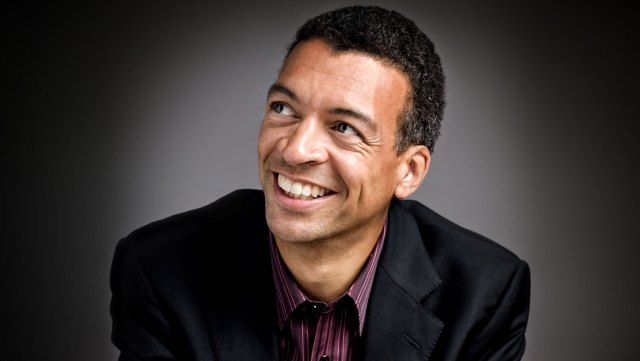
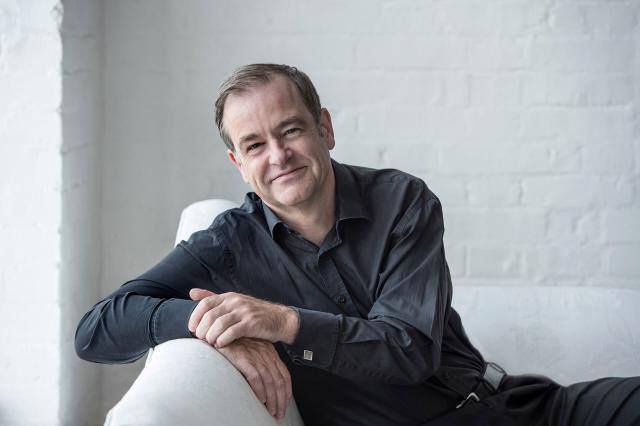
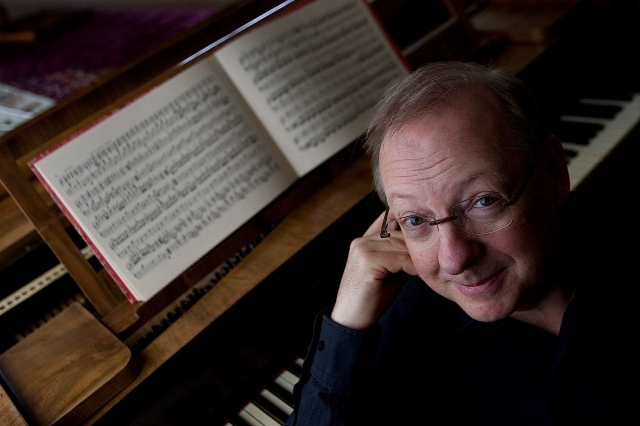
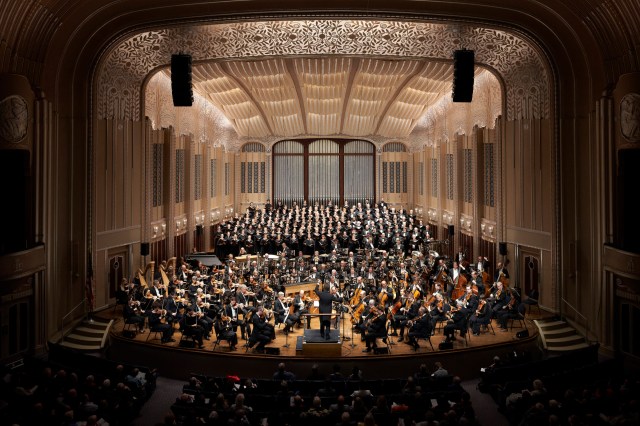
Joélle Harvey, soprano
Krisztina Szabo, mezzo-soprano
Paul Appleby, tenor
Michael Sumuel, bass-baritone
Blossom Festival Chorus
Lisa Wong, director
Severance Hall
Cleveland, OH
August 2, 2019
Mozart: Mass in C minor, K427, Great
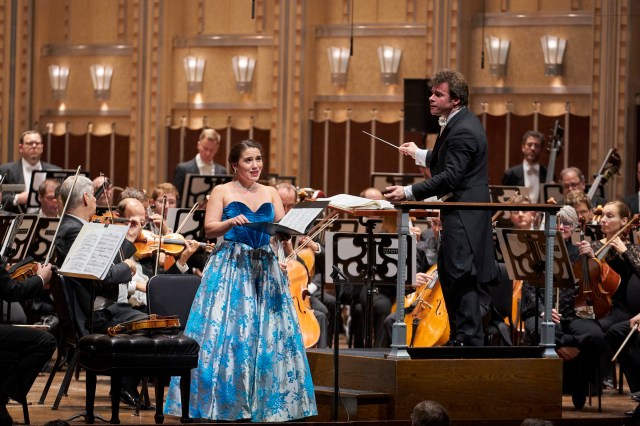
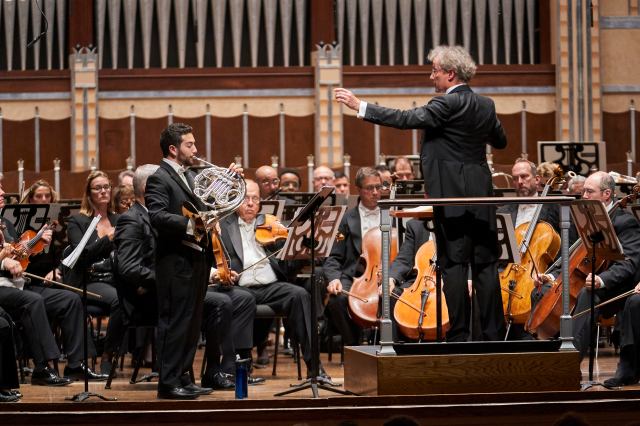
The Blossom Festival Chorus had one chance to shine during the Summers@Severance series this year, and they more than made it count in Friday’s performance of Mozart’s Mass in C minor. Mozart perplexingly never completed the Mass (and unlike the case of the also incomplete Requiem, he lived for nearly another decade), yet even its fragmentary state, it remains an undisputed masterwork. Several attempts have been made to complete the work, but conductor Matthew Halls opted for the extant torso in a performing edition by Helmut Eder.
A weighty pathos, buttressing the epithet Great, was to be had from the onset of the Kyrie. The force of the chorus was quickly introduced, countered by the delicate beauty of soprano Joélle Harvey’s voice (in a passage I cannot dissociate from a memorable scene in Amadeus). A powerful response from the chorus was elicited. Tenor Paul Appleby introduced the Gloria unaccompanied as if to announce the commanding fugue, a rather glorious affair bearing a more than passing resemblance to Handel’s Hallelujah chorus.
Mozart wrote the work with his soprano wife Constanze in mind, and consequently there exists a bounty of wondrous writing for the two soprano soloists – and Krisztina Szabo’s flexible instrument was up to the vocal acrobatics in the “Laudamus te”. Crisp dotted rhythms during “Qui tollis” were emblematic of Halls’ tight direction, and there the choral passages were of a tragic beauty that foreshadowed the Requiem. The closing “Cum Sancto Spiritu” beamed in its contrapuntal splendors, anchored by an imposing bass line in the trombone.
The booming bass-baritone of Michael Sumuel opened the Credo just as Appleby did in the Gloria. “Et incarnatus est” was a highlight in its delicate orchestrations, with fine contributions from the principal winds, strings, organ, and Harvey’s limpid vocals. An ebullient and brassy Sanctus led to the prematurely closing Benedictus, the only time vocal quartet were scored together – one only wished there were more opportunities for the ensemble to explore their obvious chemistry.
Cleveland Museum of Art
Cleveland, OH
June 22, 2019
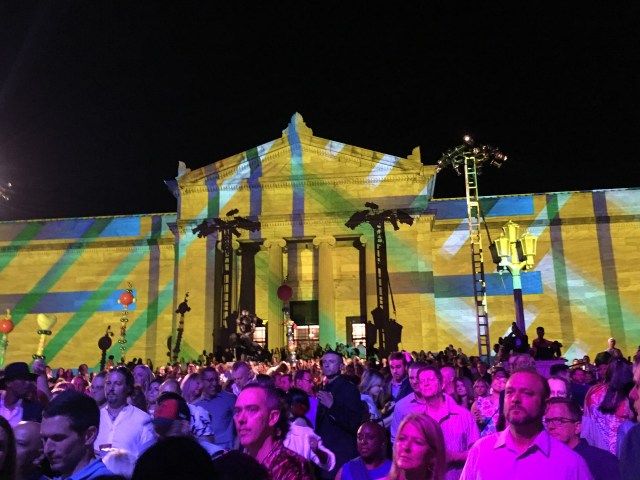
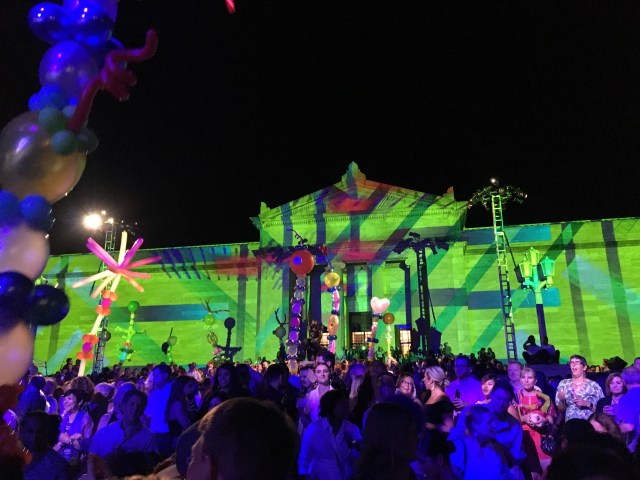
Now in its eleventh year, the Cleveland Museum of Art’s annual Solstice soirée has steadily become the banner cultural event of the Cleveland summer. Running until the early hours of the next morning, the event is first and foremost a musical celebration, with this year’s remarkably diverse lineup curated by the Philadelphia based DJ and record producer King Britt. Two stages were constructed, one in the atrium and one outdoors on the south terrace, allowing for a robust list of performers – and the inevitable frustration of not being able to be at two places simultaneously! Most striking about the outdoor stage was the extensive use of video projection, turning the facade of the museum into a massive canvas on which to display a dizzying array of colors and imagery – with credit to Undervolt & Co. and the team of curators and artists.
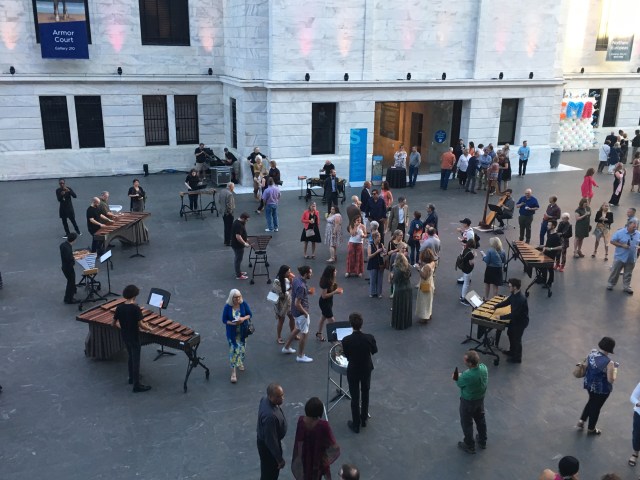
The evening opened with a performance of Terry Riley’s watershed In C. Dating from 1964, it is often considered the first major work of minimalism, setting the stage for Glass and Reich. Riley left the instrumentation, number of players, and duration open to interpretation. The present rendering was given by an ensemble of 10 instruments – xylophone, marimba, harp, steel pan, some commanded by multiple players – and lasted just over the 45 minute mark (Wikipedia notes recordings ranging from 16 to 78 minutes). I noticed the players (who were uncredited in the program) used a stopwatch to keep pace, likely a necessity in this work comprised of 53 phrases each to be repeated an indeterminate number of times. The incessant repetitions were mesmerizingly hypnotic, and I was struck by the communal ambience with the performers positioned such that the space between them and the audience all but evaporated. It was hard to not get disoriented in the wash of sound, but I did notice one subtle effect in the use of a cello bow on one of the xylophones, a technique that would later be put to effective use in John Adams’ Scheherazade.2. To close the work, each musician dropped out one at a time, almost imperceptibly, before all that remained was silence.
Terry Riley’s In C
Of course, the evening wasn’t exclusively about the music: one highlight was the opportunity to walk through the galleries after hours – and it was a bit surreal to stand in front of favorite paintings by Pissarro or Church at nearly midnight. Along with the permanent collection, the second iteration of Shinto: Discovery of the Divine in Japanese Artwas open to all, a fascinating display of visual art in praise of Japanese deities – some pieces over 1000 years old – further putting the Cleveland Museum of Art on the map as a major destination for Asian art. In addition, a full program of gallery talks were offered. I caught Amanda Mikolic’s discussion of the late 16th-century half armor designed by the noted Pompeo della Cesa.
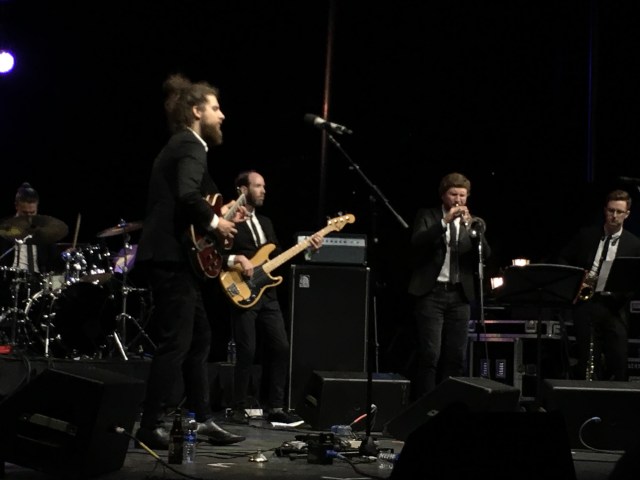
To my mind, the biggest musical discovery came from the Brooklyn based band Anbessa Orchestra, commanding a musical fusion rooted in the folk traditions of Ethiopia. The seven piece band – including a very fine trumpet player and a flutist à la Ian Anderson – had an absolutely electric chemistry, bridging both Western and African traditions with an unrelenting kinetic energy. There was nonetheless a certain cosmopolitan quality to their music, however, as if some of the folk roots got lost in translation, yet distinctive elements such as the exotic scale central to “Son of No Country” showed a nuanced understanding of the North African inspiration. Back in the atrium, the melodic strumming of guitarist Rafiq Bhatia provided a more laid back alternative to the dance club vibe on the terrace with Ohio native RJD2 – who closed the memorable evening in understated fashion on the acoustic guitar.
Cleveland Orchestra
Franz Welser-Möst, conductor
Simon Keenlyside, baritone
Severance Hall
Cleveland, OH
May 23, 2019
Grieg: Morning Mood, The Death of Åse, and At the Wedding from Peer Gynt, Op. 23
Sibelius: Kaiutar, No. 4 from Six Songs, Op. 72
Sibelius: Illale, No. 6 from Seven Songs, Op. 17
Sibelius: Aus banger Brust, No. 4 from Six Songs, Op. 50
Sibelius: Svarta rosor, No. 1 from Six Songs, Op. 36
Sibelius: Kom nu hit, död!, No. 1 from Two Songs for Shakespeare’s The Twelfth Night, Op. 60
Sibelius: Im Feld ein Mädchen singt, No. 3 from Six Songs, Op. 50
Sibelius: Die stille Stadt, No. 5 from Six Songs, Op. 50
Sibelius: Var det en dröm?, No. 4 from Five Songs, Op. 37
Strauss: Aus Italien, Op. 16
Franz Welser-Möst and The Cleveland Orchestra closed the 2018-19 season in an alluring program, with all selections stemming from the late 19th-century (and in to the early 20th), connected by Romantic fascinations from awe-inspiring destinations to drama and poetry. Beginning the evening were selections from Grieg’s incidental music to Peer Gynt. Welser-Möst culled his own suite of three excerpts rather than opting for either of the two suites the composer later produced. The selections were performed in reverse order of appearance in the source material, opening with the familiar Morning Mood (which serves as the prelude to Act 4). Silvery flutes beckoned the morning, with the songful theme passed around the woodwinds before appearing in the strings. Welser-Möst’s brisk tempo ensured matters were never sentimentalized. Lush and mournful strings made The Death of Åse the emotional crux, easily a precursor to Barber’s Adagio. At the Wedding (which opens the complete work) was given with vigor and joyous abandon. A more languorous theme was very finely played in turn by the principal winds while Wesley Collins’ offstage viola radiated folksy charm.
Simon Keenlyside and Franz Welser-Möst, photos credit Roger Mastroianni, Courtesy of The Cleveland Orchestra
On the heels of his lieder recital a few days prior, Simon Keenlyside returned for the evening’s centerpiece and highpoint – a helping of eight of the seldom-performed songs of Sibelius. The songs at hand were variously in Finnish, Swedish, or German, and in some cases orchestrated by Sibelius himself, others by contemporaries. Keenlyside brought out the lyrical qualities of the Swedish language in Kaiutar, with an orchestration that encouraged its fantastical, fairy-tale atmosphere. Crepuscular strings made Illale a true gem, and the next selection turned to German in a setting of Richard Dehmel’s Aus banger Brust. Dehmel’s poetry served as text for the likes of Strauss and Schoenberg, and Sibelius proved no less adept with the work’s acerbic dissonances and moving solo passages from concertmaster Peter Otto in faithful service of the text. Svarta rosor, a comparatively better-known quantity, was of robust lyricism and grand emotions, nearly operatic with an unforgiving close to boot.
Unlike the others all originally scored for voice and piano, Kom nu hit, död! came from a set of two Swedish settings of Shakespeare’s The Twelfth Night for voice and guitar, given a rather gloomy reading at present. The richness of Im Feld ein Mädchen singt could easily have been mistaken for Strauss, while Die stille Stadt – another Dehmel setting – maintained a remarkably surreal atmosphere, enhanced by ethereal sounds from the glockenspiel, harp, and high strings. The last selection, Var det en dröm?, displayed again Keenlyside’s keen ability to seamlessly switch languages, and brought matters to a passionate, satisfying close, feeling almost as if these eight otherwise disparate songs were conceived as a unified cycle.
Strauss’ Aus Italien drew inspiration from an Italian journey undertaken by the composer as an impressionable youth, and became the first entry in his great series of tone poems. It’s an immature work to be sure, yet many Straussian hallmarks are already firmly in place, setting the stage for the musical revolutions that would soon be flowing from his pen. This was certainly apparent in the opening Auf der Campagne which could only have been written by Strauss, with elemental beginnings burgeoning into material larger than life. Brassy passages were of arresting vigor, although otherwise matters in performance weren’t entirely polished, sounding as if some extra rehearsal time was needed – no doubt, I suspect, ironed out by the Saturday performance.
Rather than the single-movement architecture of the successive tone poems, Aus Italien was conceived far less cohesively as four distinct portraits. In Roms Ruinen followed suit, generally lighter fare of Italianate charm interspersed with more solemn moments in awe of the eponymous ruins. Strauss’ idiomatic orchestral effects certainly began to crystallize in Am Strande von Sorrent, a coloristic painting of the sun-drenched coast of Sorrento. The closing Neapolitanisches Volksleben marked the work as a foreigner’s less than reliable view of Italy in that Strauss mistook a popular tune of the day for bone fide Neapolitan folk music (I was somewhat reminded of the All’Italiana movement from the Busoni piano concerto heard earlier this season – though there the composer was no foreigner, it too juxtaposed Italianate folk melodies in the context of an otherwise very Teutonic musical language). In any case, matters were nonetheless of an infectious joie de vivre, banal yet so colorfully orchestrated. The orchestra’s committed playing heightened one’s interest: ultimately the rewards were mixed, though the players on stage made as strong a case as they could in this vintage work displaying the budding composer’s incipient genius.
Franz Welser-Möst and The Cleveland Orchestra in Aus Italien
Simon Keenlyside, baritone
Natalia Katyukova, piano
Reinberger Chamber Hall
Severance Hall
Cleveland, OH
May 19, 2019
Schubert: Winterreise, D911
If local audiences hadn’t quite gotten their fill of late Schubert with the weekend’s Cleveland Orchestra performance of the E flat major Mass, Simon Keenlyside offered the composer’s incomparable song cycle Winterreise in recital Sunday night, a prelude to his appearance with the orchestra the following week. The intimate Reinberger Chamber Hall – all too seldom used as a performance space – made for an ideal setting for the soul-baring songs, forlorn and icy cold. Though perhaps not the most seasonally appropriate on a spring evening, as if on cue with the subject matter, the temperature outside dropped appreciably nearing performance time. Supporting Keenlyside was pianist Natalia Katyukova who provided a remarkable accompaniment, on par with the baritone’s passionate delivery.
Caspar David Friedrich, Winterlandschaft mit Kirche (photo credit Wikimedia Commons)
The impact of this 70-minute song cycle – although as the program books correctly noted, Winterreise isn’t truly a cycle given the lack of recurrence – was truly visceral, and one could scarcely imagine a better advocate than Keenlyside. Originally scored for tenor, Schubert allowed for other voice types, and Keenlyside’s case for Winterreise belonging to the domain of baritones was thoroughly convincing, the lower register well-suited to the gloomy poetry of Wilhelm Müller. The highlights were many, beginning with the opening Gute Nacht, strengthened by the rich darkness of the baritone and pained dissonances in the piano. Die Wetterfahne was of angst and unrest, while there was intense drama in Erstarrung, with some modest acting from Keenlyside to enhance the outcry – though this acting was less directed at the audience and more to convey the sense that we were witnessing a deep internal monologue.
A liquescent, rippling accompaniment and gorgeous lyricism from the singer in Der Lindenbaum made for an early highpoint in the cycle. I was struck by the palpable pain on the words “mein Herz” during Auf dem Flusse, while Frühlingstraum offered some momentary respite – that is, until the titular dream ended, the song residing in a tenuous gray area between dream and reality. Einsamkeit was as forlorn as the title suggested, and time stood still in Der greise Kopf, wherein the speaker wished he was graying and thus closer to end of life – but such was only an illusion from the wintry frost, the agony of life prolonged. Die Krähe was utterly haunting in both melody and imagery (perhaps an inspiration to Edgar Allan Poe?). There was heart-wrenching isolation in Der Wegweiser, in which the speaker felt shunned by society; Mut! saw his last embers of fiery defiance – buttressed by Keenlyside’s foot-stomping – before resignation. The unnervingly inconclusive Der Leiermann saw Keenlyside staring off into the distance, mere feet from the audience but psychologically miles away as matters remained painfully unresolved. I don’t often get the goosebumps like I did from this performance, magnificent yet exhausting in its depth and darkness.
Cleveland Orchestra
Semyon Bychkov, conductor
Katia Labèque, piano
Marielle Labèque, piano
Severance Hall
Cleveland, OH
May 9, 2019
Glanert: Weites Land, Musik mit Brahms
Bruch: Concerto for Two Pianos, Op. 88a
Encore:
Ravel: Le jardin féerique, from Ma mère l’Oye
Smetana: Vyšehrad, Vltava, and Šárka from Má vlast
The Cleveland Orchestra certainly has a knack for presenting programs that resist the tried-and-true, and Thursday’s concert was no exception, another triumph of imaginative programming with both works on the first half receiving their inaugural performances from this ensemble. Guest conductor Semyon Bychkov has championed the works of contemporary composer Detlev Glanert, and opened the evening with the US premiere of the 2013 work Weites Land. Roughly translating to English as Wide Open Land, the work also bears the subtitle Musik mit Brahms. Like Brahms, Glanert hails from Hamburg, and the work of the elder composer has often served as his guiding light – here quite patently so, with the arching primary theme of the Fourth Symphony serving as the present work’s structural backbone. An obvious invocation of the symphony opened, familiar for a fleeting moment, then morphing into dissipated modernity. The Brahms theme served as guideposts at various intervals, while the wide, open spaces between were filled with colorfully dissonant filigree, often unexpected yet still approachable, and ultimately a brief Brahmsian gesture brought matters to a close.
A true rarity followed in the Concerto for Two Pianos by Max Bruch, featuring the acclaimed Labèque sisters (who opted for the Bruch in favor of the initially programmed work for the same forces by Martinů). Bruch completed the work in 1915, near the tail end of his career, in fact with another sibling duo in mind, Rose and Ottilie Sutro. To the composer’s dismay, the dedicatees performed the work in a vastly simplified version, and Bruch’s original version didn’t surface to the public until the 1970s. Bruch’s intentions were certainly respected and challenges easily surmounted Thursday evening; between the two pianists, the opening theme was presented in eight octaves, a commanding beginning saturated in solemnity. An exacting fugue followed, beginning in the pianos, and blossoming to great power when the orchestra joined.
Bychkov and the Labèque sisters’ 1993 recording of the Bruch concerto
A slow introduction marked the next movement, with sweeping arpeggios on the keyboards and gentle touches in the oboe from Frank Rosenwein. The movement proper was of scherzo-like playfulness, contrasted by the lyrical beauty of the succeeding. The octave theme returned in the finale, a passionate last vestige of German Romanticism (indeed, the four movement structure certainly pointed towards the Brahms concertos as inspiration). A work which soloists and conductor clearly believe in (having recorded it some years ago), though to my ears not the most melodically rewarding. The duo encored with the final segment of Ravel’s Ma mère l’Oye – gorgeous playing which said more in those few minutes than in Bruch’s twenty-five.
Bychkov currently serves as music director of the Czech Philharmonic, and accordingly was able to offer penetrating insights to the first three selections of Smetana’s Má vlast. A work central to Czech musical culture, it inaugurates the storied Prague Spring International Music Festival every year on May 12, the anniversary of the composer’s death – coming just days after the present performance. Vyšehrad opened with a pair of harps, lush and rhapsodic, to set the stage for the epic tale of the namesake fortress. The Vyšehrad theme – which reappears throughout the cycle – was first sounded by the horns, warm and mellow. The vicissitudes of the castle through history were depicted, always majestic in the end.
By far the most recognizable of the six tone poems, Vltava began with liquescent flutes in evocation of the confluence of the springs that form the titular river. Matters swelled to a richly lyrical theme, arching, aching, and the picturesque journey of the river was painted in delirious detail. Most memorable was the “night music”, fantastical and sublime, as well as the appearance of the Vyšehrad theme when the river snaked its way through Prague, displaying the full splendor of the Cleveland brass. The ferocity with which Šárka opened portended the darkly murderous tale to come. Folk-inflected material and the lambent clarinet of Afendi Yusuf offered some momentary respite, yet the music inexorably culminated in a violent, gruesome end. One’s appetite was certainly whetted for more Smetana – as noted in the program books, the orchestra hasn’t performed Má vlast complete since 1976, so surely it is high time for a traversal of the full cycle!
Cleveland Orchestra
Michail Jurowski, conductor
Vadim Gluzman, violin
Severance Hall
Cleveland, OH
May 5, 2019
Tchaikovsky: Violin Concerto in D major, Op. 35
Encore:
Bach: Violin Partita No. 2 in D minor, BWV 1004 – Sarabande
Shostakovich: Symphony No. 11 in G minor, Op. 103, The Year 1905
Last weekend’s Cleveland Orchestra concerts marked not only Michail Jurowski’s local debut, but – astonishingly for a 75-year-old with a long and distinguished career – his US debut. Good things come to those who wait, and given the level of playing, one could have easily mistook conductor and orchestra as seasoned collaborators. Adding to the occasion was Jurowski’s participation in a pre-concert interview along with violin soloist Vadim Gluzman, both offering fascinating insights. Gluzman spoke of his cherished instrument, a 1690 Stradivarius formerly played by Leopold Auer, the original dedicatee of Tchaikovsky’s Violin Concerto – this is to say, this is the instrument for which the composer envisioned his now ubiquitous concerto. In deference to the violin’s provenance, Gluzman remarked on his preference for Auer’s edition of the work. Jurowski fondly recalled his first exposure to The Cleveland Orchestra while the latter was on tour to Moscow in 1965 under Szell. This performance he called one of the “most powerful feelings from live music” he’d ever experienced, and was thus particularly keen to stand in front of them as conductor. He further reminisced about his personal friendship with Shostakovich, with whom he played piano duets!
Pre-concert interview, left to right: moderator Cicilia Yudha, Michail Jurowski, Vadim Gluzman
The Tchaikovsky Violin Concerto is certainly a well-known quantity, yet violinist and conductor managed to forge a fresh interpretation. A gentle, untroubled lyricism opened the work, so much at odds with the composer’s tormented life. Gluzman’s instrument was particularly rich in the low register, something Tchaikovsky took advantage of when writing the work, emanating a songful, burnished tone in this music of endless, organic development, with one theme flowing out of the next. The orchestral climax was given with vigor and swagger, and in the cadenza, one was struck by Gluzman’s crystal clear intonation of the stratospherically high notes and thorough command of his storied instrument – joined by flutist Joshua Smith in a particularly affecting moment. A choir of winds – a notch too loud to my ears – opened the central Canzonetta, and the violin sang with an ineffable melancholy, quite a contrast from the breakneck dance of the finale. Gluzman encored with the sarabande from Bach’s Second Partita, given with stately introspection.
Shostakovich’s Eleventh Symphony is patently programmatic, recounting the horrific events of Bloody Sunday in graphic detail. The events – occurring one year before the composer’s birth and witnessed firsthand by his father – entailed the mass murder of peaceful demonstrators by the tsarist regime on a fateful Sunday in January 1905. The symphony was completed in 1957, and Jurowski suggested it was inspired by the Hungarian Revolution of the year prior which had some clear parallels – in other words, ever the subversive, Shostakovich was using historical events to comment upon the present. The work opened with the eerie and chilling motionlessness of a St. Petersburg January, a calm before the storm, aspiring to the monumental stasis of a Bruckner symphony. A plethora of folk songs in support of the revolutionary program was integral to the fabric of the work, first appearing in the brilliant trumpet of Michael Sachs.
A jarring contrast was had in the following movement, structurally serving as a scherzo but miles removed from a light-hearted affair. Matters seemed to crest to apparent triumph, only to devolve into music of shattering, shocking violence, with the snare depicting gunshots in gruesome recount, leading to a grinding fugue in the low strings of blistering contrapuntal ferocity. What followed was music of a broken world, never the same, this being the beginning of the end for the tsarists, and ghostly sounds of the celesta and muted trumpet finally brought matters to an inconclusive close. The third movement, titled “Eternal Memory”, was mourning of deepest lamentation. The strings initiated, followed ominously by the low brass. Matters burgeoned to an impassioned outcry, but in due course retreated to the somber beginnings. The closing “Tocsin” (“Alarm” – fittingly at this point a siren was heard from a passing emergency vehicle outside) jolted matters out of the shadows, startling in intensity. A march of relentless vigor proceeded, toppling over into a reminiscence of the quietude of the work’s distant opening, heightened by a plaintive English horn solo from Robert Walters. The coda added bells to the texture, material as impressive and blood rushing as anything Shostakovich wrote, yet after such bombast, Jurowski held the audience suspended in shocking silence.
Cleveland Orchestra
Franz Welser-Möst, conductor
Paul Jacobs, organ
Severance Hall
Cleveland, OH
March 14, 2019
Haydn: Symphony No. 34 in D minor, Hob. I:34
Deutsch: Okeanos
Tchaikovsky: Symphony No. 5 in E minor, Op. 64
Prior to The Cleveland Orchestra’s impending and extensive tour of China, Franz Welser-Möst is back in town for a pair of programs, the first of which was centered on Cleveland’s introduction to the tenth Daniel R. Lewis Young Composer Fellow, Bernd Richard Deutsch. Also hailing from Welser-Möst’s native Austria, Deutsch is representative of what is sometimes referred to as the Third Viennese School, a loose amalgamation of composers whose music has been championed by the contemporary music ensemble Klangforum Wien.
Franz Welser-Möst and Paul Jacobs in Okeanos. Photos credit Roger Mastroianni, Courtesy of The Cleveland Orchestra
The work Deutsch made his calling card was Okeanos, a nearly 30-minute canvas for organ and orchestra dating from 2014-15, and inspired by the titular Greek personification of the oceans. Prefacing the performance, Deutsch and organist Paul Jacobs were on hand for a fascinating preconcert discussion (although I did wish that moderator Caroline Oltmanns had been gracious enough to give the two more airtime). Okeanos is conceived in four movements, each representing the fundamental elements, respectively, water, air, earth, and fire. The work began almost indeterminately, with tremolos obscuring fragments of themes, and the organ so wrapped into the fabric of the orchestra as to be hardly discernible. The movement soon grew far more animated, building to a fluid gravitas, with the organ powerfully prominent in music of cosmic visceral impact – yet the movement ended in no more than a whisper.
“Air” opened with rapid fluttering in the organ along with a wind machine used to obvious effect. Colorful glissandi on the organ were imitated by the harp and celesta. “Earth” was a more glacial affair, filled with otherworldly timbres usually emanating from the percussion battery, as vast and diverse as one could imagine. “Fire” was of rapid virtuosity and quite ferocious playing, emphasizing the rhythmic primacy of the percussion. Further striking effects were achieved through muted trombones; at movement’s end the texture dug down into the depths of the organ, ending on a sustained chord at quadruple forte – an imposing effect to be sure. Deutsch noted that the structure of the work was determined by the golden ratio – a thought-provoking compositional approach with antecedents in Debussy and elsewhere, though certainly not apparent on first hearing. As part of his fellowship, Deutsch has been commissioned to write a new work for the orchestra, to be performed at the end of next season (May 2020) – I look forward to music that lies ahead.
The evening began with the first Cleveland Orchestra performances of a lesser-known Haydn symphony, No. 34 in D minor. The first of the composer’s to be cast in the minor, it served as an incubator for the series of Sturm und Drang symphonies that would soon follow. Haydn quite surprisingly begins with the slow movement – what initially sounds like merely an introduction turns out to be a symphonic edifice nearly as long as the remaining movements combined. A lament in the strings was marked by the clarity of the inner voices in this statement of genuine expressive depth. After the weighty beginnings, the minor was all but forgotten and matters proceeded wholly unperturbed. The sudden high spirits of the second movement were further encouraged by the courtly minuet with lovely woodwind triplets during its trio. And as is often the case with Haydn’s whirlwind finales, one only wished it wasn’t so brief.
Tchaikovsky’s evergreen Fifth Symphony completed the program in lush Romanticism. A plaintive presentation of the fate motive in the clarinets opened the work to chilling effect, eventually coalescing as an energetic march, gathering great strength in the face of fate and brimming with endlessly flowing melody. Welser-Möst took matters at a startlingly brisk tempo – while I applaud his resolve to not sentimentalize, I would have preferred the music to breathe a bit more. Low strings of deep emotion marked the slow movement, a backdrop for the sumptuous horn solo, delicately interjected by Afendi Yusuf’s clarinet. While Welser-Möst might not have probed as deep as some, the result was nonetheless long, flowing lines of rapturous beauty. The tragic obsessions of the first two movements were left behind in the lilting Valse, decorated by mercurial strings. The fate motive resurfaced, suddenly benign, setting the stage for the finale wherein matters were miraculously morphed to the triumphant.
The Cleveland Orchestra performs Okeanos. Note the percussion battery and muted brass.
Apollo’s Fire
Jeannette Sorrell, conductor
Jeffrey Strauss, baritone
Kathie Stewart, traverso
St. Paul’s Episcopal Church
Cleveland Heights, OH
March 8, 2019
Vivaldi: Concerto in D for Two Violins, Two Cellos, and Strings, RV 564
Bach: Brandenburg Concerto No. 3 in G major, BWV 1048
Vivaldi: Concerto in B Minor for Four Violins, RV 580 (from L’estro armonico, Op. 3)
Telemann: Funeral Cantata for an Artistically Trained Canary-Bird, TWV 20:37
Vivaldi: Flute Concerto in D, Il gardellino, RV 428 (from Six Flute Concertos, Op. 10)
Vivaldi/Sorrell: La Folia, after Trio Sonata in D minor, RV 63 (from Twelve Trio Sonatas, Op. 1)
Branded as “Three Duels and a Funeral”, Apollo’s Fire (fresh off their win at the Grammys) offered a generous program comprised of a trio of Vivaldi concertos along with a funereal oddity by Telemann, fleshed out with additional music by Bach and more Vivaldi. The first “duel” presented was Vivaldi’s Concerto in D for Two Violins, Two Cellos, and Strings. Despite the evening’s moniker, these concertos were rather congenial affairs as far as duels are concerned, with the opening work particularly affecting in its consonant combination of soloists on both ends of the string spectrum (violinists Johanna Novom and Adriane Post, cellists René Schiffer and Rebecca Landell Reed), further encouraged by the crisp cohesiveness of the supporting ensemble. Novom led the central Largo with beautifully singing lines which Post duly imitated, while rapid fire playing amongst the four soloists made for a rousing finale.
Jeffrey Strauss and Apollo’s Fire in Telemann’s Canary Cantata, photo credit Apollo’s Fire
In her spoken introduction, Jeannette Sorrell referred to Bach’s Brandenburg Concerto No. 3 as the “most democratic piece in classical music”, owing to its equal treatment of all nine players. Matters were propelled forward with joyous energy, only to arrive at a harmonic stasis in the slow movement of only two chords, wherein Sorrell’s continuo acted as a ghostly recitative. The work closed with a driving theme, vigorously passed from instrument to another. Vivaldi’s Concerto in B minor for Four Violins saw Novom and Post resume soloist duties along with Susanna Perry Gilmore and Carrie Krause. One was quite taken intricate interplay amongst the quartet during this comparatively sober work, not in the least during a striking moment when the orchestral accompaniment all but dropped out of the fold.
The evening’s centerpiece was a work of remarkable musical eccentricity, namely Telemann’s Funeral Cantata for an Artistically Trained Canary-Bird. Written at the behest of a Hamburg patron whose pet canary fell victim to a hungry feline, the Canary Cantata retells just that over the course of its 17-minute duration, ultimately an ingenious blend of tragedy and comedy. Handling the vocal line (originally in German, presented here in Sorrell’s English translation) with verve and aplomb was baritone Jeffrey Strauss, who further brought the text to life via some choice props and acting under the direction of Christine McBurney – judiciously used to add comedy without gimmick. As detailed in an interview with Cleveland Classical, Strauss’ vitality was all the more laudable given his recent recovery from major heart surgery. Sighing strings opened the work in this music of very fine quality, such that it could easily be mistaken for that of a rather more serious subject matter. The aria “My dear Canary, sleep well tonight!” was genuinely moving, a lovely tribute to the protagonist’s avian friend. A genuine curiosity, expertly performed, and perhaps an inspiration for Alkan’s equally perplexing and similarly themed Marcia funebre sulla morte d’un Papagallo from almost a century later.
This ornithological thread was continued in one further Vivaldi concerto, the Flute Concerto in D bearing the nickname “Il gardellino” (The Goldfinch). Principal flute Kathie Stewart delivered an obvious invocation of birdcalls in her limber and fluid playing, and a charming cantabile led to the fluttering finale. Vivaldi’s rendering of La Folia has become one of AF’s signature pieces; originally a trio sonata, the evening closed with Sorrell’s arrangement, recomposed as a concerto grosso. A commanding reading of the canonical chord progression gave way to a breathless tour de force, with some good-natured dueling between violinists Alan Choo and Emi Tanabe emblematic of the ensemble’s blistering virtuosity.
Cleveland Orchestra
François-Xavier Roth, conductor
Javier Perianes, piano
Severance Hall
Cleveland, OH
February 28, 2019
Debussy: Rêve, from Première Suite d’Orchestre (orch. Manoury)
Ravel: Piano Concerto in G major
Encore:
Falla: Danza ritual del fuego, from El amor brujo
Stravinsky: Petrushka (1947 version)
An unexpected artist cancellation had the ancillary effect of morphing François-Xavier Roth’ Cleveland Orchestra debut program into a decidedly Parisian affair. Due to illness, violinist Patricia Kopatchinskaja was obliged to cancel her scheduled performance of Peter Eötvös’ Seven, a violin concerto written in memoriam the astronauts aboard the Space Shuttle Columbia – hopefully a work which can be programmed again in a future season. Spanish pianist Javier Perianes was on hand for the Ravel piano concerto instead, neatly complemented by works of Debussy and Stravinsky. The program change did little to derail Roth’s auspicious debut, a colorful portrait of Parisian musical life as the 19th-century gave way to the twentieth, and something of a pendant to Ingo Metzmacher’s program earlier in the season comprised of works of the same time period from Vienna.
Debussy catalogues had long indicated the existence of a Première Suite d’Orchestre dating from his student days, but it was assumed to be lost until as recently as 2008 when the score surfaced in New York’s Pierpont Morgan Library. Two extant versions of the four-movement suite were unearthed: a version for two pianos and a full orchestral score. The latter, however, was missing the third movement (Rêve) which was in due course orchestrated from the piano version by Philippe Manoury. While one might have wished for the entire suite to be performed, Rêve made for a fine opening selection as a standalone work. String tremolos and bubbling winds showed the present piece to be a clear precursor to La mer despite its youthful ambitions, with a lyrical theme (especially prominent in the oboe) taking its cue from the Romanticism of Debussy’s predecessors. An attractive piece – and a US premiere – with orchestration remarkably faithful to Debussy’s palette.
Credit is due to the orchestra administration to booking a first-class substitute in Perianes at short notice. Ravel’s Piano Concerto in G major was a vehicle well-suited to the pianist and a welcome addition to the evening (and parenthetically, Ravel’s other piano concerto, for left hand alone, was performed here almost exactly a year ago). Its striking whip crack opening was answered by a prominent piccolo, glittering glissandi on the keyboard, and ebullient trumpet, giving way to a bluesy, quasi-improvisatory theme in the piano. A wondrous texture from the harp led to the cadenza, bringing Perianes’ formidable technique in the spotlight. The Adagio assai opened sans orchestra, a heart-wrenchingly beautiful nocturne somewhat reminiscent of Satie’s Gymnopédies, made all the more affecting by the pianist’s lyrical phrasing and touch. A lovely flute passage ushered in the rest of the orchestra. Matters grew more impassioned, only to recede to delicate filigree in the piano in dialogue with the English horn. The finale was a wild toccata of bright colors and bursts of jazz, inevitably leading to demands for an encore. Perianes obliged in a solo transcription of Falla’s Ritual Fire Dance, with a slithery main theme growing to staggering virtuosity.
Javier Perianes, photo credit Igor Studio
Stravinsky’s Petrushka, written for the Paris-based Ballets Russes in 1911, was presented in its 1947 revision which refined and clarified the orchestration. “The Shrovetide Fair” was awash with color, immediately pulling the audience in to a bustling street scene, with busy fragments of themes quickly shifting focus from one character to the next. The vigorous “Russian Dance” was a further highpoint, later reoccurring prominently in the piano. Piquant bitonalities, first appearing in the clarinets, displayed in no uncertain terms the conflicted duality of the titular puppet, while a fine trumpet solo from Michael Sachs offered some impish, folksy charm. The final scene returned to the opening fair at evening with textures even denser than as before. Shrill clarinets added to the dizzying array of colors, ominously predicting the puppet’s eventual death with the bitonal theme having the last word – now distant and disembodied, as if the post-mortem puppet was in ghostly dialogue with himself.
Cleveland Orchestra
Alan Gilbert, conductor
Garrick Ohlsson, piano
Men of the Cleveland Orchestra Chorus
Lisa Wong, director
Severance Hall
Cleveland, OH
February 7, 2019
Haydn: Symphony No. 100 in G major, Hob. I:100, Military
Busoni: Piano Concerto in C major, Op. 39
This weekend’s Cleveland Orchestra concerts were anything but routine and truly one for the books, featuring a rarely-heard epic: Ferruccio Busoni’s Piano Concerto, an Olympian creation spanning the continuum of over 70 minutes, cast in five movements with the last including a male chorus. At the podium was former assistant conductor Alan Gilbert in his only stateside appearances this season. Before plunging into the unforgiving waters of the Busoni, the orchestra offered a delectable amuse-bouche in Haydn’s “Military” symphony.
A graceful classicism imbued the quintessentially Haydnesque slow introduction, with deftly ornamented strings. The movement proper was given with joie de vivre, though Gilbert didn’t shy away from giving matters ample gravitas where necessary: while seemingly a trifle in the wake of the Busoni, it proved to be far more than a mere featherweight. The Allegretto began unassumingly with some particularly lovely playing in the winds, while a boisterous splash of color against the pearly white classicism was achieved through the sudden introduction of cymbals, triangle, and bass drum, earning this symphony its moniker. Thought of as “Turkish” sounds with the Austro-Turkish War being in recent memory, these instruments were used to similar effect by Mozart and Beethoven; the present work’s martial feeling was further enhanced by a series of bugle calls. By comparison, the ensuing minuet was decidedly Old World, with a trio of simple charm. The finale was of frenetic energy and included a brief return of the colorful percussion.
There’s some historical context necessary in appreciating the magnitude of the Busoni performance. An absolute marathon for the soloist, it makes superhuman technical demands virtually without respite, and thus only a handful of pianists have the stamina to approach such a work. The Cleveland Orchestra first traversed the concerto in 1966 with Italian pianist Pietro Scarpini and George Szell conducting (an archive recording can be heard here), and the Cleveland performances were followed by a tour date in New York. In the audience of the Carnegie Hall performance was an eighteen-year-old Garrick Ohlsson who later that year would win the Busoni International Piano Competition. Fast-forward to 1989, and Ohlsson was the soloist in TCO’s next encounter with the work, this time under the baton of Christoph von Dohnányi. A New York performance again took place (along with Boston), as well as a recording session, the fruits of which continue to serve as a benchmark. This weekend’s two performances thus commemorated a remarkable anniversary, with Ohlsson, now 70, returning to the keyboard almost 30 years to the day of the recording (February 4, 1989).
Cleveland Orchestra and Chorus. Garrick Ohlsson and Alan Gilbert, center.
The opening Prologo for orchestra alone initiated matters with lush, hyper-Romantic strings; though written in 1904 the work’s musical language was firmly rooted in the previous century, predating Busoni’s more astringent modernism. Winds and brass were introduced in stately fashion, with the piano’s entrance at the Introito being one of commanding chords thunderously traversing the keyboard. Rarely will one hear a Steinway played with such leonine power, with Ohlsson’s effusions sailing above the orchestra and through the depths of the hall – and impressively, he had the whole score committed to memory. While generally a movement of solemnity, there were occasional hints of the composer’s Italian heritage, of central importance in the work’s even-numbered movements. The following Pezzo giocoso was just that, beginning with rapid, fantastical material leading to a dizzying folk theme. It’s a movement that for me brings to mind the analogous one from Brahms’ second piano concerto, it too being a work of enormous weight, and like Brahms, Busoni’s piano writing is often subsumed into the dense texture of the orchestra when not front and center. Afendi Yusuf offered a languorous clarinet passage, and the folk theme appeared again in the piano atop rumbling tremolos in the bass. Boisterous as the movement was, it faded away in resolution.
The central Pezzo serioso is the heart of the work, its twenty minutes further divided into three sections with an introduction preceding. The low strings emanated a somber, looming darkness, as well as a contrapuntal severity that evidenced the specter of Bach, Busoni’s greatest idol. The piano floated above the strings, almost as a nocturne, and a solemn brass chorale also found an answer from the keyboard. Powerful rolling chords marked the Prima pars, while the extensive Altera pars erupted into a storm worthy of Mahler. Indeed, had Mahler written a piano concerto, this all-encompassing vision of Busoni leaves a clue to what perhaps could have been. The bright Italian sun broke through in the penultimate movement, All’Italiana, with bubbling winds further colored by tambourine. The wild tarantella was given with a joyous abandon, almost boiling over to a breaking point before the massive cadenza, with Ohlsson not flagging in intensity even an hour in.
The concluding Cantico brought forth the men’s chorus who rose to their feet at the cadenza’s conclusion (although it should be noted that Busoni desired for the chorus to not be visible to the audience). The notion of including a chorus within a piano concerto certainly contravenes convention, save for a few odd precedents – most notably, Beethoven’s Choral Fantasy, as well as all but forgotten examples from Daniel Steibelt and Henri Herz. In scoring for male voices, one also suspects Busoni looked towards the finale of Liszt’s Faust Symphony as a guiding light. A mystical atmosphere pervaded the movement’s beginnings to set the stage for the monastic entry of the chorus, at which point Ohlsson was afforded a well-earned relief, albeit brief. The six-part choral writing yielded some striking harmonies, in the service of a text by the Danish poet Adam Oehlenschläger rendered in German. Excerpted from the poet’s “Aladdin”, the text in question is a hymn to Allah, yet much like Mahler’s texts of religious inspiration, it transcends one particular ethos. Upon conclusion of the text, the piano and full orchestra were rallied once again for the coda, magnificent and triumphant. A remarkable achievement, not to be soon forgotten.