Berlin Philharmonic closes Carnegie Hall residency with astonishing Mahler

Berliner Philharmoniker
Kirill Petrenko, conductor
Stern Auditorium
Carnegie Hall
New York, NY
November 12, 2022

Mahler: Symphony No. 7 in E minor

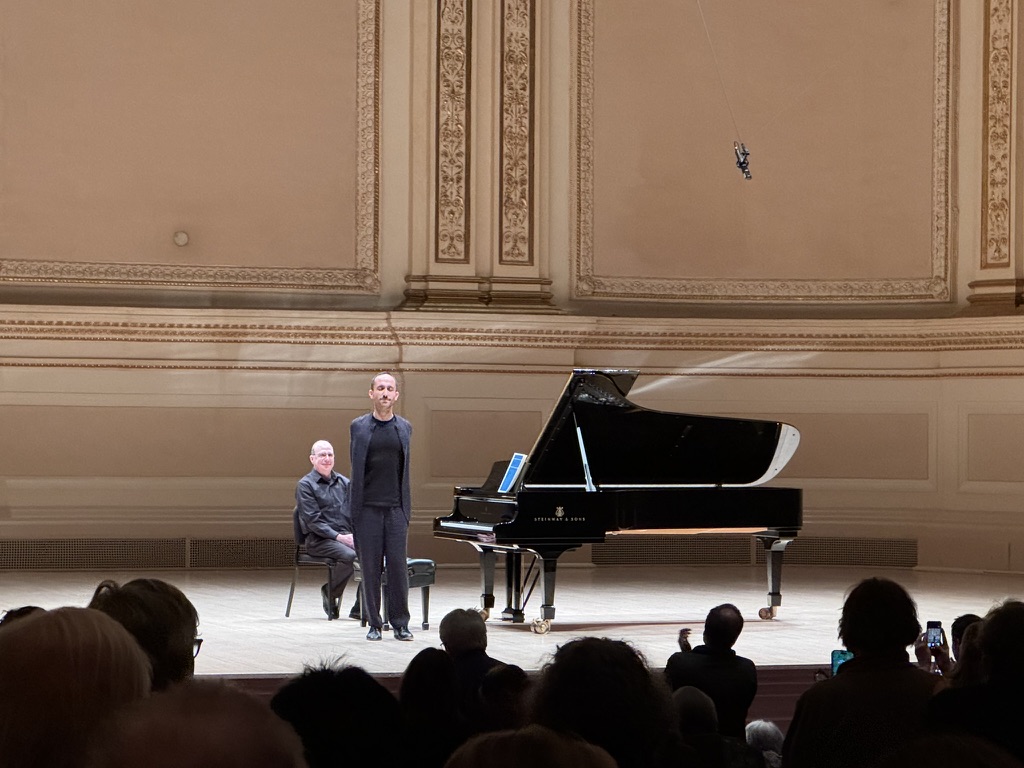
The first concert reviewed on this blog was the Berlin Philharmonic performing Mahler’s Seventh in Ann Arbor under former chief conductor Simon Rattle on Saturday, November 12, 2016. Exactly six years to the day later, we here at quasi-faust had the distinct privilege of witnessing the same ensemble in the same work, this time around at Carnegie Hall with Rattle’s successor Kirill Petrenko. The Seventh is perhaps the most enigmatic of all the Mahler symphonies, hanging on the precipice of musical modernism without quite leaving behind its Romantic pathos. Memory fades over time, but it seemed to me that Petrenko’s approach was generally a similar conception to Rattle’s, lushly Romantic and soaring to intensely dramatic heights. A thrilling close to the Philharmonic’s three-night stint at Carnegie Hall, its first appearance there since Petrenko took the reins.

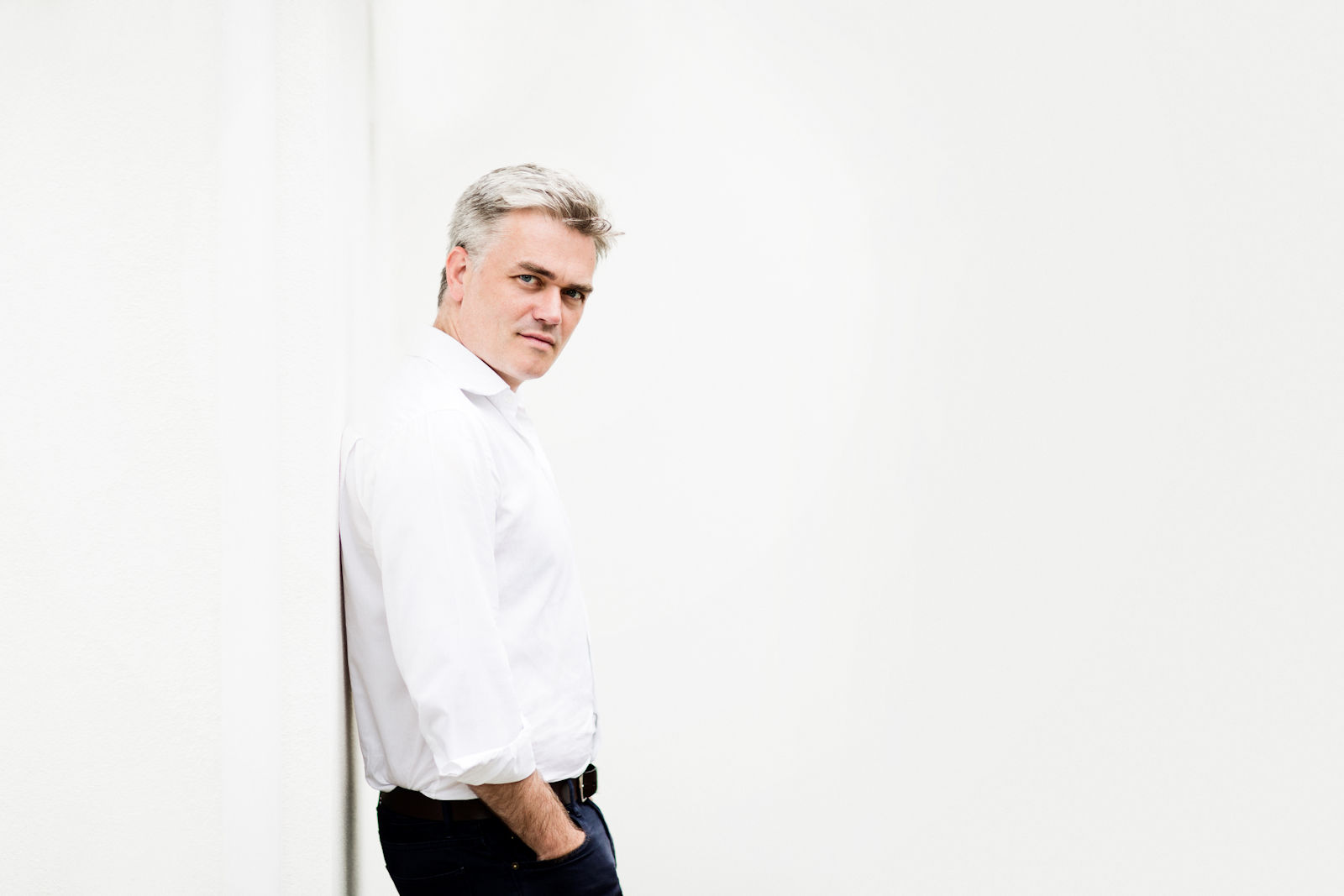
Kirill Petrenko leads the Berlin Philharmonic at Carnegie Hall, photo credit Chris Lee

The idiosyncratic rhythmic gesture that opened the sprawling first movement was given with pointed articulation, emphasizing the dotted rhythms. Matters were shrouded in an ineffable air of mystery, and the imposing solo for tenor horn grabbed one’s attention with chilling intensity. The music amassed weight and vigor as a march-like processional, while a peaceful interlude spoke to the composer’s wonderment of nature with particularly lush and lovely passagework in the harp. The coda – one of my favorite moments – was thrilling and unrelenting, a masterful conclusion.

The first of the two Nachtmusik movements began with a memorable dialogue between horns – one present, one distant. Col legno strings added to the vast palette of orchestral color, and folk-inflected melodies invoked the Austrian countryside, with cowbells leaving little guesswork as to Mahler’s alpine inspiration. With its Schattenhaft (“shadowy”) tempo marking, the central scherzo too occupied the realm of the night. Unlike the lightheartedness one might associate with such a movement, this was an essay mysterious and enigmatic, often as if in terror of some spectral presence, though the occasional lyrical passage offered moments of clarity. The latter Nachtmusik turned languid and sensuous, with some fine playing from concertmaster Daishin Kashimoto, and the lovely addition of the guitar and mandolin. Goosebumps-inducing lyricism made this one of the highpoints.

A startling wakeup was the to be had in the Rondo Finale, opening in boisterous resound with the theme hammered out in the timpani, a spirit only outdone by the brilliance of the brass. Despite being well past the one-hour mark at this point, the orchestra showed no sign of waning energy. Horns were pointed outward for maximum impact, and the clangorous percussion battery made matters all the more visceral. A truly remarkable performance, duly satisfying one’s hopes and desires for one of Mahler’s most remarkable conceptions.

Kronos Quartet celebrates contemporary music at Carnegie Hall

Kronos Quartet
Zankel Hall
Carnegie Hall
New York, NY
January 25, 2020

Gordon: Clouded Yellow
Glass: Quartet Satz
Mazzoli: Enthusiasm Strategies
Mochizuki: Boids
Riley: “The Electron Cyclotron Frequency Parlour” and “One Earth, One People, One Love” from Sun Rings
Dessner: Le Bois
Reich: Different Trains

Encore:
Man: “Silk and Bamboo” from Two Chinese Paintings

The Kronos Quartet’s sold out Saturday night performance at Carnegie’s Zankel Hall was an enthusiastic celebration of music by living, thriving composers, three of whom were present in the audience: Michael Gordon, Missy Mazzoli, and Philip Glass. About half the selections performed were products of Kronos’ ambitious and ingenious initiative Fifty for the Future, wherein 50 new works – 25 by men, 25 by women – are being commissioned over a five year period, with the score along with a recording by Kronos available for free online. A remarkable way to disseminate new repertoire for the venerable string quartet, and one had that project to thank for the works heard on Saturday by Glass, Mazzoli, Mochizuki, and Dessner.

1_small3-600x0
Kronos Quartet (not pictured, cellist Paul Wiancko), photo credit Jay Blakesberg

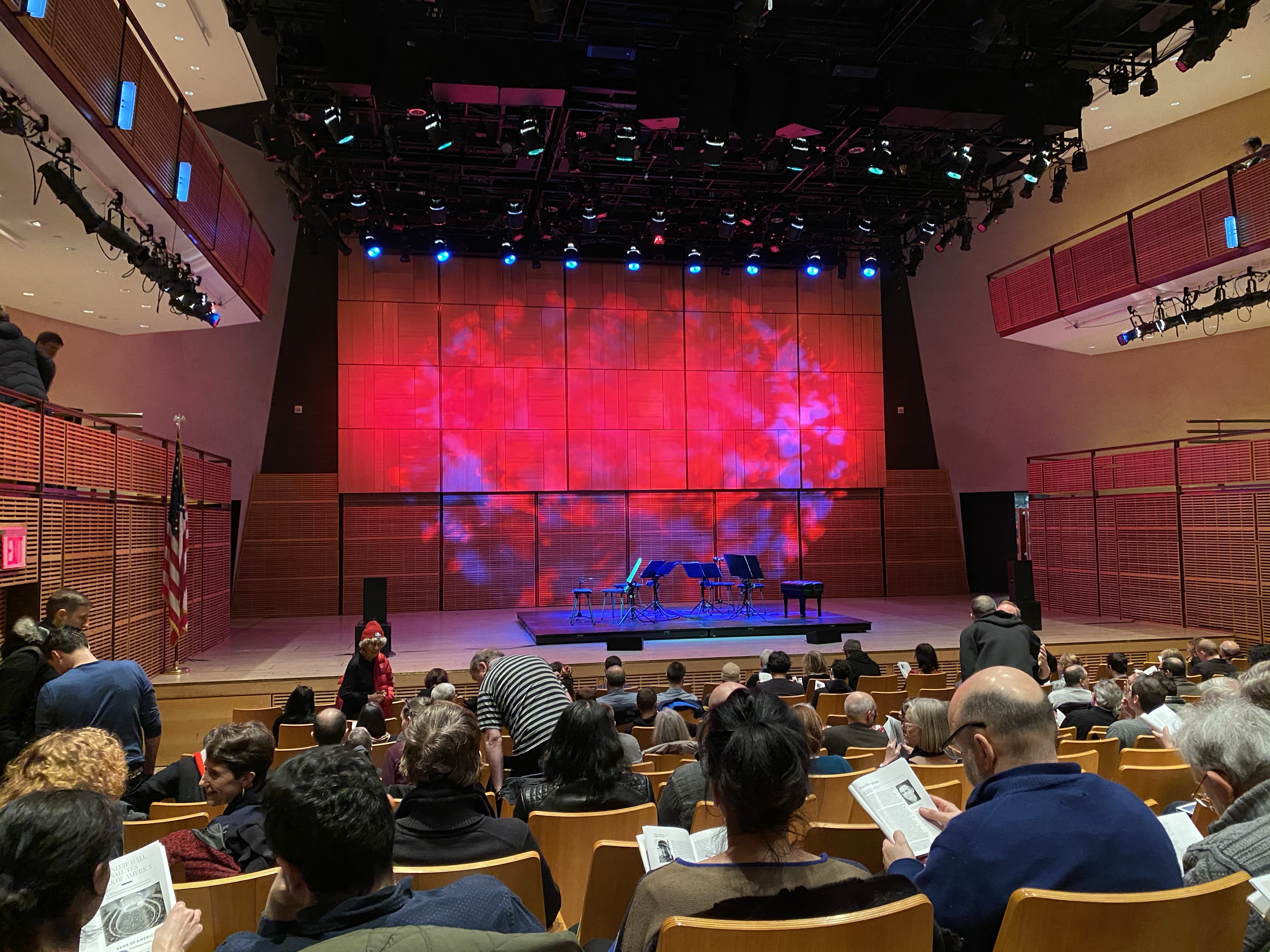
The quartet performed against a backdrop of lighting effects, adding a visual dimension to the already rich aural soundscape. Michael Gordon’s Clouded Yellow opened the evening, evoking its namesake species of butterfly with a striking harmonic palette, mutating over a cello ostinato – one of many fine contributions from cellist Paul Wiancko, substituting for Sunny Yang while she is on maternity leave. A more rhythmically driven section offered a propulsive drive, with matters eventually dissipating to mesmerizing effect. Glass’ Quartet Satz showed the composer at his most lyrical, glacially paced but not without quintessentially Glassian modulations. The New York premiere of Mazzoli’s Enthusiasm Strategies followed, an expression of joy marked by ethereal textures in the strings’ upper registers. Misato Mochizuki’s Boids refers to the flocking behavior of fish, as such, the music was filled with sudden, sharp turns, depicting the entropy found in nature.

A pair of movements from Terry Riley’s extensive suite Sun Rings rounded off the first half. With the NASA Art Program one of the work’s commissioners, Riley drew upon a literal music of the spheres, weaving in recordings of solar winds and other phenomenon: in “The Electron Cyclotron Frequency Parlour”, acoustic textures danced with cosmic electronica. In his informative commentary between selections, first violinist David Harrington noted that the concluding “One Earth, One People, One Love” has become something of an anthem for Kronos. 9/11 fell during the genesis of Sun Rings, forcing the work to take a different direction in the wake of new reality. Riley employed a recording of Alice Walker speaking the eponymous mantra, and projections of the Earth from space put the events on the surface in the context of a vast cosmos. An extended passage for solo cello was particularly moving.

Two larger works filled the second half, beginning with the world premiere of Bryce Dessner’s Le Bois. Drawing on a work by Pérotin and inspired by the modern day destruction by fire of the Notre Dame Cathedral, it began with a monastic drone, which upon taking a myriad of guises, pointed towards a contemplative ending. While I look forward to hearing more from Dessner, this work ultimately didn’t make the strongest impression. Closing the printed program was Reich’s iconic Different Trains, written expressly for Kronos in 1988. Harrington noted this marked turning point for them in which the quartet effectively became a quintet given the newfound need for a full-time sound engineer. Vigorous material opened, brimming with American idealism and optimism as encapsulated by the transcontinental railroad, only for matters to be starkly contrasted by depiction of the trains on the other side of the Atlantic that contemporaneously transported victims to the concentration camps. A definitive performance of this masterpiece.

By way of an encore, the quartet offered Wu Man’s “Silk and Bamboo”, another product of Fifty for the Future. The piece included a substantial percussion part on Chinese gong and woodblocks, expertly handled by violist Hank Dutt. A topical choice given the coincidence of the Lunar New Year, and a wonderfully festive end to the evening.

img_1777
Zankel Hall before the Kronos Quartet’s performance

Dudamel and NY Phil strong partners in Mahler and Schubert

New York Philharmonic
Gustavo Dudamel, conductor
Michelle DeYoung, mezzo-soprano
Andrew Staples, tenor
David Geffen Hall
Lincoln Center
New York, NY
January 23, 2020

Schubert: Symphony No. 4 in C minor, D417, Tragic
Mahler: Das Lied von der Erde

Not having had a New York Philharmonic appearance since 2009, Gustavo Dudamel made an eagerly anticipated return in a two week stint, the second of which coupled an early symphony by Schubert with a late work of Mahler. While Schubert’s Fourth Symphony may seem like a trifle in the wake of Mahler’s Das Lied von der Erde, it too is a canvas of deep poignancy, often befitting of its sobriquet Tragic ­– not in the least during the opening of gripping Beethovenian pathos.

83237169_10159478172377293_2274896116283604992_o
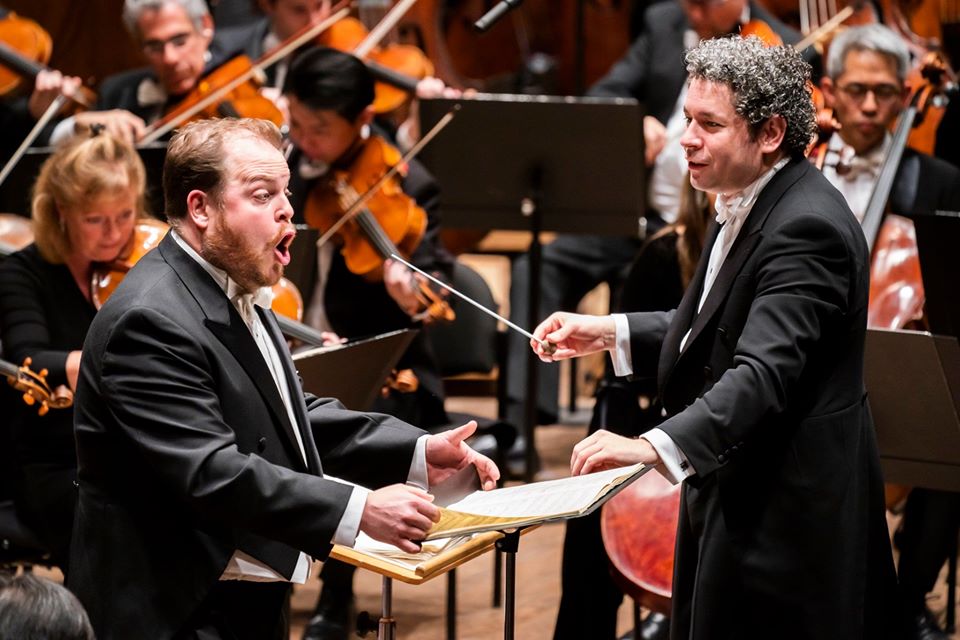
Gustavo Dudamel and Andres Staples in Das Lied von der Erde, photo credit Chris Lee

Dudamel allowed for the introduction to be spacious and breathable, and the movement proper was of pointed dynamic contrasts. He took matters at a noticeably slow tempo in spite of the Allegro vivace indication – while perhaps this served to amass gravitas, to my mind it felt unnecessarily plodding as a dirge. The orchestra on stage was quite large for Schubert, but clarity was maintained with the delicate inner voices never lost in the masses.

The Andante came as a more gentle foil, this gem of a slow movement boasting a lieder-like intimacy and a particularly fine oboe solo. What followed was a propellant Menuetto, with its trio a rather more halcyon affair. The Allegro finale returned to the pathos of the opening, with Dudamel saving the brisker firepower for the end. Lyrical interjections from the winds offered some respite, but matters were generally tightly wound and with sharp articulations by the strings, rounded off by a driving trio of chords.

Deborah Borda, the Philharmonic’s president and CEO, took to the stage to announce that Simon O’Neill, the previously scheduled tenor, was indisposed and would be replaced by Andrew Staples. Fresh off playing the role of Andres at the Met’s well-regarded run of Wozzeck, Staples hardly sounded as a mere stand-in, handily overcoming Mahler’s substantial technical demands. In its large-scale conception, rallying two singers and massive orchestra, Das Lied von der Erde is perhaps the non plus ultra of the song cycle, a venerable form with modest beginnings in Beethoven’s An die ferne Geliebte – by happy coincidence, heard the previous night at 92Y.

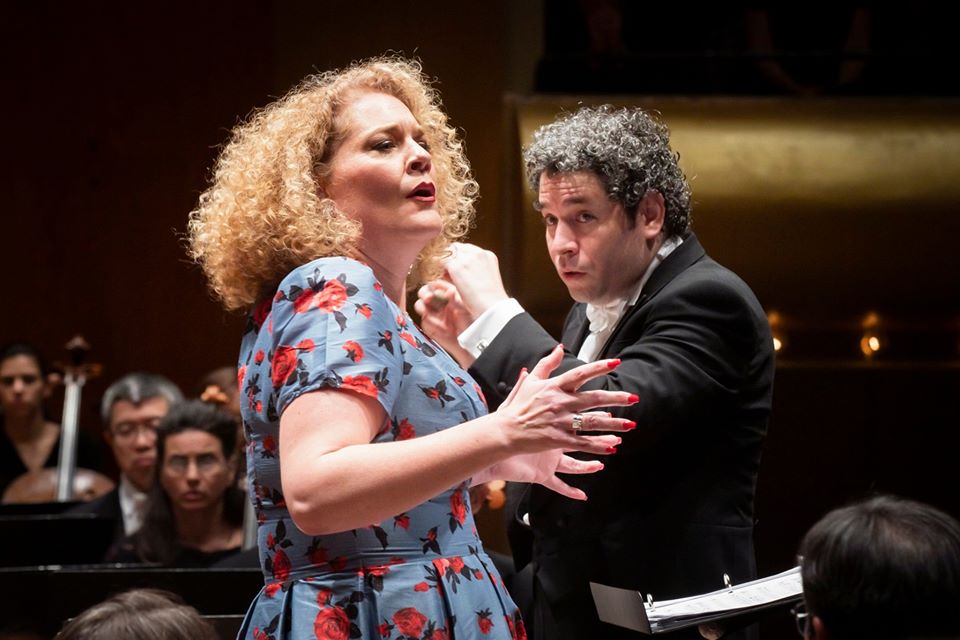
The opening “Das Trinklied vom Jammer der Erde” was of brassy energy and of a certain epic quality despite being a rather mundane drinking song. Staples had no issue projecting over the surging passions of the orchestra, and each intonation of “Dunkel ist das Leben, ist der Tod!” was increasingly pained. The interludes for orchestra alone were consistently highlights, often appropriating the pentatonic scale to invoke a certain orientalism. “Der Einsame im Herbst” turned inwards to the forlorn and pensive, beautifully captured by the frosty tone of masterful Mahlerian Michelle DeYoung.

“Von der Jugend”, the most patently pentatonic, was a burst of youthful nonchalance, a marked departure from the weight of the bulk of the work. Sparkling orchestrations gave an appealing sheen to “Von der Schönheit”, and a more agitated section arrived on cue with the text’s depiction of lads arriving on horses; a genial orchestral postlude closed. Staples’ final contribution came in “Der Trunkene im Frühling” – another drinking song – given haughtily, but portrayal of the twittering birds in the violins added a layer of fragility.

The closing “Der Abschied”, clocking in at the length of the previous five songs combined, was nothing short of extraordinary. Its otherworldly beginnings and striking timbres – of harps, celesta, and sinuous oboe – brought to mind Stefan George’s line “Ich fühle luft von anderem planeten”, written virtually contemporaneously with Das Lied von der Erde. DeYoung had a full, resounding tone, but in equal measure delicate and fragile, as if hanging on to these last embers of earthly life. Dudamel offered a keen sense of direction for the long-form trajectory, and the orchestral transition between the two poems that comprise this final movement was deeply moving. After the arduous journey, the musings landed on the repeated incantation of “ewig, ewig”, a heavenly drifting away, to which the audience responded with perhaps the greatest praise of all: a full minute of reverential silence.

82839733_10159478172522293_7752154556095528960_o
Gustavo Dudamel and Michelle DeYoung in Das Lied von der Erde, photo credit Chris Lee

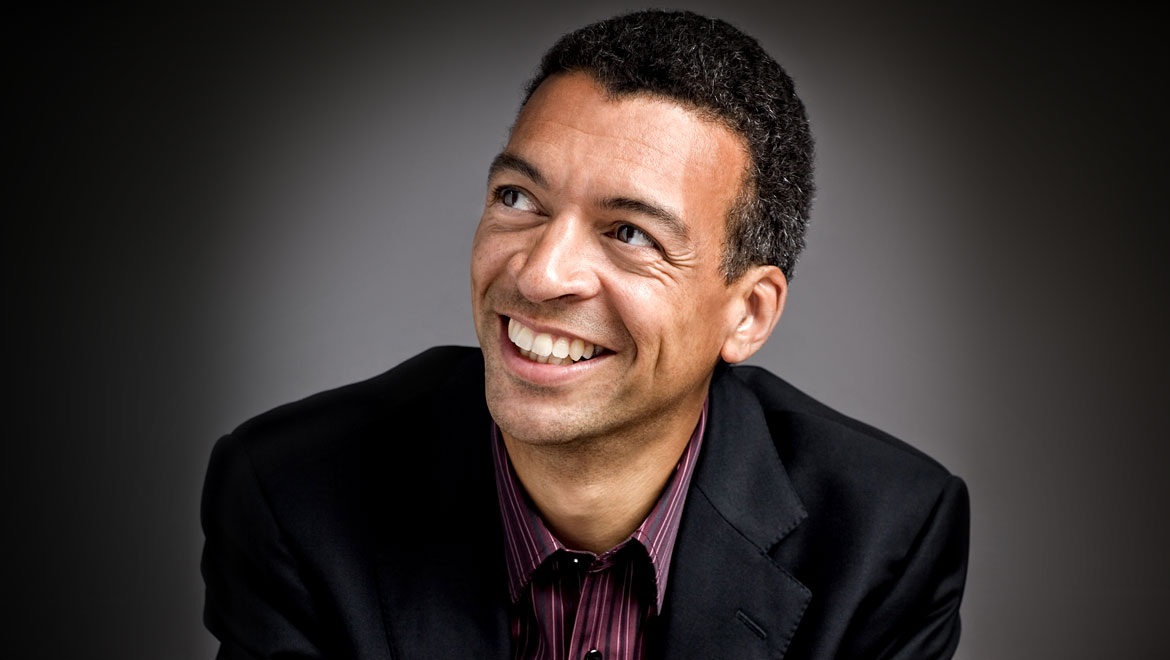
Roderick Williams vividly brings Die schöne Magelone to life at 92Y

Roderick Williams, baritone
Julius Drake, piano
Adam Gopnik, narrator
Cristina Garcia Martin, animations

Theresa L. Kaufmann Concert Hall
92nd Street Y
New York, NY
January 22, 2020

Beethoven: An die ferne Geliebte, Op. 98
Brahms: Romanzen aus L. Tieck’s Die schöne Magelone, Op. 33

If Beethoven didn’t invent the song cycle, surely he was the first great composer to embrace such a structure with his modest yet nonetheless epochal An die ferne Geliebte. In this 250th anniversary of Beethoven’s birth year, all the installments of 92Y’s vocal series include the aforementioned in concert with an entry from the immense body of work it spawned: Roderick Williams and Julius Drake’s Wednesday evening recital paired it with Brahms’ Die schöne Magelone. Before diving in to the Beethoven archetype, the affable Williams addressed the audience with some musings about what constitutes a song cycle, humorously noting that one such distinction is the point at which one applauds.

Roderick-Williams-2-Groves-Artists
Roderick Williams, photo credit Groves Artists

The six songs that comprise An die ferne Geliebte barely stretch a quarter hour, but they say much in little – tautly constructed, and with ingenious transitions in the piano to connect each song to its successor in a continuous arc. Williams’ razor-sharp German diction served to convey the wistfulness in the opening Auf dem Hügel sitz ich spähend, as did the longing appoggiaturas from the keyboard. A texture of roiling triplets marked Leichte Segler in den Höhen, delivered with a lightness of touch though matters grew darker along with the clouds depicted. The closing Nimm sie hin denn, diese Lieder counted as a further highlight in its sonorous resound in conveyance of deep Sehnsucht, with a recurrence of the material from the first song bringing things to a satisfyingly cyclical close.

The rather more extensive Magelone songs – which the program notes rightfully called a “neglected masterpiece” – were given an ambitious multimedia treatment. Brahms asked for portions of Tieck’s prose (published in the late 18th century, drawing on a legend that dates from medieval France) to be read between songs – in many regards, a necessity given the cumbersome narrative and that not all songs are from the protagonist’s point of view. Writer and essayist Adam Gopnik served as a fine narrator, delivering Tieck’s florid text in an English translation by Williams. Additionally, during the narrations, animations by Cristina Garcia Martin were projected, illustrating the tale on a colorful and stylish canvas, and at their best, obviating the need for the audience to meticulously follow along with texts and translations.

The opening Keinen hat es noch gereut was a courtly affair of rollicking energy, while the succeeding Traun! Bogen und Pfeil showed the performers at their most defiant, with Drake offering some extrovert playing, handily surmounting Brahms’ thorny piano writing. Wie soll ich die Freude was a touchingly lyrical expression of bliss and joy – this fairy tale with an eventual happy ending so much the opposite of the tragic depths favored in the Romantic era song cycles – and served as a logical break before the intermission. Wir müssen uns trennen offered delicate imitation of the lute, and here was a clear case where the narration and animation helped frame the song in context – otherwise one might well have been left wondering why at this point the protagonist was singing a heartfelt goodbye to a lute.

By the same token, given the improbability of this fairy tale narrative, I couldn’t help but wonder if these extramusical interjections were altogether necessary – perhaps it is more fruitful to eschew any distractions from a convoluted plot and instead allow the audience to zero in on the exquisitely crafted music in of itself. Wie schnell verschwindet was the first real instance of melancholy, and quite movingly so, but countered in due course by the coquettishness of Sulima. Williams and Drake gave the penultimate Wie froh und frisch mein its requisite heroism, and the closing Treue Liebe dauert lange was a hymn to the power of true love, with Williams’ rich baritone resonating stately and pensive.

54
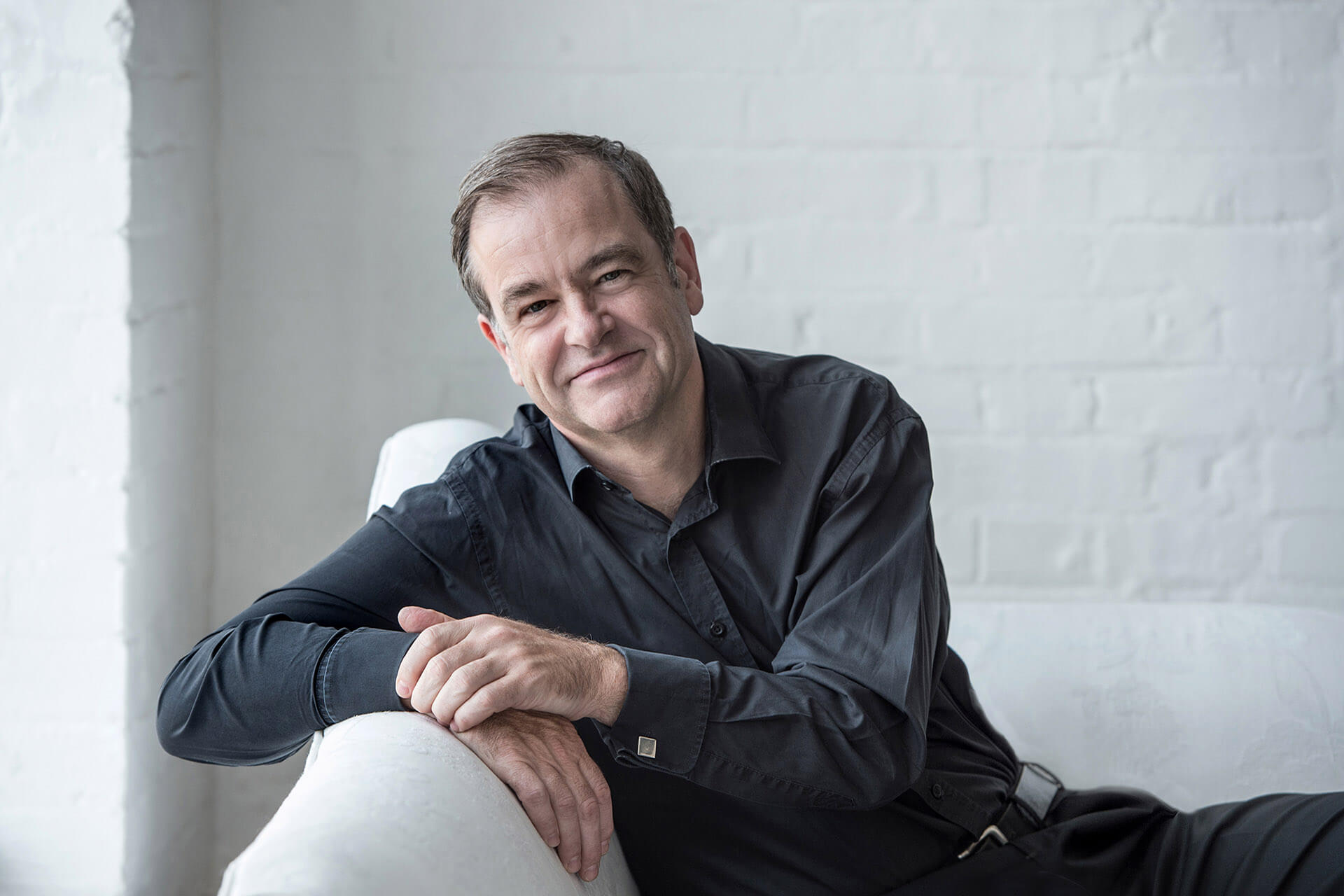
Julius Drake, photo credit Sim Canetty-Clarke

Hough and Imani Winds a sheer delight in Mostly Mozart’s A Little Night Music

Stephen Hough, piano
Imani Winds
Stanley H. Kaplan Penthouse
Lincoln Center
New York, NY
August 10, 2018

Debussy: Clair de lune from Suite bergamasque
Mozart: Quintet in E-flat major for Piano and Winds, K452
Poulenc: Sextet for Piano and Wind Quintet, FP 100

Encore:
Poulenc, arr. Hough: No. 1 from Trois mouvements perpétuels, FP 14

Right on the heels of the Mostly Mozart Festival Orchestra’s concluding performance of the summer season, one had a late-night opportunity to see pianist Stephen Hough in a much more intimate setting: a remarkable chamber music performance with the Imani Winds at the Stanley H. Kaplan Penthouse, part of the festival’s A Little Night Music series. Hough opened the program sans winds in a luminous, shimmering account of Debussy’s Clair de lune. Debussy is a composer to whom Hough has recently turned ample attention, releasing a very fine all-Debussy album at the beginning of the year (although one would need to look to his French Album for a recording of the present work). The acoustics in the Penthouse were a bit dry, but the striking setting of flickering candlelight and the Manhattan skyline made it a small price to pay, an atmospheric complement to the rapturous beauty of Hough’s pianism.

hough_pic46_large
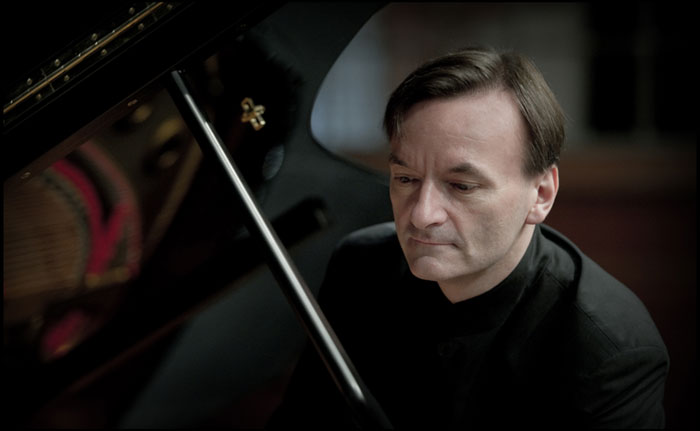
Stephen Hough, photo credit Sim Canetty-Clarke

The remainder of the brief program was devoted to sterling examples of chamber works for piano and winds by Mozart and Poulenc. Hough noted that these disparate composers had little in common musically save for their wry sense of humor. A stately introduction opened the former’s Quintet (K452), giving way to a jaunty primary theme which beautifully melded Hough’s elegant keyboard playing with the graceful winds – a harmonious blend of diverse timbres. The Larghetto was sweet and dulcet in its delicate trills and ornaments, and an almost sinfully sumptuous melody was passed through the winds. The finale was a jovial affair yet in no apparent hurry with a lyrical subject at its core.

Poulenc’s Sextet, dating from the early 1930s, added the flute to the forces onstage. The commanding opening brought to life a scene bustling with coloristic contrasts and manic syncopations evoking American ragtime. A searching monologue in the bassoon (Monica Ellis) and impressionistic writing from the piano offered some introspection, only for the movement to conclude in a dramatic flourish. An underlying melancholy – perhaps another parallel to Mozart – was palpable in the central divertissement with some especially fine playing from oboist Toyin Spellman-Diaz. More frenzied contrast was manifest in due course, with a rambunctious and perky finale leading inexorably to a bright and brilliant end.

A lone encore continued the ensemble’s exploration of Poulenc, namely Hough’s own transcription for the sextet of the first of the Mouvements perpétuels (originally a work for solo piano). Hough was certainly apt in remarking it had “not a bit of angst”, and the seamless performance closed the evening in pure delight.

IMANI_WINDS_7_25_16_1022
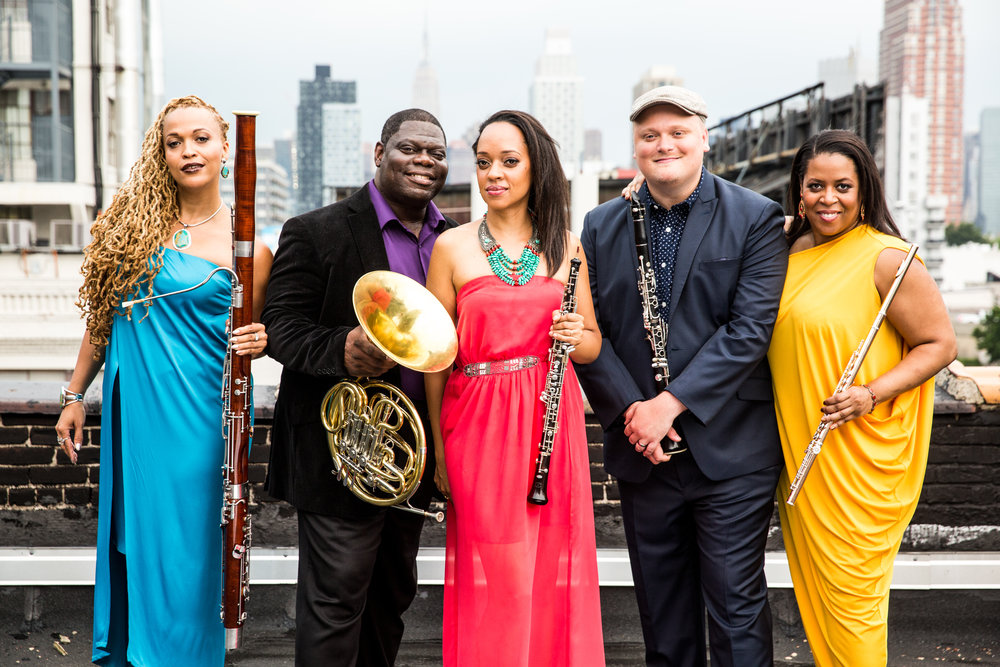
Imani Winds, photo credit Matt Murphy

Gardner and Denk deliver inspired performances at Mostly Mozart

Mostly Mozart Festival Orchestra
Edward Gardner, conductor
Jeremy Denk, piano
David Geffen Hall
Lincoln Center
New York, NY
July 29, 2017

Mozart: Masonic Funeral Music, K477
Beethoven: Piano Concerto No. 4 in G major, Op. 58
 Encore:
 Mozart: Piano Sonata No. 16 in C major, K545 – 2. Andante
Schubert: Symphony No. 5 in B flat major, D485

A New York summer tradition for over half a century, the Mostly Mozart Festival is a paean to not only its eponymous composer, but as the name suggests, those who bore his influence.  Saturday night’s program embodied just that with music of Mozart prefacing works by Beethoven and Schubert that exuded a quintessentially Mozartean classicism.  At the podium was the probing English conductor Edward Gardner who opened the evening with a user-friendly introduction, explicating the connections between the selections on the program.

168-colour-hi-res-E-Gardner-28June2016-c-B-Ealovega
Edward Gardner, photo credit Benjamin Ealovega
The only work from Mozart’s pen on the printed program was a certified rarity, namely the Masonic Funeral Music.  In his remarks, Gardner noted the enlarged wind section – inclusive of basset horns and the contrabassoon – and humorously commented that this orchestration was perhaps well-suited to Tony Bennett.  He then demonstrated the work’s striking interpolation of a Gregorian chant, aptly describing it as of an “astounding resonance.”  Gardner’s reading was deftly balanced, exuding a funereal pathos that anticipated the Masonic passages in The Magic Flute, and made a case for more frequent hearings of this finely-crafted gem.

The heart of the program was Beethoven’s genial Piano Concerto No. 4 in G major, which brought forth the charismatic soloist Jeremy Denk.  Denk’s unaccompanied entrance was of a dreamy serenity, and bell-like clarity of tone.  His fingers spun a wondrously flowing melodic line, and not at the expense of plumbing the intensity of the work’s more dramatic moments.  Denk and Gardner were a somewhat unusual coupling; while the pianist was patently idiosyncratic, often looking out into the audience with closed eyes, and playing with a remarkable (perhaps too remarkable) flexibility, Gardner was much more straight-laced.  In spite of the incongruity of their approaches, their results were largely inspired, and Gardner’s sensitive accompaniment was adroitly balanced with the piano.

Denk began the first movement’s cadenza unassumingly, only to soon fill the depths of the Geffen Hall with resound.  Agitated strings opened the Andante con moto, in due course calmed by the beauty of Denk’s chordal passages.  The jocular concluding rondo was elegant yet down to earth, pearly and effervescent even through the minor key episodes.  Denk obliged the enthusiastic audience with an encore by – you guessed it – Mozart, the slow movement from the Piano Sonata in C major, K545, familiar to any young piano student.  Under Denk’s hands, this was a study in poise and refinement.

While Schubert looked ahead to Romanticism in his tempestuous Fourth Symphony, the Fifth was quite to the contrary: a glance backwards towards his classical antecedents.  The Festival Orchestra delivered the opening movement with a blended and homogeneous sound, opting for the repeat of the graceful exposition, and Gardner guided orchestra and audience alike through development’s exploration of distant keys with aplomb.  Gorgeous tones seemed to pour from Gardner’s baton in the slow movement, highlighted by an especially fine flute solo from Jasmine Choi, who that evening treated concertgoers to a pre-concert recital with pianist Roman Rabinovich.  A bit more fire was introduced in the minuet, though not without a certain joviality.  The finale was taken at a brisk pace, a beaming Haydnesque wit tempered by Mozartean drama, a fitting way to close Schubert’s lovely tribute to his predecessors.