Simone Dinnerstein calms the storm in tender meditation at the Gilmore Festival

Simone Dinnerstein, piano
Stetson Chapel
Kalamazoo College
Kalamazoo, MI
May 7, 2024

Couperin: Les barricades mystérieuses, from Pièces de clavecin
Schumann: Arabeske, Op. 18
Satie: Gnossienne No. 3
Glass: Mad Rush
Schumann: Kreisleriana, Op. 16

Encore:
Couperin: Les barricades mystérieuses, from Pièces de clavecin

There’s a first time for everything, and I can safely say that Tuesday evening at the Gilmore Festival was the first concert I’ve attended in which the audience was asked to shelter in the venue’s basement for 45 minutes due to uncomfortably close tornados raging nearby. A hearty crowd of committed pianophiles stuck it out, however, and were amply rewarded with an artfully crafted recital from Simone Dinnerstein.
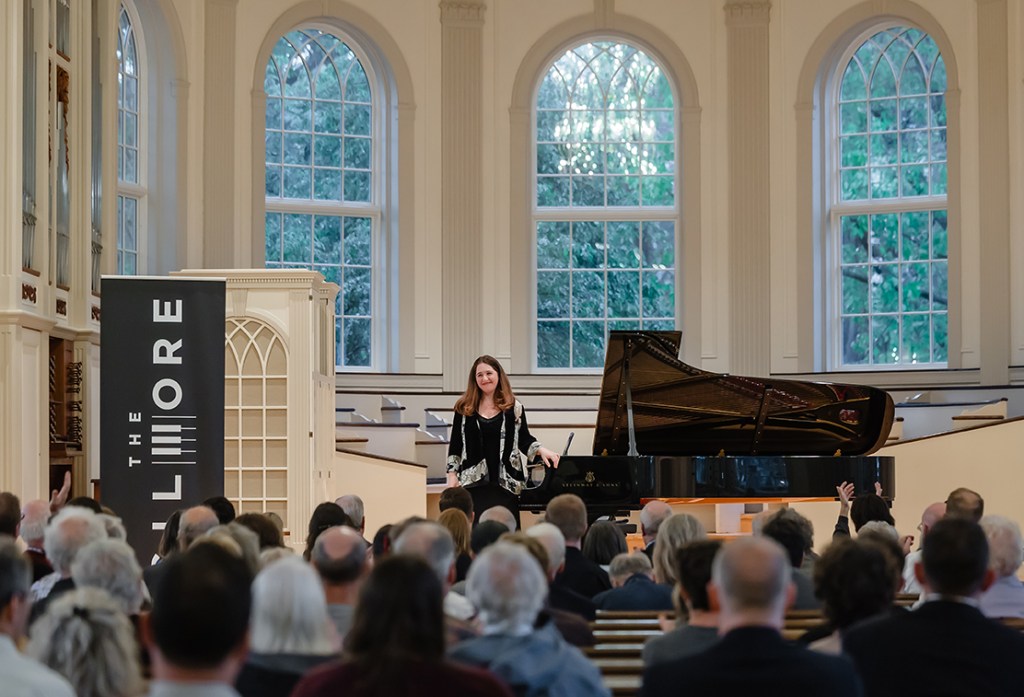
Simone Dinnerstein at Stetson Chapel, photos © Chris McGuire Photography, courtesy of The Gilmore

This was essentially a live performance of her Undersong album, the last of a trilogy of projects she recorded during the pandemic. The title, an archaic word for chorus or refrain, refers to the idea of return, revisiting places after the passage of time. All of the diverse body of music programmed engaged with the theme in a different way, but in each case, a melody presented resurfaced in some context later on. The delayed evening began with Couperin’s gem of a piece Les barricades mystérieuses, quite literally the calm after the storm. Elegantly ornamented, Dinnerstein drew from the piano a rich, reflective tone.

Schumann’s Arabeske saw the composer at his most Schubertian with its lyrical, rippling figures, arriving at a point of return following some contrasting episodes, and its gentle coda amounts to one of Schumann’s loveliest inspirations. Philip Glass’ Mad Rush continued the theme into the late 20th-century. Undulating figures changed subtly, almost imperceptibly, growing in intensity as Dinnerstein filled the Stetson Chapel with waves of sound. She has a close affinity for the music of Glass, with the composer having written his Third Piano Concerto with her in mind.

The third of Satie’s Gnossiennes evoked the French composer’s rarefied, idiosyncratic language, distilled of any excess and expressive in its barrenness. Recurrence is a key element of the eight vignettes that comprise Schumann’s Kreisleriana. Fleet and mercurial, the opening was given an impassioned workout. The most extended selection of the suite followed, with contrasting themes bound together by its common thread. Nearly manic, the penultimate episode introduced contrapuntal textures in homage to Bach, played with incisive clarity, and the final piece was stately and sensitive, the culmination of a long trajectory.

Dinnerstein’s lone encore embodied the undersong theme in returning to the Couperin with which the recital began. What a lovely gesture it was to close the program full-circle.

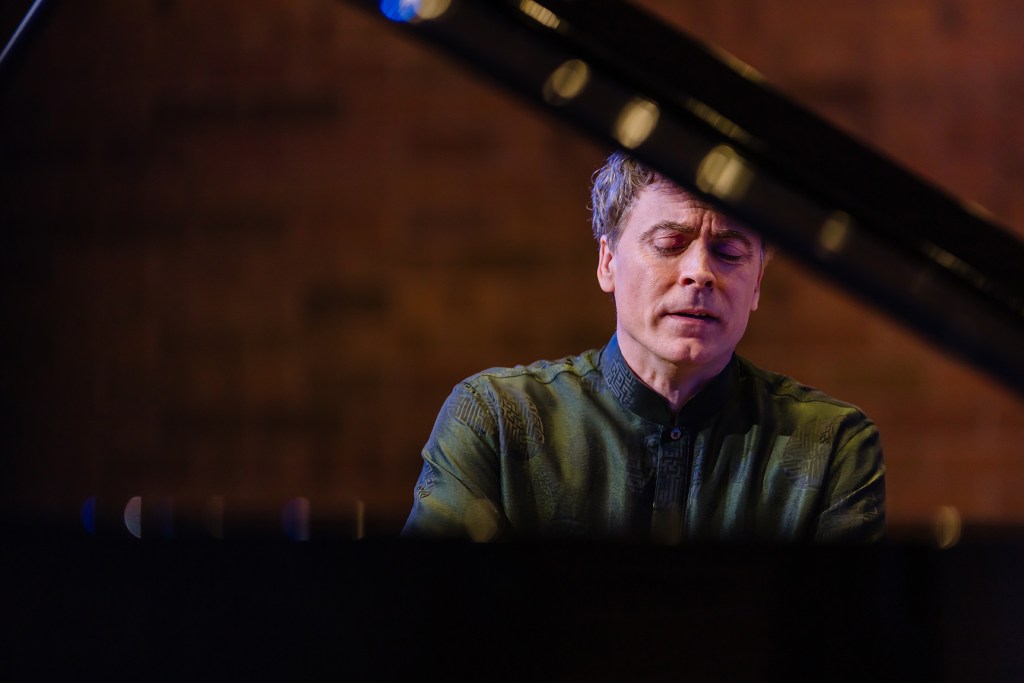
5/7/24 – Kalamazoo, Michigan: Simone Dinnerstein, Gilmore Piano Festival. © Chris McGuire Photography.

Paul Lewis closes Schubert series in magisterial form at the Gilmore Festival

Paul Lewis, piano
Dalton Center Recital Hall
Western Michigan University
Kalamazoo, MI
May 6, 2024

Schubert: Piano Sonata No. 19 in C minor, D958
Schubert: Piano Sonata No. 20 in A major, D959
Schubert: Piano Sonata No. 21 in B-flat major, D960

I am deeply grateful to Paul Lewis for introducing me to remarkable piano music of Schubert, a composer who can be unjustly overlooked in the wake of Beethoven and other contemporaries. I still have fond memories of a revelatory Schubert cycle he presented at Chicago’s Symphony Center, traversing all of the composer’s late piano works over the course of five recitals, a multi-season exploration that began back in February 2011. The 2024 Gilmore Festival saw Lewis in a similar undertaking, in this case, focusing on the piano sonatas over a quartet of recitals in the space of a single week. I was only fortunate enough to catch the final entry, consisting of the last three sonatas – one of those holy grail piano programs, on par with the final Beethoven sonatas or the Goldberg Variations.

Paul Lewis at the Gilmore Festival, photos © Chris McGuire Photography, courtesy of The Gilmore

The opening of the C minor sonata was given with ample weight and drama, only to be contrasted by lighter, buoyant material, with the quick-shifting moods akin to flickering candlelight. Lewis was fully enraptured and played with unwavering commitment; the intervening decade since I last saw him play Schubert has certainly brought even closer to the core of this music. In the slow movement, Lewis delicately voiced the chordal passages, with a nuanced shading given to each gesture. A rollicking triple meter marked the finale, one of the composer’s most thrilling creations.

Spacious, majestic beginnings were had in the A major sonata, answered by rippling triplets, and Lewis played with a distinct gracefulness, a particular joy to watch during the passages for crossed hands. In the tragic slow movement, the brightness of A major faded to a bleak F-sharp minor, and the primal agony of the central section was of startling ferocity. And then – a theme familiar from the G-flat impromptu surfaced, like sunlight shining through dark clouds for a wondrous calming effect. The sprightly scherzo was no trifle, packing in ample drama. The rondo finale was lyrical at heart, interspersed with themes that contrasted, and the closing figure was strikingly in mirror of the sonata’s opening where the long journey had begun.

The incomparable final sonata rightfully occupied the entire second half. The valedictory work opened in contemplative stillness, punctuated by silence (a theme that connected to Mark Nepo’s moving talk at the Kalamazoo Public Library earlier in the day, a further event hosted by the Gilmore). Rumbles in the bass undulated as tolling bells, and the development built to coruscating tension. A dotted rhythm underpinned the Andante sostenuto, giving way to an urgent lyricism that was simply heavenly. The scherzo marked a sudden shift to the jovial, given with carefree abandon, an ethos that continued into the good-natured finale that amounted to a satisfying, all-encompassing close. Still, Lewis found great variety, employing something of a chiaroscuro effect as shadows emerged in sharp relief, in due course bringing the sonata – and Lewis’ cycle as a whole – to a bold close.

Notice the tablet displaying the Andantino from D959!