ProMusica closes season with Beethoven and Mendelssohn

ProMusica Chamber Orchestra
David Danzmayr, conductor
Martina Filjak, piano
Southern Theatre
Columbus, OH
May 7, 2022

Clyne: Stride
Beethoven: Piano Concerto No. 3 in C minor, Op. 37
 Encore:
 Pärt: Für Alina
Mendelssohn: Symphony No. 4 in A major, Op. 90, Italian

This weekend saw the close of ProMusica’s 43rd season, and the first full season since the pandemic hit. The evening kicked off in particularly delightful fashion with young students from ProMusica’s Play Us Forward program performing two short works for strings. ProMusica then took to the stage with a recent work by Anna Clyne, written in 2020 for the Beethoven 250th anniversary. Stride takes its cue from Beethoven’s Pathétique sonata and its name comes from the broken octave figures in the bass that one finds in the sonata and would later be associated with stride piano playing. Clyne’s work is cast in three interconnected movements, mirroring the structure of the source material. As in the Pathétique, prominent dotted rhythm gestures opened, and the “stride” figures were interlaced with quotes from the sonata, some more veiled than others. I was particularly struck by theme of the rondo finale being presented at a slow tempo, revealing a languid character beneath the surface. A brilliant reimagining of this venerable sonata.
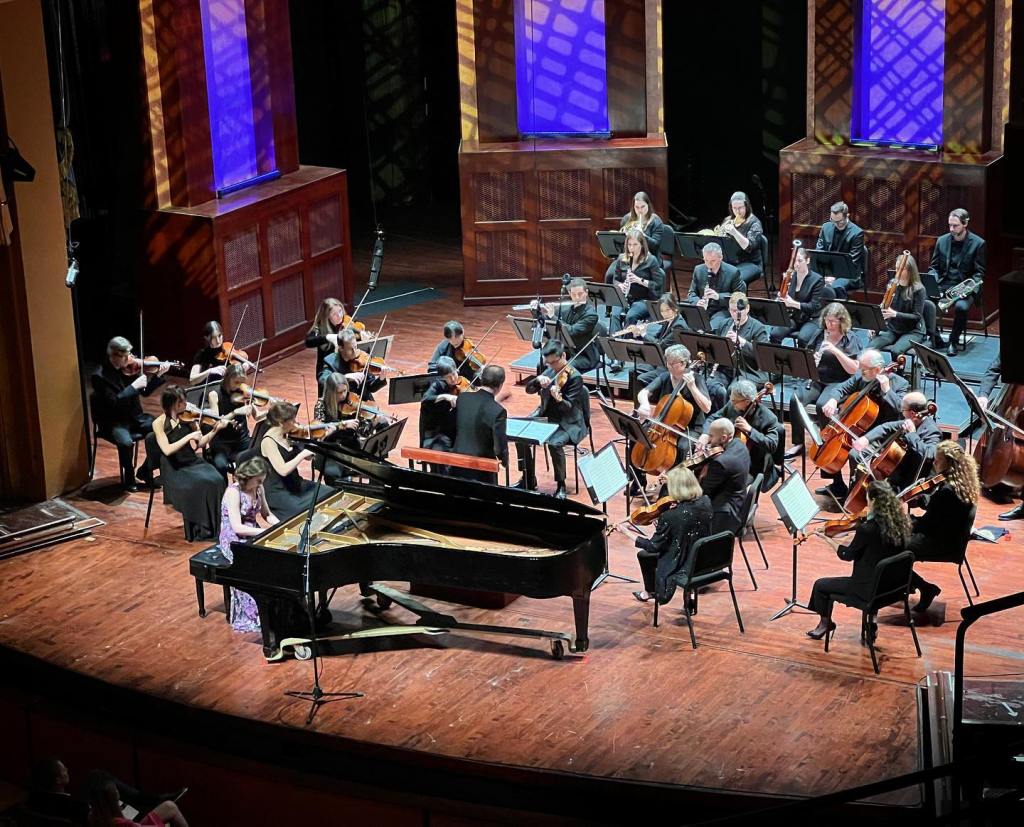
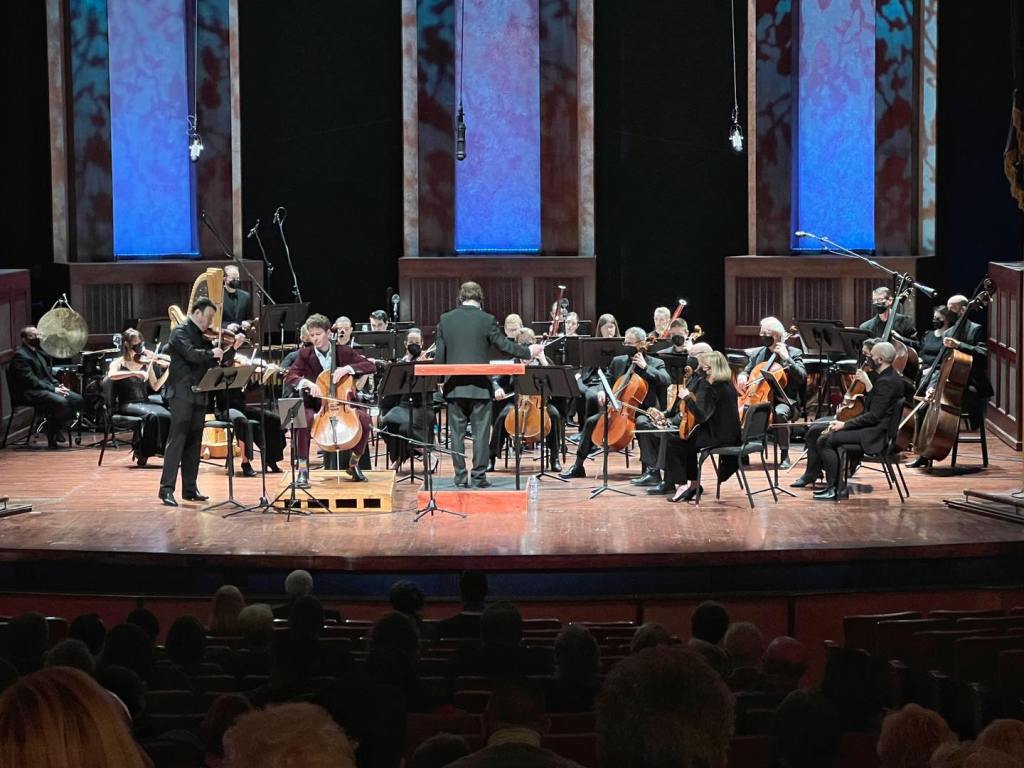
Martina Filjak, David Danzmayr, and ProMusica, photo credit ProMusica

Beethoven reserved C minor for some of his most personal works – a body of work that includes the Pathétique sonata as well as the Third Piano Concerto, the latter of which engaged Croatian pianist Martina Filjak. I remember seeing her last when she won the 2009 edition of the Cleveland International Piano Competition, and it was wonderful to see her again all these years later with a flourishing career to her name. The orchestral introduction was crisply articulated, although one perhaps wanted conductor David Danzmayr to draw out even greater dynamic contrasts and variety. Filjak’s entry had the requisite drama, but her playing was stylish and elegant at heart, showing Beethoven at his most urbane and cosmopolitan. It seemed that she approached the work more akin to a Mozart concerto; while the first two certainly show indebtedness to the composer’s predecessor, the Third marks a stark departure. Nonetheless, the cadenza was fiery and impassioned, and the first movement’s enigmatic ending was deftly executed.

The lovely Largo was prayer-like and plaintive, and the concluding Rondo started with a sudden burst of the energy, building to the brilliant switch to the major in the final few bars. As an encore, Filjak opted for a work worlds apart from Beethoven (despite any associations to Beethoven the title might suggest): Pärt’s Für Alina, strikingly wonderful in its barren textures and mystical musings.

This season has seen several major works of Mendelssohn performed – the Scottish symphony, the violin concerto – and the trend was continued with the ebullient Italian symphony. Some unevenness in the brass did little to detract from the first movement’s buoyancy, given with classical economy and balance. A really delightful performance, perhaps nowhere more so than in the kinetic energy of the vibrant, sunny saltarello that closed.
Dawn Upshaw brings Purcell into the 21st-century with Brentano String Quartet

Dawn Upshaw, soprano
Brentano String Quartet
Southern Theatre
Columbus, OH
April 30, 2022

Purcell: “Oh let me weep” from The Fairy Queen, Z.629 (arr. Mark Steinberg)
Purcell: Fantasia a 4 in B-flat major, Z.736

Matthew Locke: Suite No. 2 for Four Viols in D minor/major
Dowland: “Come again, sweet love doth now invite” (arr. Stephen Prutsman)
Dowland: “Can she excuse my wrongs” (arr. Stephen Prutsman)
Dowland: “Weep you no more, sad fountains” (arr. Stephen Prutsman

Thomas Tomkins: Alman in F
Byrd: Though Amaryllis dance in green
Robert Johnson: The Witty Wanton

Purcell: Fantasia a 4 in C minor, Z.738
Purcell: “When I am laid in earth” (Dido’s Lament) from Dido and Aeneas, Z.626

Melinda Wagner: Dido Reimagined

Dawn Upshaw joined forces with the Brentano String Quartet at Chamber Music Columbus for a fascinating program, the first half of which surveyed music from the English Renaissance and early Baroque, and a latter half which presented a contemporary response to the earlier work. An extensive series of songs and instrumental works traversing Purcell, Downland, Byrd, and others were presented in arrangements for modern string quartet, recalling some of the repertoire performed by the Aizuri Quartet earlier this season.

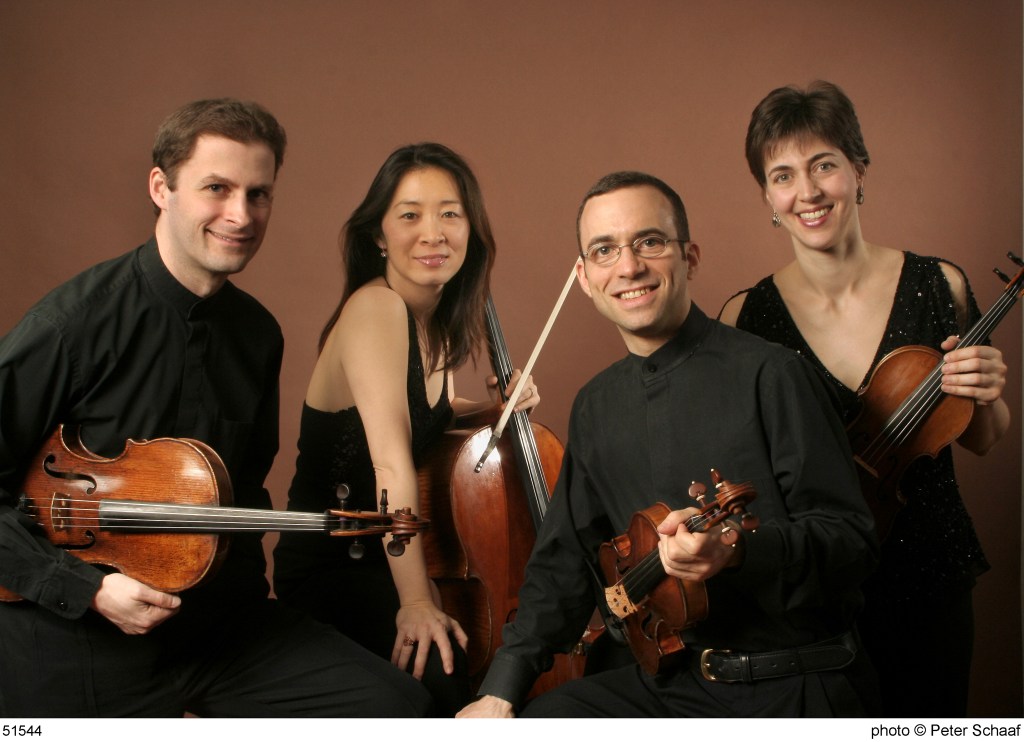
Brentano String Quartet, photo credit Peter Schaaf

Purcell’s “Oh let me weep” opened, the plaintive tears brought to life by Upshaw’s instantly recognizable voice. Movements of a suite by Matthew Locke – including a particularly touching Ayre – were interlaid with songs by John Downland. The Locke was a fascinating look at the genesis of the string quartet in this early work for viol consort, a direct ancestor to the contemporary ensemble. Dowland’s “Can she excuse my wrongs” benefitted from the character and personality with which Upshaw imbued it. Byrd’s “Though Amaryllis dance in green” delighted in its dancing energy, and the first half concluded as it began with a pair of works by Purcell, closing with the indelible aria “When I am laid in earth” – heart-wrenchingly beautiful, and grounded by the bass line of cellist Nina Lee.

Melinda Wagner’s Dido Reimagined, first premiered earlier this year, was written as a direct response to the Purcell aria. It’s an ambitious 40-minute piece, with a libretto by Stephanie Fleischmann that recasts the Dido tale with a decidedly feminist bent – an endeavor that broadly speaking reminded me of John Adams’ Scheherazade.2 which offers a modern, feminist take on the Arabian Nights. The textures in the string quartet seemed to suggest the Purcell source material, but otherwise this was a work very much in Wagner’s own language. The narrative would have perhaps been easier to follow had the text been provided in the program books – which would have also highlighted some subtle bits of humor, for instance, rhyming “Port Authority” with “purgatorio.” The work was performed with conviction by these artists for whom it was written, closing with a pensive, meditative statement. A piece I would be keen to give a second listen.

Dawn Upshaw, photo credit Brooke Irish

Gluzman and Roman terrific soloists with ProMusica

ProMusica Chamber Orchestra
David Danzmayr, conductor
Vadim Gluzman, violin
Joshua Roman, cello
Southern Theatre
Columbus, OH
April 2, 2022

Golijov: Last Round
Mendelssohn: Violin Concerto in E Minor, Op. 64
 Encore:
 Silvestrov: Serenade
Roman: Confluence
Haydn: Symphony No. 94 in G major, Hob. I:94, Surprise

April’s ProMusica program began in the always intriguing world of contemporary Argentine composer Osvaldo Golijov, namely with the 1996 string orchestra work Last Round. It was a lively, high-octane opener, marked by rhythmic drive and astringent harmonies. The more languid, tango-inflected latter section contrasted in its impassioned lyricism.

Vadim Gluzman, Joshua Roman, David Danzmayr, and ProMusica Chamber Orchestra, photo credit ProMusica

Mendelssohn’s evergreen Violin Concerto followed with ProMusica’s Creative Partner and Principal Guest Artist Vadim Gluzman as soloist. The haunting opening melody was clear-toned as it seared and soared, and Gluzman projected well atop the vigorous and supportive orchestral accompaniment. The cadenza displayed his virtuosity and control over whole range of the violin’s register, with the work clearly ingrained deep in his fingers. The Andante proceeded as a gentle song without words, and the finale was fleet and featherlight. As an encore, Gluzman turned towards music of his Ukrainian home country in Valentin Silvestorv’s deeply poignant Serenade. In contending with a heartbreaking global situation, Gluzman reminded us of the importance of art, referencing the Soviet quote “when the cannons are heard, the muses are silent. When the cannons are silent, the muses are heard.”

The latter half saw saw the latest entry in ProMusica’s enterprising Composer/Performer Project, an endeavor which features musicians distinguished in both disciplines – and has resulted in now 68 commissions. Joshua Roman’s Confluence was at last brought to life almost exactly two years to the day of the originally scheduled premiere, owing to covid cancellations. Roman was appointed principal cellist of the Seattle Symphony at age 22 – the youngest principal player in that ensemble’s history – but left after just a few years to pursue a solo career, and this marked the fourth work of his featured on a ProMusica program.

Confluence is a fifteen-minute work that hearkens back to the double concerto, featuring both cello and violin as soloists. A pulsating marimba made for a striking opening, and Gluzman’s rapid violin blended well with Roman’s lyrical cello. Roman did much to capitalize on his instrument’s resonant bass register, and true to the title, the work was marked by a confluence of harmonious, lyrical voices. A glass harp (wine glasses) added to the colorful soundscape, and a tender ending felt at peace with the world – in a way, at odds with the uncertain backdrop in which the piece was written.

The program closed with Haydn’s Surprise symphony, and Austrian conductor David Danzmayr showed a natural affinity for music of his compatriot. An effervescent joie de vivre made matters all the more delightful, and the musicians were clearly having fun in emphasizing the dynamic contrasts of the Andante which earned this symphony its moniker.

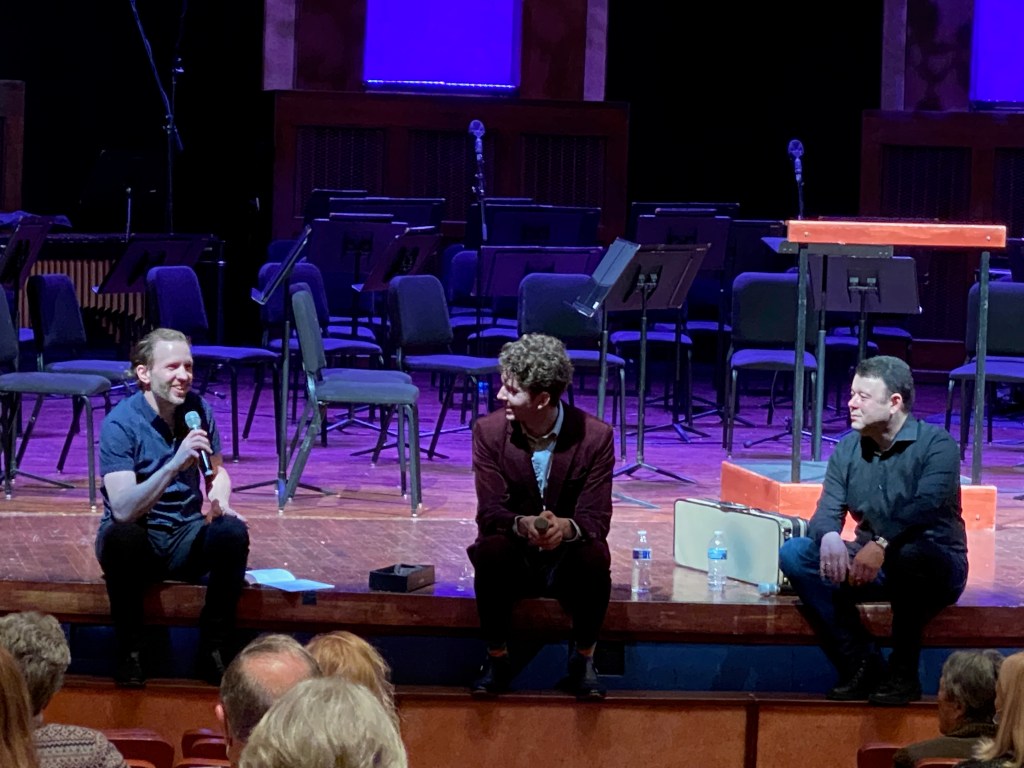
Post-concert Q&A with David Danzmayr, Joshua Roman, and Vadim Gluzman

Conductor Carolyn Kuan makes notable Columbus Symphony debut

Columbus Symphony Orchestra
Carolyn Kuan, conductor
Vijay Venkatesh, piano
Ohio Theatre
Columbus, OH
March 26, 2022

James Lee III: Towards a Greater Light
Saint-Saëns: Piano Concerto No. 2 in G minor, Op. 22
 Encore:
 Schubert-Liszt: Ständchen, S560/7
Schubert: Symphony No. 9 in C major, D944

Currently music director of the Hartford Symphony Orchestra, conductor Carolyn Kuan made a welcome debut with the Columbus Symphony in the final performance for March. The program opened with the brief 2017 work Towards a Greater Light by American composer James Lee III, meant to mark the 500th anniversary of the Protestant Reformation. Scored for strings alone, matters were often in a meditative stasis, saying much in its five-minute duration.

Carolyn Kuan, Vinjay Venkatesh, and the Columbus Symphony, photo credit Columbus Symphony

The young soloist Vijay Venkatesh was brought forth for Saint-Saëns’ Piano Concerto No. 2. The commanding, improvisatory-like opening for the soloist alone pointed towards the passionate primary theme. Venkatesh displayed a formidable technique, from delicate filigree to fiery double octaves. The central Allegro scherzando was gossamer – and rather Mendelssohnian – in texture. Though an impressive finish, it felt clarity was sacrificed for speed in the breakneck finale. Venkatesh returned for an encore in the Schubert-Liszt Ständchen transcription, showing a haunting, lyrical side of the pianist not revealed in the ebullient concerto.

An apt choice of encore given that the rest of the evening was devoted to Schubert in the towering Ninth Symphony. Kuan allowed for the solo horn call which opened to be played freely, though it perhaps could have benefitted from her conducting to initiate things with more focused direction. Matters gradually amassed, leading the grandiose movement proper. The trombones were especially striking, forming the spine of the work, and the busy orchestra harmoniously blended together. A limber oboe passage in the Andante con moto was a quintessentially Schubertian melody, and gorgeous strings were a turn inwards in a work that otherwise shows the composer at his most exuberant. The third movement’s vigor spoke to an affinity with dance, though never without a certain Viennese charm and grace, and the high-spirited energy was sustained through the vivacious finale. A strong showing from Kuan – let’s hope she’s invited back to the CSO podium soon.

Ying Quartet and PUSH Physical Theatre explore connections of dance and chamber music

Ying Quartet
PUSH Physical Theatre
Southern Theatre
Columbus, OH
March 26, 2022

Theofanidis: Valley of Detachment from Conference of the Birds
Haydn: Allegro di molto from String Quartet in A major, Op. 20 No. 6, Hob. III:36
Haydn: Allegro from String Quartet in A major, Op. 20 No. 6, Hob. III:36
Bartók: Andante from String Quartet No. 5, Sz. 102
Wolf: Italian Serenade
Tchaikovsky: Andante funebre from String Quartet No. 3 in E-flat minor, Op. 30
Mendelssohn: Andante espressivo from String Quartet No. 3 in D major, Op. 44 No. 1
Schulhoff: Alla Czeca from Five Pieces for String Quartet
Schulhoff: Alla Tarantella from Five Pieces for String Quartet
Randall Thompson: Alleluia, Amen (arr. Ying Quartet)
Dvořák: Allegro ma non troppo from String Quartet No. 12 in F major, Op. 96, American

At Chamber Music Columbus, the Ying Quartet teamed up with PUSH Physical Theatre – both ensembles of which are based in Rochester, New York – to breathe fresh air into the vaunted sting quartet recital. A wide-ranging sampling of the string quartet literature was intriguingly presented in tandem with physical theater, with each group of selections centered on a particular theme to invoke a narrative arc. At the heart of this creative collision was the art of storytelling, which as violist Philip Yang noted in his spoken remarks, lies central to who we are as human beings.

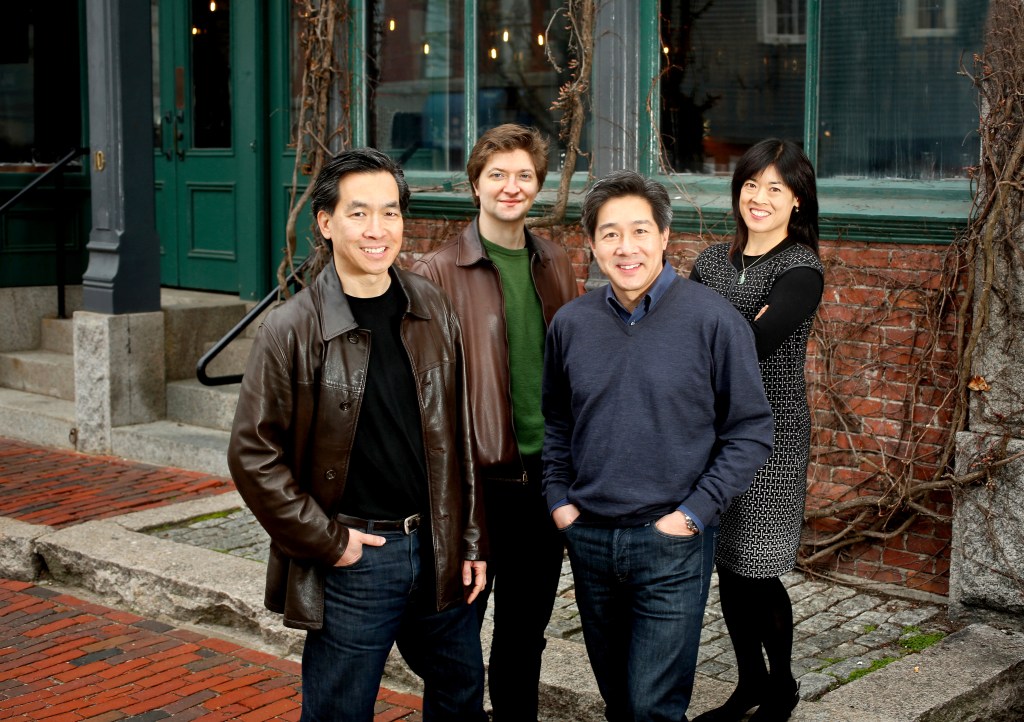
Ying Quartet, photo credit Tim Greenway

A movement from Christopher Theofanidis’ Conference of the Birds opened, with the gestures from the dance troupe mirroring the ebb and flow of the music. Two movements from Haydn followed; in this case, the elegance of the music was contrasted by the rather more risqué dance. The Andante from Bartók’s great Fifth Quartet took us into the realm of the surreal, a prime example of the Hungarian composer’s rarefied night music. Hugo Wolf’s lovely Italian Serenade was brought to life by a laugh-out-loud routine from PUSH, bringing humor and levity to what is usually a serious affair. At the opposite end of the spectrum was the doleful Andante funebre from Tchaikovsky’s Third Quartet – a tender wistfulness which served to depict the human cost of war.

Randall Thompson’s 1940 “Alleluia, Amen” – given in an arrangement by the Ying Quartet – served as a plaintive contrast to the gritty perpetuum mobile of the Schulhoff that preceded. The performance came to a close with the spacious opening movement of Dvořák’s American quartet. It’s a piece that resonates deeply with the Ying Quartet – just as the composer found solace and inspiration while spending a summer in the small town of Spillville, Iowa, the Ying Quartet found similar stimulus and connection during an extended residency in Jesup, Iowa in the 1990s. The performers gave Dvořák’s music with a natural fluency and affinity – lyrical, gracious, and generous. For this audience member, the highlight was certainly the quartet’s fine playing, but I applaud their efforts to push the boundaries of the way we experience chamber music, and seek connections from one artistic discipline to another.

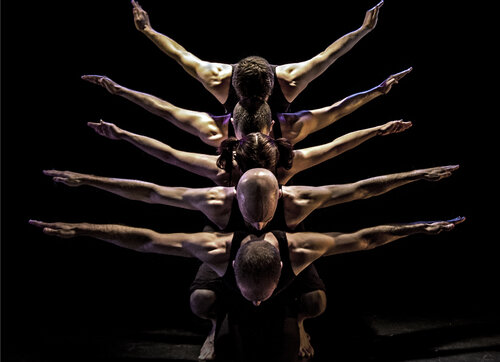
PUSH Physical Theatre, photo credit Avi Pryntz-Nadworny

ProMusica brings lush Vaughan Williams and vibrant Piazzolla to St Mary

ProMusica Chamber Orchestra
David Danzmayr, conductor
Katherine McLin, violin
St. Mary Catholic Church
Columbus, OH
March 20, 2022

Vaughan Williams: Fantasia on a Theme by Thomas Tallis
Piazzolla: The Four Seasons of Buenos Aires (arr. Desyatnikov)

Encore:
Piazzolla: Adios Nonino

Nestled in the heart of German Village, Saint Mary Catholic Church – a structure that dates back to 1868 – recently underwent an extensive restoration, and proved to be a gorgeous setting for last weekend’s ProMusica performance. The program opened with Vaughan Williams’ Fantasia on a Theme by Thomas Tallis, and the plaintive theme reflected the solemnity of the setting in this glance backwards in English musical history. Though the heavy reverb in a church can create acoustical challenges, here the resonance seemed to further enhance the richness of the strings – and indeed, the work’s 1910 premiere occurred at Gloucester Cathedral. The work is scored for double string orchestra with string quartet, and one was struck by the clarity of the interplay between the various subsets of the ensemble.

ProMusica at St Mary, photo credit ProMusica

The remainder of the evening was devoted to Piazzolla, continuing the celebration of his centenary begun at last month’s chamber music concert. The Four Seasons of Buenos Aires, rendered in Spanish as Estaciones porteñasporteño being the demonym for one from a port city, though it chiefly refers specifically to the Argentine capital – paints a colorful, vibrant portrait of the composer’s homeland. The work was presented in its arrangement by Leonid Desyatnikov, recast so as to highlight connections with its Vivaldian predecessor, including some direct quotations from Vivaldi, and scoring for string orchestra with violin soloist, a role undertaken with aplomb and verve by concertmaster Katherine McLin.

A sultry energy began the opening Otoño porteño, and a series of glissandos showed the composer to be a master of effect. A languid lyricism offered some pointed contrast. Invierno porteño was noted for its substantial passage for cello (Marc Moskovitz), thorny at first but melting into the songful. Given the concert’s coincidence with the vernal equinox, Primavera porteña was certainly the most topical – and perhaps the most ardently lyrical of the set, though not without some sprightly violin acrobatics. Verano porteño made for a vigorous finale with some particularly striking timbres achieved through sul ponticello playing from the soloist. Danzmayr and the orchestra offered a further Piazzolla work as an encore, Adios Nonino. Touchingly lyrical and with rich chromatic harmonies, it burgeoned into a big-boned, almost Hollywood-esque sumptuousness. The performance was billed as “a delightful evening” – a promise amply delivered upon.

Milanov and Columbus Symphony make compelling case for Liszt’s Dante Symphony

Columbus Symphony Orchestra
Rossen Milanov, conductor
Brian Mangrum, horn

Women of the Columbus Symphony Chorus
Ronald J. Jenkins, chorus director

Ohio Theatre
Columbus, OH
March 18, 2022

Britten: Four Sea Interludes from Peter Grimes, Op. 33a
Strauss: Horn Concerto No. 1 in E flat major, Op. 11
Liszt: Dante Symphony, S109

Though Franz Liszt is rightly remembered as chiefly a composer for the piano, he produced a vast body of orchestral works – including virtually inventing the tone poem – that should not be overlooked. In some particularly ambitious programming, the Columbus Symphony offered the first local performances of the Dante Symphony, an orchestral portrait of The Divine Comedy. An informative pre-concert conversation between music director Rossen Milanov and Jonathan Combs-Schilling from Ohio State’s Italian department gave thoughtful insight into both the music and its literary inspiration. A visual element was added with Gustave Doré‘s iconic illustrations to accompany the text – produced in 1857, the same year as the symphony – projected along with the music. Though an intriguing idea, the stage lights largely diluted the projections, rendering them more a distraction than an enhancement.

Gustave Doré’s illustration to Dante’s Inferno. Plate VIII: Canto III: The gate of Hell. “Abandon all hope ye who enter here”, photo credit Wikimedia Commons

The first movement Inferno began with an imposing descent to the hell in the low brass – trombones in particular have long been associated with depictions of the underworld, dating back to Monteverdi’s Orfeo. A wound-up tension was purveyed in music that was unrelenting, often overwhelming in ferocity, but Milanov had a thorough grasp of the large-scale form, serving as an incisive guide. Secondary material depicted the doomed love affair of Francesca and Paolo, a languid contrast. A skeletal recitative-like passage in the bass clarinet was quite striking, and Liszt made use of richly chromatic, Wagernian harmonies, sounding at times like a page out of Tristan. Milanov rightly reined in the bombast during the coda, but still yielded a close that was powerfully unforgiving.

The second movement Purgatorio provided some much needed peace after the preceding, with some especially touching scoring for the harp and oboe. This was fittingly music of stasis, held in contemplative limbo, although a triumphant passage and a thorny fugue gave matters both variety and perhaps a glimmer of hope. Liszt had originally envisioned concluding the work with a Paradiso movement, mirroring the source material, but conceded that depicting heaven would be all but impossible. Instead, he provided a lovely Magnificat as something of a pendant to previous movement. It’s a hymn of sorts wherein we manage just a glimpse of the entrance to paradise. It was a magical moment when the women of the Columbus Symphony Chorus appeared practically out of the ether, offering an angelic vision of what lies beyond in the most deeply moving music of the work. The performance was a laudable achievement, and I hope Milanov and the CSO will continue to explore Liszt’s lesser-known orchestral pieces.

The program began with Britten’s Four Sea Interludes from Peter Grimes, a quantity which amazingly hasn’t appeared on a CSO program since 1979. High strings opened with an almost mystical evocation of dawn, though the intonation left something to be desired. “Sunday Morning” saw a brassy awakening, replete with tolling church bells. “Moonlight” was tranquil though not without foreboding as matters took a darker turn in the closing “Storm.”

The ensemble afforded the spotlight to one of its own in Strauss’ Horn Concerto No. 1 in bringing Brian Mangrum front and center, the CSO’s principal horn since 2018. Written when the composer was a precocious 18 year old, the regal E flat major tonality set the stage for a decisive solo entrance, and Mangrum offered a warm, rich tone. A lyrical slow movement saw the horn in dialogue with a rising gesture in the strings, a moment of repose before the jaunty and limber finale.

Rossen Milanov, Brian Mangrum, and the Columbus Symphony. Photo credit Columbus Symphony

Esfahani delivers marathon Bach program at Early Music Columbus

Mahan Esfahani, harpsichord
Huntington Recital Hall
Capital University
Bexley, OH
February 25, 2022

Bach: French Suite No. 5 in G major, BWV 816
Bach: Goldberg Variations, BWV 988

Encore:
Stölzel: Bist du bei mir (attr. Bach, BWV 508)

The Goldberg Variations is an evening’s worth of music in its own right – and a generous one at that – but for Mahan Esfahani’s ambitious harpsichord recital at Early Music in Columbus, it was merely the second half. In addition to providing his own program notes, Esfahani was on hand for an engaging preconcert discussion, showing himself to be a deep thinker on the music in question. The program began with the French Suite No. 5. Esfahani took the opening Allemande at a relaxed tempo, seemingly relishing in its elegance. The Courante that followed offered sprightly contrast, and each subsequent dance was imbued with individual charm, perhaps none more so than stylishly virtuosic Gigue that closed.

Mahan Esfahani, photo credit Kaja Smith

Few pieces in the repertoire are as life-affirming as the Goldberg Variations. The Aria on which the work is based was pure and deeply felt, a nuanced reading of an outwardly simple melody. The first variation offered more forward motion in contrast to the stasis of the source material, pointing towards the multitude of directions the work would explore, and the composer’s fertile inventiveness. Variation 3, the first of the canons, plumbed the richness of the instrument, and Esfahani purveyed an exacting clarity in the contrapuntal textures. Variation 5 employed an impressive virtuosity in thoroughly utilizing both the instrument’s keyboards.

A pensive, unresolved close to Variation 15 marked the halfway point, and the subsequent variation, a brilliant overture, made for a powerful statement to herald the even more ambitious latter half of the work. Striking contrast was had in Variation 19, wherein Esfahani made use of his instrument’s plucked timbres. Time seemingly stood still in the otherworldly Variation 25 – the so-called “Black Pearl” – yet the following was once again bright and effervescent. Variation 28 is always a highlight for this listener, and here Esfahani’s playing was sparkling and radiant, replete with elaborate hand-crossings rivaling anything in a Scarlatti sonata. I was further struck by the blazing technique in Variation 29 as well as the irresistible charm of the Quodlibet, given with exultant abandon. The Aria da Capo concluded where matters began, a welcome return home after a long journey.

“What does one play after that?” Esfahani quipped. Nonetheless, he mustered the energy for a lovely encore, a transcription of the aria Bist du bei mir from Gottfried Heinrich Stölzel’s opera Diomedes. For a long time falsely attributed to Bach, it was included in the Notebook for Anna Magdalena Bach – as was the aria to the Goldbergs. Certainly a recital for the books, though perhaps it is best to close with Esfahani’s own assessment:

Eddins shows his mettle as both conductor and pianist with the Columbus Symphony

Columbus Symphony Orchestra
William Eddins, conductor and piano
Ohio Theatre
Columbus, OH
February 20, 2022

Perkinson: Sinfonietta No. 1
Gershwin: Rhapsody in Blue (1926 orchestration, Grofé)
Beethoven: Symphony No. 5 in C minor, Op. 67

Guest conductor Williams Eddins led the Columbus Symphony last weekend in a decidedly populist program, though matters nonetheless opened with an unfamiliar work by an unfamiliar composer. The quantity in question was the Sinfonietta No. 1 by African-American composer Coleridge-Taylor Perkinson, named after Samuel Coleridge-Taylor who perhaps served as a guiding inspiration to the younger composer. A compact three-movement work dating from 1954, the work opened with angular gestures though generally lyrical at heart, colored by piquant harmonies. A mournful slow movement seemed to echo Barber’s Adagio for Strings (this work too was scored for strings alone), while the vigorous finale purveyed textures akin to a Baroque concerto grosso. A finely crafted product of midcentury America given with compelling advocacy from Eddins and the Columbus strings.

William Eddins, photo credit Jonathan Kim

Eddins served double duty as pianist and conductor in Gershwin’s Rhapsody in Blue, but first took several minutes to introduce the work – as historically-informed as it was entertaining. Principal clarinet David Thomas delivered the iconic opening in a sultry solo. The work was presented in its 1926 pit orchestra scoring for an authentic feel of the roaring twenties, and it was certainly fitting for the performance to take place in a venue that was a product of the same decade. Eddins proved equally adept at both roles, and guided the ensemble in a charismatic, high-octane performance.

It’s a challenge for conductors to make such a well-worn piece as Beethoven’s Fifth Symphony sound fresh. I wasn’t convinced Eddins managed to say anything novel, but the performance nonetheless served as an always welcome encounter with an old friend. The opening Allegro con brio benefitted from Eddins’ energetic conducting, an intensity countered by the warm lyricism of the strings in the slow movement – though I found the brass to be a bit overzealous. The scherzo started out as a whisper, employing the ubiquitous rhythmic gesture that binds the work, and gradually grew in urgency. Matters were held in suspense until the brassy C major finale broke through the clouds. Still, the journey is far from over – Beethoven has gift for profligate finales! – and the energy on stage seemed to flag for a somewhat anticlimactic ending.

Imani Winds delights in colorful exploration of women composers

Imani Winds
Southern Theatre
Columbus, OH
February 19, 2022

Coleman: Umoja
Nathalie Joachim: Seen
Crawford Seeger: Suite for Wind Quintet
León: De Memorias
Esmail: The Light is the Same
Coleman: Afro-Cuban Concerto

Chamber Music Columbus’ first program of 2022 brought the dynamic Imani Winds to the Southern Theatre in a diverse, wide-ranging program, with all works by women composers. Valerie Coleman’s Umoja made for a bright and joyous opening. Coleman was the founder and former flutist of Imani, and Umoja has become her signature piece; transcriptions exist for a variety of other ensembles in addition to this original incarnation for wind quintet.

Imani Winds, L-R: Mark Dover, Brandon Patrick George, Monica Ellis, Kevin Newton, and Toyin Spellman-Diaz, photo credit Shervin Lainez

Haitian-American composer Nathalie Joachim wrote Seen as part of Imani’s Legacy Commissioning Project, an initiative which has produced a wealth of new music. A recent work, premiered just last year, Seen is comprised of five short movements, one for each member of the quintet, depicting their colorful, distinctive personalities in charming vignettes. Each of their respective instruments were emphasized in turn, with the other members present but relegated to the background; in the second selection I was especially struck by the expressive range of the busy bassoon (Monica Ellis).

The first half closed with the Suite for Wind Quintet by Ruth Crawford Seeger (stepmother to folk singer Pete Seeger), a major force in twentieth century American music who likely never realized her full potential owing to the gender barriers of the time. The 1952 work employs a serialist language, sophisticated but without sounding dryly academic, and Imani handled the considerable technical challenges with grace and precision. The whirlwind finale made for an imposing close, and the taut coordination between flute (Brandon Patrick George) and bassoon was a standout.

Tania León’s De Memorias was a piquant and evocative reflection of her childhood in Cuba, contrasting a pulsating ostinato with more free-sounding, rhapsodic material. Reena Esmail’s The Light is the Same is featured on Imani’s Grammy-nominated album Bruits. It’s a remarkable amalgamation of Western and Hindustani musical traditions, with a sinewy oboe line (Toyin Spellman-Diaz) introducing the raga on which it is based. A piccolo passage, gently floating above the rest of the ensemble, made for a strikingly ethereal moment, and one was quite taken by the rhythmic complexities of the dance-inflected finale.

The program closed with another piece by Coleman, the Afro-Cuban Concerto, dating from 2001. As the title indicated, the quintet took on a larger than life role, effectively functioning as a mini orchestra. The recurring 6/8 rhythmic gestures were given an energetic workout in the opening “Afro” movement, while the central “Vocalise” proved just as lyrical and songful as the moniker suggested. The closing “Danza” was spirited and played with aplomb, replete with a gleaming horn solo (Kevin Newton) as well as some intricate passagework from the clarinet (Mark Dover).