Calidore Quartet contrasts elegant Mozart and Beethoven with contemporary works at Chamber Music Columbus

Calidore String Quartet
Southern Theatre
Columbus, OH
April 1, 2023

Hu: A Wondrous Hope
Mozart: String Quartet No. 17 in B-flat major, K458, The Hunt
Watkins: String Quartet No. 2
Beethoven: String Quartet No. 16 in F major, Op. 135

Encore:
Beethoven: Cavatina from String Quartet No. 13 in B-flat major, Op. 130

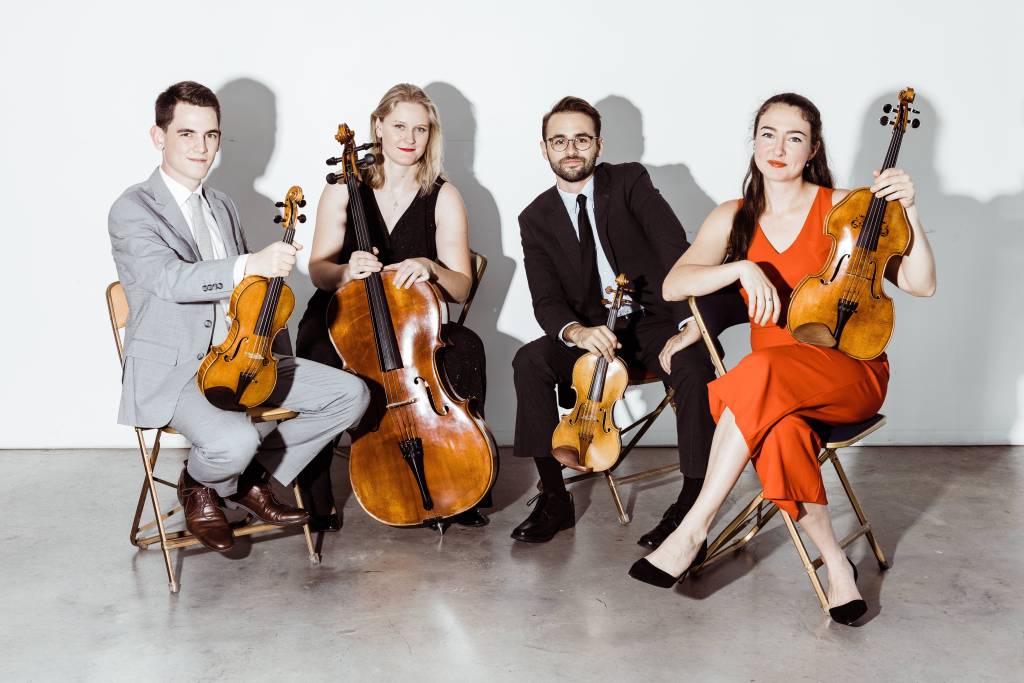
The penultimate installment of Chamber Music Columbus’ 75th season saw the Calidore Quartet – the third consecutive string quartet to be featured this season – in a program anchored by major works of Mozart and Beethoven. The next “puzzle piece” of Ching-Chu Hu’s ubiquitous fanfare opened the evening, titled A Wondrous Hope. Filled with yearning, it explored different combinations within the quartet in harmonious balance, and shifts in texture added variety and color.
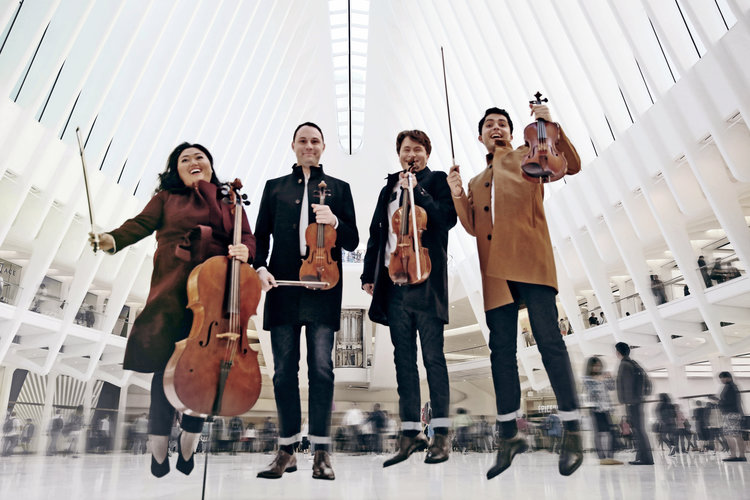
Calidore Quartet, photo credit calidorestringquartet.com

Mozart’s Hunt quartet was given with deft balance and clear articulation – particularly evident during the delicate ornaments – and a genteel approach at times tempered by a more rustic feel, fitting per its epithet. The minuet danced with light touch and an elegant melody from first violinist Jeffrey Myers (who also appeared on this stage during the season-opening performance with VIVO). The Adagio was a songful, flowing statement, and like the best of Mozart’s finales, the closing movement was of high spirits and exuberance.

Though unable to make it to Columbus in person, Huw Watkins conveyed to the trio his “thoughts of joy and optimism” when writing his String Quartet No. 2, premiered by Calidore at the Wigmore Hall last May, with Saturday counting as the first American performance. Starting with a single pluck, fragments of themes coalesced, signaling much potential to be explored. Matters took flight, fluttering into the strings’ high register, and was given an energetic workout. A central slow movement began sweetly nostalgic, growing in urgency as the composer explored more dissonant harmonies, though never straying too far from resolute tonality. The opening pluck returned to set off the finale of vigorous, pungent harmonies, closing in a burst of energy.

Beethoven’s final string quartet (the last major work he completed) closed the evening. A resonant gesture in the viola began, evidencing the ensemble’s keen attention to the inner voices for a reading refined and reflective. The Vivace was of rhythmic vitality and intricacy, and not without some unexpected syncopations. Deeply felt, the plaintive slow movement unfolded with eloquence, a divinely beautiful prayer. A discursive, questioning gesture initiated the wide-ranging finale, further demonstrating the quartet’s chemistry and cohesion.

Introducing the encore, Myers – a Columbus native – spoke fondly of the influence of two luminary violinists we have sadly lost in recent months, Charles Weatherbee and David Niwa. Dedicating the closing selection of Beethoven’s Cavatina from the op. 130 quartet to their memory, it was a gorgeous, loving tribute.
An eclectic mix prefaces a Mozart symphony at ProMusica’s neighborhood series

ProMusica Chamber Orchestra
David Danzmayr, conductor
Ellen Connors, bassoon
St Mary Catholic Church
Columbus, OH
March 19, 2023

Strauss: Serenade in E-flat major, Op. 7
Villa-Lobos: Ciranda das sete notas, W325
Tauský: Coventry: Meditation for Strings
Mozart: Symphony No. 38 in D major, K504, Prague

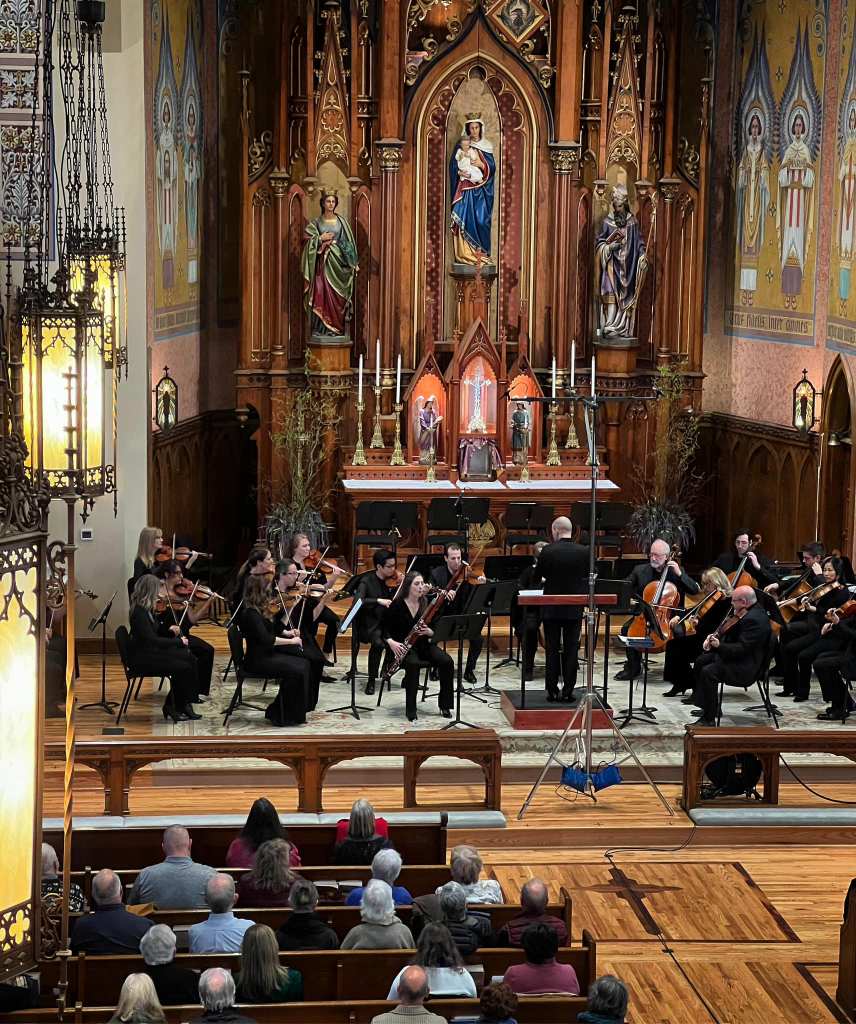
In a continued effort to reach wider audiences, ProMusica presents a “neighborhood series,” leaving their usual home at the Southern Theatre in favor of various locations throughout Columbus. I caught Sunday afternoon’s performance at the beautiful St Mary Church in German Village. A youthful Serenade by Richard Strauss opened. The winds and brass for which it was scored were warm and mellifluous in this classically-proportioned work, hardly foreshadowing the extravagant use of those instruments in the mighty tone poems that would follow. The ensemble filled the church almost like an organ; such a venue can suffer from excessive reverberation, though apparent, conductor David Danzmayr did much to adapt to the space.

Ellen Connors with David Danzmayr and ProMusica at St Mary, photo credit ProMusica

Villa-Lobos’ single movement Ciranda das sete notas (“Round Dance of Seven Notes”) brought forth ProMusica’s principal bassoon Ellen Connors. There was a wonderful energy present from the onset, and the richly harmonized material captured one’s attention. Connors offered a clear tone with playing surprisingly limber for such a lumbering instrument. The work demanded a substantial range and speed, with barely a moment for the soloist the breathe even in the slower central section. The meditative final moments were especially lovely.

A work for strings from the Czech composer Vilém Tauský followed. A Jew, he was forced to flee in homeland in 1939, settling in England where he remained until his death in 2004. Coventry, written in 1979, reflects with raw emotion on the trauma of war. One was struck by the resonance of low strings that opened, soon to be joined by the violins. Lyrical at heart but peppered with dissonances pained and poignant, it was a piece of solemn intensity that painted a forlorn picture.

Mozart’s Prague symphony was a markedly cheerier affair. Only a small handful of the composer’s 41 symphonies begin with a slow introduction; the Prague has the most substantial, stately and weighty beginnings before one of Mozart’s most delightful themes took shape. Danzmayr opted for a brisk tempo choice, but clarity was maintained even during the bracing development. A graceful and measured slow movement served as a moment of repose before the whirlwind finale, wherein the ProMusica woodwinds were in especially fine form.

Columbus Symphony explores the confluence of classical and jazz

Columbus Symphony Orchestra
Rossen Milanov, conductor
Aaron Diehl, piano
Ohio Theatre
Columbus, OH
March 17, 2023

Perry: Study for Orchestra
Gershwin: Concerto in F
Tchaikovsky: Suite from The Nutcracker, Op. 71a
Ellington/Strayhorn: The Nutcracker Suite

The Columbus Symphony’s program served as a colorful depiction of elements of jazz seeping into the classical tradition – and vice-versa. Matters began on a different note, however, with an example of the considerable body of work from the often forgotten 20th century American composer Julia Perry. A native of Lexington, Kentucky who spent her final years in Akron, Ohio, her reputation was tragically stifled by the establishment’s prejudices towards an African-American woman.

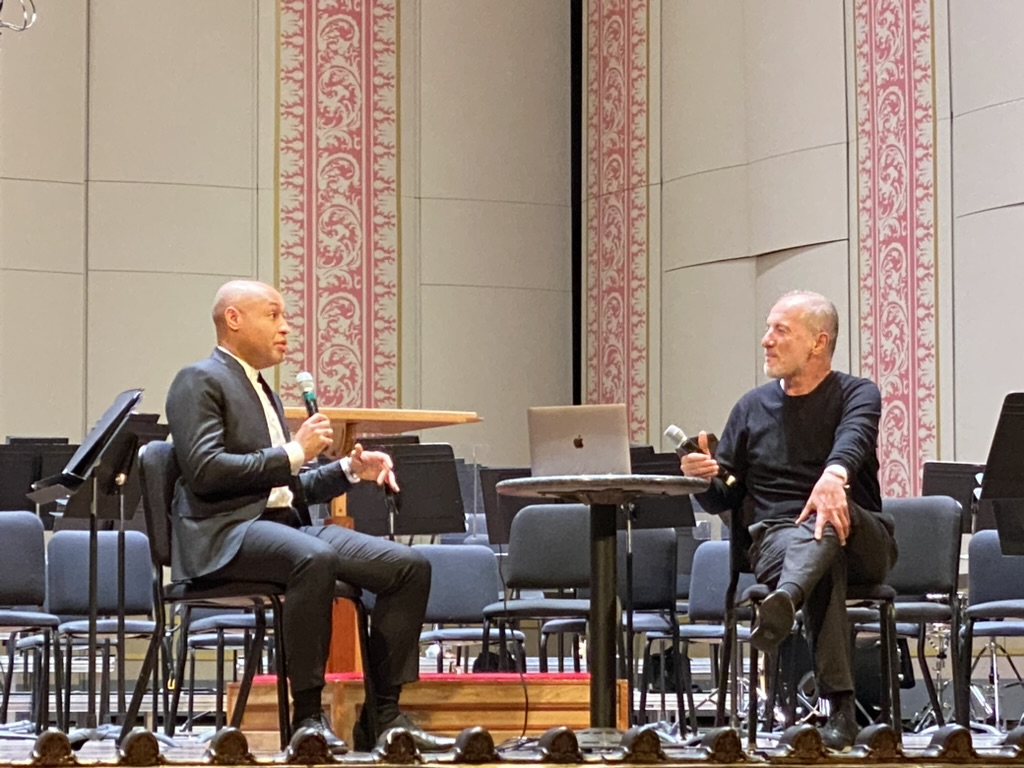
Aaron Diehl in conversation with Rossen Milanov

Nonetheless, she produced a substantial output – including more than ten symphonies – and the 1952 Study for Orchestra, included on the present program, was performed by the New York Philharmonic in 1965, certainly a major milestone. Bracing, strident beginnings gave way to more lyrical interludes. Albeit brief, it was a work of adroit craftsmanship, and certainly piqued my interest in discovering more of her music.

Gershwin’s great Concerto in F filled the balance of the first half, and was fitting platform for the belated CSO debut of Aaron Diehl – a Columbus native, Juilliard-trained, and equally at home in classical and jazz. A thunderous opening in the timpani pointed towards a lively Charleston rhythm. The pianist’s entry was graceful and elegant, with the virtuosity and vigor quickly ramping up. An impassioned lyrical melody served as the first movement’s climax, as lush as anything Rachmaninov wrote.

The brass with which the slow movement opened evidenced Gershwin’s skill at orchestration, much improved from the earlier Rhapsody in Blue for which he had the enlist the assistance of Ferde Grofé. The gently cascading piano was quite lovely, and the cadenza afforded Diehl the opportunity to improvise – and the orchestra musicians seemed to be watching him in awe. A motoric toccata-like movement closed the work with a big-boned finish. Diehl offered an encore (perhaps of his own composition?) that filled the theater with ethereal jazz harmonies.

In 1960, Duke Ellington released an album re-imagining Tchaikovsky’s Nutcracker as a jazz piece. Conductor Rossen Milanov cleverly devised a suite in which Tchaikovsky’s originals were interwoven with Ellington’s take, and it was quite fascinating to hear them juxtaposed. Delicate musical tinsel marked the opening Overture; in the ensuing Ellington version, the orchestra seamlessly morphed into a bona fide jazz band. Ellington’s adaptation of the Marche was styled as the “Peanut Brittle Brigade”; it expanded the rhythm and harmonies while the source material remained recognizable. In the “Dance of the Sugar Plum Fairy” the celesta sparkled; Ellington’s “Sugar Rum Cherry” retooled it for sax and brass. Tchaikovsky was given the final word, however, with a lush and lilting “Waltz of the Flowers.”

Milanov leads Columbus Symphony in a Mahlerian farewell to life

Columbus Symphony Orchestra
Rossen Milanov, conductor
Ohio Theatre
Columbus, OH
March 3, 2023

Mahler: Symphony No. 9 in D major

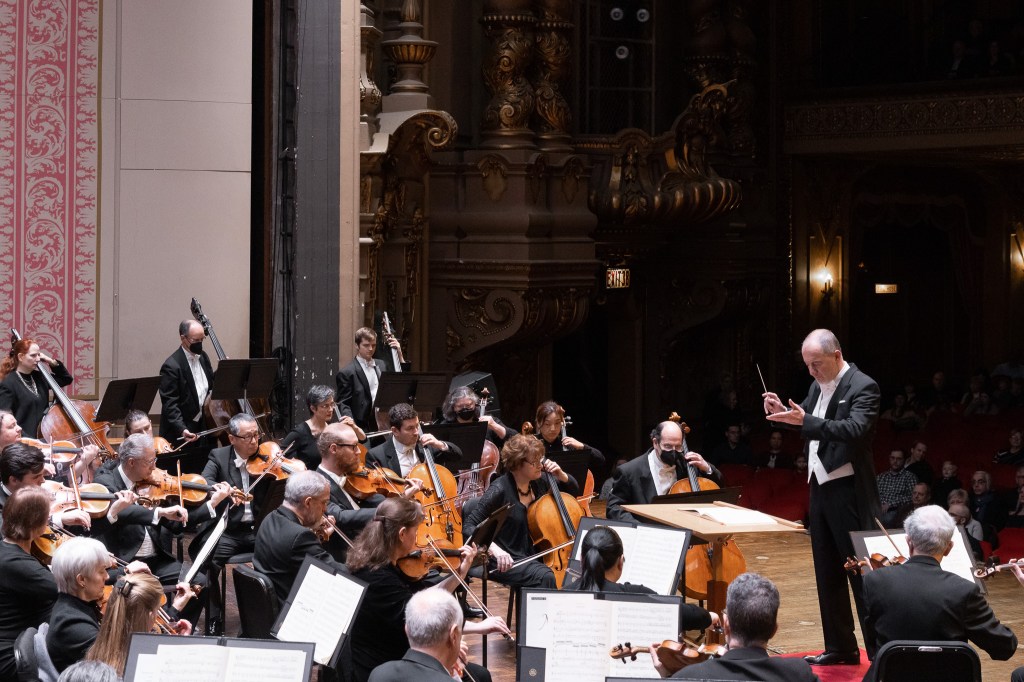
In his preconcert remarks, Columbus Symphony music director Rossen Milanov noted it has long been his dream to conduct Mahler’s final completed work, the Ninth Symphony. That opportunity finally arrived this weekend, leading the CSO – expanded to over 80 players – in this autumnal, valedictory canvas.

The work began tentatively, hesitantly, almost as if unsure of its footing – some have suggested the limping rhythmic figure was meant to mirror the composer’s irregular heartbeat. Nonetheless, the work soon found its stride in sighing, calming lyricism. The music surged to grating climaxes at key inflection points in the long paragraph of the opening Andante comodo, yet they tended to come across a bit thin, lacking the robustness one desires for Mahler. The tolling of the tubular bells was of striking effect, heralding the welcome return of the main theme after a long journey. A solo passage from concertmaster Joanna Frankel was quite tenderly played.

The following movement brought us back down to the corporeal world from the philosophical musings of the opening. A spunky ländler took shape, with Mahler ever keen to invoke his affinity for folk traditions, even (or perhaps especially) in this late work. A panoply of striking timbres colored the movement, with the orchestra sounding quite a bit more polished here. The ensuing Rondo-Burleske opened with a strident, angular trumpet call, and a vigor that inexorably pulled matters forward, only to be later stopped in its tracks by an impossibly high passage for trumpet, echoed in the strings and winds – and a preview of the plaintive finale to come. At one point, Milanov’s baton was launched airborne, as sure a sign as any of the intensity with which he conducted!

The finale is simply quite unlike anything else in the repertoire. A heartwrenching chorale resonated through the Ohio Theatre, with the Columbus strings shining in their aching, arching lyricism. In the final bars, matters were all but disembodied, drifting away to peaceful, serene resolution, and Milanov managed to hold the audience in contemplative silence – perhaps the most appropriate response to such a singular statement.

Columbus Symphony spotlights principal clarinet

Columbus Symphony Orchestra
Rossen Milanov, conductor
David Thomas, clarinet
Ohio Theatre
Columbus, OH
February 18, 2023

Price: Andante ma non troppo from Symphony No. 3 in C minor
Berio/Brahms: Op. 120 No. 1
Schubert: Symphony No. 4 in C minor, D417, Tragic

It has been deeply gratifying to see renewed attention given to the formidable work of Florence Price in the past few years. Last year’s Grammy for best orchestral performance went to the Philadelphia Orchestra’s warmly recommended recording of her First and Third symphonies under Yannick Nézet-Séguin – an ensemble of which Rossen Milanov served as assistant conductor for almost a dozen years before coming to Columbus. Last weekend’s Columbus Symphony program opened with the slow movement of the Third Symphony.

David Thomas, photo credit Columbus Symphony

A plaintive choir of winds began, with a tuneful melody gently unfolding. Like Dvorák before her (as in the New World symphony, heard here two weeks prior), Price purveyed a language steeped in folk tradition without making use of specific quotations. A passage for brass chorale was particularly affecting and distinctly American in character before the movement reached a serene ending, aided by a touch of harp. It certainly whetted one’s appetite for more, and I hope the complete symphony can be programmed in an upcoming season.

Though at the forefront of the avant-garde, Luciano Berio had a knack for faithfully transcribing other composers’ works for various media (including a particularly delightful selection of Beatles songs). A 1986 commission from the Los Angeles Philharmonic saw him transcribe Brahms’ late Clarinet Sonata in F minor, Op. 120 No. 1 for soloist and orchestra. Championing the work was David Thomas, serving as the CSO’s principal clarinet since 1989.

Passionate, brooding beginnings were had, with Berio’s orchestration inimitably Brahmsian as he left his iconoclastic proclivities far behind – the work sounded almost as the clarinet concerto Brahms never wrote. Thomas’ rich tone was well-suited to this autumnal work, finely balanced with the larger ensemble, and conveying a natural chemistry with his orchestral colleagues. The slow movement proceeded as a long-breathed song without words – really gorgeous – while an Allegretto grazioso charmed with its inflections of the ländler in both rhythm and spirit. A repeated motif marked the closing Vivace, a finale of appropriate vigor.

Another C minor symphony closed the program, namely Schubert’s Tragic. Weighty introductory material announced the minor tonality in no uncertain terms; the movement proper brimmed with Sturm und Drang in this early expression of Romanticism. The primary theme was deftly articulated in the strings, and a development section traversed distant keys before the movement landed – quite surprisingly – in the major.

The Andante boasted one of Schubert’s loveliest melodies, first presented in the strings with a touching countermelody in the oboe, searching for peace amidst the tumult of the rest of the work. The minor key shading gave the minuet added vigor, a contrast heightened by the lilting trio. Milanov leapt right in the to the finale – perhaps in reaction to some of the audience’s insistence on applauding after every movement. Matters felt a tad rushed, but this was an energetic outing nonetheless, leading to a dramatic finish.

Callisto Quartet pairs new and old at Chamber Music Columbus

Callisto Quartet
Southern Theatre
Columbus, OH
February 18, 2023

Haydn: String Quartet in F major, Op. 77 No. 2, Hob. III:82
Fujiwara: Sunsets, Like Childhood
Hu: As Hope Builds
Debussy: String Quartet in G minor, Op. 10

February’s Chamber Music Columbus concert was originally slated to feature the St. Lawrence String Quartet; following the very sad passing of their first violinist Geoff Nuttall, a substitute was booked in the Callisto Quartet – an ensemble currently serving as quartet in residence at the Yale School of Music. Kudos to Callisto for presenting a very fine, polished program on short notice that included two world premieres along with two cornerstones of the quartet repertoire.

Callisto Quartet, photo credit callistoquartet.com

The program opened with Haydn’s final completed quartet (Op. 77 No. 2) from his vast output in the form (a projected sixty-eighth string quartet would follow as Op. 103, but was left incomplete). The opening Allegro moderato was elegant and deftly balanced. Bucking the tradition the composer himself largely established, a Menuetto was placed ahead of the slow movement. Sprightly and harmonically adventurous, it was almost more akin to something of Beethoven. The theme and variations Andante was given with careful attention to detail, bringing out its rhythmic intricacies. Despite being the composer’s final quartet, there was certainly nothing valedictory about the finale, spirited and vivacious, with some particularly energetic playing from first violinist Cameron Daly.

As the 75th anniversary celebrations continue, the next featured composer was Korine Fujiwara. Though now based in the Pacific Northwest, she is someone with strong local connections (describing Columbus as her “emotional home” during her spoken remarks): violinist in the Columbus Symphony for many years, composer of a new work for Opera Columbus, and founding member of the Carpe Diem String Quartet. Sunsets, Like Childhood alludes to a quote from author Richard Paul Evans, and seeks to capture the energy of a sunset, and childlike sense of wonder many of us continue to have for this daily occurrence.

A short cello line opened, soon joined by the rest of the ensemble in lush harmony. Rapid tremolos and arpeggios conveyed a sense of evanescence like the fleeting sunset. The piece was simply full of life – celebratory, almost exuberant, yet still wistful and reflective with a particularly lovely theme surfacing about halfway through before the work peacefully drifted away into the night.

Ching-chu Hu’s next “puzzle piece” of the 75th anniversary fanfare opened the second half, entitled As Hope Builds. A self-described “eternal optimist,” that mindset was very much reflected in the work’s theme and character, amassing strength and vigor through the titular hope.

The recital closed with Debussy’s sole entry in the string quartet medium, and a fine one at that. A rich sound opened, with the quartet communicating as a seasoned ensemble as the conversation on stage naturally shifted to Debussy’s impressionist language. Striking pizzicato sonorities marked the scherzo, and not without a certain wit one doesn’t always associate with the Frenchman. The Andantino was the heart of the work, gorgeous and serene with the quartet purveying a singing tone throughout, an essay of repose before cleanly negotiating the thorny textures of the finale.

Columbus Symphony celebrates American music with standout guest conductor and soloist

Columbus Symphony Orchestra
David Alan Miller, conductor
Aubree Oliverson, violin
Ohio Theatre
Columbus, OH
February 3, 2023

Simon: This Land
Barber: Violin Concerto
 Encore:
 Puts: Arches
Dvořák: Symphony No. 9 in E minor, Op. 95, From the New World

Under guest conductor David Alan Miller, the Columbus Symphony presented an exuberant program of American music – the first half comprised of American composers, the latter the view of a foreigner looking in. As music director of the Albany Symphony Orchestra, Miller has developed a reputation for his commitment to contemporary music, and began the CSO program with a 2019 work of Carlos Simon. This Land is a musical depiction of the Statue of Liberty, and in particular, the Emma Lazarus poem at its base. It began introspectively with earthy harmonies, as a mediation on the poem and monument, and perhaps the less than promised realization of those ideals. A patchwork tapestry of various national anthems took shape, and the brief work closed as pensively as it began.

Aubree Oliverson, David Alan Miller, and the Columbus Symphony, photo credit Corinne Mares

Barber’s Violin Concerto put the considerable talents of soloist Aubree Oliverson in the spotlight. Eschewing introductory material, the music got right down to business with a rich lyricism from bar one, heightened by Oliverson’s warm, amber tone – self-assured, and articulately projecting over the orchestra. The movement was not without moments of tension, but never wandered far from its lyrical heart. A mournful oboe marked the central Andante, music clearly from the same pen as the Adagio for Strings, and the solo writing reached high into the range of Oliverson’s instrument. A breathless moto perpetuo – and the most harmonically adventurous of the movements – made for an exciting, energetic close. Certainly one of the finest concertos to come from this country, and on a personal note, I have fond memories of hearing the work here back in March 2010 – the very first time I attended the Columbus Symphony.

As a well-deserved encore, Oliverson selected another American composer in Kevin Puts, a name which has gotten much attention as of late following the premiere of his opera The Hours at the Met this past November. Arches proved to be a real treat for the audience: the violinist selected the final caprice wherein she drew out the titular arches without respite, increasingly wide and to mesmerizing effect – a jaw-droopingly virtuosic response to the Barber finale.

The evening closed with Dvořák’s “New World” symphony, the crowning product of his American sojourn. Some local concertgoers may have heard the symphony just the night before, concluding the Lviv National Philharmonic’s performance at Denison University. A passionate and brooding opening purveyed drama without bombast, while a stirring chorale began the Largo, setting the stage for the memorable English horn solo. In the scherzo, Dvořák found a way to remind us of his Czech origins in its flavor, seamlessly blended with the “American” material, and the lilting trio was especially delightful. The finale was dramatic to the finish of this polished performance, evidencing Miller’s fine chemistry with this orchestra.

Cavani Quartet makes strong impression in diverse program at Chamber Music Columbus

Louise Toppin, soprano
Southern Theatre
Columbus, OH
January 28, 2023

Hu: The Clarity of Hope
Saint-Georges: String Quartet in C minor, Op. 1 No. 4
Lomax: A Prayer for Love
Price: String Quartet No. 2 in A minor

Encore:
Washington: Midnight Child

Chamber Music Columbus’ first program of the new year brought forth the Cleveland-based Cavani String Quartet in an afternoon of diverse string quartets by an equally diverse body of composers – none of whom fit the “dead white male” archetype all too prevalent in classical music, perhaps the vaunted string quartet even more so. The program opened with the next iteration of Ching-chu Hu’s fanfare for the organization’s 75th anniversary, styled here as The Clarity of Hope.

Cavani String Quartet, photo credit Robert Muller

In this guise, one was taken by the intimate warmth of the strings – rather different than the initial casting for brass quintet – and the scoring afforded each member of the quartet a moment in the spotlight. Cavani next turned to the work of the fascinating figure sometimes referred to as the “Black Mozart”: namely, Joseph Bologne, Chevalier de Saint-Georges, born in Guadeloupe a decade before Mozart to a French father and Senegalese mother. The brief C minor quartet had an opening filled with longing of that tragic key (a tonality later favored by both Mozart and Beethoven for their most personal, profound creations), but an elegance at its core as encouraged by Cavani’s detailed reading. The closing Rondeau was a lively foil, in due course arriving at a bright C major.

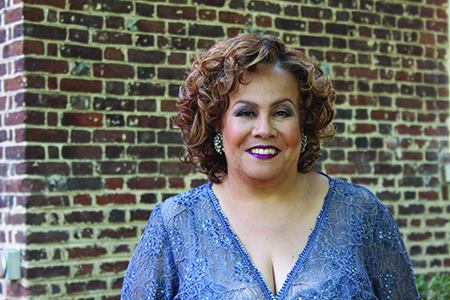
The next of the 75th anniversary commissions turned toward one of Columbus’ own, the multi-faceted Mark Lomax II. A Prayer for Love intriguingly adds soprano voice to the quartet, singing the text of “A Prayer” by Claude McKay, Jamaican-born poet of the Harlem Renaissance. Searching, richly chromatic harmonies opened, and the work’s rhythmic complexities were astutely articulated by Cavani – surely Lomax’s background as as drummer encouraged his keen attention to rhythm. Louise Toppin’s lyrical soprano soared over the uncertain, often jagged accompaniment, at last giving way to peaceful resolution. In his interview with me, Lomax noted inspiration from Mahler’s blending of voice with orchestra, and the intimacy that creates in the context of a vast symphony. The taut communication here between soprano and strings conveyed, in a similar vein, an inward-looking affinity.

In recent years, a renewed attention has been given to the work of Florence Price – a major talent and essential voice of American music – and Cavani closed the printed program with her substantial String Quartet No. 2, dating from 1935. A wistfulness wandered throughout the opening Moderato, encouraged by the warm resonance of the strings: an eloquent statement, often bracing. Though in the European tradition, the work exuded a distinctly American flavor with stylistic echoes of Dvořák’s “American” quartet, though arguably more authentic.

The richly voiced Andante cantabile served as a calming spiritual, while the third movement Juba was of good-natured charm, brimming with syncopations that invoked ragtime and were played with abandon. The finale was a largely energetic affair, though still lyrical at its core, and led towards a blistering coda. As an encore, the quartet selected a work by Columbus native Charles Washington called Midnight Child, based upon the spiritual “Sometimes I Feel Like a Motherless Child”: freely incorporating jazz elements, it made for a delightful close to the afternoon.

Louise Toppin, photo credit umich.edu

Columbus Symphony delights in Viennese triumvirate

Rossen Milanov, conductor
Columbus Symphony Orchestra
Ohio Theatre
Columbus, OH
January 20, 2023

Beethoven: Leonore Overture, Op. 72b
Mozart: Symphony No. 36 in C major, K425, Linz
Haydn: Symphony No. 100 in G major, Hob. I:100, Military

Haydn, Mozart, and Beethoven are all but synonymous with the classical style, and this weekend’s Columbus Symphony program offered one sterling example from each of these Viennese masters (and although indelibly associated with the Austrian capital, none were in fact natives). Beethoven produced no less than four overtures for his sole opera Fidelio; the third, bearing the opera’s original title Leonore, opened the program. Ripe with operatic drama, it functions well as a standalone concert piece – and in the opera house, it has become a long-standing tradition to inject this version between scenes in the second act.

 Rossen Milanov and the Columbus Symphony, photo credit Corinne Mares

Somber beginnings gave rise to dramatic tension, thoughtfully paced by Milanov. Offstage trumpets sounded as a fanfare, suggesting narrative details of the source material, and the work ended in brassy splendor. Slow introductions were par for the course in Haydn’s symphonies, but rather rare for Mozart’s output. He employed such a device for the first time in the Linz symphony (No. 36), a technique he would only revisit twice (nos. 38 and 39). It made for a stately opening, setting up the effervescent main subject of the movement proper, given with airy clarity.

The Andante made for a gentle interlude, though punctuated by insistent brass and timpani. A most elegant of minuets followed, with Milanov’s baton bringing emphasis to the sprightly triple meter. The finale was lithe, lean, and joyous – one of Mozart’s most untroubled creations.

The introduction to Haydn’s Military symphony was given with clarity and careful articulation; the main theme was established with the unusual scoring for flute and oboe, and matters proceeded with a refined charm. Over two centuries later, the Allegretto which gives this symphony its moniker is still so striking and wonderfully surprising with its ceremonial percussion and brass fanfare. Such a movement is a hard act to follow, but the minuet was full of wit and charisma, with playing from the well-rehearsed CSO boasting the requisite transparency demanded by this repertoire. A vigorous return of the percussion made the finale an especially exciting affair.

Opera Project Columbus explores art song by Black composers in I, Too, Sing America

Justin T. Swain, baritone
Dione Parker Bennett, soprano
Calvin Griffin, bass-baritone
Ed Bak, piano

Lincoln Theatre
Columbus, OH
January 15, 2023

Coleridge-Taylor: Songs of Sun and Shade – Nos. 2 and 4
Coleridge-Taylor: 24 Negro Melodies, Op. 59 – No. 8: The Bamboula
Coleridge-Taylor: Six Sorrow Songs, Op. 57 – Nos. 2 and 5
Coleridge-Taylor: Five Fairy Ballads – Nos. 3 and 4
Graham Du Bois: Excerpts from Tom Tom

Opera Project Columbus first presented I, Too, Sing America in January 2021 – recorded in an empty hall in the midst of the covid pandemic. An initiative to shed light on the all too often forgotten or overlooked work of Black composers, a second installment was performed over the MLK Day weekend some two years later, this time to an enthusiastic live audience. Surveying art songs of Samuel Coleridge-Taylor and excerpts of a long-lost opera by Shirley Graham DuBois, it was an afternoon ripe with musical discovery, and the program was peppered with informative historical commentary from Toni Shorter-Smith. Like the first installment, this too was filmed, with a broadcast slated for June.

Opera Project Columbus at the Lincoln Theatre, L-R: Dione Parker Bennett, Toni Shorter-Smith, Justin T. Swain, Calvin Griffin, Ed Bak

The first half was the devoted to the work of the considerably prolific Coleridge-Taylor, championed by baritone Justin T. Swain. Both vocalist and pianist (Ed Bak) were amplified – while presumably this will ensure fidelity on the recording, I found it to be rather overpowering in the 582-seat Lincoln Theatre. Two excerpts from Songs of Sun and Shade opened, displaying Swain’s sharp diction and powerful stage presence from the onset; the latter showed him more introspective. “The Bamboula” for solo piano followed, given by Bak with flair and virtuosity in its captivating interpolation of a folk melody – a quantity also used in Gottschalk’s work of the same title. A pair of examples from the Six Sorrow Songs were of fitting melancholy, and two of the Five Fairy Ballads closed the first half, noted for their broad expressive range – and the octave leaps of “Big Lady Moon” seemed to predict that gesture so recognizably used a few decades later in “Over the Rainbow.”

The wife of W.E.B. Du Bois, Shirley Graham Du Bois was a major talent in her own right, an accomplished writer, playwright, activist, and, as this afternoon proved, composer. Her 1932 opera Tom Tom: An Epic of Music and the Negro was given a single run of just two performances in Cleveland that collectively drew a crowd of over 25,000 (in a further Ohio connection, Graham Du Bois was educated at Oberlin College). Despite its initial success, the score was inexplicably lost, only to be rediscovered in recent years amongst her husband’s papers after they were acquired by Harvard in 2001 (the manuscript can be viewed online). The latter half of the present program was devoted to excerpts from the opera; if this preview was any indication, its an appealing and thought-provoking work of both cultural and musical significance – should Opera Project Columbus undertake a staged performance of the complete work, it would be a major and welcome achievement.

Calvin Griffin cut an imposing bass-baritone in “Listen to the distant Tom Toms,” and the piano accompaniment made strikingly innovative use of tone clusters, almost bringing to mind the music of Charles Ives. Swain delivered “Nkosi ke leh lah ee Africa” as a dirge-like interlude, while the dance material that followed was given with swagger, countered by the dulcet soprano of Dione Parker Bennett. Griffin brought “No! No! Not that! You are free!” to life as an expressive aria; Parker Bennet offered some particularly touching wistfulness in “No time.” “And now this ship will go to Africa” served as the final selection, putting Griffin in the spotlight again. Its meditative beginnings burgeoned to a thunderous conclusion.