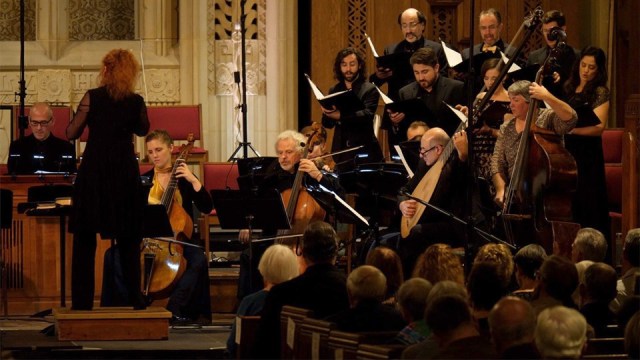
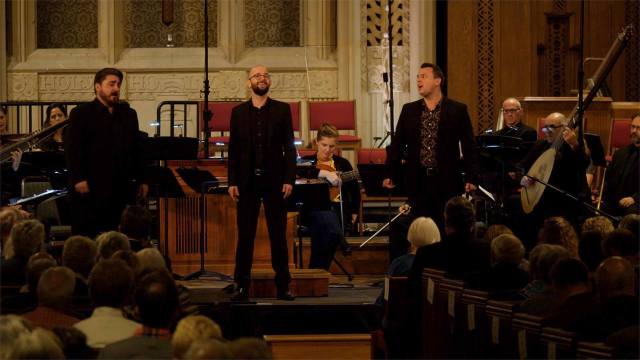
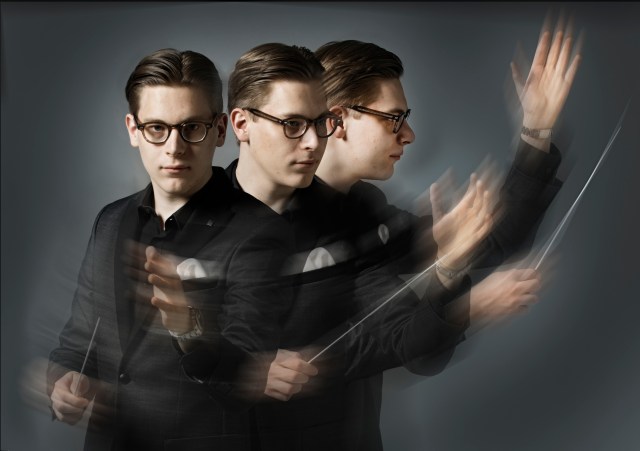
Apollo’s Fire explores a colorful confluence of cultures in O Jerusalem!

Apollo’s Fire
Jeanette Sorrell, conductor

Amanda Powell, soprano
Jeffrey Strauss, baritone
Sorab Wadia, tenor
Jacob Perry, tenor
Daphna Mor, winds and vocals
Zafer Tawil, oud and qanun

Gartner Auditorium
Cleveland Museum of Art
Cleveland, OH
March 11, 2020

I. O Jerusalem!
Ir me kero, Madre a Yerushalayim
Kuándo el Rey Nimrod
Bani Adam

II. The Jewish Quarter
Tzur mishelo akhalnu
Nani Nani
A la Una yo nací

III. The Christian & Armenian Quarters
Havun-Havun
Falconieri: Passacaglia in G minor
Rossi: La Bergamasca
Santa Maria, Strela do Dia, No. 100 from Cantigas de Santa Maria Codex

IV. Mosque, Synagogue, & Cathedral
Muslim Call to Prayer
Sancta Maria succure miseris
Monteverdi: Nigra sum sed formosa, from Vespers of 1610
Nigra sum sed formosa
Tzur mishelo akhalnu
Ki eshmera Shabbat
Monteverdi: Gloria Patri and Lauda Jerusalem, from Vespers of 1610

V. The Arab Quarter
Qanun improvisation
Lamma bada
Longha Farahfaza
Longha Nahawand

VI. Neighborhood Fiesta
La Komida la Manyana

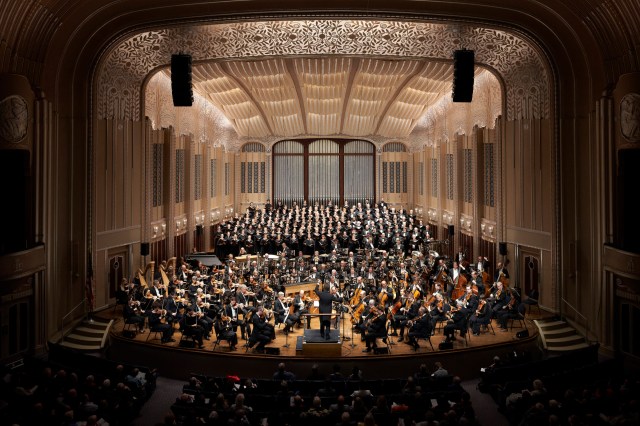
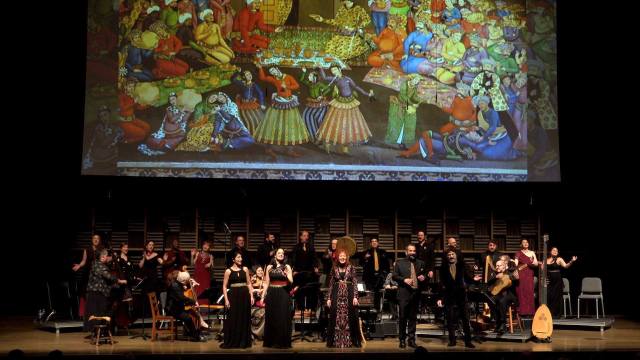
First presented to enthusiastic audiences last year, Apollo’s Fire’s O Jerusalem! is a fascinating travelogue through its titular city’s tapestry of musical cultures. In addition to AF’s usual circuit around the Cleveland area, the program this year was also performed further afield in both New York and Chicago. Cleverly conceived in six sections, each gathered around a common a common theme – including each of the quarters of the Old City – the program thoughtfully illuminated Jerusalem’s rich and diverse heritage through music, further enhanced by a kaleidoscope of projected images.
90101632_10157996240692398_3048093935843934208_o
Apollo’s Fire in O Jerusalem, photo credit Apollo’s Fire

A pair of medieval Sephardic songs opened, featuring soloists Jeffrey Strauss, Sorab Wadia, and Amanda Powell. The violins entered in procession from the back of the hall, enveloping the Gartner Auditorium in a spiritual longing, buttressed in due course by the chorus. Bani Adam closed the first segment on a lively and festive note. Daphna Mor (who along with Brian Kay was on hand for an informative preconcert talk) served as a commendable vocalist in the sacred Hebrew poem Tzur mishelo akhalnu, and there was a touching wistfulness to Amanda Powell’s rendition of the lullaby Nani Nani, countered by rumblings in the plucked strings. Rather more celebratory was the Sephardic ballad A la Una yo nací to round off the exploration of the Jewish Quarter.

The sacred Armenian chant Havun-Havun brought cellist René Schiffer in the spotlight, expertly navigating the subtle modal intricacies. Pivoting to the secular repertoire, the Passacaglia in G minor of seventeenth-century composer Andrea Falconieri unfurled as an animated dialogue between slices of the orchestra. Santa Maria, Strela do Dia rallied the whole ensemble to end the first half in blistering energy. The Muslim call to prayer brought the audience back from intermission, halting the mundane day-to-day in its moving solemnity. In an analogous vein, the Gregorian chant Sancta Maria succure miseris was of dignified unity. Nigra sum sed formosa was intriguingly presented in both Monteverdi’s setting from the Vespers and in its roots as plainchant. The former featured the excellent tenor Jacob Perry, and in the winding melismas of the latter one saw parallels to the similarly discursive inflections of a muezzin. A further sequence of Jewish material highlighted Strauss’ natural affinity for the repertoire, while two additional selections from the Vespers again called upon Perry, there with angelic echoes from the women of the chorus.

The penultimate segment musically traversed the Arab Quarter, opening with a dazzling improvisation on the qanun by Zafer Tawil, who introduced the work by speaking of his hopes for peace in the conflict-laden region – a sentiment which received enthusiastic applause. Tawil joined forces with Powell in Lamma bada, an Arab/Andalusian mwasha, and the segment concluded with a pair of jaunty instrumentals, the latter featuring extended improvisations from several orchestral soloists. La Komida la Manyana closed the evening, a veritable celebration of all the preceded. An enjoyable, festive evening – and while matters proceeded largely business as usual on Wednesday, this has unexpectedly become perhaps the last local public performance for the time being as the spreading coronavirus has necessitated cancellation of such gatherings through at least the coming weeks.
Tilson Thomas shines as both composer and conductor with The Cleveland Orchestra

Cleveland Orchestra
Michael Tilson Thomas, conductor
Sasha Cooke, mezzo-soprano
Dashon Burton, bass
Severance Hall
Cleveland, OH
February 20, 2020

Tilson Thomas: Meditations on Rilke
Berlioz: Symphonie fantastique, Op. 14

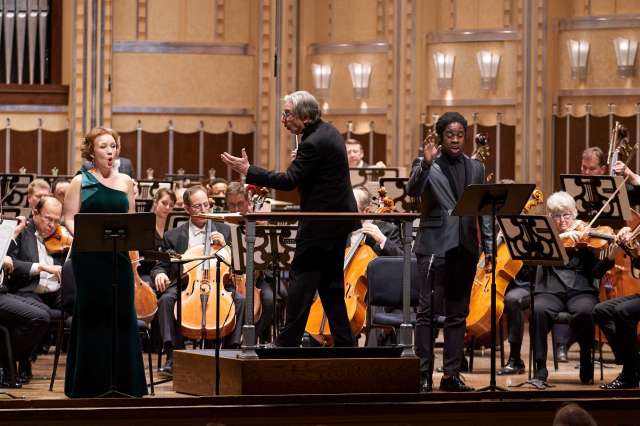
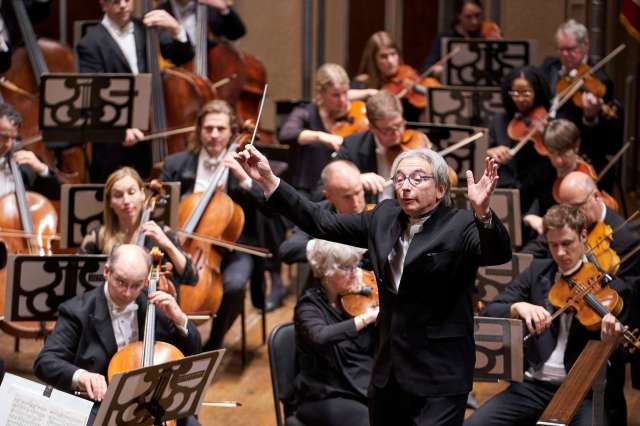
Now in his twenty-fifth and final season as music director of the San Francisco Symphony, Michael Tilson Thomas has increasingly devoted his time to composition, following in the footsteps of the composer-conductor luminaries with whom he closely worked – Stravinsky, Copland, and Bernstein amongst them. His freshly-minted song cycle Meditations on Rilke was given its second set of performances last weekend, following the San Francisco world premiere in January. It’s a work, however, which has been gestating in the back of Tilson Thomas’ mind for some time: in a recent interview, he referred to it as a “pages of [his] musical diary.” Structurally, the piece immediately brings to mind Mahler’s Das Lied von der Erde in its scoring for large orchestra with mezzo-soprano and bass soloists alternating between the six Rilke poems. While not on as large a scale as the Mahler, it’s still quite substantial, clocking in at just under forty minutes – the program was originally slated to open with Berlioz’s Roman Carnival Overture, a quantity which was excised when the MTT work burgeoned to its current dimensions.

164968-clo-022020-270c-roger-mastroianni--courtesy-of-the-cleveland-orchestra
Sasha Cooke, Michael Tilson Thomas, and Dashon Burton with The Cleveland Orchestra, photos credit Roger Mastroianni, courtesy of The Cleveland Orchestra

A deliberately out-of-tune, honky-tonk sounding upright piano had the first word in the opening “Herbsttag,” setting the scene in a small-town dive bar where the pianist introduces influences from the classical repertoire in addition to the standard pub fare, setting in motion the present set of stream-of-consciousness reflections. The texture grew from the solo piano to an orchestral landscape of colorful effects, remaining resolutely tonal and approachable. Dashon Burton offered a deep and powerful tone, yet was often touchingly pensive, and the spirit of Mahler was never far away – hardly a surprise in a work from such a distinguished Mahlerian as MTT. “Ich lebe mein Leben” was given a lushly gorgeous setting, sweetly sung by Sasha Cooke, and an oboe passage from Frank Rosenwein served as a further highlight. “Das Lied des Trinkers” again brought to mind Das Lied von der Erde in its apparent affinity for drinking songs. A rather more rambunctious counterpart to the preceding song, matters began plaintively but soon crested to the thorny and dissonant.

“Immer wieder” featured a glowing brass chorale, and as elsewhere, extensive paragraphs for orchestra alone. Cooke had a natural feel for MTT’s language in this gem of the cycle, which the composer colorfully likened to a “Schubert cowboy song” – Morricone came to my mind as well. The crack of a whip epitomized the vigor given to “Imaginärer Lebenslauf” which called upon both singers, often quite ingeniously blended. The concluding “Herbst” opened with a long flute solo very finely given by Joshua Smith. The harp and pizzicato strings gave matters an ineffably autumnal quality, and the cycle closed with Burton’s repeated incantation of “fallen”, serving a similar function as “ewig” in the work’s Maherlian predecessor.

MTT has a long history of not only conducting the Berlioz Symphonie fantastique, but conducting it in Cleveland, having first performed it with this orchestra in 1977. It made for a choice pairing with the Rilke songs with both works deeply autobiographical and evidencing their respective conductors’ acute ear for orchestral color. The dreamy “Rêveries” that opened was meditative yet never shying away from building to hypnotic passions. The first presentation of the ubiquitous idée fixe was refined, hardly hinting at the grotesque mutations to come, and the pious solemnity of the coda was another highpoint of this first movement. “Un bal” began as lilting waltz, emanating a Gallic elegance, only to dissolve in making way for the idée fixe. There was sharp clarity even given the sprawling orchestra, paying dividends in the blazing conclusion.

The “Scène aux champs” was given with ample breathing room, a capacious portrait of the quietude of the countryside. The dialogue between English horn Robert Walters and offstage oboe Jeffrey Rathbun was expertly articulated – and at the long movement’s end, Walters was answered not by Rathbun, but by the rumbling timpani, signaling the impending storm. “Marche au supplice” was tautly concentrated, erupting with brilliant brass anchored by a backbone of bassoons (four of them, no less). Daniel McKelway’s shrill interjections on the E-flat clarinet made for arresting effect in the closing “Songe d’une nuit du sabbat”, perhaps only outdone by the tolling cathedral bells and goosebumps-inducing low brass.

164966-clo-022020-473c-roger-mastroianni--courtesy-of-the-cleveland-orchestra
Tilson Thomas and The Cleveland Orchestra

CIM pianists Babayan and Trifonov dazzle in gala concert

Sergei Babayan, piano
Daniil Trifonov, piano
Mixon Hall
Cleveland Institute of Music
Cleveland, OH
February 19, 2020

Schumann: Andante and Variations for Two Pianos, Op. 46
Pärt: Pari intervallo
Mozart: Sonata for Two Pianos in D Major, K448
Rachmaninov: Suite No. 1 for Two Pianos, Op. 5, Fantasie-Tableaux
Rachmaninov: Suite No. 2 for Two Pianos, Op. 17

Encore:
Prokofiev, transc. Babayan: Idée fixe from The Queen of Spades, Op. 70

To inaugurate the celebrations surrounding the Cleveland Institute of Music’s landmark centennial year, two of the most distinguished pianists associated with the institution teamed up for a duo recital on Wednesday night. Sergei Babayan has held the title of CIM’s Artist-in-Residence since 1992, shortly after taking first prize in the Cleveland International Piano Competition, and at the second piano was his former student Daniil Trifonov. Trifonov’s meteoric rise is surely indebted in part to CIM where he earned an artist certificate in 2013, with an artist diploma following in 2015. Both pianists generously donated their time for the evening, and this benefit concert raised over $100,000 for the student scholarship fund. In his opening remarks, CIM’s president and CEO Paul Hogle further underscored the Institute’s role in the dynamic classical music scene of northeast Ohio, epitomized by over half of The Cleveland Orchestra being connected to CIM as alumni or faculty – if not both.

img_1899
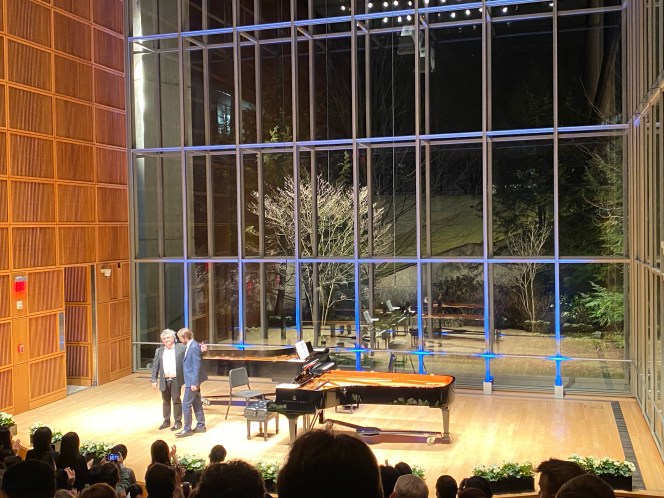
Sergei Babayan and Daniil Trifonov at Mixon Hall

Two pianos on the stage of intimate Mixon Hall made a bold impression, and while both instruments were oriented in opposite directions, their keyboards were aligned to enhance the natural communication between this teacher-student duo. Schumann’s Andante and Variations began the program. An intensely lyrical presentation of the theme opened, burgeoning into quintessentially Schumannesque music of Romantic fantasy and imagination. A militant march variation made for a powerful climax, with matters eventually giving way to a lovely, ruminative conclusion. Arvo Pärt’s Pari intervallo was quite far removed from any other selection performed, but certainly a highlight in spite of its brevity. Evaporated to the essential, its monastic austerity was enchantingly pensive and otherworldly in its repeated bell-like invocations, with the pianists sustaining a meditative state of unblinking concentration.

Mozart’s effervescent Sonata for Two Pianos in D major closed the first half, recalling Babayan’s memorable recital with Martha Argerich two seasons ago. Vigorous energy opened this pearl of the two piano literature, with seamless, crystalline playing evidencing the innate understanding amongst the duo. Rapid passages were crisply in sync, a must in the unforgiving transparency of this repertoire. A singing quality, almost akin to an operatic aria, was given to the central Andante, heightened by its delicate ornaments. The music became rather more unbuttoned in the finale, interspersed with varied material but inexorably gravitating back towards the joyous main theme, of dancing lightness and sparkling articulations.

The latter half was devoted to both of Rachmaninov’s hyper-Romantic Suites for Two Pianos. The “Barcarolle” of the First flowed with liquescent ease, and the pianists cleanly negotiated the detailed filigree. “La nuit… L’amour…” proceeded as a love song of often hypnotic beauty, and the following “Les larmes” was marked by its melancholy cantilena. While both pianists have a reputation for their leonine power, here we saw them turn inwards in music of quiet intimacy: perhaps the description of Rachmaninov possessing “fingers of steel and a heart of gold” applies to them as well. It was the former persuasion, however, that had the last word in the “Pâques” finale. Babayan introduced the theme at a moderate, measured pace, before matters erupted into a modal frenzy to close the suite with formidable weight and power.

A commanding, kinetic opening to the Second Suite showed in no uncertain terms that neither pianist was waning in energy as we neared the end of the program, cutting through the thickness of the dense chordal textures with ease. Here, for the first time, Trifonov assumed the primo role. The “Valse” was handled with rapid legerdemain, varied by an entrancing waltz theme, and the “Romance” offered a wonderfully lyrical interlude. An inevitable tour de force was to be had in the “Tarantelle”: a powerhouse conclusion punctuated by the relentless rhythms of the titular dance. As an encore, the pianists turned to one of Babayan’s own remarkable Prokofiev transcriptions (which can be heard on his emphatically recommended recording with Argerich), namely, the “Idée fixe” from The Queen of Spades, closing the festive evening in pile-driving intensity.

Mälkki and Josefowicz champion Sibelius, Knussen with The Cleveland Orchestra

Cleveland Orchestra
Susanna Mälkki, conductor
Leila Josefowicz, violin
Severance Hall
Cleveland, OH
February 6, 2020

Sibelius: En saga, Op. 9
Knussen: Violin Concerto, Op. 30
Sibelius: Symphony No. 1 in E minor, Op. 39

Ever the dynamic podium presence, Susanna Mälkki brought to The Cleveland Orchestra a pair of imposing yet less-trodden Sibelius scores, bookending a seminal 21st-centruy concerto from the late Oliver Knussen. Sibelius’ early tone poem En saga is the work of a confident young composer self-assuredly finding his voice, not heard at Severance Hall since a 1965 performance under George Szell. Undulating strings gave this single-movement essay an epic sense of scale, countered by thornier winds with the composer masterfully spinning a tale worthy its saga designation. A particularly memorable theme was articulated through the burnished, musky warmth of the violas and cellos, while a solo from clarinetist Daniel McKelway pointed towards a somber end: a mere whisper in the strings, fading away with remarkable control at the ppp dynamic level.

DSC_0072_nolamp-1024x683
Susanna Mälkki, photo credit Jiyang Chen

Knussen is a man who had a wonderfully fruitful relationship with TCO up to his untimely passing in 2018, both as composer and conductor. His 2002 violin concerto received its second Cleveland hearing, this time with champion of the contemporary violin repertoire Leila Josefowicz. Orchestral bells opened the work in striking fashion, with rapid runs high in the violin’s stratosphere. Despite the modernist dissonances, Josefowicz delivered with a luminous clarity. In many regards, this is a Romantic work at heart, a persuasion most pronounced in the resonant lyricism of the central Aria. The closing Gigue thrilled in its intricate web of rhythmic intricacies, negotiated with aplomb and finesse by all.

While the influences of the late Romantic milieu abound in Sibelius’ First Symphony, its opening of a solo clarinet – gorgeously played by Afendi Yusuf – over a rumbling timpani is pure Sibelius, unmistakably the composer’s own rarefied language, even in this inaugural symphonic effort. The strings entered in their celestial radiance for the movement proper with the music lush and rewarding. A dose of Nordic chill was introduced in the development, and perhaps it was Mälkki’s shared heritage with the composer that gave her such innate Sibelian fluency in this thoroughly convincing performance.

The endless melody of the Andante could easily be mistaken for a Tchaikovsky slow movement: he we saw not the forward-thinking Sibelius we would later come to know, but one firmly – and comfortably – rooted in the 19th-century. The scherzo was in turn a nod to Bruckner, and the orchestra remained in tight cohesion even at vigorous speed. A slow, measured introduction to the finale was seeped in melancholy and tragedy, yet in due course gave way to a boisterous, unrelenting affair, occasionally contrasted by a rich melody that resided deep in the strings. The brash coda proceeded with confident swagger, only to turn inward at the last moment to close in unexpected anticlimax.

20150924_C000231cRikimaru_Hotta
Leila Josefowicz with Oliver Knussen in 2015, photo credit Rikimaru Hotta

Rare Prokofiev highlights Welser-Möst’s offbeat Cleveland Orchestra program

Cleveland Orchestra
Franz Welser-Möst, conductor
Severance Hall
Cleveland, OH
January 30, 2020

Prokofiev: Symphony No. 6 in E flat minor, Op. 111
Bridge: The Sea, H100
Dukas: The Sorcerer’s Apprentice

Following their annual residency in Miami, The Cleveland Orchestra is back home for a hearty stretch of concerts leading up to another tour this spring that will take them to Europe and the Middle East. Franz Welser-Möst, continuing his often revelatory exploration of Prokofiev, opened the program with the composer’s seldom heard Sixth Symphony. If the Fifth Symphony celebrates the glories and triumphs of World War II, the Sixth takes a much darker approach in its bracing depiction of the war’s tragedies and losses. As Welser-Möst noted in his spoken introduction, here we have the usually complacent Prokofiev living on the “knife’s edge” of what was acceptable artistically to the Soviet authorities – with its ambiguities and underlying tragedy, it draws comparison to the subversive works of Shostakovich.

prok6
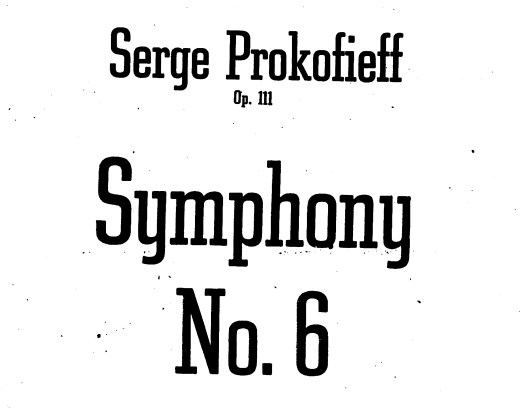
Title page of Prokofiev’s Sixth Symphony

The opening Allegro moderato was thorny and unforgiving, foregoing the familiar cohesion of sonata form for a structure underpinned by garish thematic transitions, through which Welser-Möst guided the orchestra with exacting precision. Stark textures were drawn from the low brass and rather busy piano, and the metallic climaxes depicted in no uncertain terms the true trauma of war. The central Largo served as the emotional crux, with arching strings introducing a pained lyricism. A percussive section, however, ensured this was far from a purely meditative affair, and the celesta added another striking timbre. The motoric finale, patently Prokofiev, delivered rapid fire repeated notes with a Haydnesque wit. An interjection of sparse and forlorn material gave pause before the conclusion – cacophonous, bombastic, and in apparent triumph, albeit only skin-deep.

An even rarer quantity followed after intermission in Frank Bridge’s orchestral suite The Sea. The Cleveland Orchestra gave the US premiere of the work under first music director Nikolai Sokoloff in 1923, and remarkably, hasn’t touched it since. Its four movements depict the titular entity in various guises, and would be a clear inspiration for the Four Sea Interludes from Peter Grimes by Britten, Bridge’s one and only composition student. Additionally, Bridge spent much time on the coast at Eastbourne, where Debussy too gleaned inspiration for another indelible musical sea portrait, La mer.

“Seascape” opened in lavish orchestration with a flowing melody in clear evocation of the sea – music of great beauty and appeal. The scherzo-like frothiness of “Sea Foam” depicted the ever-changing surface, while “Moonlight” unfolded as a nocturne with a delicate flute melody in counterpoint with the harp. Thundering timpani and dissonant brass conjured the closing “Storm”, but the sun shone through for a resplendent end – let us hope it is not nearly another century before we hear the work again!

Dukas’ one-hit wonder The Sorcerer’s Apprentice closed the evening in exciting fashion. Quiet mystery opened, setting the stage for the indestructible march theme, giving the bassoon and contrabassoon a rare moment in the spotlight. The orchestra amassed to vigor in bringing Goethe’s fantastical poem to life in musical terms, only to dissipate in a closing gesture as blistering as it was sudden.

Viotti makes memorable Cleveland debut in Russo-French program

Cleveland Orchestra
Lorenzo Viotti, conductor
Yuja Wang, piano
Severance Hall
Cleveland, OH
November 29, 2019

Prokofiev: Suite from The Love for Three Oranges, Op. 33bis
Rachmaninov: Piano Concerto No. 4 in G minor, Op. 40
 Encore:
 Gluck-Sgambati: “Dance of the Blessed Spirits” from Orfeo ed Euridice
Poulenc: Sinfonietta, FP 141
Ravel: La valse

Over the Thanksgiving weekend, The Cleveland Orchestra dependably serves a musical feast, and this year was hardly an exception. Friday (coincidentally, the 150th birthday of the orchestra’s founder, Adella Prentiss Hughes) marked the local debut of 29-year-old conductor Lorenzo Viotti. Currently principal conductor of Portugal’s Gulbenkian Orchestra, and dubbed to assume the same role with the Netherlands Philharmonic Orchestra next season, Viotti is a conductor who Cleveland music director Franz Welser-Möst singled out as being especially promising during an interview previewing the current season. Viotti’s colorfully appealing program was bifurcated by nationality with a Russian first half preceding a French second.

900 Lorenzo-liggend (1)
Lorenzo Viotti, photo credit Desiré van den Berg

Prokofiev’s six-movement suite from The Love for Three Oranges opened with the composer’s characteristically vigorous orchestrations, bringing to life the opera’s colorful cast of characters with gentler, dancing winds contrasting. The following “Infernal Scene” was darkly surreal in its unusual timbres, while the “Marche” – the opera’s most indelible quantity – was given a crisply rhythmic and foot-tapping workout. “The Prince and the Princess” made for a lyrical interlude, the deeply touching language anticipating Romeo and Juliet. Viotti roused the requisite virtuosity for the roiling “Flight” that closed.

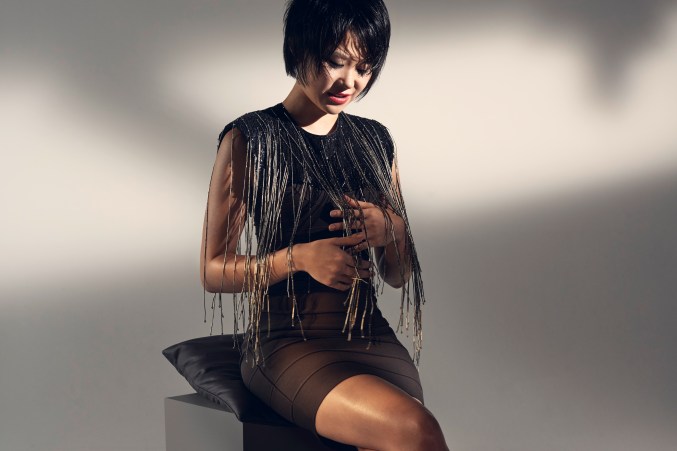
As central to repertoire as Rachmaninov’s works for piano and orchestra are, the Fourth Concerto has been relegated to periphery, not having been performed by this orchestra since 1996. An arsenal of energy opened, quickly paving the way for the full-bodied entry of the incomparable Yuja Wang. The fiendishly difficult piano writing was easily surmounted by her fleet fingerwork, and about two thirds of the way through the movement, matters burgeoned to a climax as grand and lush as anything Rachmaninov wrote. The solo introduction of the Largo was of deep melancholy, revealing Wang’s lyrical gifts, and in due course aided by burnished strings.

Textures grew impassioned and stormier, leading to the jarring transition to the closing Allegro vivace. Wang’s sleight-of-hand pianism negotiated the jazz-inflected rhythmic complexities, and chains of double octaves were effortlessly delivered with fire and panache. The orchestra supported Wang with a colorful accompaniment – Jeffrey Rathbun’s oboe a standout – culminating in a muscular conclusion. While ultimately perhaps not as memorable as the composer’s other works in the medium, it certainly merits hearings at more regular intervals! Although not indulging the Severance Hall audience in one of her encore marathons, Wang nonetheless responded to the hearty ovation with the wistful lyricism of a transcription from Gluck’s Orfeo ed Euridice.

The Cleveland Orchestra gave the US premiere of Poulenc’s Sinfonietta under George Szell in 1949, but remarkably hasn’t touched it since. Kudos then to Viotti for resurrecting this vintage gem, which despite its obscurity, local audiences had the chance to hear as recently as this past March on a CityMusic program. The opening movement brimmed with melodies of immediate appeal, piquant and bright, a sort of synthesis of 20th-century sensibilities within a classical economy, invoking comparison to Prokofiev’s Classical symphony. The inner movements were respectively joyfully light-hearted and sweetly songful, the latter with noteworthy solo passages from the trumpet and clarinet. Perhaps an expression of post-war bliss, the finale was utterly untroubled, and delectably so.

Continuing with French appropriations Germanic forms, matters turned to waltz in Ravel’s iconic La valse. Originally conceived for solo piano (heard just the previous weekend in Soyeon Kate Lee’s recital at the Cleveland Museum of Art), the orchestral version shows in no uncertain terms the composer’s stunning mastery of instrumentation. Beginning with barely audible rumbles, a sultry waltz theme took shape, with sumptuous harps adding to the dizzyingly rich tapestry: a glitteringly cataclysmic dissolution of the once venerable waltz.

Yuja-Wang-by-Norbert-Kniat-DG-11
Yuja Wang, photo credit Norbert Kniat


McGegan’s Cleveland Orchestra program effervesces with classical charm

Cleveland Orchestra
Nicholas McGegan, condcutor
Michael Sachs, trumpet
Severance Hall
Cleveland, OH
November 21, 2019

Schubert: Selections from Rosamunde, D797: Overture – Ballet Music No. 1 – Entr’acte No. 3 – Ballet Music No. 2
Hummel: Trumpet Concerto in E major
Haydn: Symphony No. 104 in D major, Hob. I:104, London

This marked the third consecutive November Nicholas McGegan has stood at The Cleveland Orchestra podium, and his charm and affable spirit without fail warms an otherwise chilly time of the year. The present program straddled the eighteenth and nineteenth centuries, with Hummel’s Trumpet Concerto the centerpiece, bringing into the spotlight Cleveland principal Michael Sachs. Proceeding in reverse chronological order, McGegan opened with selections from Schubert’s incidental music to Rosamunde.

Nicholas+McGegan+Photographer+Randy+Beach.jpg
Nicholas McGegan, photo credit Randy Beach

What is known as the overture to Rosamunde was in fact the repurposed overture to Schubert’s earlier (and unsuccessful) opera Der Zauberharfe. A bold sense of drama opened, but the remainder of the work bubbled with a graceful Schubertian charm. The first of the ballets was of a symphonic weight in its Sturm und Drang sensibility, but more mellow material offered contrast near the end, heightened by the clarinet of Afendi Yusuf. One of Schubert’s most cherished melodies, later reused in one of the impromptus for piano as well as the thirteenth string quartet, resounded through a choir of strings and winds in the Entr’acte. Another ballet rounded off McGegan’s suite, given with a rustic abandon.

Hummel’s Trumpet Concerto remained a forgotten quantity until it was rediscovered in the 1950s by trumpeter Armando Ghitalla. Originally cast in the key of E major, Ghitalla opted to publish the work transposed to E flat for ease of playability on the modern trumpet. It continues to be most often heard in the lower tonality today, including in Sachs’ two previous performances of the work with this orchestra. This time, however, Sachs stayed faithful to the composer’s intentions, easily surmounting the inherent technical hurdles. The martial opening was bright and brilliant with the soloist offering a limpid flexibility and climactic trills. The long-breathed tones of the central Andante, interjected by further trilling gestures, were pitted over an undulating accompaniment – a lyrical essay to be sure, but not without a certain grandeur. A jaunty rondo served as the finale, showcasing Sachs’ rapid-fire virtuosity and a never-waning vigor from both soloist and orchestra.

Haydn’s final entry of his long series of symphonies concluded the evening. The attention-grabbing opening made a sharp turn to the doleful minor before this introductory material gave way to the delectably appealing material firmly in the home key of D major. Here and throughout, McGegan drew out a playing in equal parts refined and joyous. The slow movement was a gentle affair, deftly balanced and crisply articulated. A rhythmic vitality served the minuet well, with Jeffrey Rathbun’s oboe of note in the trio. Energy was never at the expense of clarity in the effusive finale, the main subject of which was rooted in a Croatian folk song.

Hrůša explores the end of life through Adams and Mahler

Cleveland Orchestra
Jakub Hrůša, conductor
Joélle Harvey, soprano

Cleveland Orchestra Chorus
Lisa Wong, director
Cleveland Orchestra Children’s Chorus
Ann Usher, director
Cleveland Orchestra Youth Chorus
Daniel Singer, director

Severance Hall
Cleveland, OH
November 14, 2019

Adams: On the Transmigration of Souls
Mahler: Symphony No. 4 in G major

Following up on last week’s juxtaposition of Shostakovich and Beethoven, Jakub Hrůša offered a second week of incisive contrasts in Adams and Mahler. Both works were concerned in some fashion with the end of life, though of vastly different orientations. Written as a tombeau for the victims of 9/11, Adams’ On the Transmigration of Souls received its belated Cleveland premiere this week. Conceived almost immediately in the wake of the events memorialized, the work was first performed in New York in September 2002, and earned Adams the Pulitzer Prize for Music the following year.

151730-clo111419-508-credit-roger-mastroianni-courtesy-of-the-cleveland-orchestra
Jakub Hrůša and Cleveland Orchestra and choruses perform On the Transmigration of Souls. Photos credit Roger Mastroianni, Courtesy of The Cleveland Orchestra

In addition to large orchestra, chorus, and children’s chorus, the work makes extensive use of pre-recorded electronica, with an elaborate array of speakers wrapping the hall in surround sound. Ambient sounds of the city opened the piece, initially sounding as business as usual, but quickly giving way to sirens and boy’s repeated incantation of “missing.” The choir entered, ethereal and wordless, and strident trumpet solo was heard from an offstage Michael Sachs. It’s a daunting task to adequately capture the emotions of this subject matter in music, and to that end, Adams took pains to eschew any conventional notions of a requiem, instead producing a work with almost no narrative structure, allowing for a multitude of individual responses to its entrancing and mournful solemnity.

Particularly poignant were the recordings of brief tributes to certain victims – one who was described as having “a voice like an angel”: and such a voice we were to hear in the subsequent Mahler. About two-thirds of the way in came a caustic climax, and one could viscerally feel the weight of the events of that day. I would suggest another parallel to Mahler in that it follows a similar arc to the first movement of the Tenth Symphony, spanning roughly the same length, and of autumnal feeling until the shattering crest at about the same point. The music waned, especially doleful as names were read, and matters faded once again into the fabric of the cityscape.

Mahler’s Fourth Symphony has been called the most Viennese of his symphonies, following a more traditional four movement structure and of modest proportions in length and orchestration (by Mahler’s standards, at least). It’s a piece thus particularly well-suited to this orchestra, noted for their classical precision and balance as well as a strong Mahler tradition – and documented in a noted recording of this symphony with Pierre Boulez. The sleigh bells that opened made for a fantastical, almost fairy-tale like atmosphere, countered by graceful strings. The apparent naïveté ran only surface-deep, however, with Hrůša probing beyond its appealing veneer. The winds were in fine form, especially principal flute Joshua Smith, bright and bucolic, and the trumpets hinted at what would become the iconic opening of the Fifth. The more impassioned sections could have benefited from greater clarity, but there was a wonderful moment of serenity before the movement’s boisterous end.

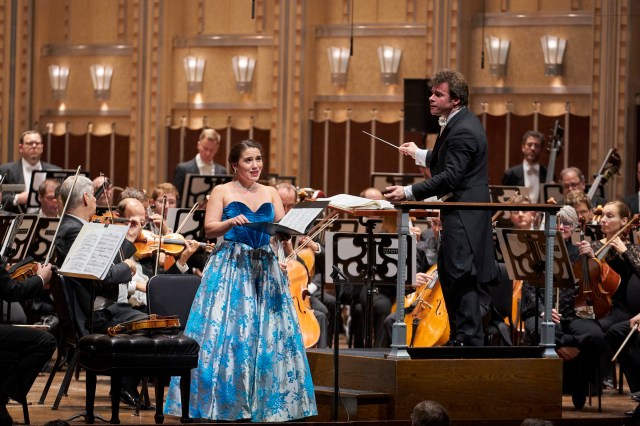
Announced by the horns, the second movement was rooted in the ländler, but as through a distorted lens. Concertmaster Peter Otto coarsely played a detuned violin, emulating a folksy fiddle, and Daniel McKelway’s contributions on the clarinet were shrill yet stylish. The ensuing Ruhevoll opened in a divine simplicity, the strings of the orchestra playing with the intimacy of a quartet. In his pre-concert lecture, Bryan Gilliam keenly noted that Mahler created a nostalgia for a world that never was. The brass were particularly warm in the climactic opening of heaven’s gates, with the strings reaching higher and higher, grounded by the angelic harp. A silky clarinet marked the finale, introducing soprano Joélle Harvey, who previously sang Mahler with this orchestra in last season’s performance of the Second. Her limpid and fluid voice offered the Wunderhorn setting much character, closing each stanza with a profundity that gave weight and authenticity to this child’s depiction of heaven.

151728-clo111419-390-credit-roger-mastroianni-courtesy-of-the-cleveland-orchestra
Joélle Harvey in Mahler’s Fourth Symphony

Apollo’s Fire opens season in brilliant Venetian program

Apollo’s Fire
Jeannette Sorrell, conductor
Apollo’s Singers
Dark Horse Consort

Trinity Cathedral
Cleveland, OH
October 18, 2019

Gabrieli: Canzon in echo à 12, for 3 choirs, Ch. 192
Monteverdi: Cantate Domino à 6, from Motets, Book I
Gabrieli: In Ecclesiis à 14, for 3 choirs, Ch. 78, from Sacrae symphoniae II
Rosenmüller: Sonata No. 12 in D minor
Praetorius: Ach, mein Herre, from Polyhymnia Caduceatrix et Panegyrica
Monteverdi: Chiome d’oro, bel tesoro, from Madrigals, Book 7
Monteverdi: Zefiro torna e di soave accenti, from Madrigals, Book 9
Marini: Sonata in Ecco con tre violini, Op. 8 No. 44
Monteverdi: Duo Seraphim, from Vespers of 1610
Schütz: Jauchzet dem Herren, SWV 100, from Psalmen Davids
Praetorius: Meine Seel Erhebt den Herren, from Polyhymnia Caduceatrix et Panegyrica
Riccio: Canzon a doi soprani in Echo proposta, from Il secondo libro delle Divine Lodi
Gabrieli: Canzon in Echo duodecimi toni, Ch. 180, from Sacrae symphoniae
Monteverdi: Nisi Dominus, Suscepit Israel, and Sicut erat in principiov, from Vespers of 1610

Venice in the Renaissance and Baroque bore witness to an extraordinary flourishing of musical life, the focal point of which was the magnificent St. Mark’s Basilica. That venue virtually inspired a whole repertoire of music, tailored to the basilica’s unique acoustics wherein musicians were often dispersed throughout to yield a mystical echo effect. Appropriately styled as “Echoes of Venice”, Apollo’s Fire sought to recreate this body of work in a program curated by musicologist Marica Tacconi, who was on hand for an informative pre-concert lecture. A generous helping of composers who served as the basilica’s maestro di cappella formed the backbone of the program, loosely organized by theme, and was fleshed out with works from a handful of Germans who took clear inspiration from their Venetian counterparts – a testament to the far-reaching influence of this aesthetic.

73008090_10157547116302398_932548003959406592_n
Jeanette Sorrell and Apollo’s Fire in “Echoes of Venice”, photos credit Apollo’s Fire

For the weekend’s performances, AF was buttressed by the Boston-based period ensemble Dark Horse Concert, adding to the forces cornetti, sackbuts, and additional strings. The opening selection from the younger Gabrieli was lively and conversant, even if the intonation left something to be desired, reverberating throughout the Trinity Cathedral. Monteverdi’s Cantate Domino à 6 was crisply articulated, and introduced the resonant choir. Another selection from Gabrieli followed, stemming from the extensive Sacrae symphoniae (I was reminded of a Cleveland Orchestra program that touched this repertoire a couple seasons ago). Divided into three “choirs”, namely the instrumentalists and two groups of singers, the antiphonal layering achieved a striking effect.

Johann Rosenmüller was the first voice from the north heard on the program in his Sonata No. 12 in D minor. An ensemble of strings grounded by two theorbos gave genuine feeling to the three brief movements that comprised this doleful lament. Praetorius’ Ach, mein Herre could reasonably be mistook for a Venetian work, save for the language. Amanda Powell was the standout in a trio of sopranos that also included Rebecca Myers and Madeline Apple Healey, handling the intricate writing with aplomb. A pair of Monteverdi madrigals rounded out the first half. Chiome d’oro, bel tesoro was marked the rhythmic snap of the strings countered by the angelic blending of the two sopranos, Powell and colleague Raha Mirzadegan. Zefiro torna e di soave accenti charmed in its dance-inflected rhythms, with conductor Jeanette Sorrell leading from the tambourine.

Marini’s Sonata in Ecco con tre violini made for a striking opening to the second half. Beginning as a fairly standard sonata for a solo violin, the soloist was in due course joined by two further violinists stationed elsewhere around the cathedral. The space itself was thus used musically in this mesmerizing echo effect. Monteverdi’s Duo Seraphim, a gem from the Vespers, called upon three tenors – Jacob Perry, Nathan Hodgson, and Nathan Dougherty. Starting as a quite gorgeous duet, midway through the third joined in evocation of the trinity. Heinrich Schütz has justly been dubbed the “Gabrieli of the north”; choirs were positioned in both the front and back to envelop the audience in the euphony of his psalm setting Jauchzet dem Herren. Praetorius was revisited in Meine Seel Erhebt den Herren, bringing forth the same soprano trio as before, a magnificat fittingly magnificent, and the evening closed in the radiance of four further selection from Monteverdi’s Vespers.

73001138_10157547116527398_5798715761002283008_o
Tenors Jacob Perry, Nathan Dougherty, and Nathan Hodgson perform Monteverdi’s Duo Seraphim


An unexpected Severance Hall debut yields appealing results

Cleveland Orchestra
Klaus Mäkelä, conductor
Augustin Hadelich, violin
Severance Hall
Cleveland, OH
October 17, 2019

Messiaen: Les Offrandes oubliées
Prokofiev: Violin Concerto No. 2 in G minor, Op. 63
 Encore:
 Tárrega: Recuerdos de la Alhambra
Beethoven: Symphony No. 7 in A major, Op. 92

Following the cancellation of Jaap van Zweden, the weekend’s Cleveland Orchestra concerts found a substitute in the shape of the youthful Finnish conductor Klaus Mäkelä, poised to become chief conductor of the Oslo Philharmonic next season. Thursday counted as Mäkelä’s Severance Hall debut, having first conducted TCO at Blossom just a few months ago. Van Zweden’s program stayed intact save for the originally slated opener of Louis Andriessen’s Agamemnon, which hopefully can be revisited in a future season. When faced with a last-minute program change, most orchestras would opt for the familiar, but not so for TCO who turned attention to Messiaen’s Les Offrandes oubliées.

Makela_17-04-25_067c_A4
Klaus Mäkelä, photo credit Heikki Tuuli

Dating from 1930, Les Offrandes oubliées is the composer’s first published orchestral work (a piano transcription would follow the next year). Structured as triptych in evocation of the trinity, the plaintive opening was almost monastic in its austerity. The central section contrasted in every way, often violent in intensity, and time stood still in the glacially-paced final panel, entranced in spiritual contemplation – even in spite of the particularly vociferous army of coughers present in Thursday night’s audience.

Violinist Augustin Hadelich was also making his Severance Hall debut, having performed with this orchestra a handful of times at Blossom since 2009. Prokofiev’s Violin Concerto No. 2 shows the composer at his most lyrical, beginning unaccompanied with a winding and rather unsettling lyricism emanating from Hadelich’s “Ex-Kiesewetter” Stradivarius. The orchestra supported him via a colorful accompaniment, with Hadelich in deft balance, always achieving a clear projection. The central slow movement features one of Prokofiev’s most lush and lovely melodies, so different from the motoric and mechanistic works of his youthful years as an iconoclastic firebrand. Near the movement’s end was a striking role reversal wherein Hadelich offered a pizzicato accompaniment to buttress the orchestra’s lyricism. The foot-tapping finale was given with a driving vigor, its dance inflections heightened by the use of castanets, also a nod to where the concerto received its 1935 premiere: Madrid. Hadelich’s encore continued the Spanish thread with a transcription of Tárrega’s Recuerdos de la Alhambra, the rapid repeated notes of mesmerizing effect.

The finale of the Prokofiev also dovetailed neatly with the closing Beethoven: none of Beethoven’s works invoke dance as much as the Seventh Symphony, which Wagner famously called “the apotheosis of the dance.” The introduction, the longest of any of the Beethoven symphonies, was given with marked weight in hinting at all that was to come. Rhythmic fragments were introduced, eventually coalescing into the movement proper’s thematic material, heralded by principal flute Joshua Smith. Featherlight textures danced, soon to be countered by the might of the full orchestra. The principal winds were all in fine form, the leading force of the orchestra’s seemingly boundless reserves of energy.

Mäkelä rightly conducted the Allegretto not as a funereal dirge, but in emphasizing its songful beauty, with matters solemn and often awe-inspiring. Rambunctious strings took flight in the scherzo, contrasted by the gleaming brass of its trio. The energy was cranked up yet another notch for the finale, taken at a brisk, uncompromising tempo. An all-around strong showing from a talented young conductor.