Takács Quartet marks 50th anniversary in return to Cleveland Chamber Music Society

Takács Quartet
Cultural Arts Center
Disciples Church
Cleveland Heights, OH
November 11, 2025

Haydn: String Quartet in G minor, Op. 74, No. 3, Hob. III:74, Rider
Bartók: String Quartet No. 3
Dvořák:  String Quartet No. 13 in G major, Op. 106

Encore:
Debussy: String Quartet in G minor – 2nd mvt.

Founded in 1975 while students at the Liszt Academy in Budapest, half a century later the Takács Quartet continues to offer a gold standard of string quartet playing — and remarkably, still counts one original member in its ranks (cellist András Fejér). Tuesday night marked a welcome return to the Cleveland Chamber Music Society (which celebrated its own 75th anniversary last season) where they have long been regular guests — in recent years, performing with Marc-André Hamelin and in a memorable Grieg/Shostakovich program.

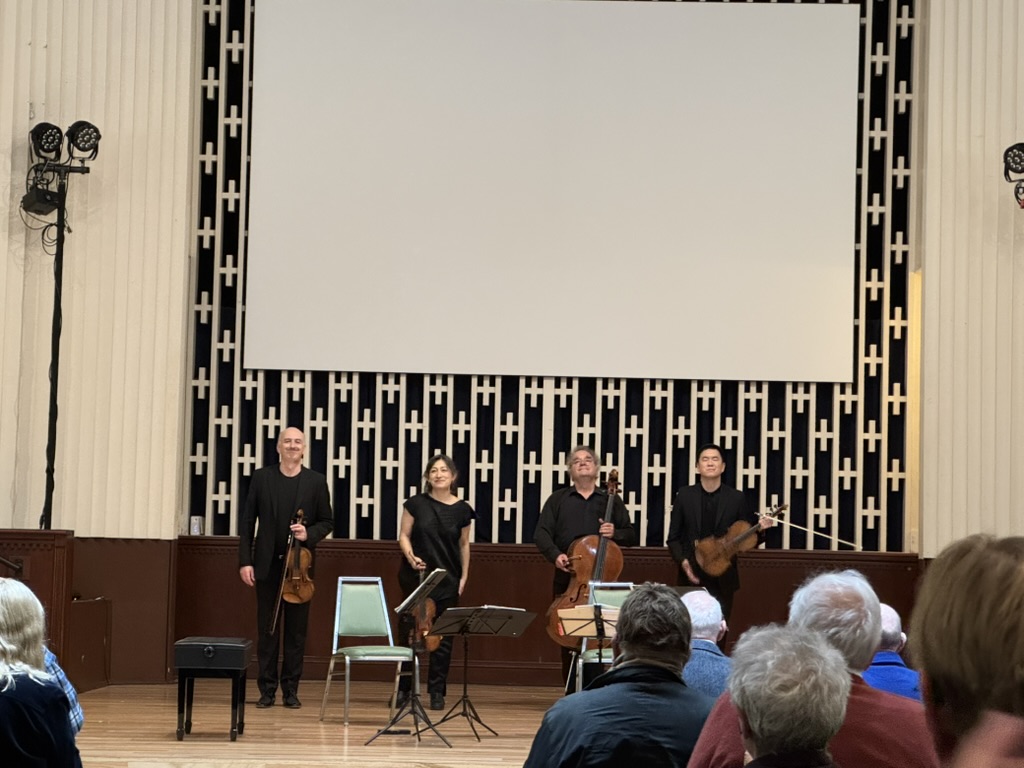
Takács Quartet at the Cleveland Chamber Music Society

The so-called father of the string quartet, Haydn is always a rewarding composer with which to begin a string quartet recital. Tuesday’s selection was the Rider quartet in its bristling G minor. It opened in quintessential Haydnesque fashion with its delicate ornamentations and sudden pauses. This genteel material was given with tight cohesion, carefully conveying its layered textures with clarity. Some striking modulations were heard in the slow movement before an elegant minuet countered by a rather stormy trio (usually it’s the trio that’s the calmer one). The fiery, galloping finale is what gave this work its epithet, and Haydn had the last laugh with its humorously deceptive close.

Of Bartók’s six iconoclastic quartets, the Third is the shortest but also the most concentrated. It’s quite unusual in form, too, with two contrasting parts subsequently repeated in a loose mirror of their initial presentation. Protean strands began, organically growing in weight and intensity — preconcert lecturer Kevin McLaughlin aptly compared this soundscape to Stravinsky’s Rite of Spring. A panoply of extended techniques were deployed, yielding an array of captivating sounds. Melodically, harmonically, and rhythmically intricate, the second part was blistering in its driving appropriation of folk song. The so-called Ricapitulazione of first part surfaced like a distant dream of the opening before the work’s uncompromising close.

It was lovely to hear Dvořák on a string quartet program in a piece that isn’t the justly famous American quartet. The Takács instead offered the Bohemian composer’s penultimate work in the genre: no. 13 in G major, Op. 106 (I was also reminded the Apollon Musagète Quartet presenting Dvořák’s final quartet on a CCMS program in February 2020, just ahead of the covid shutdown). In these last two works in the form, Dvořák sailed to new heights, only to then turn his attention away from chamber music and to opera and the tone poem.

Gentle gestures opened to set an intoxicatingly bucolic mood, only to grow in dramatic tension and orchestral heft. First violinist Edward Dusinberre had a soaring melodic line, and the broad first moment movement drew to particularly robust coda. Rich textures were layered on top of each in the angelic slow movement, somewhat reminiscent of Beethoven’s Heiliger Dankgesang. At its conclusion, some earthy pentatonicism reminded us this came from the same pen as the man wrote the New World symphony.

Even more quintessential Dvořák came in the following, wherein the composer proudly displayed his Czech origin in the shape of a spunky furiant. I was struck by the Takács intense physicality here, playing with their whole bodies. The bold, wide-ranging finale was given with unified direction for a powerful close.

As an encore, the quartet turned to the second movement of Debussy’s sole work in the medium in a show of their versatility, equally adept in the Frenchman’s impressionist enigma.

Masterful Brahms and completion of Prokofiev cycle at The Cleveland Orchestra

Cleveland Orchestra
Franz Welser-Möst, conductor
Daniil Trifonov, piano
Mandel Concert Hall
Severance Music Center
Cleveland, OH
October 9, 2025

Prokofiev: Symphony No. 7 in C-sharp minor, Op. 131
Brahms: Piano Concerto No. 2 in B-flat major, Op. 83

Encore:
Prokofiev: No. 20 from Visions fugitives, Op. 22

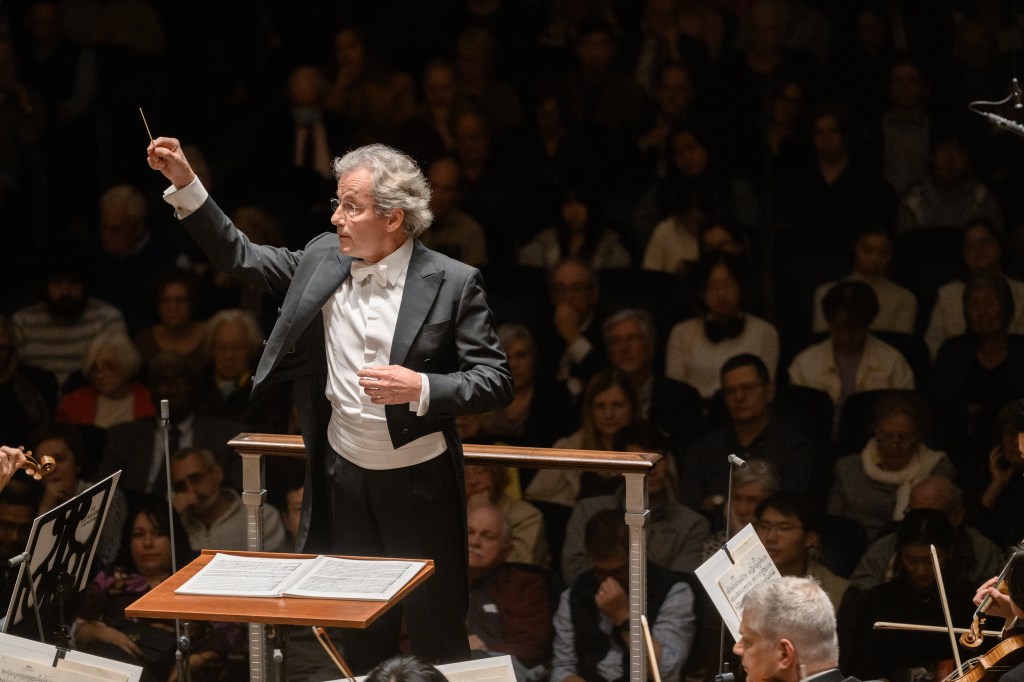
I’ve been intrigued by Franz Welser-Möst’s endeavor to perform and record all seven of the Prokofiev symphonies with The Cleveland Orchestra. After some eight years, that cycle came to fruition this weekend with the enigmatic Seventh Symphony, the last major work the composer completed. Only the First and Fifth of these symphonies are performed with any regularity, so it’s been a welcome opportunity to discover the rest — though the quality can be uneven.

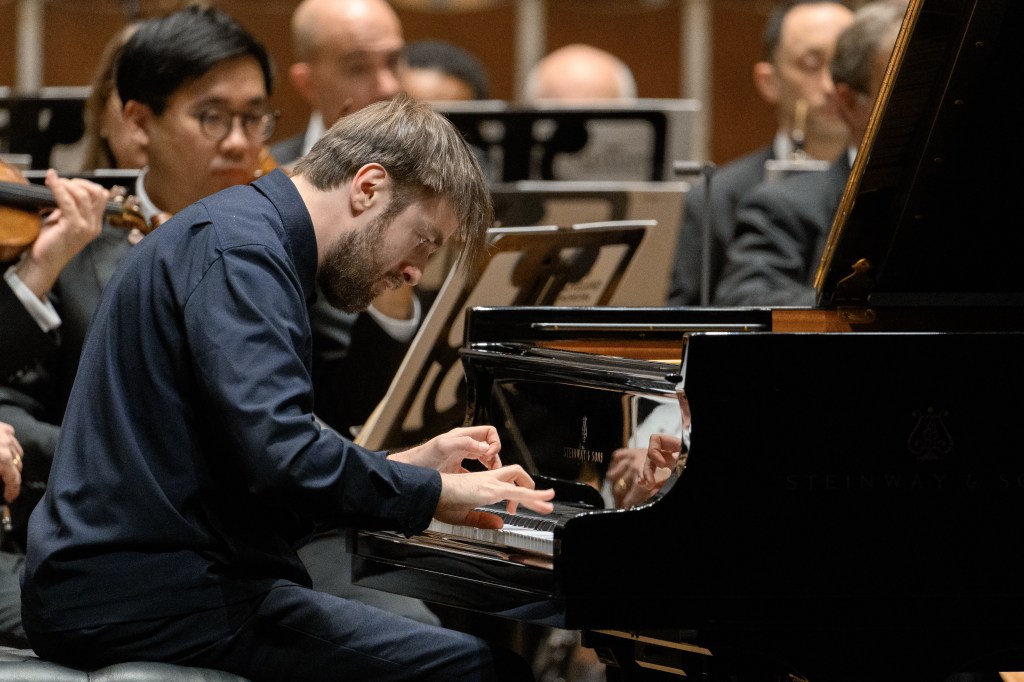
Daniil Trifonov performs Brahms with The Cleveland Orchestra. Photos credit Human Artist / Yevhen Gulenko

Moderately-paced material opened the work in the unusual key of C-sharp minor (common in the piano literature, rare for the orchestra), somewhat mysterious in character in the way that composers’ late works often are. The lyricism was straightforward and unadorned, but what stood out were the striking instrumental combinations, spattered with liberal use of the glockenspiel. A scherzo followed with vestiges of a waltz. A bit spikier than the restrained opening, it was still generally reserved until the boisterous close.

In the Andante espressivo, one was reminded of the poignant lyricism in Prokofiev’s ballet scores, contrasted by the playful and rather sardonic finale. The composer revised the original quiet ending for a bombastic one in an attempt to better appease the Soviet authorities, but was to said to have preferred the original — a preference which Welser-Möst rightfully respected in these performances.

Having been educated at the Cleveland Institute of Music on the precipice of his meteoric rise, pianist Daniil Trifonov remains a local favorite. He served as a probing soloist in Brahms’ daunting Second Piano Concerto (a follow up to his performance of the First two seasons ago — so effectively, another cycle came to a close Thursday evening). An amber horn call opened to herald the gentle arpeggios that rolled across the keyboard. Right at the beginning there was a solo cadenza which put Trifonov’s bold sound and rich tone on full display. An impassioned performance, he conceived the spacious first movement in broad strokes, with piano and orchestra functioning as equal partners in a work that’s perhaps more symphony than concerto.

Though the two works on this program had little in common, they mirrored each other in terms of structure, so as with the Prokofiev, a scherzo followed ahead of the slow movement. Brahms’ was generally a sunny affair though not without discord, played with a driving intensity that was briefly abated during the gentler trio and a passage of ravishing lyricism. Principal cellist Mark Kosower opened the Andante with a gorgeous solo, also serving to give the pianist a momentary but well-earned rest. This slow movement made for a serene moment in an otherwise energetic work. And despite the weight and seriousness of the preceding, the closing movement was of joyous abandon.

As an encore, Trifonov fittingly returned to the composer that opened the evening in Prokofiev, namely the last of the Visions fugitives, a suite of twenty artfully crafted miniatures for piano (the pianist performs the whole set on his recital programs this season). A touching way to bring the evening full-circle.

Leif Ove Andsnes contrasts Chopin with Norwegian piano sonatas in Cleveland recital

Leif Ove Andsnes, piano
Mandel Concert Hall
Severance Music Center
Cleveland, OH
March 27, 2025

Grieg: Piano Sonata in E minor, Op. 7
Tveitt: Piano Sonata No. 29, Op. 129, Sonata etere
Chopin: Preludes, Op. 28

Encore:
Debussy: La cathédrale engloutie, from Préludes Book I

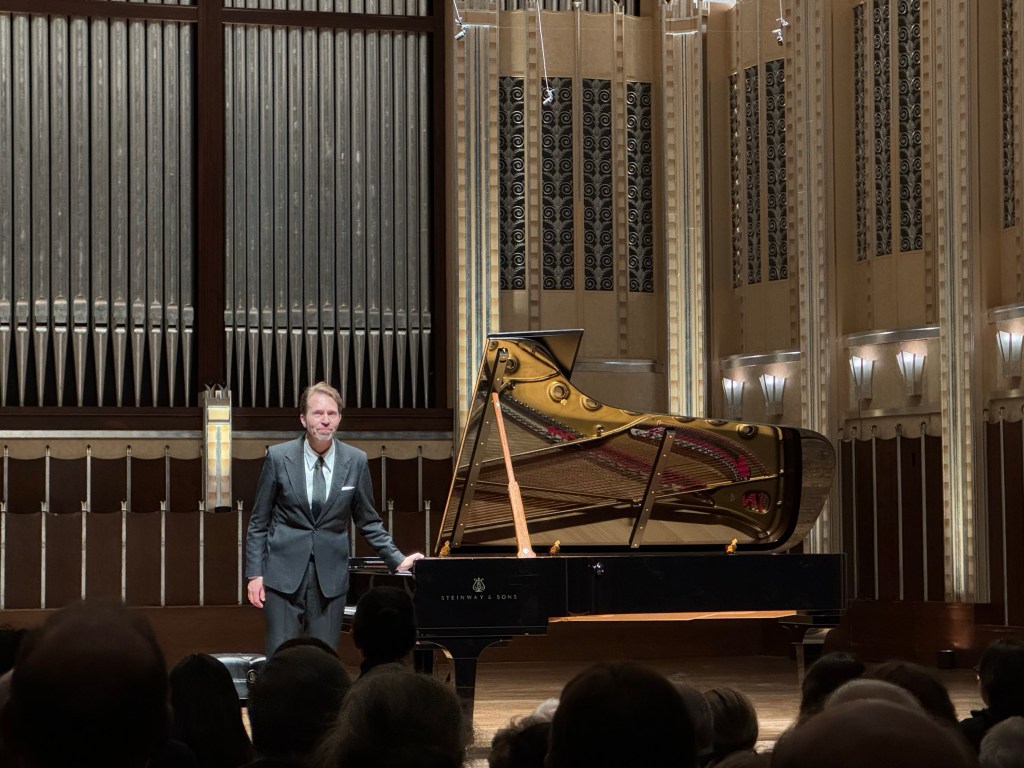
The first half of Leif Ove Andsnes’ Thursday night piano recital in Cleveland plunged into wholly unfamiliar territory in an exploration of the Norwegian piano sonata. The pianist proved to be an incisive guide to the music of his home country, beginning with the Piano Sonata in E minor from the pen of a 22-year-old Edvard Grieg.

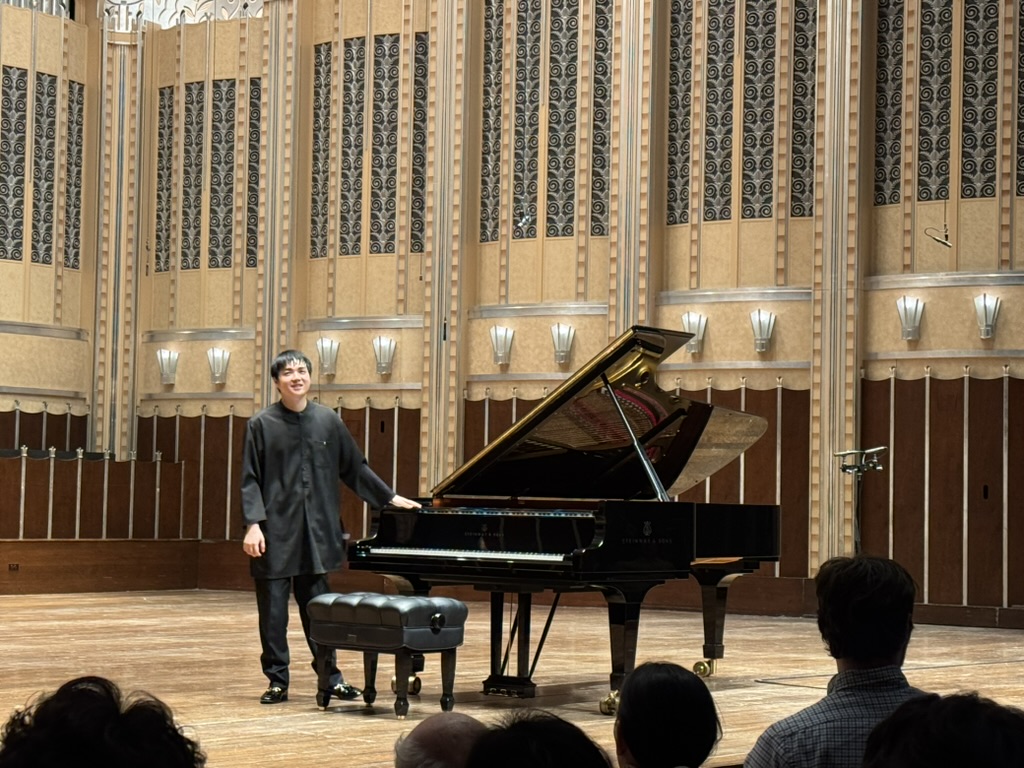
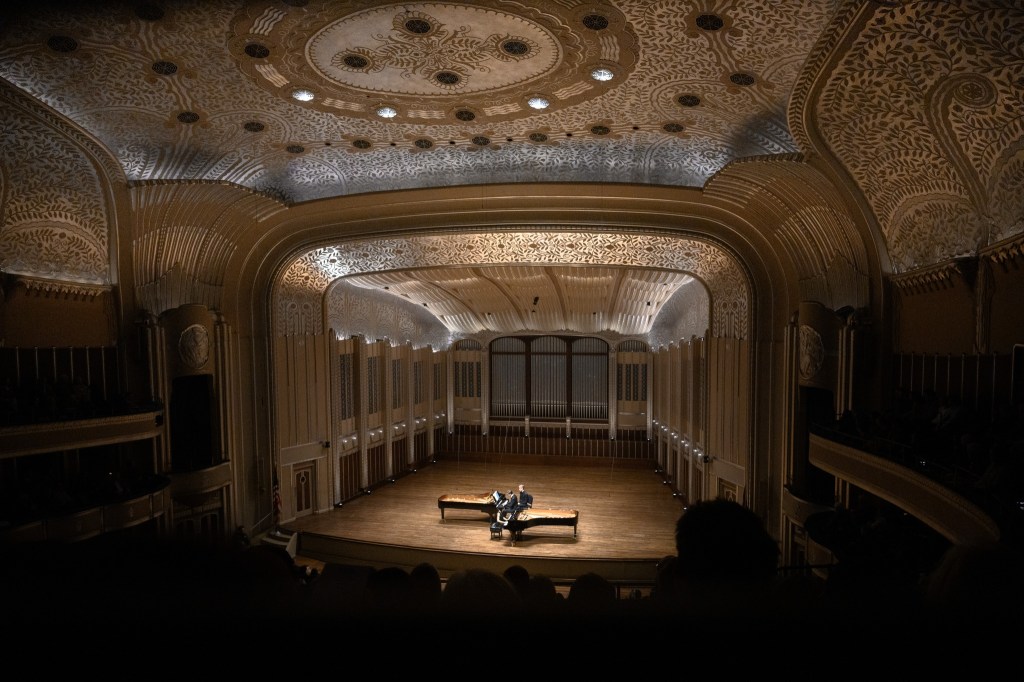
Leif Ove Andsnes at Severance Hall

Brimming with youthful energy, the piece balanced both the lyrical and the dramatic. A slow movement was delicate in its simplicity, though it built in density and traversed some striking harmonic modulations. The sonata very much bore the influence of Schumann above all, but the brief third movement was quite original, showing the composer finding his individual voice. The finale capped off this attractive work with a bravura march.

The real rarity came in the Piano Sonata No. 29 of Geirr Tveitt. Like Grieg, Tveitt studied in Leipzig, but returned to Norway where he developed his unique style. He settled in an isolated area in Norway’s Hardanger region, though tragedy would strike when a fire in 1970 would destroy nearly 300 of his unpublished manuscripts, the majority of his body of work. The Sonata etere (“Ethereal Sonata”) is the only surviving piano sonata — astonishingly, number 29 out of an unknown quantity lost to the flames.

A startlingly original work, there are perhaps nods to Prokofiev or Bartók in its percussive gestures or the French impressionists in its coloristic writing, but one imagines the composer writing in isolation, free from outside influences. A large-scale, 35-minute conception, the first movement (titled In cerca di — “In search of”) was propelled forward with driving energy — and I found Andsnes even more compelling than the composer’s own recording.

The central Tono Etereo in Variazoni consisted of 19 variations, most strikingly featuring a cluster of notes depressed with the pianist’s entire left arm, an ethereal resonance that would recur throughout. Overtop this were spiky jabs in the right hand the drew out the skeleton of a theme on which the variations were based. The variations were largely lyrical, and with subtle yet captivating effects. The closing Tempo di Pulsazione was virtuosic and bracing, though not purely percussive with its lyrical interludes, in due course fading away into the ether.

Chopin’s magnificent set of 24 preludes comprised the second half. Andsnes gave each one of these gems loving attention to detail, bringing out their unique personalities and sharpening contrasts across the set. I was struck by the majestic take on #9 and the ferocious energy given to #12, only outdone by the chillingly dramatic closing prelude. I loved the way he deftly voiced the chords in #20, and the warmly poetic readings he gave to #13 and #17 were deeply rewarding.

Andsnes offered a single encore from another great cycle of preludes in Debussy’s Sunken Cathedral, painting a wondrous soundscape.

While several artists have justly announced boycotts of the US in response to the current political climate, upon his arrival in this country, Andsnes thoughtfully mused on the potential music has to bring people together. A further post saw him marveling at the beauty of the Severance Hall stage. The pianist certainly proved that a captivating performance in a gorgeous venue can offer much-needed solace.

Ólafsson and Wang dazzle in spectacular two piano recital

Yuja Wang, piano
Víkingur Ólafsson, piano
Mandel Concert Hall
Severance Music Center
Cleveland, OH
February 23, 2025

Berio: Wasserklavier (No. 3 from Six Encores)
Schubert: Fantasie in F minor, D940
Cage: Experiences No. 1
Nancarrow: Study No. 6 (arr. Adès)
Adams: Hallelujah Junction
Pärt: Hymn to a Great City
Rachmaninoff: Symphonic Dances, Op. 45

Encores:
Brahms: Waltz in A-flat major, Op. 39 No. 15
Dvořák: Slavonic Dance in E minor, Op. 72 No. 2
Brahms: Hungarian Dance No. 1 in G minor
Brahms: Waltz in E major, Op. 39 No. 2
Brahms: Waltz in G-sharp major, Op. 39 No. 3

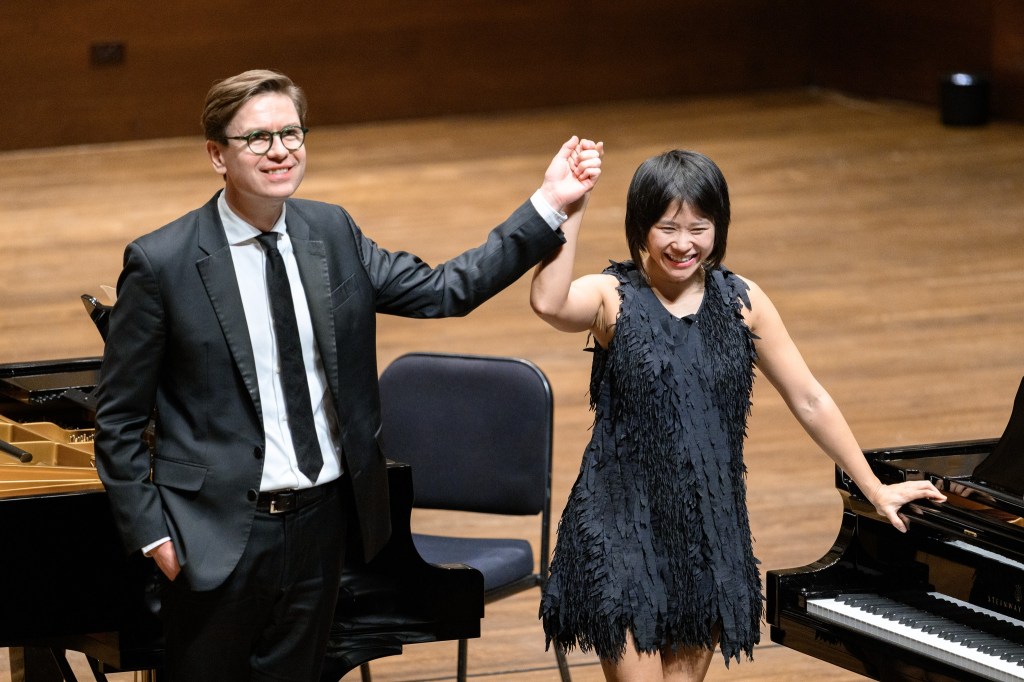
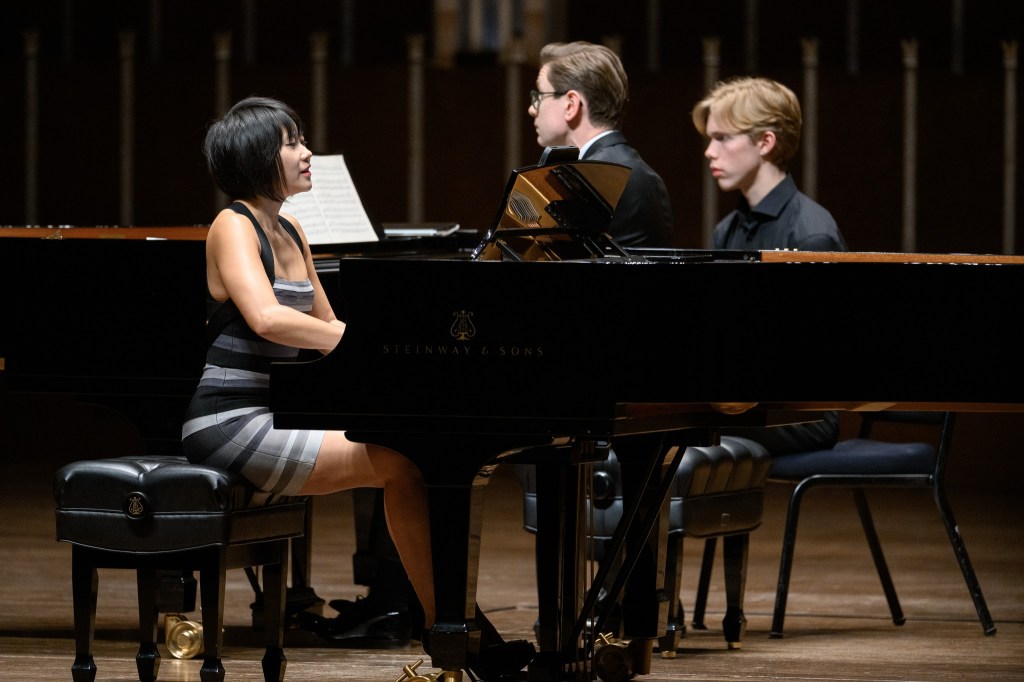
Sunday afternoon marked a remarkable high point in The Cleveland Orchestra’s immensely rewarding recital series, with pianists Yuja Wang and Víkingur Ólafsson joining forces in a stop at Severance Hall on a brief US tour. Both superstar soloists in their own right, it was truly electrifying seeing these two band together. Yet this was more than just a celebrity pairing calculated to maximize box office receipts: their artistic temperaments complemented each other well, showing the whole can be greater than the sum of its parts.

Víkingur Ólafsson and Yuja Wang at Severance Hall, photos credit Human Artist Photography + Cinema 

The program was ripe with discovery, skirting some of the more commonly played fare for two pianos. Luciano Berio’s Wasserklavier began, a meditative opening with liquescent textures freely flowing. The piece made subtle nods to Brahms and Schubert, and fittingly, the pianists artfully segued directly into the latter’s own Fantasie in F minor. Usually played four hands on a single piano, hearing it spread across two instruments gave the work a greater resonance and depth of sound.

Crisply articulated dotted rhythms began, plunging into penetrating drama — rarely will one hear Schubert played with such intensity. Dance-like sections contrasted, exuding joy with the twenty fingers at work, intricately choreographed. A fascinating selection of works from the late 20th-century followed, beginning with John Cage’s Experiences No. 1. The composer’s characteristic minimalist textures were piquantly harmonized, punctuated by silence.

The sixth of Conlon Nancarrow’s 49 studies for player piano followed, made humanly playable in its two-piano arrangement by Thomas Adès (who local concertgoers had the chance to see conduct a remarkable Cleveland Orchestra program just the night before). In this case, the two pianos seemed to be at odds with one another, yet the jagged rhythms fit together in interlocking fashion.

The first half closed with John Adams’ Hallelujah Junction, to my mind, the highlight of the program. Pulsating energy filled Severance Hall with pianistic brilliance. Music of almost perpetual motion — quite a contrast to the minimalism of Cage — gave a larger-than-life portrayal of the namesake town on the California-Nevada border, and demonstrated in no uncertain terms the electric chemistry between these two pianists. The more lyrical pulses of a downtempo section captivated in their rhythmic intricacies, only to build back up to a dazzling density of sound.

Arvo Pärt’s Hymn to a Great City was marked by Wang’s playing in the upper register that rang with the purity of bells, and some delicate filigree that decorated the otherwise barren textures. Rachmaninoff’s Symphonic Dances — his final work — closed the printed program. Hammering out the main theme with pile-driving intensity, an almost manic energy between the two created a rich orchestral sonority. Yet matters were still clear and articulate, with a contrasting theme of haunting lyrical beauty. Sultry waltz rhythms in the central dance were given with stylish playing, and the finale was bold and grandiose, with broad gestures cascading spectacularly.

No less than five encores followed, a delightful selection of dances by Brahms and Dvořák, performed on a single piano, four hands. A charming, convivial close to a memorable afternoon.

Hamelin a star soloist in Cleveland Orchestra’s feast of American music

Cleveland Orchestra
David Robertson, conductor
Marc-André Hamelin, piano
Mandel Concert Hall
Severance Music Center
Cleveland, OH
November 29, 2024

Copland: Suite from Appalachian Spring (1945 orchestration)
Gershwin: Rhapsody in Blue (arr. Grofé)
Ellington: New World A-Comin’
Copland: Suite from The Tender Land

Over the Thanksgiving weekend, The Cleveland Orchestra and guest conductor David Roberston served up a rich course of American orchestral music. As the centerpiece was a pair of works for piano and orchestra with virtuoso Marc-André Hamelin, both of which artfully brought jazz and popular traditions into the concert hall.

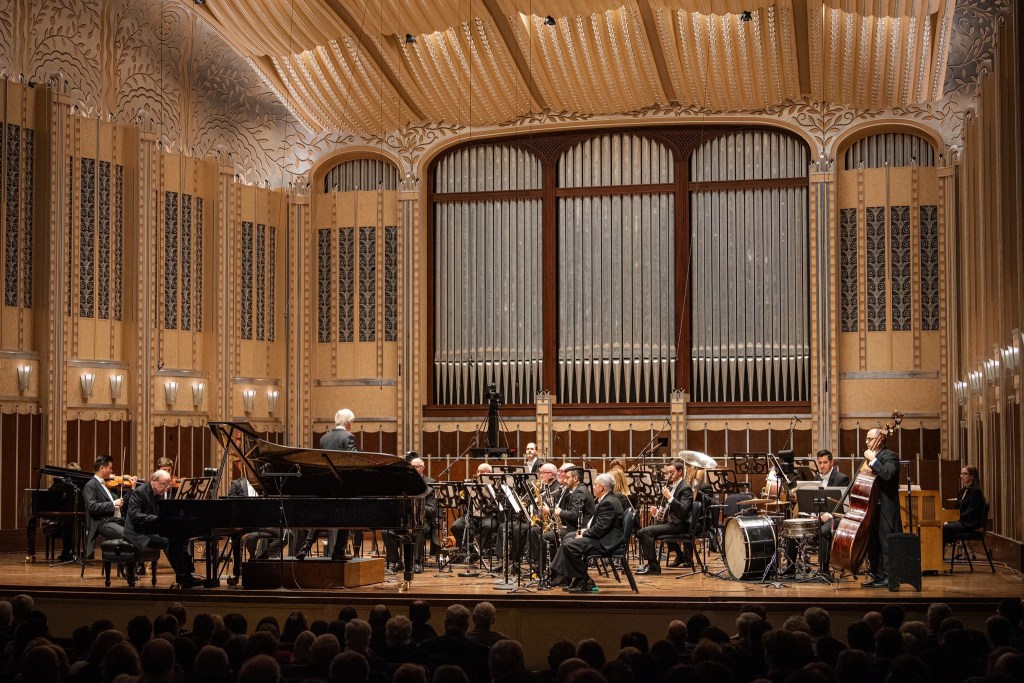
Marc-André Hamelin, David Robertson, and The Cleveland Orchestra perform Rhapsody in Blue. Photos credit Extraordinaire Photos

This year marks the centennial of Gershwin’s epochal Rhapsody in Blue, and the evening’s performers offered an energetic and joyous performance fitting for such an anniversary. The work was presented in its original jazz band orchestration arranged by Ferde Grofé, as it would have been heard in its 1924 premiere at Carnegie Hall — and The Cleveland Orchestra morphed into a bona fide dance hall band.

The iconic wail of the clarinet opened the work, stylishly played by Daniel McKelway. A muted trumpet responded in its striking timbre, setting the stage for Hamelin’s commanding pianism, given with flair and virtuosity. In this amalgamation of the classical and the vernacular, the two resided not in opposition, but as a unified whole. A downtempo section was a sultry affair, while a passage of repeated notes conveyed the mechanistic fury of the Industrial Age, not unlike what one finds in Prokofiev at the same time. All cares were left aside though in the abandon of the foot-tapping finale.

Duke Ellington’s 1943 work New World A-Comin’ premiered under similar circumstances as the Gershwin: a Carnegie Hall performance that endeavored to break the confines of the traditional classical repertoire. Unlike Rhapsody in Blue, Ellington’s work was not initially well-received. Credit, then to Hamelin et al. for offering a compelling performance. A lushly-scored opening in the orchestra gave way to a quasi-improvisatory passage for piano, with silky filigree and silvery runs, colored by jazz-inflected harmonies. A drum kit onstage added to the rhythmic pulse. Comprised of alternating sections for orchestra and piano, it lacked the cohesion of the Gershwin, but proved an attractive discovery nonetheless. On the subject of jazz-influenced classical works, Hamelin’s 2008 album In a state of jazz is warmly recommended.

Bookending the concertante works was music of Aaron Copland, in both cases orchestral suites extracted from stage works. Appalachian Spring made for a lovely opening to the evening. Earthy harmonies began, brimming with hope and possibility. Robertson and the orchestra gently breathed life into this soft-spoken material, starkly different from the bustling Manhattan streetscape conveyed in Gershwin’s Rhapsody. More angular material was enhanced by the sheen of the brass, and rhythmic inflections conveyed a dance-like quality — this was, after all, originally a ballet. A magical moment saw the first appearance of the Simple gifts hymn, first in the winds and then blooming to its magnificent orchestration. The loveliest of epilogues concluded, wholly at peace.

Less well-known was the three movement suite from Copland’s opera The Tender Land, dating about a decade after Appalachian Spring. Strident, brassy beginnings retreated inward for a gentle love song. A specialist of the American repertoire, Robertson served as a keen guide in this deeply lyrical writing. A boisterous, raucous “Party Scene” took matters in a rather different direction, splashed by piquant touches from the xylophone. The closing “Promise of the Living” was a peaceful paean with a fine English horn solo, and a touching, topical close for the Thanksgiving program.

And for those who couldn’t make it to Severance Hall in person, Sunday’s performance was live-streamed and subsequently available on demand through Adella and Stage+.

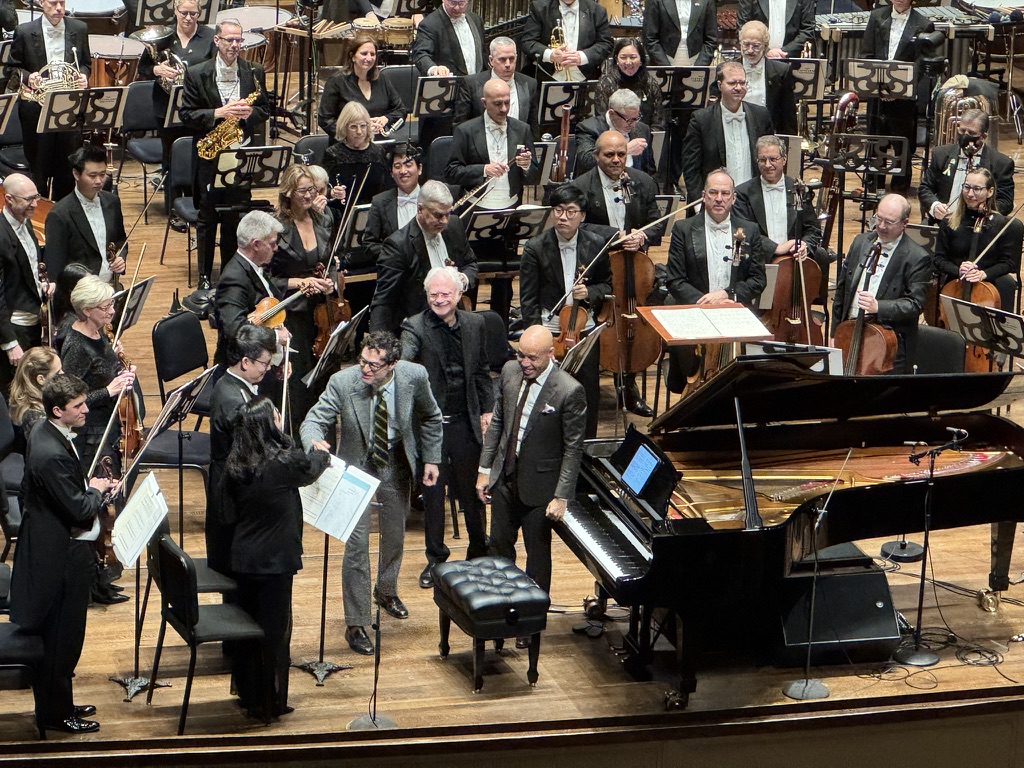
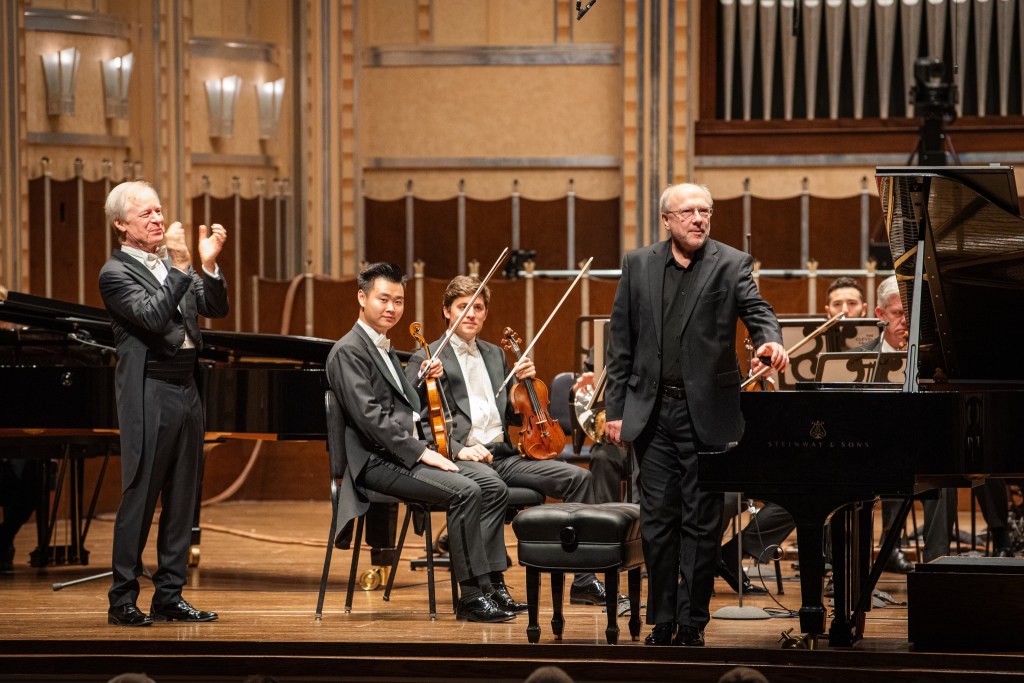
David Robertson applauds Marc-André Hamelin

Goerne and Kissin join forces for an afternoon of song

Matthias Goerne, baritone
Evgeny Kissin, piano
Mandel Concert Hall
Severance Music Center
Cleveland, OH
April 14, 2024

Schumann: Dichterliebe, Op. 48
Brahms: Four Ballades, Op. 10
Brahms: Sommerabend, Op. 85 No. 1 
Brahms: Mondenschein, Op. 85 No. 2 
Brahms: Der Tod, das ist die kühle Nacht, Op. 96 No. 1 
Brahms: Meerfahrt, Op. 96 No. 4
Brahms: Lieder und Gesänge, Op. 32

Encore:
Schumann: Mein Wagen rollet langsam, Op. 142 No. 4

In the this season’s final installment of Severance Music Center’s admirable recital series, two artists who exemplify their instruments came together for an intimate lieder recital: baritone Matthias Goerne and pianist Evgeny Kissin. On a side note, it’s lovely to see Kissin become a more regular presence in Cleveland following his return after a long absence – and he is on tap for next season’s recital series as well.

Evgeny Kissin and Matthias Goerne at Severance Music Center

The first half was devoted to Schumann’s epochal song cycle Dichterliebe. Sixteen songs go by in a flash as quicksilver vignettes, each occupying a rarefied state that we only get to visit for a fleeting moment. Goerne’s vocal command showed this to be a work firmly in his repertoire, and Kissin responded in kind with probing accompaniment. Though a month premature, the opening Im wunderschönen Monat Mai began matters gentle and longing, only to be upended by the subsequent Aus meinen Tränen sprießen which contrasted in its melancholy. The thunderous Im Rhein, im heiligen Strome was a standout, answered by the familiar Ich grolle nicht, given an exultant and impassioned reading, anchored by the pianist’s bass octaves. As the most extended song of the set, the closing Die alten, bösen Lieder was powerful and bracing, only to close with pensive postlude for piano alone.

The latter half gave Kissin a moment in the spotlight, opening with Brahms’ four Ballades for solo piano – and for this listener, the highlight of the afternoon. The first, nicknamed Edward after the eponymous Scottish poem, was a stately, almost royal, processional, building to a powerful climax – especially so for such a brief work. In the chordal passages, Kissin’s nuanced voicing yielded a wondrous effect. The second followed a similar trajectory, with gentle beginnings giving way an animated, march-like central section. The following ballade was rather more animated, inflected by Hungarian rhythms (a Brahms favorite), while the final piece was Schumannesque in its poetry, languorous and lyrical, rapturously beautiful under Kissin’s hands.

Lieder by Brahms filled out the balance of the program, a composer whose path used Schumann’s influence as a signpost to discover his own individual voice. Four settings of Heinrich Heine (the poet of Dichterliebe) were culled from opp. 85 and 96. The pair captured the sultry atmosphere of Sommerabend; the closing line “Schimmern in dem Mondenscheine” made for a seamless segue to Mondenschein wherein the luminous moonlight dispelled the darkness. Meerfahrt, by comparison, was a stormier affair.

The nine Lieder und Gesänge of opus 32 were given a deeply expressive reading, evident from the opening Wie rafft’ ich mich auf in der Nacht, further conveyed by the substantial piano accompaniment. Two distinct poets were traversed across the set (August von Platen and Georg Friedrich Daumer), making it not quite as cyclical and coherent as Dichterliebe, but arguably a work which probed greater range and variety. Wehe, so willst du mich wieder made for an emphatic midpoint ahead of the sorrowful Du sprichst, daß ich mich täuschte. Peace was found, however, in the closing Wie bist du, meine Königin, arriving at a blissful state not unlike where the recital began with Im wunderschönen Monat Mai.

The duo returned full circle to Schumann for the lone encore of the late song Mein Wagen rollet langsam, wherein gently flowing textures were countered by more urgent martial material.

Wesler-Möst and Cleveland Orchestra riveting in iconoclastic symphonies of Prokofiev and Webern

Cleveland Orchestra
Franz Welser-Möst, conductor
Mandel Concert Hall
Severance Music Center
Cleveland, OH
January 18, 2024

Prokofiev: Symphony No. 2 in D minor, Op. 40
Webern: Symphony, Op. 21
Prokofiev: Symphony No. 5 in B-flat major, Op. 100

Franz Welser-Möst is back in Cleveland to start the year off with two weeks of subscription concerts before taking the orchestra on tour to Carnegie Hall and Miami. The conductor seemed in robust form, his first local appearance since undergoing cancer treatment, as well as official confirmation that he will be stepping down as music director in 2027, following a remarkable quarter century in that capacity.

Welser-Möst conducts Prokofiev, photo credit Roger Mastroianni

Thursday’s program offered three works all bearing the title “symphony” and composed within the span of two decades, but each vastly different conceptions of the form. The evening was bookended by Prokofiev, beginning with the rarely-heard Second Symphony. The conductor has turned ample attention to Prokofiev in recent seasons, including traversals of the lesser-known symphonies, albeit with mixed results when the work is more curiosity than masterpiece – though I found the Second to be much more convincing than the Third or Fourth. It’s also worth nothing that the Second was last intended to be performed in March 2020, only to be the first of months of Covid cancellations.

The work opened blistering and uncompromising, in mechanistic fury – in the composer’s own words, music of “iron and steel.” A product of the 1920s, it embraced a celebration of industry that also gave inspiration to Varèse, Antheil, and Honegger, as well as Prokofiev’s own Scythian Suite. Rhythmic pulsating continued unabated with the industriousness of an assembly line, and Welser-Möst managed to find clarity amongst the busy textures. The work’s unusual structure has been compared to that of Beethoven’s final piano sonata: a stormy sonata-form opening movement, followed by an expansive set of variations. A flowing oboe melody (Frank Rosenwein) carved out the theme, a somber turn inward. Animated transformations of the theme followed, while the fourth variation served as the work’s only extended slow passage. The manic and frenetic came back in due course, and strikingly, the theme returned at the end in its unadulterated form, with hauntingly orchestrated final chords shrouded in mystery.

Anton Webern’s sole symphony follows a similar two movement form, but couldn’t be more different. The orchestra was reduced to modest, classically-sized proportions, and barren, almost emaciated textures. Conductor and orchestra gave the coloristic score a nuanced, exacting reading, with the composer’s distinctive Klangfarbenmelodie technique yielding a protean ebb and flow as gestures were passed throughout the ensemble.

Prokofiev’s masterpiece in the form, the Fifth, closed the program (which like the Second, has also been recently recorded by these forces). The orchestra again swelled to the brim of the stage, and articulated a broad opening statement in which one felt the voice of a man with newfound energy and confidence. Welser-Möst emphasized the grand sweep of the movement, pointing towards a triumphant, blazing finale. The Allegro marcato had mechanistic echoes of the earlier symphony, highlighted by the shrill clarinet of Afendi Yusuf as well as prominent piano. With its militant snares, this is to my ears the closest Prokofiev came to sounding like his Soviet compatriot Shostakovich.

The brooding triple meter of the Adagio wouldn’t have sounded out of place in Romeo and Juliet which dates from a similar time, while the angular main melody of the finale had a distinctly Soviet feel. Welser-Möst was keen not to hit the listeners all at once by way of a slow, carefully-judged buildup in potency, leading to the pile-driving intensity of the work’s final statement. This weekend’s Carnegie Hall audiences certainly have an invigorating listen in store.

Inkinen makes Cleveland Orchestra debut in hearty Eastern European program

Cleveland Orchestra
Pietari Inkinen, conductor
Augstin Hadelich, violin
Mandel Concert Hall
Severance Music Center
Cleveland, OH
November 24, 2023

Dvořák: Othello Overture, Op. 93
Tchaikovsky: Violin Concerto in D major, Op. 35
 Encore:
 Forrester: Wild Fiddler’s Rag
Dvořák: Symphony No. 8 in G major, Op. 88

The Thanksgiving weekend saw the Finnish conductor Pietari Inkinen make his Cleveland Orchestra debut in a program of works all composed within just over a decade and from the heart of Eastern Europe. Dvořák’s Othello Overture opened, conceived as the final entry of a trilogy of related overtures. Written just four years after Verdi’s landmark opera on the same subject, Dvořák likely drew inspiration from the Italian he greatly admired, though his overture tended to suggest the essence of the Shakespearean source material rather than spell out a specific narrative.

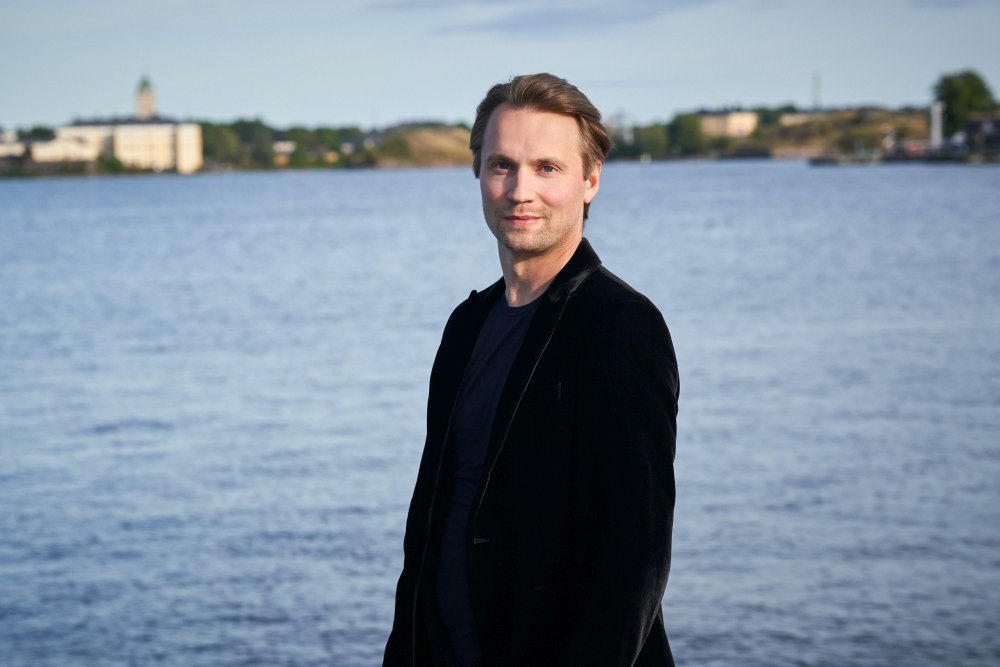
Pietari Inkinen, photo credit pietariinkinen.com

Slow and somber introductory material built to music of great drama. It seemed that Inkinen could have benefited from some additional rehearsal time with a handful of uncoordinated entrances, but an effective performance was managed nonetheless. The slow material returned at the end, with stentorian brass strikingly invoking the slumber motif from Wagner’s Die Walküre as something of a final prayer before the unequivocally tragic end. So much of the time Dvořák is programmed we hear one of the last few symphonies (or the cello concerto), but this overture was a welcome discovery, and should certainly encourage listens to look at Dvořák’s orchestral corpus beyond the warhorses.

The balance of the program, however, was dedicated to warhorses – and in no way a detriment! Tchaikovsky’s evergreen Violin Concerto called upon soloist Augustin Hadelich. A gentle dip set things in motion in this most graceful of openings, with Hadelich’s solo line articulate, keenly phrased, and above all, richly lyrical. Nimble and nuanced, he displayed some especially impressive fingerwork in the cadenza. A choir of winds opened the central Canzonetta, and the songful, mournful violin purveyed a delicate cantilena. The finale is such joyous affair for someone who lived such a tragic life as its composer, and Hadelich’s sprightly virtuosity closed the work in the highest spirits. He returned for a well-deserved encore, his own arrangement of Howdy Forrester’s Wild Fiddler’s Rag – a piece of great fun with its bluesy inflections.

Franz Welser-Möst set the bar high for Dvořák’s Eighth Symphony two seasons ago; while Inkinen didn’t quite reach that height, it was here he made the strongest impression – and opted to conduct this score from memory. The deeply lyrical opening gesture gave way in due course to material of an inimitable Bohemian charm, aided by fine solo passages from the principal winds. Still, greater dynamic contrast would have helped, with conductor leaning a bit too heavily in the orchestra’s upper end of the range.

A bucolic slow movement built to a resonant climax, and the lovely Allegretto grazioso was flowing and deftly shaped, though a tad rushed for my taste. The call to arms in the trumpet initiated the energetic and often boisterous finale, nearly overflowing with gracious material that never strayed far from the composer’s Czech origins. On a final note, how gratifying it was to see nearly every seat of Severance Hall filled, and with such a warm, enthusiastic audience.

Augustin Hadelich, photo credit Suxiao Yang

Montero in recital: Romantic drama, piquant neoclassicism, and free improvisation

Gabriela Montero, piano
Reinberger Chamber Hall
Severance Music Center
Cleveland, OH
July 9, 2023

Chopin: Polonaise-fantaisie, Op. 61
Schumann: Carnaval, Op. 9
Stravinsky: Piano Sonata
Montero: Improvisations on themes by Beethoven, Gershwin, and Piaf

As part of the Cleveland International Piano Competition and Institute for Young Artists, Venezuelan pianist Gabriela Montero presented a wide-ranging recital at Severance’s Reinberger Chamber Hall. Two pinnacles of the Romantic repertoire occupied the first half – both works which often feature on contestant programs in Piano Cleveland’s adult counterpart of the youth competition, to be held next in 2024. Chopin’s Polonaise-fantaisie was given an introspective, spacious opening, more fantasy than polonaise before the dance meter took shape.

Gabriela Montero at Reinberger Chamber Hall

Montero purveyed remarkably clear voicing through Chopin’s densely-textured writing, crisply punctuating the polonaise rhythms. A chorale section was of lyrical contrast, its delicate cantilena suggesting an Italianate bel canto, in due course giving way to an energetic coda. Schumann’s Carnaval provided a wonderfully picturesque series of vignettes from the titular festival, arrestingly brought to life by Montero. An opening preamble was colorful and exuberant, almost orchestral in force.

Each subsequent scene was shaped with distinct character: the coquettishness of “Arlequin”, the darkly passionate “Chiarina” – emphasizing the dotted rhythms, Montero sculpted a fervent climax. “Chopin” was rapturously lyrical, a fitting tribute to the Pole – and in the present recital, a callback to the previous selection – while “Paganini” was a sprightly affair with Montero traversing the keyboard in leaps and bounds. The buoyant march which closed the work did much to heighten its drama.

I first encountered Stravinsky’s brief piano sonata on a warmly recommended album from Earl Wild. Despite being a pianist himself, Stravinsky’s output for the instrument tends to get overlooked, and the sonata made for an intriguing opening to the latter half. Crisp and detached, it epitomized the composer’s neoclassical period, though a melody of surprising sweetness took shape. The central movement served as an interlude replete with piquant dissonances and intricate ornamentations. The finale recalled the measure of the opening, though its imitative textures suggested a two-part invention.

The balance of the evening was devoted to Montero’s signature improvisations, wherein she requests a theme from the audience and proceeds to develop a five-minute or so improvisation based on that theme. It’s a rare thing to experience in a classical piano recital, and a remarkable gift to witness. In her spoken remarks, Montero noted that improvisation is “the way I communicate through sound”; indeed, what followed flowed just as natural conversation, improvising on Beethoven’s Für Elise, Gershwin’s Rhapsody in Blue, Piaf’s La Vie en rose, and Beethoven again in the opening theme of the Fifth Symphony.

Cleveland Orchestra strikes operatic gold in La fanciulla del West

Cleveland Orchestra
Franz Welser-Möst, conductor

Emily Magee, soprano (Minnie)
Roman Burdenko, baritone (Jack Rance)
Limmie Pulliam, tenor (Dick Johnson)
Tony Stevenson, tenor (Nick)

Scott Conner, bass (Ashby)
Iurii Samoilov, baritone (Sonora)
Owen McCausland, tenor (Trin)
Joseph Lattanzi, baritone (Sid)
Benjamin Taylor, baritone (Bello)
Joseph Tancredi, tenor (Harry)
Alex McKissick, tenor (Joe)
Joseph Barron, bass-baritone (Happy)
Kyle Miller, baritone (Jim Larkens)
Zachary Altman, bass-baritone (Billy Jackrabbit)
Taylor Raven, mezzo-soprano (Wowkle)
John Brancy, baritone (Jake Wallace)
Michael Adams, baritone (Jose Castro)
John-Joseph Haney, tenor (Pony Express Rider)

Men of the Cleveland Orchestra Chorus

Mandel Concert Hall
Severance Music Center
Cleveland, OH
May 20, 2023

Puccini: La fanciulla del West

I’ve long felt the Franz Welser-Möst’s greatest achievement as Cleveland Orchestra music director lies in his programming of complete operas, and last weekend’s performance of Puccini’s Fanciulla del West only furthered cemented my contention. Welser-Möst certainly has stellar operatic credentials, holding directorships of the major opera houses of both Zurich and Vienna. Puccini’s 1910 work tends to be overshadowed by the blockbusters that surround it, but Welser-Möst along with TCO and a strong vocal cast made quite the compelling case for it.

Emily Magee as Minnie in The Cleveland Orchestra’s La fanciulla del West, photos credit Roger Mastroianni, courtesy of The Cleveland Orchestra

Announced well before the pandemic – a sign of the long-range planning behind putting on such an ambitious production with an international cast – some cast changes were perhaps all but inevitable, with Emily Magee stepping in for Tamara Wilson as Minnie, and Roman Burdenko singing the role of Jack Rance in place of the originally announced Eric Owens. Though perhaps not as deeply familiar as La bohème or Madama Butterfly, the arresting, lush beginnings from the orchestra made matters instantly recognizable as Puccini, surging with a passion only he could write.

Singing of homesickness – what must have been a common experience for those braving the American West – Kyle Miller’s Jim Larkens was a lovely, inward moment, touchingly accompanied by the harp. Minnie’s entrance showed Emily Magee – despite suffering from a cold – to be a commanding presence, mastering the daunting role. I envy audiences who saw the two performances prior to Saturday, in which her voice presumably would have been in even stronger shape. She blended beautifully with Limmie Pulliam’s Dick Johnson, closing Act I in a sumptuous duet.

This arc continued into the second act, with a rapturous love scene between them before conflict erupted, gunshots chillingly fired, and matters built to the tensely climactic poker scene. The final act began in cacophonous tumult, with the now captured Johnson booming and defiant to the end. Minnie implored for compassion in a heartfelt dialogue with the miners (“Ah! Ah! È Minnie!”), persuasive enough to afford a redemptive ending – for Puccini, a rarity indeed!

Buttressing the cast of soloists were the men of the Cleveland Orchestra Chorus, colorfully portraying a miscellany of miners at a Gold Rush camp. Performing the work in a concert hall rather than an opera house allowed The Cleveland Orchestra to be front and center rather than relegated to the pit – and rightfully so, as they were perhaps the true star of the show, with meticulous and compelling playing that served Puccini well. One doesn’t always get to hear an opera anchored by such fine orchestral playing, certainly a high note on which to close the 2022-23 concert season.

Franz Welser-Möst leads The Cleveland Orchestra, Chorus, and soloists in La fanciulla del West