Renée Fleming brings The Brightness of Light to Cincinnati May Festival

Cincinnati Symphony Orchestra
Robert Moody, conductor
Renée Fleming, soprano
Rod Gilfry, baritone

May Festival Chorus
Matthew Swanson, director

Springer Auditorium
Music Hall
Cincinnati, OH
May 22, 2025

Vaughan Williams: Serenade to Music
Stravinsky: Symphony of Psalms
Puts: The Brightness of Light

This year’s edition of the Cincinnati May Festival featured the incomparable Renée Fleming as Festival Director, affording her the opportunity to curate a diverse selection of repertoire across the festival’s eight-day span. The penultimate program was anchored by Kevin Puts’ ambitious 2019 work The Brightness of Light, starring Fleming alongside baritone Rod Gilfry.
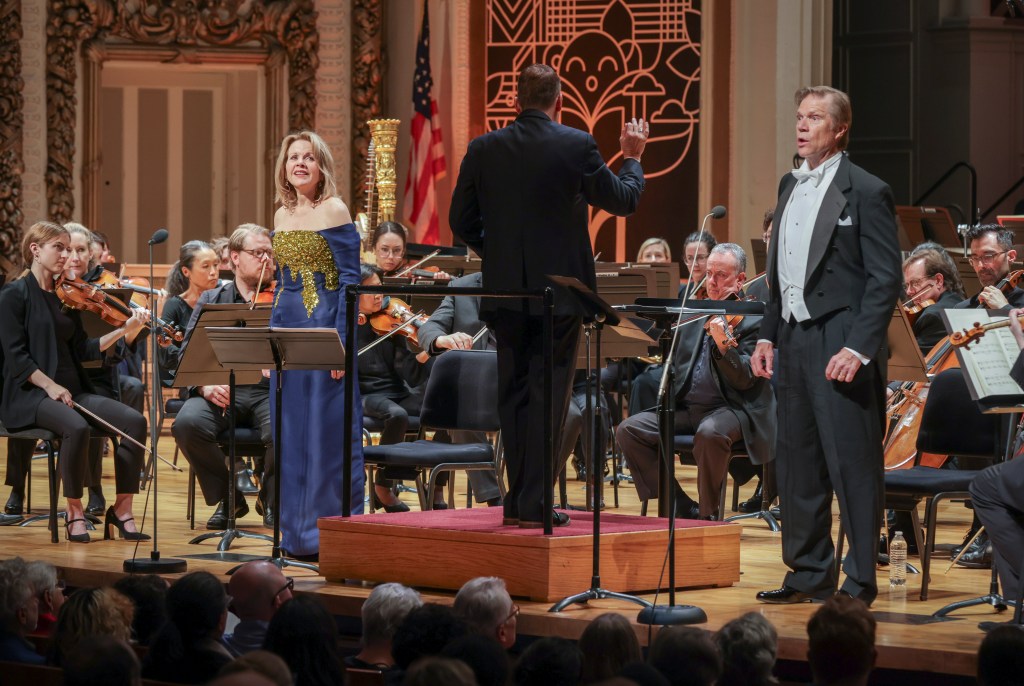
Renée Fleming, Robert Moody, Rod Gilfry and the Cincinnati Symphony perform The Brightness of Light, all photos credit Mark Lyons

The 45-minute conception chronicles the relationship of Georgia O’Keefe and Alfred Stieglitz — from agent to lovers to married couple, closing at O’Keefe’s final years as a widower in the solitude of the American Southwest. Giving the performance a multimedia dimension, projections by Wendall Harrington featured O’Keefe’s art alongside photographs of the couple through the years. The texts were extracted from the vast trove of letters they exchanged, beginning as professional correspondence that quickly turned to love letters.

Therein lies the fundamental challenge with the work, however, as texts of letters rarely provide the best material for vocalists. Poetic as they sometimes were, matters often veered more discursive and verbose. Nonetheless, Fleming and Gilfry captured the essence of their respective characters, painting a largely sympathetic portrait of these enigmatic figures via this epistolary drama. Puts’ musical language isn’t particularly groundbreaking, but remains appealing and approachable, somewhat reminiscent of the mid-century American composers — and thus stylistically contemporary with the two protagonists. Puts called for a large orchestra, and the Cincinnati Symphony supported the singers with aplomb. The composer exploited the orchestra’s colorful potential, as if expressing the colors of an O’Keefe painting in musical terms. Marshaling these forces was conductor Robert Moody, gracefully stepping in as a last-minute substitute for Juanjo Mena.

O’Keefe was quoted in saying that her first memory “is of the brightness of light, light all around,” hence the work’s title and the text with which it began, tenderly intoned by Fleming. The beginning of their correspondence was of playful, innocent humor, but the tone shifted in “A Soul Like Yours,” wherein gentle touches in the piano and violin gave to way to some deeply impassioned singing from Gilfry. Orchestral interludes served as key inflection points, underscoring the importance of the orchestra to the piece despite the top-billing of the two operatic legends — and I wonder if there’s the potential to extract a standalone orchestral suite.

I particularly liked the twang of the violin to mark the transition to the Southwest, and exploring the ups and downs of this relationship yielded musical variety. Matters culminated with the fittingly valedictory “Sunset,” pensive and reflective, a touchingly beautiful use of Fleming’s voice. Despite the work’s sincerity and the strength of this performance, ultimately I left Music Hall with mixed impressions, but much credit nonetheless to the ambition of the performers and creative team.

The first half was comprised of two shorter works that featured the May Festival Chorus, beginning with Vaughan Williams’ Serenade to Music. Luminous sounds blanketed the hall with the beauty of the harp and strings, and the tender voices of the chorus were a meditation on music itself. Serene and with arching lyricism, it made for the loveliest of openers.

Written in 1930 on a Koussevitsky commission for the fiftieth anniversary of the Boston Symphony, the bristling neoclassicism of Stravinsky’s Symphony of Psalms sharply contrasted. The work sets a trio of psalms against a strikingly idiosyncratic orchestration that even called upon not one but two pianos. In his spoken remarks, Moody noted how it would later influence Orff’s Carmina Burana and Bernstein’s Chichester Psalms. Conducting without baton, Moody perhaps channeled his inner Pierre Boulez (who made a benchmark recording of the work with Berlin), imbuing each gesture with clarity and a strict sense of place.

Following a brassy close of the first psalm, the central selection began with a searching oboe solo, drawing richly contrapuntal textures given with severity and exactitude. Longer than the first two combined, the closing entry was a larger-scale conception with disparate elements seamlessly woven together, in due course arriving at a peaceful resolution.
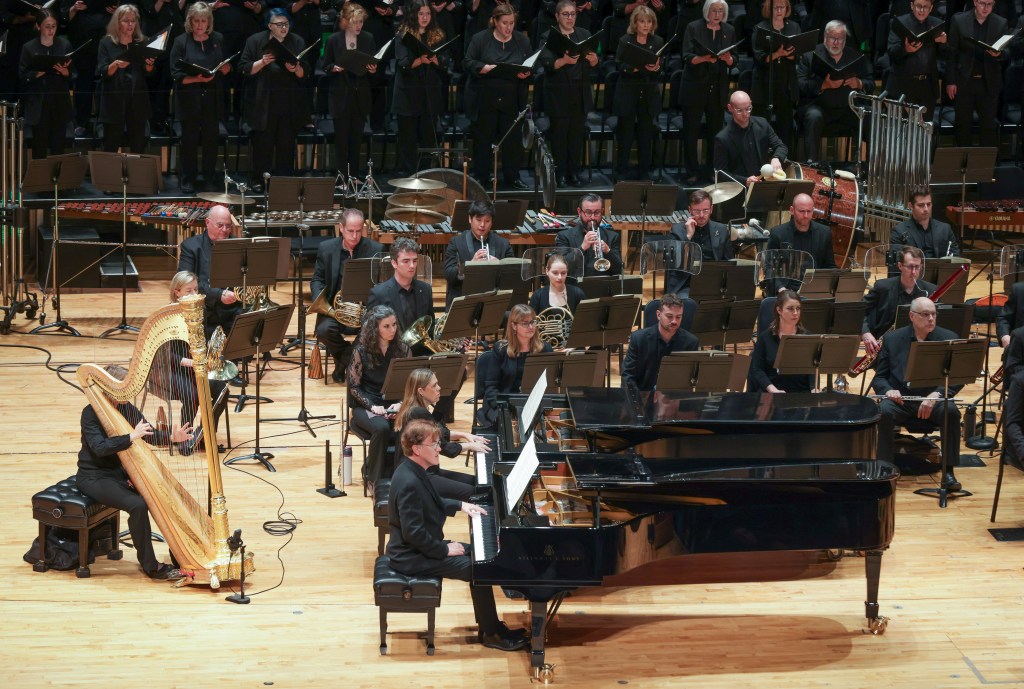
Cincinnati Symphony and May Festival Chorus in Stravinsky’s Symphony of Psalms

Rosamunde Quartet anchors Linton Chamber Music program with sublime Beethoven

Rosamunde String Quartet
First Unitarian Church of Cincinnati
Cincinnati, OH
March 3, 2024

Haydn: String Quartet in C major, Op. 20 No. 2, Hob. III:32
Puts: Credo
Beethoven: String Quartet No. 15 in A minor, Op. 132

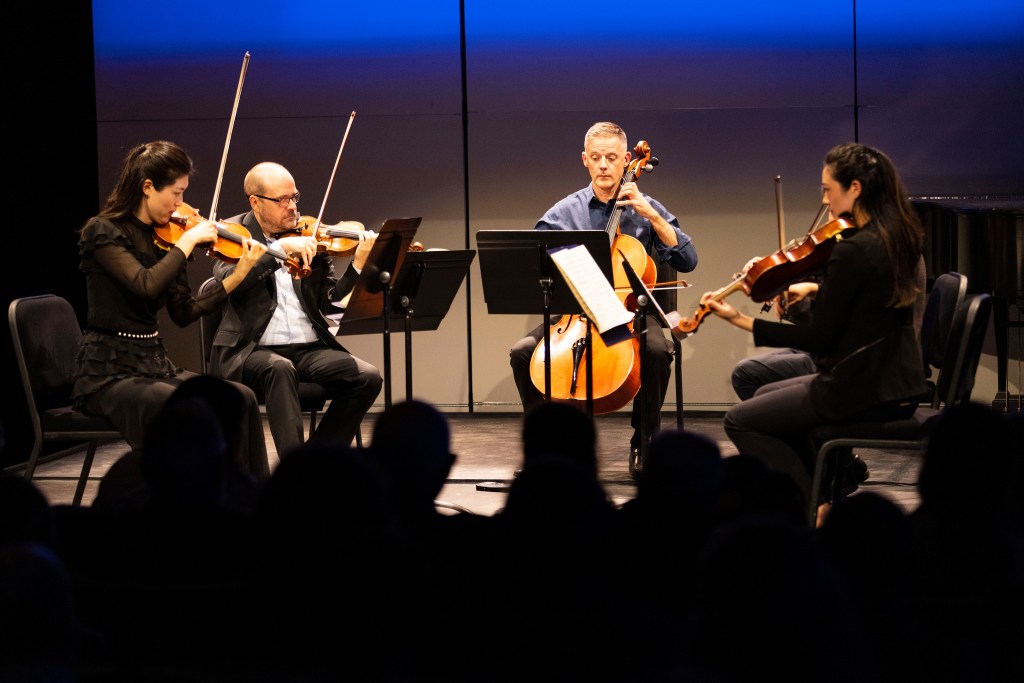
Something of a supergroup amongst string quartets, the Rosamunde is comprised of current or former members of the Berlin, New York, and Los Angeles philharmonics, affording these players an opportunity to supplement their orchestral responsibilities by indulging in their love of chamber music. Their Sunday afternoon program at Cincinnati’s Linton Chamber Music offered two major classical period quartets sandwiching a more recent expression in the medium.

Rosamunde String Quartet at Linton Chamber Music. L-R Nathan Vickery, Shanshan Yao, Teng Li, Noah Bendix-Balgley

Dubbed the “father of the sting quartet,” Haydn virtually invented the form – and it was the set of six that comprise the watershed opus 20 in particular that earned him the title. Collectively known as the Sun Quartets owing to an early edition’s cover illustration, the Rosamunde selected the second quartet, in the sunny key of C major. A rather mellow beginning was had with the first violin absent from the opening few bars, and there was a particularly robust part for cello – Haydn was at his most lyrical here. A slow movement was stern and solemn, perhaps a look back towards the Baroque stylistically, but the latter section was truly radiant – and fittingly timed with the late afternoon sunlight streaming through the church’s stained glass windows.

A minuet followed without pause, much more restrained than typical for the composer, and a trio contrasted in the minor. Though less of a hallmark of Haydn’s later quartets, half of opus 20 concludes with a fugue. The four-voice fugue that closed the present example evidenced the Rosamunde’s incisive clarity and taut communication.

A 2007 work by Kevin Puts took the string quartet to the present day. On commission from the Miró Quartet, Puts was tasked with writing a work to capture the “lighter side of America,” a requirement he found quite a challenge given the backdrop of wars in the Middle East and mass shootings back home. The resulting Credo painted short vignettes which inspired feelings of hope in some fashion.

The Violin Guru of Kantonah brought to life an instrument maker in the titular New York town. Improvisatory in character, it seemed to gingerly experiment with the different possibilities of the instruments, and a cross-section of excerpts from the violin repertoire surfaced in the first violin. Infrastructure was inspired by the bridges and highways the composer passed taking the path along the Monongahela River in Pittsburgh. Guttural and motoric, it depicted the marvels of industry with vigor.

Intermezzo: Learning to Dance recollected when Puts observed a mother teaching her daughter how to dance, its nostalgic lyricism capturing a sweet moment. The Pittsburgh tableau was reprised with the vigor turned up one more notch before the closing Credo, the heart of the piece. Puts purveyed a resonant lyricism, grappling and questioning for answers, ultimately finding a peaceful if inconclusive resolution.

Beethoven’s monumental opus 132 completed the program. Somewhat in the manner of where the Puts left off, Beethoven’s penultimate quartet began searching and musing, with the opening movement finding its footing in material that the Rosamunde gave with a rich sonority, a wide-ranging essay that culminated in a blistering coda. The crux of the work came in the central Heiliger Dankgesang, unfolding as a deeply-felt hymn. In his spoken remarks, violinist Noah Bendix-Balgley suggested a connective thread between the Puts and Beethoven in that both find hope in difficult times (in Beethoven’s case, in the wake of recovering from serious illness). At times the mood was simply ecstatic, an expression of joy all too uncommon for the tragic composer. The brief march that followed was rather quotidian by comparison, bringing matters back down to the earthly, and providing a moment of levity before the pathos-laden finale.

Cincinnati Symphony musicians delight in Chamber Players concert

Musicians from the Cincinnati Symphony Orchestra*
Wilks Studio
Music Hall
Cincinnati, OH
October 28, 2022

Gounod: Petite symphonie
Schumann: Piano Quartet in E-flat major, Op. 47
Beethoven: String Quintet in C major, Op. 29

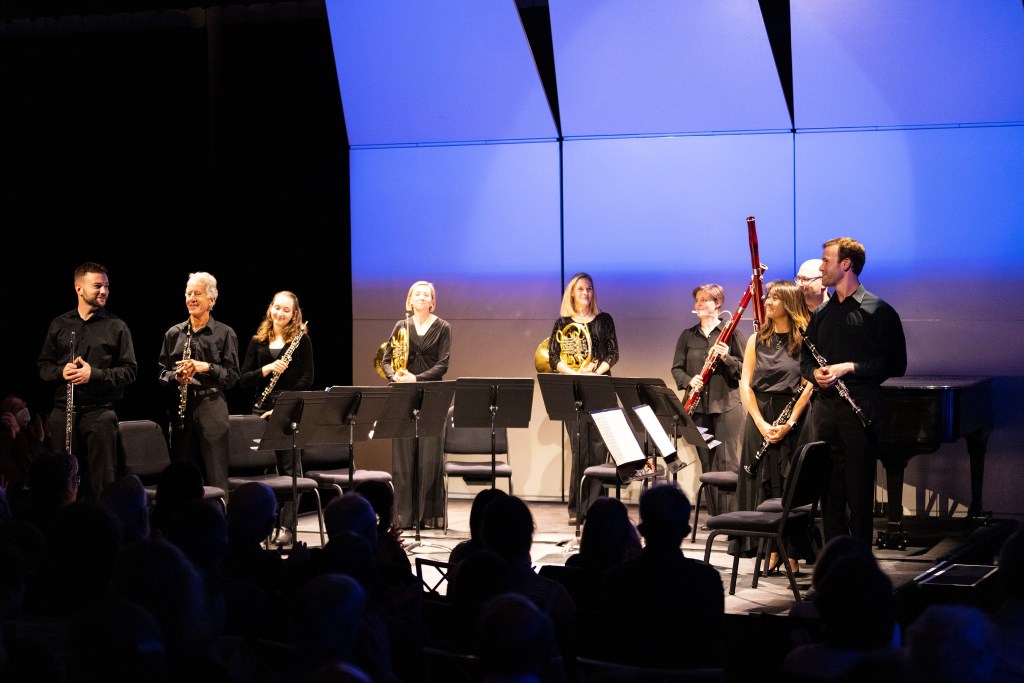
The evening prior to a particularly memorable Cincinnati Symphony program, one had the distinct pleasure of hearing select CSO musicians band together for a varied selection of chamber music. Held in the Wilks Studio – a rather more intimate space than the Springer Auditorium – the trio of works presented spanned the nineteenth-century, traversing configurations as diverse as wind nonet, piano quartet, and string quintet.

Going in reverse chronological order, the program opened with Gounod’s delightful Petite symphonie, scored for nine winds – a work which flautist Henrik Heide aptly introduced as one of the “pearls of the wind chamber music repertoire.” A stately, classical introduction initiated, an enticing set up for the movement proper’s pure joie de vivre, its Gallic lightness a sparkling contrast to the weightier Germanic works that would follow. A limpid, singing flute line highlighted the Andante cantabile, while the scherzo saw its march-like material regally announced by the horns. The finale rounded matters off with insouciant charm.

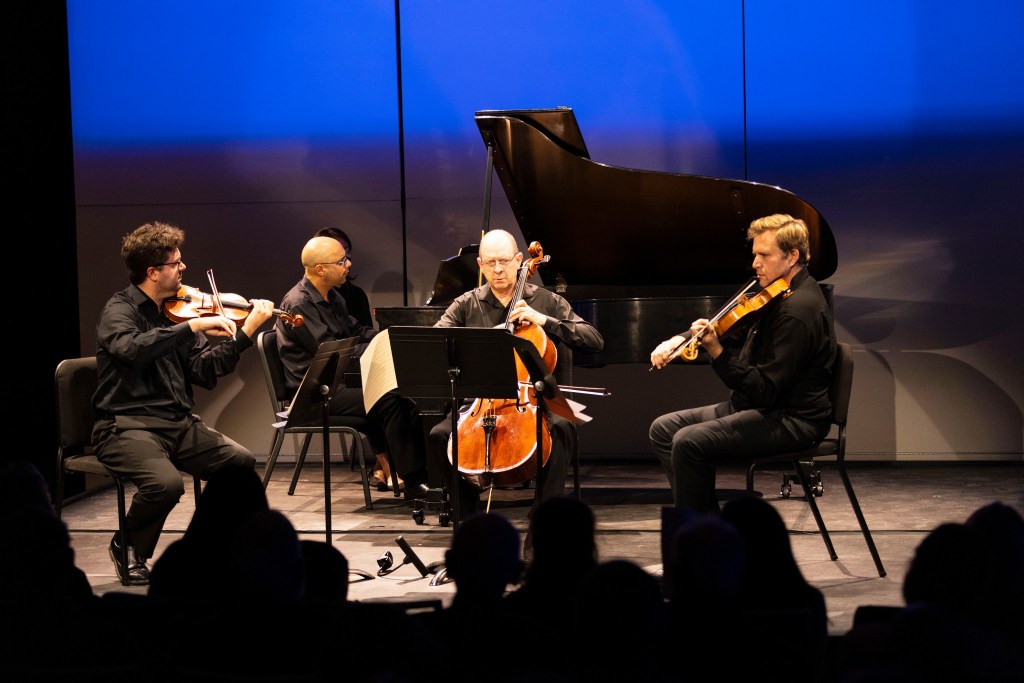
Schumann’s Piano Quartet occupied a vastly different soundworld – and also makes for an interesting contrast to the composer’s more frequently heard but contemporaneous Piano Quintet, also in E-flat major: though not without ample drama, the Quartet tends to be more restrained and intimate. Introductory material functioned a bit like a rhapsodic warmup, and a richly flowing melody built to fervent passions, encouraged by the powerful pianism of Dror Biran. Schumann took a cue from Beethoven in placing the scherzo second, a movement played by this group of musicians seamlessly even at breakneck speed. The slow movement that followed was truly gorgeous, with especially generous material from the cello (Daniel Culnan) and a searching line in the violin (Charles Morey), and the melody was increasingly decorated – very much in the spirit of the lieder pouring from the composer’s pen at the time. An energetic affair, the finale was especially striking in its fugato passage, expertly and crisply articulated.

Beethoven’s String Quintet in C major is, perhaps surprisingly, his only work in the medium, save for some adaptations of other pieces. The work opened graceful and genial, varied by sprightly filigree, occasionally leading to stormier sections – especially in the development. A slow movement was sweetly lyrical by contrast, while the scherzo saw a tenuous balance of drama and buoyancy – although a handful of passages could have been served by better intonation. As Beethoven was oft to do in closing movements, the final Presto was replete with contrapuntal textures, though it was the more playful material that was given the last word.

*
Gounod:
Henrik Heide, flute
Lon Bussell, oboe
Emily Beare, oboe
Christopher Pell, clarinet
Ixi Chen, clarinet
Martin Garcia, bassoon
Jennifer Monroe, bassoon
Elizabeth Freimuth, horn
Lisa Conway, horn

Schumann:
Charles Morey, violin
Christopher Fischer, viola
Daniel Culnan, cello
Dror Biran, piano

Beethoven:
Minyoung Baik, violin
Eric Bates, violin
Caterina Longhi, viola
Gerry Itzkoff, viola
Theodore Nelson, cello

Pogorelić brings all-Chopin program to Cincinnati

Ivo Pogorelić, piano
Gallagher Student Center Theater
Xavier University
Cincinnati, OH
April 22, 2022

Chopin: Fantaisie in F minor, Op. 49
Chopin: Piano Sonata No. 3 in B minor, Op. 58
Chopin: Polonaise-fantaisie in A-flat major, Op. 61
Chopin: Berceuse in D-flat major, Op. 57
Chopin: Barcarolle in F-sharp major, Op. 60

Encores:
Chopin: Prelude in C-sharp minor, Op. 45
Chopin: Nocturne No. 18 in E major, Op. 62 No. 2

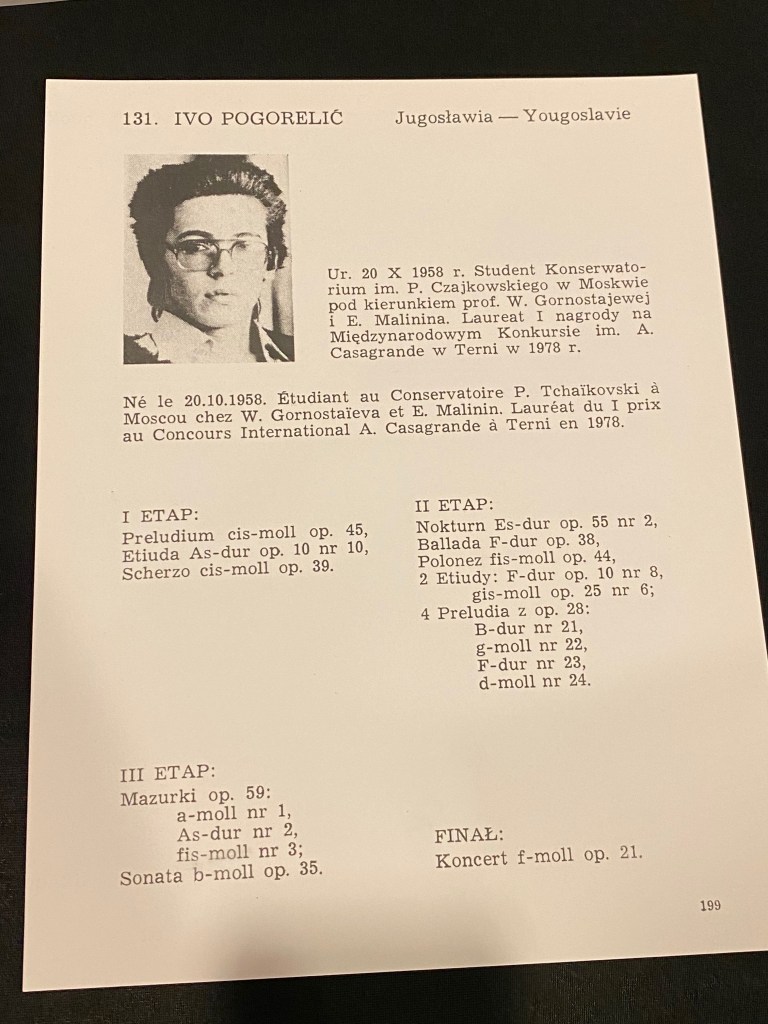
Ivo Pogorelić is perhaps the archetypal maverick amongst pianists, coming to international attention not by winning a competition, but by being cut in the 1980 edition of the Chopin Competition – which famously caused Martha Argerich to resign from the jury in protest. What followed was a legendary rise to prominence in the 1980s and 1990s, a subsequent hiatus from the public eye, a return which led to the infamous New York Times review calling him “an immense talent gone tragically astray,” and individualized, idiosyncratic interpretations of standard repertoire that continue to this day to polarize audiences.

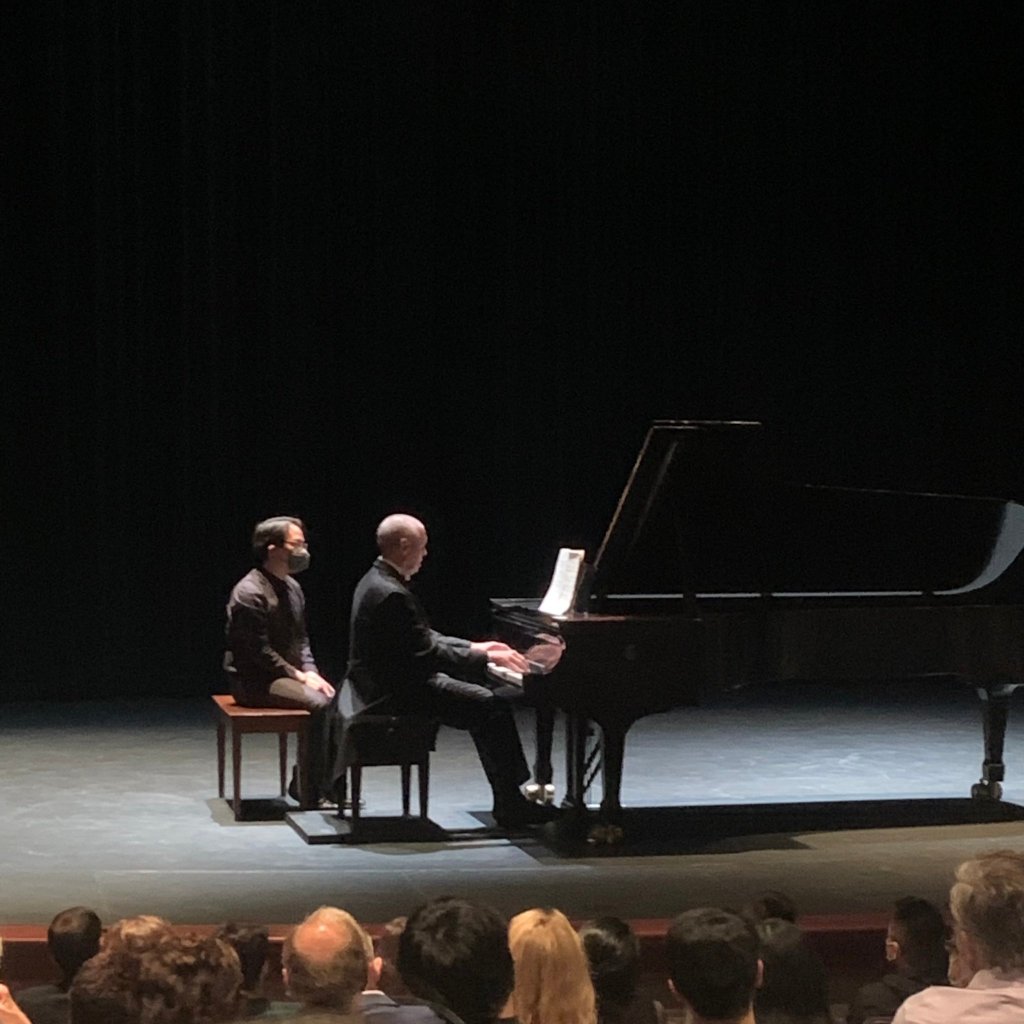
Ivo Pogorelić at Xavier University, photo credit Xavier Music Series

In 2019, Pogorelić returned to the recording studio after more than two decades away, producing an album of sonatas by Beethoven and Rachmaninov, and a survey of Chopin’s late piano music appeared at the beginning of this year. Friday night’s program at Xavier’s Classical Piano Series overlapped with much of the contents of the Chopin album, focusing on the Polish composer’s late masterpieces – and this marks the pianist’s only US appearance on his current recital tour. A fascinating display of memorabilia pertaining to Pogorelić and the Chopin Competition was on display in the lobby. Though generally customary for pianists to memorize recital programs, Pogorelić played from score – with no less than Zsolt Bognár as page-turner.

In the Fantaisie in F minor which opened, the pianist played the gestures in the bass dry and detached, proceeding at a glacial tempo choice and dynamics barely above a whisper. In due course, however, the fantasy took flight, rhapsodically building to great drama – though the oceanic fortes came across rather too percussive for Chopin. The Third Piano Sonata filled out the first half, with an almost funereal tempo choice in the Allegro maestoso, anchored by muscular playing – but again, really to the point of overkill. Textures were murky, and the fleet scherzo that followed also would have benefitted from greater clarity in its articulation. The Largo is perhaps the heart of the work, and here Pogorelić was far more convincing in this languid nocturne, holding the audience spellbound in stasis before the return of the main theme. In the finale, matters were in equal measure impassioned and bombastic.

Following intermission, the Polonaise-fantaisie was initiated with a commanding opening, and rhapsodic flourishes that recalled the previously heard Fantaisie. Pogorelić punctuated the polonaise rhythms, and maintained intense concentration and composure in spite of the many latecomers filing in. Two comparatively more subdued selections rounded out the printed program to counter the dramatic and tragic works – to my ears, where Pogorelić was at his best. A delicate cantilena highlighted the Berceuse, and the chromatically-tinted lyricism of the Barcarolle made for a poignant close. Pogorelić offered a pair of encores before even taking a curtain call – the resonant Prelude, Op. 45, and finally, ending on a gentle note with a late nocturne.

On a personal note, I have a memory of attempting to attend a Pogorelić recital at the Vienna Konzerthaus back in October 2008. A completely sold-out affair, I was amongst a sizable group queuing at the box office in hopes of scoring a returned ticket, only for all of us to be disappointedly turned away. How glad I am to have now had the chance to see Pogorelić in concert some fourteen years later.

Pogorelić’s program at the 1980 Chopin Competition, on display in the lobby