
Igor Levit, piano
Stern Auditorium
Carnegie Hall
New York, NY
January 22, 2026
Beethoven: Thirty-Three Variations on a Waltz by Diabelli, Op. 120
Rzewski: The People United Will Never Be Defeated
In his solo recital at Carnegie Hall, pianist Igor Levit paired two massive sets of variations, each pinnacles of the form by composers who were virtuoso pianists themselves. Both the works have been in Levit’s repertoire for many years; in 2015 he released a monumental album with them along with Bach’s Goldberg Variations. One of Beethoven’s final works for solo piano — and his last large-scale essay for the instrument — the incomparable Diabelli Variations takes a simple, innocuous theme and yields a summation of everything the composer developed for the keyboard.
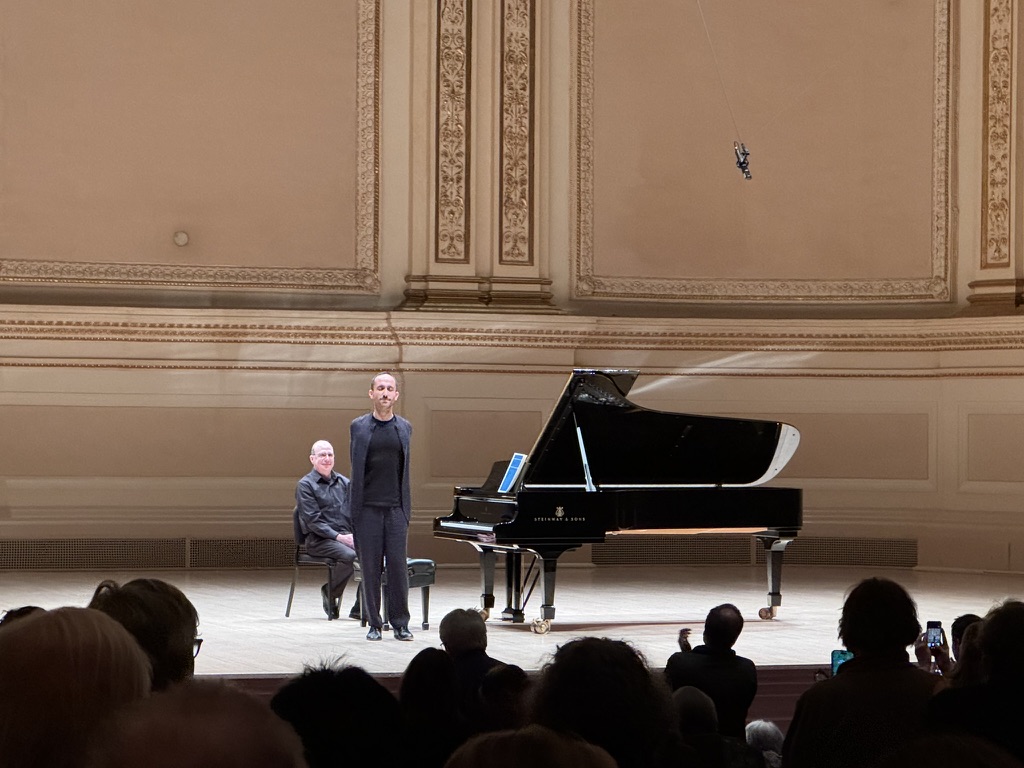
A ringing cell phone just before the music was to begin saw some humorous banter from Levit, a moment of levity before the weighty program, matching the high spirits and humor of Diabelli’s theme. The first variation was grandiose in delivery, a hint of the scale of the work to come. Levit teased out endless variety and character in the wide-ranging variations, from the panache and virtuosity of #5 to the rapid flurries of #10, or perhaps most affecting, the quiet majesty of the slow variations. Variation 20 in particular was the dignified heart of the work, probing profundity from the banal theme.
Levit keenly injected pauses for dramatic effect and to give one room to breathe, and there was an extended moment of silence following that profound statement before the more playful variations that followed. No. 28 was a mesmerizing study in perpetual motion ahead of the solemn sequence of nos. 29-31, teeing one up for the majestic, life-affirming fugue. Though following the fugue seems a nearly impossible task, the final variation radiated purity in its simplicity.
Dating from 1975, Frederic Rzewski’s variations on the Chilean protest song The People United Will Never Be Defeated is the 20th-century answer to the Diabellis. Thirty-six variations in total, it’s cast into six sets of six, with the final variation from each set a summation of the previous five. The theme is marked “with determination”, a directive powerfully observed by the pianist for a commanding, coloristic introduction.
The first set of variations alone was remarkable, propelled by Levit’s faultless, towering virtuosity. Variation 1 was of strikingly pointillist textures; the “dreamlike, frozen” fifth variation was suspended in a mystical realm, only to be sharply contrasted by the granitic sixth. Subsequent groupings introduced a panoply of extended techniques, including tapping the wood of the piano, shouting, and whistling. The angular variation 19 (“with energy”) made an impression, as did the rapid fire repetitions of the succeeding. And Variation 21 was utterly cataclysmic (marked “relentless, uncompromising”, another directive Levit observed to the letter).
Variation 25 arrived at a meditative stasis, upended by the militant 26th. The late twenties saw impassioned swells, building to massive climaxes to riveting effect. In the final sextet of variations, a firestorm from the keyboard was countered by a lone whistle. And the tapping of the wood was explored and exploited, varying the intensity and location on the instrument for a range of percussive effects. A passing siren from outside hardly felt out of place, seamlessly folding into the fabric of the work. An improvised cadenza followed the final variation, and Levit delivered an entrancing take on the theme, veering off into unexpected directions. Taking a cue from Bach’s Goldbergs, the hourlong work concludes with a return of the theme for a powerfully satisfying close.
 quasi-faust