
Westmoreland Symphony Orchestra
Daniel Meyer, conductor
Timothy Chooi, violin
Palace Theatre
Greensburg, PA
October 18, 2025
Khachaturian: Suite from Masquerade
Korngold: Violin Concerto in D major, Op. 35
Encore:
Corigliano: Red Violin Caprices
Borodin: Symphony No. 2 in B minor
Last weekend, the Westmoreland Symphony Orchestra opened its 57th season at Greensburg’s Palace Theatre. The repertoire selected for the occasion was not only alluring, but somewhat off-kilter for an evening that skirted any overly-familiar warhorses. Opening the program was the five-movement suite from Aram Khachaturian’s incidental music to the Lermontov play Masquerade.
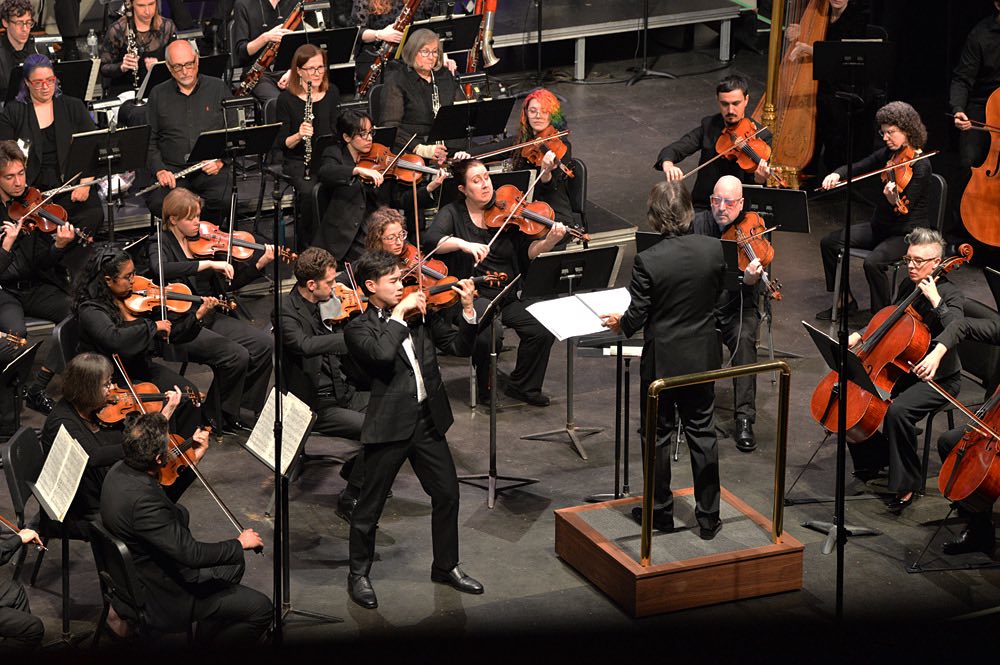
One of the Armenian composer’s most recognizable melodies came in the opening Waltz, given with panache. A languid Nocturne contrasted, with a fine solo from concertmaster Jason Neukom. Conductor Daniel Meyer gave the flamboyant Mazurka character by way of a flexible rubato. A lyrical trumpet solo (Adam Gillespie) highlighted the Romance ahead of the tongue-in-cheek Galop which closed.
The sumptuous Violin Concerto of Erich Wolfgang Korngold introduced Timothy Chooi as soloist. Lush, honeyed sounds of this late-Romantic idiom were searingly beautiful, and Chooi’s attention to detail conveyed its intricacies with artful phrasing. The central Romance was of quiet repose before energetic finale of coruscating virtuosity. As an encore, Chooi further impressed in a technically brilliant segment of the Red Violin Caprices by John Corigliano.
The real rarity came in Alexander Borodin’s Symphony No. 2 in B minor which occupied the second half. Though seldom-performed, it’s Borodin’s most important large-scale instrumental work, and one of few symphonic examples from the so-called Russian Five. A big-boned theme — this was not an evening for subtlety — that drew on Russian folk tradition made for an attention-getting opening. The writing is perhaps a bit heavy-handed, but Meyer’s careful balance ensured matters weren’t overdone.
A fleet scherzo danced by, almost in the manner of Mendelssohn, and a downtempo section was especially lovely — and included some striking scoring for flute and triangle. The Andante was noted for a gleaming horn solo (Mark Addleman), setting up the grandiose and jubilant finale.

 quasi-faust