
Leif Ove Andsnes, piano
Mandel Concert Hall
Severance Music Center
Cleveland, OH
March 27, 2025
Grieg: Piano Sonata in E minor, Op. 7
Tveitt: Piano Sonata No. 29, Op. 129, Sonata etere
Chopin: Preludes, Op. 28
Encore:
Debussy: La cathédrale engloutie, from Préludes Book I
The first half of Leif Ove Andsnes’ Thursday night piano recital in Cleveland plunged into wholly unfamiliar territory in an exploration of the Norwegian piano sonata. The pianist proved to be an incisive guide to the music of his home country, beginning with the Piano Sonata in E minor from the pen of a 22-year-old Edvard Grieg.
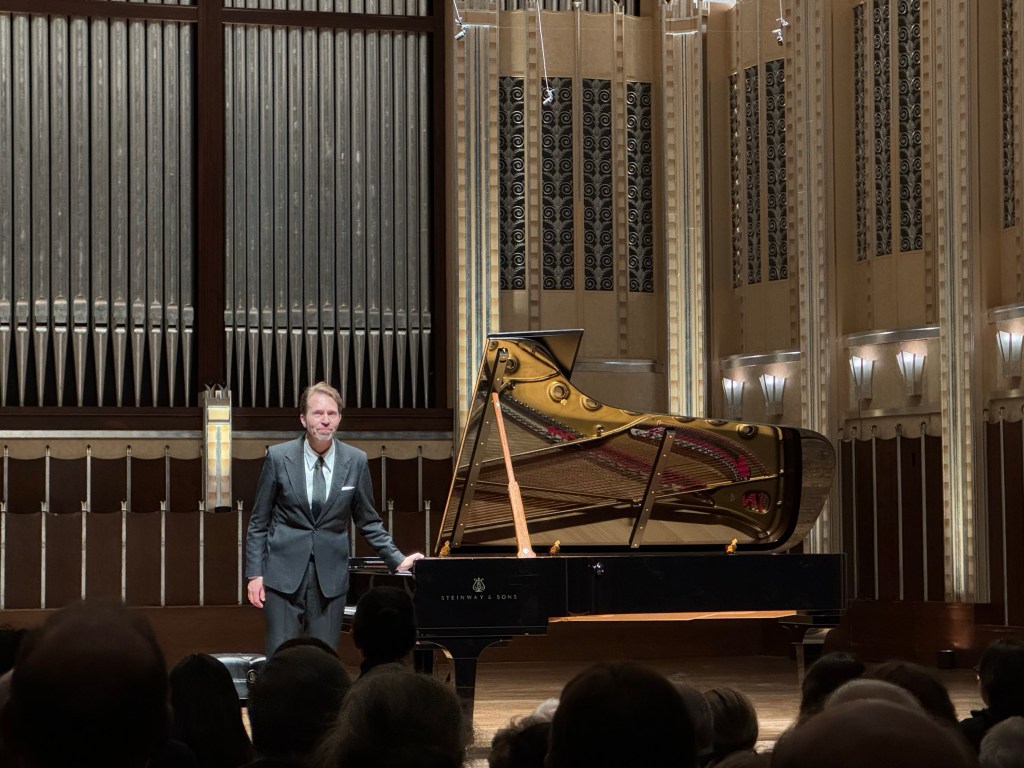
Brimming with youthful energy, the piece balanced both the lyrical and the dramatic. A slow movement was delicate in its simplicity, though it built in density and traversed some striking harmonic modulations. The sonata very much bore the influence of Schumann above all, but the brief third movement was quite original, showing the composer finding his individual voice. The finale capped off this attractive work with a bravura march.
The real rarity came in the Piano Sonata No. 29 of Geirr Tveitt. Like Grieg, Tveitt studied in Leipzig, but returned to Norway where he developed his unique style. He settled in an isolated area in Norway’s Hardanger region, though tragedy would strike when a fire in 1970 would destroy nearly 300 of his unpublished manuscripts, the majority of his body of work. The Sonata etere (“Ethereal Sonata”) is the only surviving piano sonata — astonishingly, number 29 out of an unknown quantity lost to the flames.
A startlingly original work, there are perhaps nods to Prokofiev or Bartók in its percussive gestures or the French impressionists in its coloristic writing, but one imagines the composer writing in isolation, free from outside influences. A large-scale, 35-minute conception, the first movement (titled In cerca di — “In search of”) was propelled forward with driving energy — and I found Andsnes even more compelling than the composer’s own recording.
The central Tono Etereo in Variazoni consisted of 19 variations, most strikingly featuring a cluster of notes depressed with the pianist’s entire left arm, an ethereal resonance that would recur throughout. Overtop this were spiky jabs in the right hand the drew out the skeleton of a theme on which the variations were based. The variations were largely lyrical, and with subtle yet captivating effects. The closing Tempo di Pulsazione was virtuosic and bracing, though not purely percussive with its lyrical interludes, in due course fading away into the ether.
Chopin’s magnificent set of 24 preludes comprised the second half. Andsnes gave each one of these gems loving attention to detail, bringing out their unique personalities and sharpening contrasts across the set. I was struck by the majestic take on #9 and the ferocious energy given to #12, only outdone by the chillingly dramatic closing prelude. I loved the way he deftly voiced the chords in #20, and the warmly poetic readings he gave to #13 and #17 were deeply rewarding.
Andsnes offered a single encore from another great cycle of preludes in Debussy’s Sunken Cathedral, painting a wondrous soundscape.
While several artists have justly announced boycotts of the US in response to the current political climate, upon his arrival in this country, Andsnes thoughtfully mused on the potential music has to bring people together. A further post saw him marveling at the beauty of the Severance Hall stage. The pianist certainly proved that a captivating performance in a gorgeous venue can offer much-needed solace.
 quasi-faust