
Pittsburgh Symphony Orchestra
Manfred Honeck, conductor
Sheku Kanneh-Mason, cello
Heinz Hall
Pittsburgh, PA
March 21, 2025
Shekhar: Lumina
Shostakovich: Cello Concerto No. 1 in E-flat major, Op. 107
Encore: I Say a Little Prayer
Strauss: Don Juan, Op. 20
Strauss: Symphonic Fantasy from Arabella, Op. 79 (arr. Honeck/Ille)
The Pittsburgh Symphony is to be commended for its advocacy of contemporary music, with many of this season’s programs introducing a recent work by a living composer. This week’s program began with the 2020 work Lumina by Nina Shekhar. Shekhar is currently a doctoral student in music composition at Princeton (presumably classmates with Hannah Ishizaki, featured on a PSO program a month ago). The composer also draws from an engineering background, evident in the present work that concerns the spectrum of light.
It’s a work that demands attention from both performers and audience. Silence is just as important as sound, and effects are achieved through subtle, nearly imperceptible gestures: microtones, harmonics, bowing of the vibraphone. A soft-spoken essay, it occasionally burgeoned into strident climaxes. I’m not sure this is a piece that fully earned the attention it required, yet I appreciate the PSO’s attention to a rising composer.
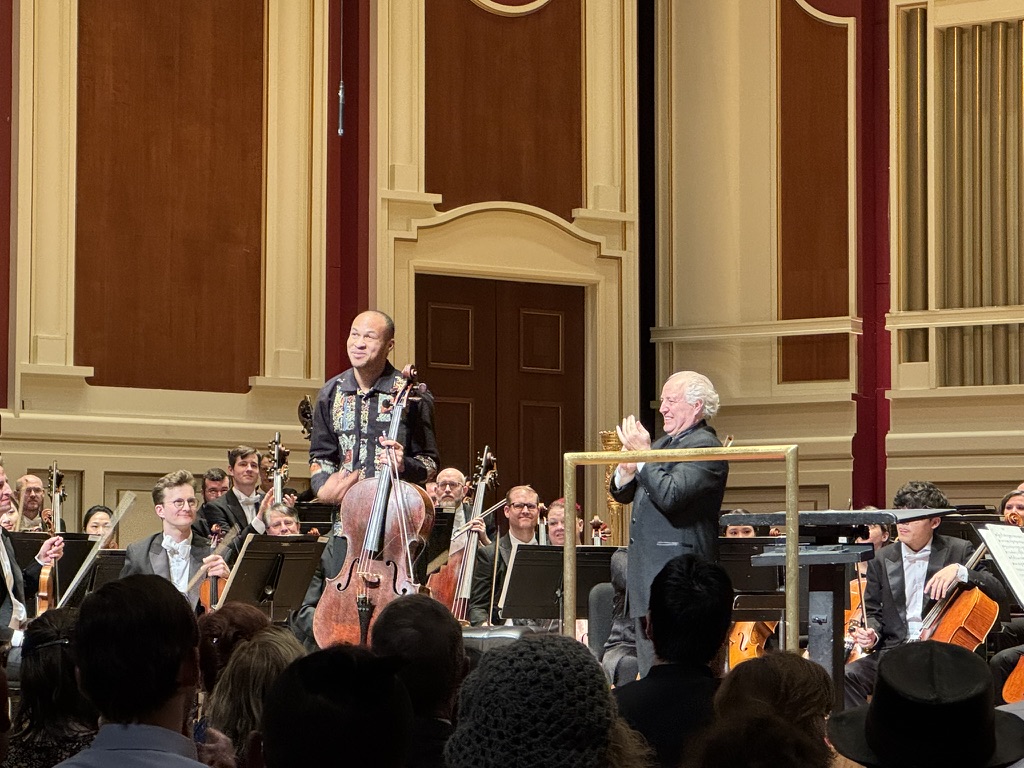
The main draw of the evening was the Pittsburgh debut of cellist Sheku Kanneh-Mason in the Cello Concerto No. 1 of Shostakovich. Kanneh-Mason drew a fittingly gritty tone out of his Matteo Goffriller instrument that dates from 1700, delivering a variation on the composer’s musical signature with a caustic bite. The cellist was flexible and limber, imbuing the score with character and color. Manfred Honeck and the PSO supported the soloist with piquant accompaniment. Unusually for Shostakovich, the horn is the only brass instrument used — a tip of the hat to William Caballero for single-handedly serving as the brass section. The Moderato was of desolate, pained lyricism, reduced to a skeletal orchestration.
Like the composer’s First Violin Concerto, an extended cadenza served as effectively a standalone movement in the heart of the work. One was struck by Kanneh-Mason’s expressive range — and while not an overtly virtuosic affair, the cellist showed a deep command of his instrument. The finale was quintessential Shostakovich in both its urgency and coloristic writing, up to the blistering end. As an encore, Kanneh-Mason offered a transcription I Say a Little Prayer, the Burt Bacharach song made famous by both Dionne Warwick and Aretha Franklin — a lovely piece in its jazzy pizzicato (for a recording, see Kanneh-Mason’s warmly recommend album Song).
The second half was devoted to Richard Strauss, beginning with his iconic tone poem Don Juan. Its opening was akin to drinking from a firehose, with blazing virtuosity and brassy splendor. The music crested to searing passions, highlighted by a long and languid oboe solo from Cynthia Koledo DeAlmeida. By the coda, matters came crashing down for a tragic, somber end.
Closing the program was an appealing alternative to the more well-worn tone poems, in the world premiere of a suite based on Strauss’ opera Arabella. Conceived by Manfred Honeck and arranged by Tomáš Ille (a team that has previously devised suites based on Elektra and Janáček’s Jenůfa), it captured the essence of the opera in a span of eighteen minutes. A bold, dense opening was arresting in its rich chromaticism. A lilting waltz — in a similar spirit to Rosenkavalier — contrasted, and the PSO’s superb playing brought out a gorgeous lyricism, leading to a brilliant close.
 quasi-faust
Pingback: Kanneh-Mason bares the soul of the cello with Pittsburgh Symphony players – quasi-faust