
Ébène Quartet
Belcea Quartet
Carnegie Music Hall
Pittsburgh, PA
November 12, 2024
Mendelssohn: String Octet in E-flat major, Op. 20
Enescu: String Octet in C major, Op. 7
Encore:
Fauré: In paradisum from Requiem, Op. 48
In a special presentation from Chamber Music Pittsburgh, two major string quartets – the Ébène and the Belcea – joined together for an evening of octets. Far and above the most recognizable work of the string octet literature is Mendelssohn’s sterling example, a quantity which was paired with a less familiar octet by George Enescu. Remarkably, this was an evening of music composed by teenagers – Mendelssohn was a prodigious 16-year-old when writing his; Enescu was hardly far behind at 19.
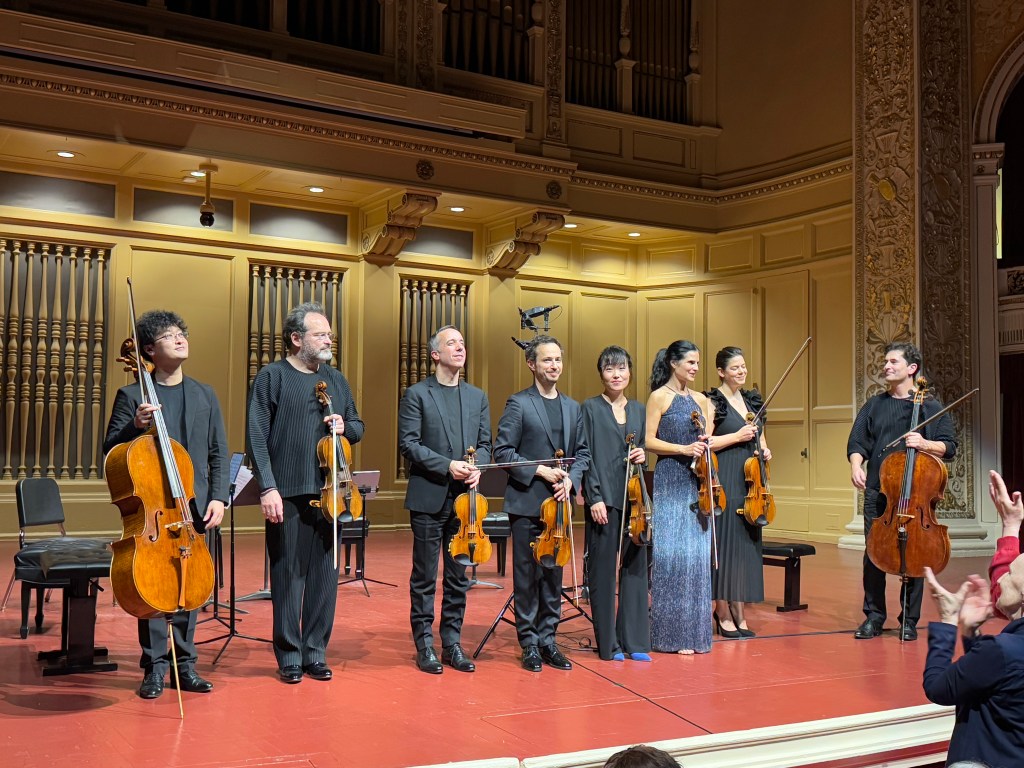
The Mendelssohn opened the program warm and gracious, with a lushly flowing melody from the violin. The eight players on the Carnegie Music Hall stage collectively drew a rich orchestral heft, sounding not as eight soloists or two quartets, but a single, unified organism. A more playful contrasting theme danced in its delicate interplay.
The Andante movement was plaintive and pensive. Just few minutes in duration, the scherzo defined and crystallized the very term Mendelssohnian: fleet and gossamer, it was given with a featherlight touch, the musicians perfectly in sync. Furious gestures from the cello opened the finale, with the others joining in succession in a wide-ranging fugato. A movement of great drama, given here with exacting clarity and attention to detail.
Enescu almost certainly looked to Mendelssohn for inspiration when writing his own octet, but it’s a work that nonetheless bears his individual voice. Some changes were made to the seating arrangement on stage, alternating which players commanded the primo parts. A full-bodied tone and textural richness made for a bracing beginning. The melodic line had some striking harmonic inflections, perhaps a nod to the folk music of the composer’s native Romania. The performers illuminated the opening movement’s complex form, and the work proved an intriguing discovery (though admittedly, anything can seem a letdown after the Mendelssohn – perhaps the Enescu would have been better positioned being programmed first?).
A sudden contrast was had in the following movement, marked with the French Très fougueux (“very fiery”). Spiky, angular material was given with impassioned – and yes, fiery – playing, and a beguiling chord progression served as a transition to the slow movement. Calm and stillness pervaded before the coruscating and bold finale, capping off this ambitious work in grand form.
As an encore, the ensemble offered a transcription for octet of the closing In paradisum from Fauré’s Requiem – which also served to whet one’s appetite for the Pittsburgh Symphony’s upcoming performance of the work. With some particularly lovely pizzicato material given to the viola, it served as a gorgeously beautiful close to the evening.
 quasi-faust