
Tom Borrow, piano
Justine Campagna, violin
Jeremy Black, violin
Tatjana Mead Chamis, viola
Anne Martindale Williams, cello
Strings of the Pittsburgh Symphony Orchestra
Heinz Hall
Pittsburgh, PA
October 19, 2024
Mozart: Violin Sonata No. 21 in E minor, K304
Grieg: Holberg Suite, Op. 40
Dvořák: Piano Quintet in A major, Op. 81
One of the Pittsburgh Symphony’s more enterprising endeavors is the PSO360 series, which engages the guest soloist from the weekend’s subscription concerts in chamber music with select PSO members. An intimate audience of 200 is seated on the Heinz Hall stage, circled around the performers, affording the opportunity to see another side of the soloist and orchestra players alike.
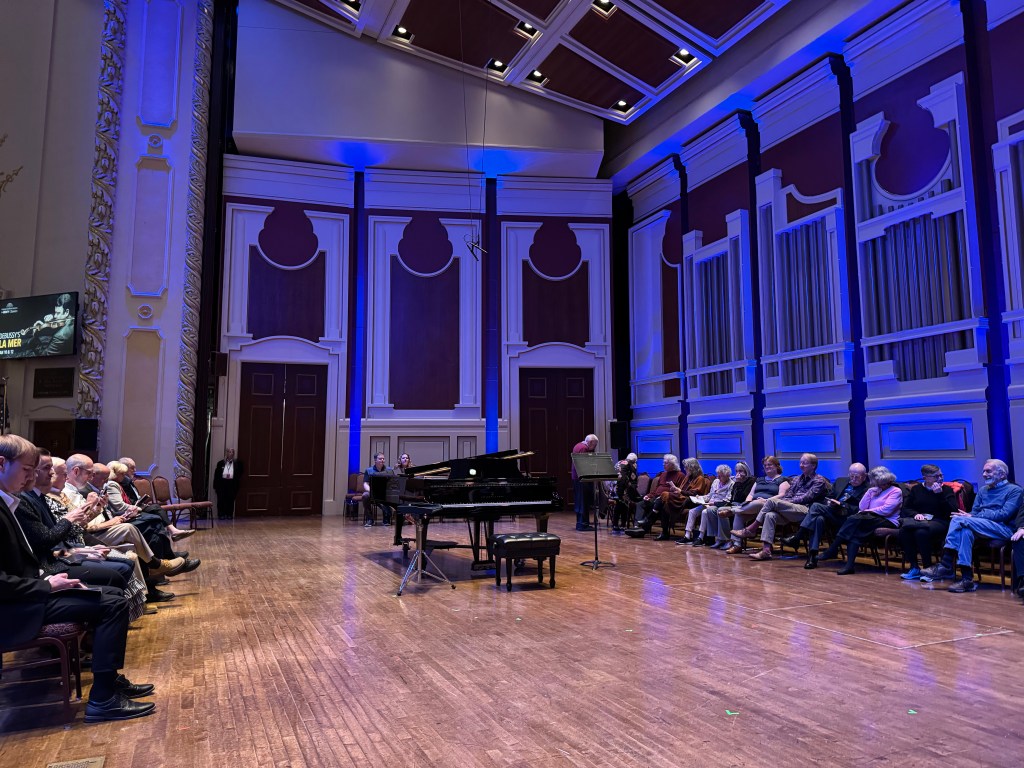
The soloist in question was the young Israeli pianist Tom Borrow, who made a strong impression in the performances of Ravel’s piano concerto that flanked Saturday’s chamber concert. To begin, Borrow teamed up with associate concertmaster Justine Campagna in Mozart’s E minor violin sonata. The only work in Mozart’s vast catalogue to be cast in that key, it’s a particularly deeply-felt creation, one that the program notes aptly compared to the A minor piano sonata (K310) for its expressive range.
Campagna was elegant and articulate, and Borrow responded in kind with sparkling, quintessentially Mozartian pianism. The development section was particularly emotive, and the minuet that closed the two-movement sonata was perhaps the most profound of all minuets, a rich conversation between violinist and pianist.
Grieg’s Holberg Suite brought out the Pittsburgh string section, and there was a visceral energy in being onstage with 20 string players, evident from the effusive prelude which opened. Peaceful, lyrical movements followed, swelling to a warm resonance, and I was especially struck by the clarity of the inner voices. Perhaps most affecting was the Air, songful and mournful — and a touching homage to Bach. The Rigaudon brought the suite to a close with joyous abandon.
Following intermission, Borrow returned with a quartet of strings for Dvořák’s great A major piano quintet. A graceful introduction in the piano paved the way for a lyrical cello passage (Anne Martindale Williams). The five players wove together a rich tapestry with a feverish intensity, yet at its core still as good-natured as the composer himself. An elegant piano gesture marked the Dumka, a wistful essay punctuated by gorgeous interludes.
There was a vivacity to the folk inflections of the Scherzo that could only put a smile on one’s face, and the finale continued in the highest of spirits — but not without a blistering fugato. Here as throughout, Borrow sounded like a seasoned collaborator with these Pittsburgh players.

 quasi-faust