
North Carolina Symphony
Joseph Peters, conductor
Meymandi Concert Hall
Martin Marietta Center for the Performing Arts
Raleigh, NC
September 27, 2024
Farrenc: Symphony No. 3 in G minor, Op. 36
Beethoven: Symphony No. 8 in F major, Op. 93
Despite the threat of severe thunderstorms as vestiges of Hurricane Helene, the show went on at Raleigh’s Meymandi Concert Hall, with the North Carolina Symphony offering a delightful matinee program. At the podium was Joseph Peters, who also serves as the Symphony’s associate principal oboe and English horn.
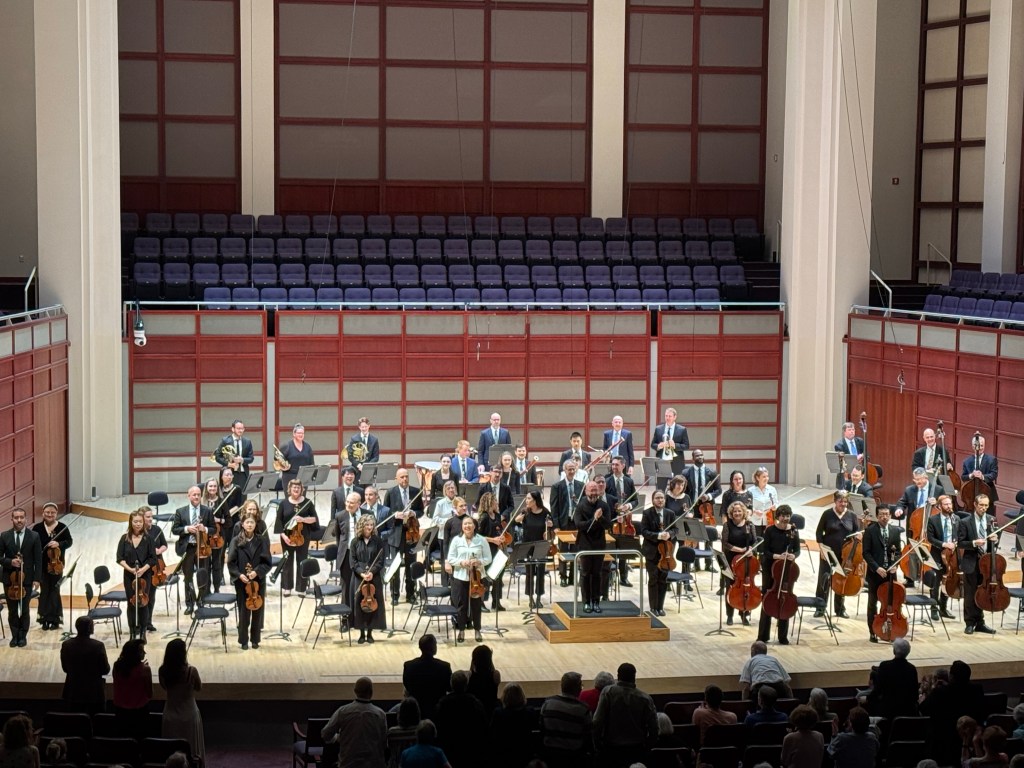
With a Strauss serenade being jettisoned for the shortened afternoon performance, two symphonies were contrasted, beginning with the largely forgetten Third Symphony of Louise Farrenc. A testament to her talent, Farrenc had the distinction of the being the only woman to hold professorship at the Paris Conservatoire in the nineteenth century. Her third and final symphony dates from 1847, a rare instance of a French symphony from that time as French composers sought to explore mediums different from their Germanic counterparts.
A brief slow introduction served to firmly establish the G minor tonality, giving way to a pointed theme, crisply articulate in its presentation. To me, it sounded as something of an amalgamation of Mozart’s two great symphonies in the same key with a touch of Mendelssohn’s Scottish — though there was ample evidence of Farrenc’s own voice, not the least in the mellifluous winds which offered an inimitable Gallic charm. A blistering coda brought the opening movement to a close.
The Adagio cantabile was marked by a deeply lyrical theme in the honeyed clarinet, answered by the strings. Beginning quietly, dynamic contrasts were maximized in the scherzo, Mendelssohnian in its briskness — and to no detriment of clarity. A brief but vigorous finale led to a to satisfying conclusion, and this counted as a welcome opportunity to hear a neglected yet skillfully crafted work.
In Beethoven’s Eighth Symphony, he aspired to the lightheartedness and joviality of his former teacher Haydn — almost as if he needed to create seven monuments before he could attempt such an endeavor. The opening seemingly overflowed with exuberance, with accents punctuating its rhythmic vivacity. The Allegretto scherzando was light and gossamer, and the most patently indebted to Haydn’s wit. Despite being a driving force in replacing the minuet with a scherzo in the symphony, here Beethoven retreated to the venerable dance form. The swagger was infectious, and the horns in the gentler trio were especially lovely — and the work’s finale was of an ebullience that even exceeded that of the opening.
 quasi-faust