
Sergei Babayan, piano
Daniil Trifonov, piano
Mixon Hall
Cleveland Institute of Music
Cleveland, OH
February 19, 2020
Schumann: Andante and Variations for Two Pianos, Op. 46
Pärt: Pari intervallo
Mozart: Sonata for Two Pianos in D Major, K448
Rachmaninov: Suite No. 1 for Two Pianos, Op. 5, Fantasie-Tableaux
Rachmaninov: Suite No. 2 for Two Pianos, Op. 17
Encore:
Prokofiev, transc. Babayan: Idée fixe from The Queen of Spades, Op. 70
To inaugurate the celebrations surrounding the Cleveland Institute of Music’s landmark centennial year, two of the most distinguished pianists associated with the institution teamed up for a duo recital on Wednesday night. Sergei Babayan has held the title of CIM’s Artist-in-Residence since 1992, shortly after taking first prize in the Cleveland International Piano Competition, and at the second piano was his former student Daniil Trifonov. Trifonov’s meteoric rise is surely indebted in part to CIM where he earned an artist certificate in 2013, with an artist diploma following in 2015. Both pianists generously donated their time for the evening, and this benefit concert raised over $100,000 for the student scholarship fund. In his opening remarks, CIM’s president and CEO Paul Hogle further underscored the Institute’s role in the dynamic classical music scene of northeast Ohio, epitomized by over half of The Cleveland Orchestra being connected to CIM as alumni or faculty – if not both.
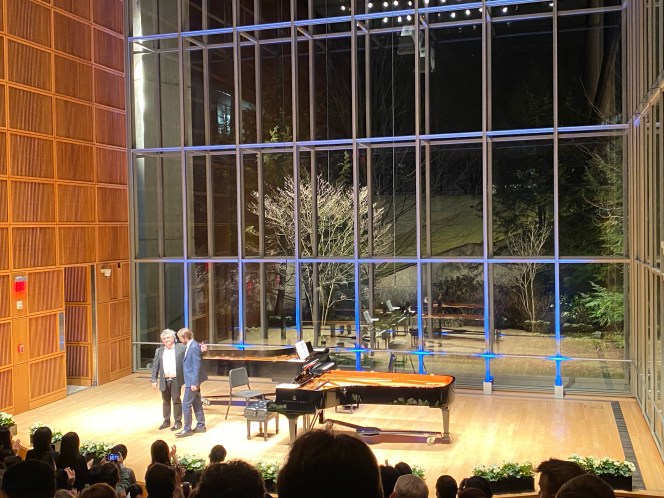
Two pianos on the stage of intimate Mixon Hall made a bold impression, and while both instruments were oriented in opposite directions, their keyboards were aligned to enhance the natural communication between this teacher-student duo. Schumann’s Andante and Variations began the program. An intensely lyrical presentation of the theme opened, burgeoning into quintessentially Schumannesque music of Romantic fantasy and imagination. A militant march variation made for a powerful climax, with matters eventually giving way to a lovely, ruminative conclusion. Arvo Pärt’s Pari intervallo was quite far removed from any other selection performed, but certainly a highlight in spite of its brevity. Evaporated to the essential, its monastic austerity was enchantingly pensive and otherworldly in its repeated bell-like invocations, with the pianists sustaining a meditative state of unblinking concentration.
Mozart’s effervescent Sonata for Two Pianos in D major closed the first half, recalling Babayan’s memorable recital with Martha Argerich two seasons ago. Vigorous energy opened this pearl of the two piano literature, with seamless, crystalline playing evidencing the innate understanding amongst the duo. Rapid passages were crisply in sync, a must in the unforgiving transparency of this repertoire. A singing quality, almost akin to an operatic aria, was given to the central Andante, heightened by its delicate ornaments. The music became rather more unbuttoned in the finale, interspersed with varied material but inexorably gravitating back towards the joyous main theme, of dancing lightness and sparkling articulations.
The latter half was devoted to both of Rachmaninov’s hyper-Romantic Suites for Two Pianos. The “Barcarolle” of the First flowed with liquescent ease, and the pianists cleanly negotiated the detailed filigree. “La nuit… L’amour…” proceeded as a love song of often hypnotic beauty, and the following “Les larmes” was marked by its melancholy cantilena. While both pianists have a reputation for their leonine power, here we saw them turn inwards in music of quiet intimacy: perhaps the description of Rachmaninov possessing “fingers of steel and a heart of gold” applies to them as well. It was the former persuasion, however, that had the last word in the “Pâques” finale. Babayan introduced the theme at a moderate, measured pace, before matters erupted into a modal frenzy to close the suite with formidable weight and power.
A commanding, kinetic opening to the Second Suite showed in no uncertain terms that neither pianist was waning in energy as we neared the end of the program, cutting through the thickness of the dense chordal textures with ease. Here, for the first time, Trifonov assumed the primo role. The “Valse” was handled with rapid legerdemain, varied by an entrancing waltz theme, and the “Romance” offered a wonderfully lyrical interlude. An inevitable tour de force was to be had in the “Tarantelle”: a powerhouse conclusion punctuated by the relentless rhythms of the titular dance. As an encore, the pianists turned to one of Babayan’s own remarkable Prokofiev transcriptions (which can be heard on his emphatically recommended recording with Argerich), namely, the “Idée fixe” from The Queen of Spades, closing the festive evening in pile-driving intensity.
 quasi-faust
Pingback: Cleveland, 2019-20: Top 10 classical music performances – quasi-faust